
Clicky

Charging Stations for Multiple Devices Explained

If your desk looks like a tangled mess of cables, you're not alone. But the fix is much easier than you might think. A charging station for multiple devices is a central hub designed to power up all your gadgets—phones, tablets, laptops, and more—all from a single wall outlet. They're the secret to turning a cluttered space into a clean, organized power zone.

Taming the Chaos of Cords
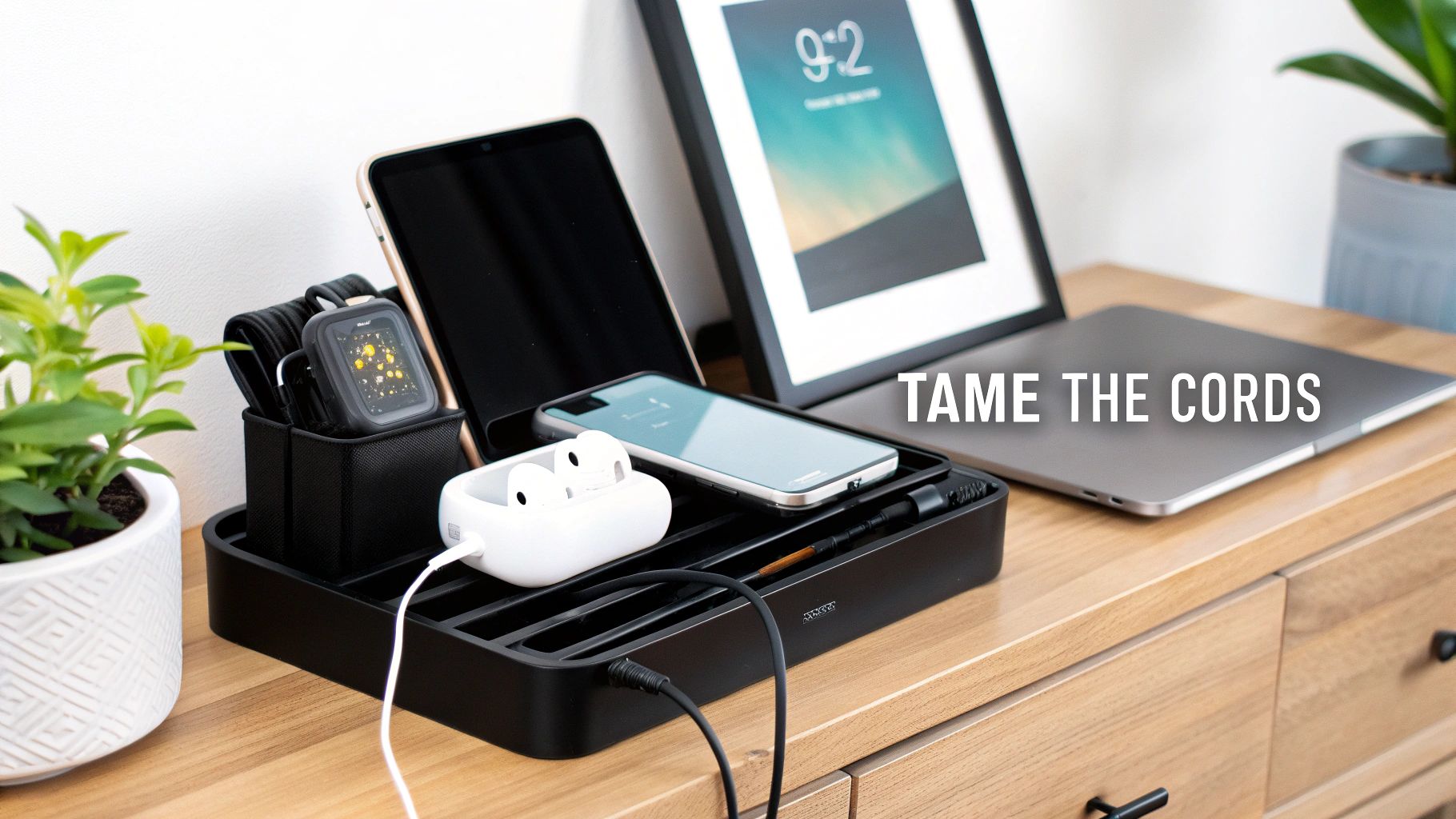
Desk organizer with multiple electronic devices charging, including a tablet, phone, AirPods, and smartwatch.

It happens slowly, then all at once. First, it’s just the one charger for your phone. Then you add another for a tablet, one for your headphones, and maybe one for a smartwatch. Before you know it, every outlet is taken, and a web of wires has taken over your desk.

This isn't just about looks; it's a real pain. Hunting for an open outlet or the right charging block becomes a daily frustration. Devices end up scattered all over the house, making it way too easy to forget where you left something charging. This is the modern clutter we're all trying to escape.

The Rise of the Centralized Power Hub

Fortunately, there’s a simple way to get your space—and your sanity—back. A multi-device charging station acts like a command center for all your electronics. Instead of juggling half a dozen power bricks, you get one clean solution that genuinely simplifies your daily routine.

The whole idea is to bring everything together. By putting all your charging needs in one spot, you get a bunch of benefits that go way beyond just being tidy. These hubs are built to handle the power demands of modern life without any trouble.

The real magic of a charging station isn't just getting rid of cords; it's about creating a dedicated, reliable home for your tech. That simple shift clears up mental clutter and makes your day run a lot smoother.

Key Benefits of a Multi-Device Station

Switching to a dedicated charging solution does more than just clean up your desk. It brings some real, practical improvements to how you manage your essential gadgets.

  • Declutter Your Space: The most obvious win is getting rid of that nest of tangled cords. Your space instantly looks cleaner and feels more organized.
  • Ultimate Convenience: All your devices are in one predictable spot, fully charged and ready to go when you are. No more frantic searches for a misplaced phone or a dead tablet.
  • Save Outlet Space: A single station can power 5 or more devices while only taking up one wall outlet. That frees up your other sockets for lamps, monitors, or anything else.
  • Improved Device Management: In a family or office, a central station means everyone knows where to charge their gear. It cuts down on the "who stole my charger?" arguments and lost cables.

This guide will walk you through everything you need to know, from the different types of stations out there to understanding the power specs that actually matter. The goal is to give you the confidence to pick the perfect charging hub for your home, office, or even your car.

Finding Your Perfect Charging Hub

A modern multi-device charging hub organizing a laptop, tablet, and smartphone on a wooden desk.

Choosing a charging station isn't just about plugging things in. It's about picking the right tool for the job. You wouldn't use a sledgehammer to hang a picture, right? The same idea applies here—you don't need a huge industrial unit for your bedside table.

The trick is to match the station to your actual daily life. A good one solves the cable clutter problem without creating new headaches. Let's break down the main types of charging stations for multiple devices with some simple comparisons to help you find the perfect fit for your home or office.

The Desktop Dock: The Tidy Parking Garage

Think of a desktop dock as a neat little parking garage for your most-used gadgets. These are the stations with slots and stands that hold your phone, tablet, and maybe a smartwatch upright and organized. It's all about giving your daily devices a proper, easy-to-reach home.

The real win here is organization. Instead of a jumble of electronics on your counter, each device gets its own spot. Many of these docks cleverly hide the power block and messy cables inside the base, leaving you with a clean, simple look.

A desktop dock is more than just a charger; it's a piece of furniture for your technology. It turns a messy pile of devices into a neat display, making it perfect for the kitchen counter, living room, or your personal desk.

These are perfect for families or anyone wanting to keep their essential devices in one central, easy-to-find spot. If your main goal is to charge a phone, a tablet, and a few accessories while keeping things looking sharp, a dock is a fantastic choice. For those who want to take tidiness to the next level, it's worth exploring the best wireless charging stations for your devices.

The USB Hub: The Power Strip For Your Tech

If a desktop dock is a parking garage, then a USB hub is like a power strip. It's usually a small block that gets rid of the dividers in favor of packing in as many charging ports as possible. Its one job is to deliver a lot of power from a small box.

USB hubs are the best choice in situations where space is tight, and you just need more outlets for your gear. They're very versatile—put one on your desk, tuck it in a drawer, or even mount it under a tabletop to make all the cables disappear.

A few things to love about USB hubs:

  • Lots of Ports: You'll often find 6, 8, or even 10 ports squeezed into a very small package.
  • Easy to Carry: Their small size makes them great for travel or for setting up a quick charging spot wherever you need it.
  • Flexibility: You're not limited to phones and tablets. You can charge anything with a USB cable, like cameras, power banks, and gaming controllers.

These hubs are a lifesaver for people with a lot of tech, busy offices, or conference rooms where many people need to power up at once. They're all about raw charging power, not fancy organization.

Carts and Lockers: The Secure Armory

When you're dealing with dozens of devices in a school, hospital, or large business, you need something much more heavy-duty. That's where charging carts and lockers come in. Think of them as a secure storage unit for technology—big, often mobile units built to store, charge, and protect a whole fleet of devices.

Charging carts are basically wheeled cabinets filled with shelves and built-in power strips, letting you charge and move 20 to 40 laptops or tablets at the same time. Lockers go a step further, offering individual, locked compartments so people can securely charge their personal devices.

These large-scale solutions are built to solve three big problems:

  1. Mass Charging: Powering up an entire classroom or department from just a few wall outlets.
  2. Security: Locking doors and compartments prevent theft and keep devices safe.
  3. Distribution: Carts make it easy for staff to hand out and collect devices efficiently.

While they're definitely too much for your living room, these stations are the backbone of device management in any large school or business.

Trying to figure out which of these is for you? This quick table should help.

Which Charging Station Fits Your Life?

A quick comparison to help you match your daily needs with the best type of charging station.

Station Type Best For Common Use Case Key Feature
Desktop Dock Home users, families Kitchen counter, nightstand, home office desk Organization and looks
USB Hub Power users, travelers Desks, conference rooms, travel bags Many ports in a small space
Carts & Lockers Schools, businesses Classrooms, IT departments, offices, hospitals Mass charging, security, and mobility

Ultimately, whether you need a sleek "parking garage" for your daily tech or a powerful "power strip" for all your gadgets, there's a solution out there that fits perfectly.

Understanding Power Without the Headache

Diving into the world of multi-device charging stations can feel like you need an engineering degree. You see terms like watts, amps, and volts on the box, but what does any of that actually mean for you? Let's cut through the confusing terms and make sense of it all.

Think of wattage (W) as the power of your charger. A more powerful engine gets a car up to speed faster, and higher wattage generally means a faster charge. A basic phone charger might be slow at 5 watts, while a powerful laptop charger could be very fast with 100 watts or more.

But it’s not just about raw power. The charger and your device need to work together to use that power safely. This is where modern "smart charging" comes in, making sure your gadgets get the perfect amount of power every single time.

The Smart Fuel Pump in Your Charger

Imagine your device's battery is a fuel tank and the charger is the pump at the gas station. An old, "dumb" charger is like a pump that flows at one constant, slow speed. It gets the job done, but it's not very efficient.

Modern chargers, especially those with Power Delivery (PD), are like a smart fuel pump. This technology lets your charger and device have a quick conversation the second you plug them in.

Your phone might say, "Hey, I'm almost empty and can take a lot of power right now!" The charger responds, "Great, here's a fast flow to get you filled up quickly!" As the battery gets closer to full, the phone tells the charger to slow down to protect its long-term health. This smart communication is what makes fast charging both possible and safe.

Power Delivery isn't just about speed; it's about being smart. It's the technology that lets a single powerful charging station safely power both a tiny pair of earbuds and a big laptop, giving each one exactly the energy it needs without any risk of damage.

This communication is very important. Without it, a powerful charger could easily damage a smaller device. PD acts as a smart go-between, making sure every device gets a custom charge—a must-have for any station built for multiple devices.

What is Power Sharing?

Now, let's talk about a key feature of multi-device stations: power sharing. This is how a station divides its total power among all the connected devices. To understand it, picture the charger's total power as the water flowing through a big pipe.

Each port on the station is like a tap connected to that main pipe. If you only turn on one tap (plug in one device), it gets the full, powerful flow. But what happens when you turn on several taps at once?

The total flow of water has to be split among them. Each tap might get a little less pressure than it would on its own. Power sharing works the exact same way. A station might have a total of 100W, but that power gets divided when you start plugging in multiple gadgets.

For example, plug in a laptop that needs 65W, and it'll get that full amount. But if you then plug your phone into another port, the station might smartly share the power—maybe giving 65W to the laptop and 20W to the phone. The key is that the total power used doesn't go over the station's 100W limit.

It's important to understand how a specific model handles this. Some stations have set power per port, while others move power to where it's needed most. You can learn more about figuring out the right amount of power in our guide on how many watts it takes to charge a laptop.

Reading the Fine Print on Power

So, how do you use this knowledge when you're shopping? When you look at a charging station, keep an eye on two key numbers:

  1. Total Wattage: This is the station's maximum power output, like the 100W in our example. It tells you the total power the charger has available. A bigger number is generally better, especially if you plan on charging power-hungry devices like laptops.
  2. Per-Port Wattage: Check the maximum power each individual port can deliver. A station might have a 100W total output but limit each port to 30W. This means it can charge multiple phones quickly, but it won't be able to fast-charge a 65W laptop.

By understanding these simple power concepts, you're ready to choose a charging station that truly has enough juice for all your gadgets, making sure everything from your smartwatch to your laptop gets powered up efficiently and safely.

Why Your Cables and Ports Matter

Think of your new multi-device charging station like a powerful engine. It’s got all this power, ready to go. But without the right "fuel line," all that potential just sits there. Your cables and ports are that fuel line, and they’re just as important as the charger itself.

A strong charging station is only half the story. The connectors you use can either let that power flow freely or create a bottleneck that slows everything down. Getting the simple stuff right—the cables and ports—is the key to getting the fast, safe, and reliable charging you paid for.

The type of port on your station determines which cables you can use and how much power can flow through them. For a long time, the rectangular USB-A port was the most common type. It’s still around and reliable for basic tasks, but it wasn't built for the high-power needs of modern gadgets like laptops or tablets.

The new champion is the oval-shaped USB-C port, and for good reason. It’s a true powerhouse, able to handle much more power, which is essential for fast-charging technologies like Power Delivery (PD). Best of all, it's reversible, so you can finally say goodbye to fumbling around trying to plug it in the right way.

This diagram helps show how everything—from raw power to smart charging tech—comes together to power up your gear.
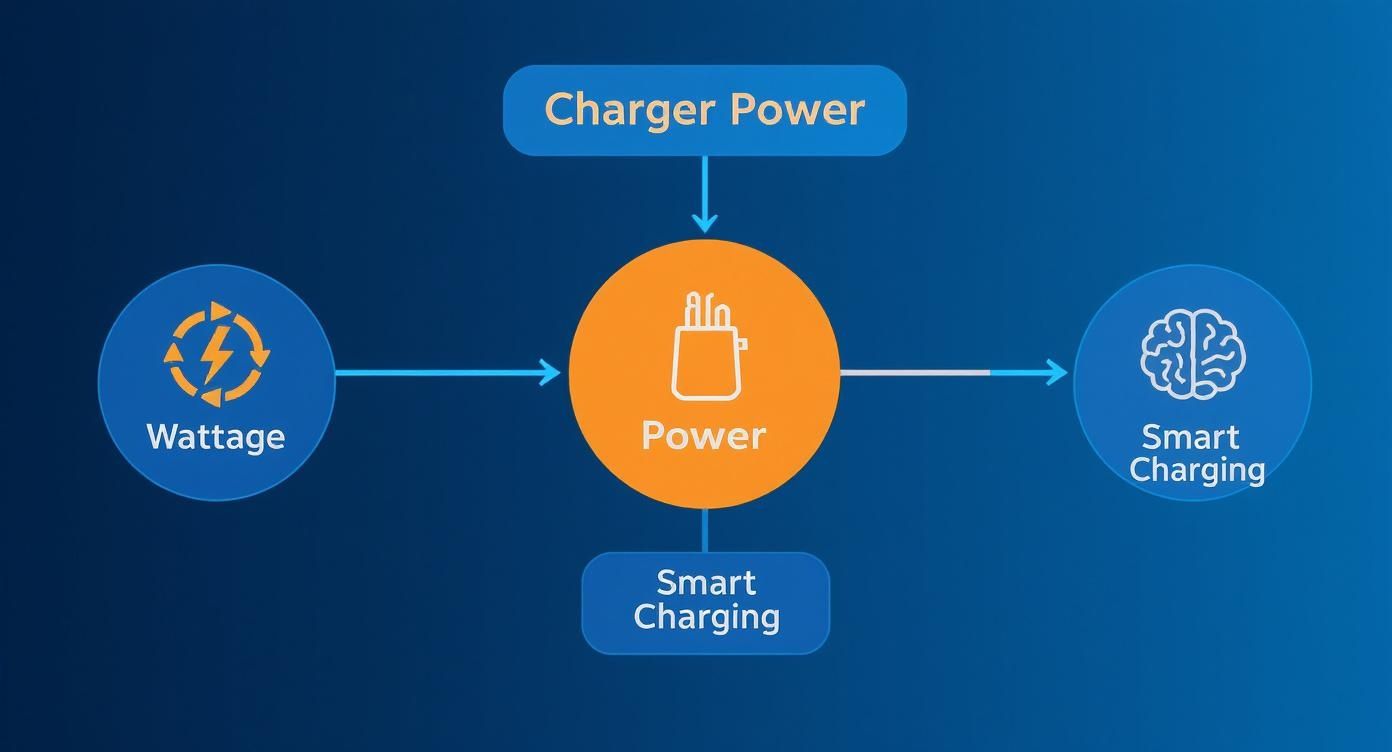
Diagram illustrating power flow from wattage and charger power to smart charging.

As you can see, a modern charging setup isn't just about brute force (wattage). It's about a smart combination of total power, intelligent sharing, and how that power is delivered across all your connected devices.

Why a Quality Cable is Non-Negotiable

I get it. It’s tempting to grab the cheapest cable you can find. But this is one area where cutting corners can cause real problems. A low-quality cable is like trying to fill a swimming pool with a flimsy drinking straw. Even if your station is pushing out a ton of power, a cheap cable just can't handle the flow. The result? Painfully slow charging.

Even worse, a poorly made cable can be a real safety risk. They often skip the proper wiring and internal protection needed to manage heat and power surges. That creates a very real risk of overheating, which could damage your expensive phone, tablet, or laptop.

Investing in a certified, high-quality cable isn't just an extra cost; it's an insurance policy. It guarantees that the power from your station reaches your device safely and at top speed, protecting your gear and giving you peace of mind.

Certified cables from brands you trust have been tested to meet strict safety and performance standards. They’re your ticket to getting the full benefit of your charging station’s power without the risk. If you want to dive deeper, there's a great guide on the different kinds of Type-C adapters and their capabilities that breaks it all down.

Simple Tips for Choosing and Organizing Cables

You don't need to be an expert to pick the right cables. Just keep a few simple things in mind to keep your setup running smoothly and looking tidy.

  • Match the Cable to the Task: For power-hungry devices like a MacBook or an iPad, make sure you're using a high-power, PD-rated USB-C cable. For smaller accessories like headphones or a mouse, a standard cable is perfectly fine.
  • Look for Certification: Good cables will often mention certifications like USB-IF on their packaging. That's a solid sign they’ve been properly tested for both safety and performance.
  • Keep Things Tidy: A little organization goes a long way. Use simple Velcro ties, cable clips, or sleeves to manage your cords. It not only looks cleaner but also prevents them from getting tangled, twisted, and damaged over time.

By paying just a little attention to your ports and cables, you ensure your charging station for multiple devices actually works like it's supposed to—delivering fast, safe, and organized power to every gadget you own.

Putting Safety and Device Health First

https://www.youtube.com/embed/R3JE_aAFuos

A great multi-device charging station does more than just fill up your batteries; it acts like a bodyguard for your expensive electronics. When you invest in a quality, certified charger, you're really investing in peace of mind and protecting your gear for the long run.

Ever notice those logos on electronics packaging, like UL, CE, and FCC? They're not just random letters. They’re a seal of approval from safety experts, confirming that a product has passed many tests for electrical safety. It's a promise that it won't be a fire or shock hazard.

Choosing a station with these certifications is the single most important step you can take. It tells you the manufacturer didn’t cut corners and built a product that meets tough safety standards. For anything you plug into a wall, this is a must-have.

Keeping Cool Under Pressure

Have you ever picked up a charger and felt it was uncomfortably hot? That intense heat is just wasted energy, and too much of it can damage both the charger and whatever’s plugged into it. This is where thermal management comes in—a simple way of saying it prevents things from overheating.

Think of it like the cooling system in your car. An engine generates a lot of heat, and the radiator's job is to pull that heat away so everything keeps running smoothly. A well-designed charging station does the same thing, using a smart design and better parts to get rid of heat before it becomes a problem.

Good heat management comes down to a few key things:

  • Quality Components: Higher-grade internal parts are more efficient and create less waste heat from the start.
  • Smart Ventilation: The physical design itself allows air to move around, preventing hot spots from building up inside the unit.
  • Intelligent Power Control: The charger can sense when it's getting too hot and will automatically slow down the power flow to protect itself and your devices.

This is the kind of built-in protection that separates a reliable charger from a cheap, risky one.

Extending Your Battery Lifespan

The other side of device health is all about taking care of your battery. Lithium-ion batteries—the kind in pretty much all of our gadgets—don't like being stressed. Their two biggest enemies are too much heat and, surprisingly, being kept at 100% charge for long periods.

When you leave a device plugged in all night, every night, you force its battery to constantly "top off" from 99% to 100%. This constant small charging creates heat and puts a lot of strain on the battery, causing it to wear out much faster. Over time, that's what turns a battery that once lasted all day into one that's dead by lunch.

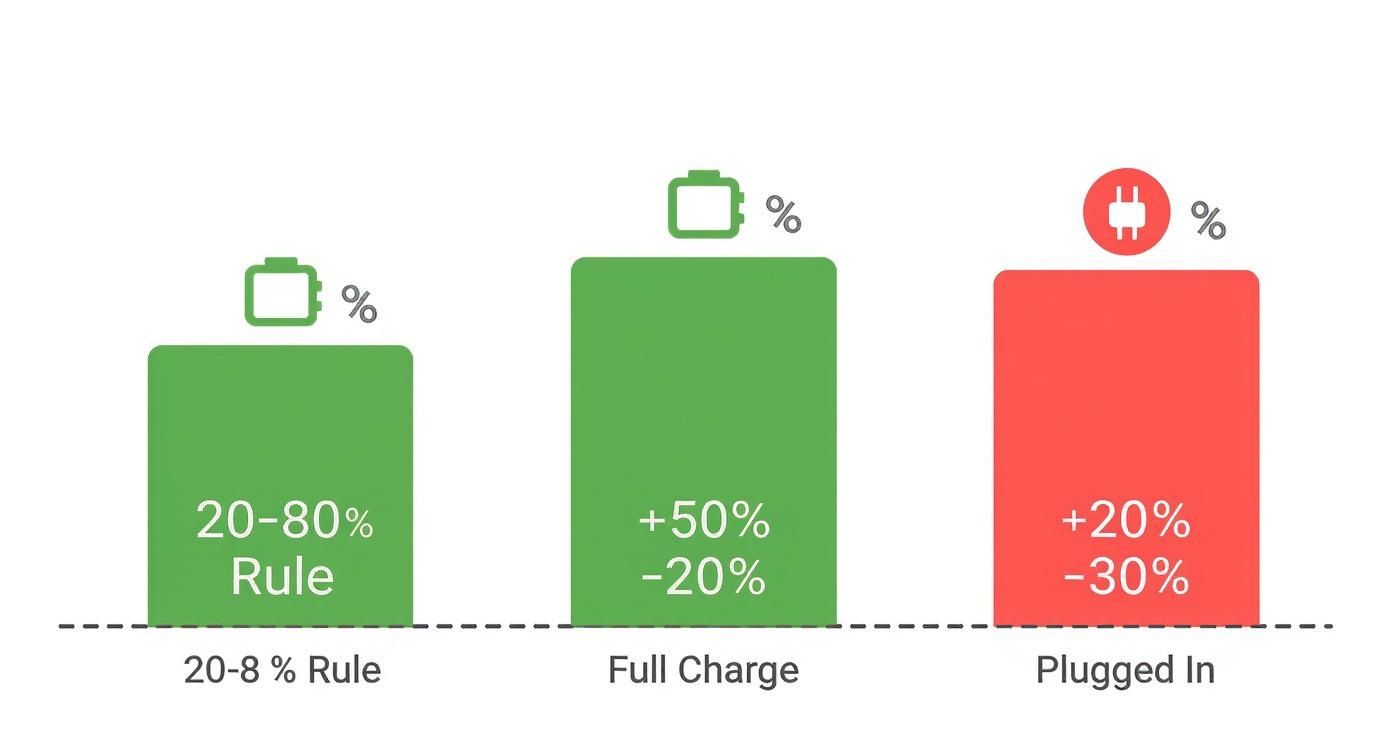
A battery is happiest when it's not at its extremes. The sweet spot for long-term health is generally keeping the charge level between 20% and 80%, avoiding the stress of being fully charged or completely drained.

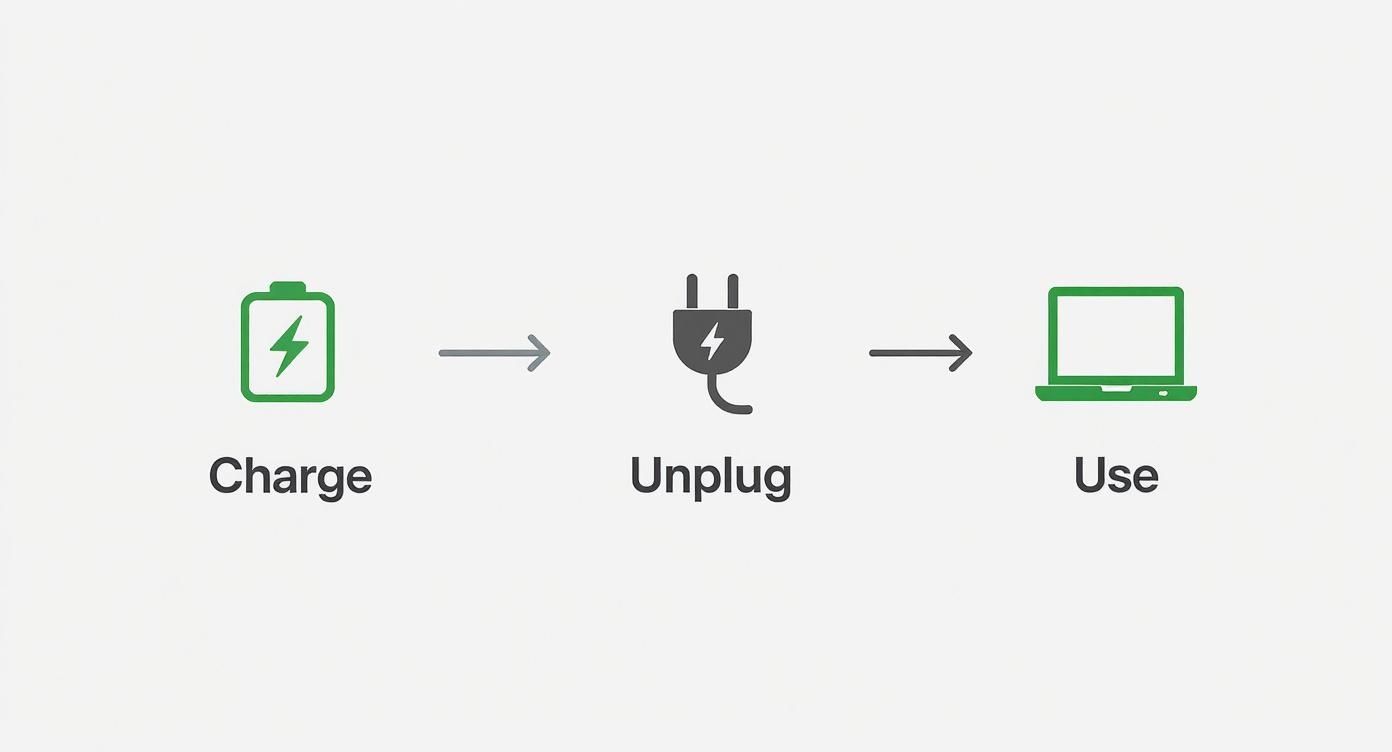
This is where smart charging habits—and some handy tools—can make a massive difference. By simply unplugging your device before it hits 100% or using a system to do it for you, you can greatly extend its usable life.

Tools and Habits for a Healthier Battery

You can take control of your device’s battery health with just a few simple changes. Instead of charging overnight, try plugging in your devices when you get home from work and then unplugging them before you go to bed.

For a more automated, set-it-and-forget-it approach, tools like Chargie are fantastic. It's a small device that fits between your charger and your cable, letting you use an app to decide when charging starts and stops. You can set it to stop the charge at 80% or 90%, completely eliminating the damage caused by overnight charging.

Protecting your gear goes beyond just plugging it in. To really ensure a long and safe life, it helps to understand a bit about the technology and adopt safe charging practices and buying tips for various battery types. When you combine a certified, high-quality charger with smarter habits, you'll learn how to properly charge your lithium-ion battery for a longer life. This smart approach keeps your tech safe and performing at its best for years to come.

How to Set Up Your Charging Station
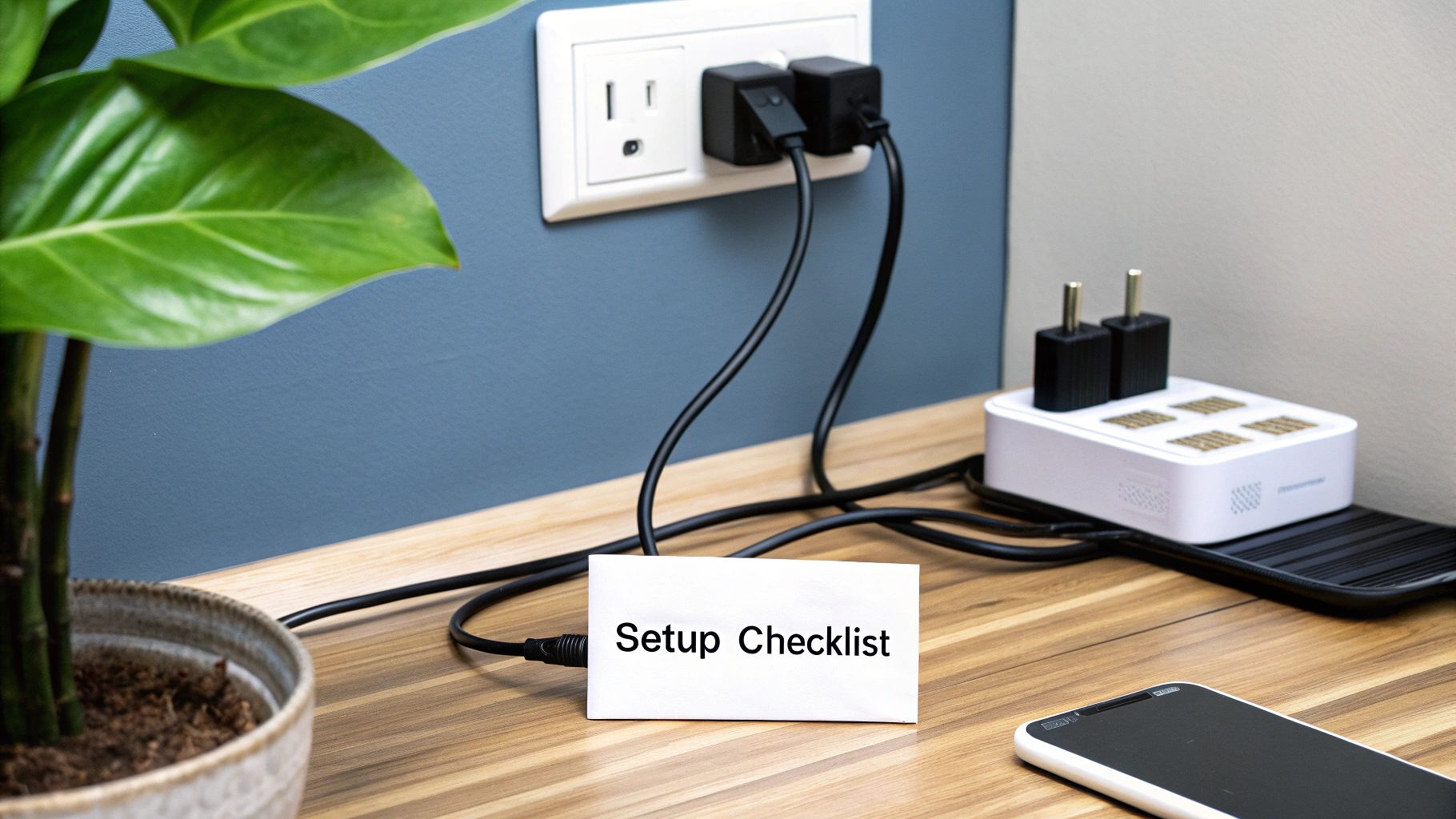
A clean desk setup with smart plugs in a wall outlet, a multi-port charging station, and a plant.

Alright, let's talk about setting up a charging station that actually works for you, not against you. The real goal here is to make powering up your gear totally effortless and organized, whether you're at home, in a busy office, or on the road. A little bit of planning upfront can save you from a lot of frustration, like tangled cords or running out of battery at the worst possible time.

Every place has its own needs. A home setup needs to be family-friendly and not look like a tech mess in your living room. An office setup? That’s all about security and making sure it can handle everyone's devices.

I've put together a few simple checklists to help you think through your own setup and create a charging space that just works.

The Home Setup Checklist

Creating a central charging hub for the family can finally put an end to the daily "who took my charger?!" chaos. It's all about finding that perfect balance between pure convenience and something that looks good in your home.

  • Pick a Central Spot: Think about a busy area, like the kitchen counter or a side table in the living room. This makes it a natural spot for everyone to drop off their devices.
  • Do a Headcount: Count up all the devices your family uses regularly—phones, tablets, headphones, smartwatches, and more. Get a station with enough ports for today, and maybe add one or two extra for when guests come over or for that new gadget you know is coming.
  • Tame the Cable Monster: Use short cables or look for a station with built-in dividers and organizers. A clean setup is one you'll actually want to use.
  • Think About Bedside Manners: If you're putting a station in a bedroom, find a model with dim indicator lights or none at all. Blinking lights can ruin a good night's sleep.

A well-placed charging station for multiple devices can really transform a cluttered countertop into an organized command center.

The Office Deployment Checklist

In an office, a charging station isn't just a nice extra; it's a real productivity tool. But here, security and safety have to be the top priorities.

  1. Check Your Needs: Start by figuring out how many employees you have and where the common areas are. It's always a good idea to pick a system that can grow with your team.
  2. Lock It Down: For shared spaces, charging lockers with individual keypads or keys are a fantastic idea. This stops any "accidental" device swaps and keeps everyone's gear safe while it powers up.
  3. Put Safety First: Make sure the station is UL-certified or meets local safety standards. You'll also want to place it in a well-ventilated area, far from anything that can catch fire, to follow workplace rules.
  4. Label Everything: Clearly mark the charging area and maybe even provide simple instructions. A label maker is your best friend here—labeling cables can prevent mix-ups and reduce damage to company property.

On the Go: Vehicle and Fleet Considerations

Charging stations aren't just for buildings. When you're setting up a vehicle—whether it's the family minivan or a whole fleet of work trucks—durability is the most important thing.

For any mobile setup, stability is everything. You need to look for stations that are rugged, can handle constant vibrations, and can be securely mounted so they aren't sliding all over the place. This is about both safety and making sure you get a reliable charge on the road.

This need for strong and easy-to-access power is growing everywhere. Just look at the electric vehicle market for a sneak peek into the future. Experts are predicting the number of EV charging ports worldwide will climb to over 206 million by 2040, growing at a steady 12.3% each year. If you want to see how power access is changing, you can explore more about these trends in public charging.

A Few Common Questions, Answered

Jumping into the world of multi-device charging stations can bring up some practical questions. Let's clear up a few of the most common ones so you can feel confident you're making the right choice.

Can I Really Charge My Laptop with One of These?

Sometimes, but you have to pick the right one. Laptops are thirsty for power and need a charging station with high-power ports—think 45W or higher—that specifically support Power Delivery (PD).

Look for a port clearly labeled "PD" or "Laptop." A standard USB port just won't have enough power to get the job done, so always double-check the details before you buy.

Is It Okay to Leave My Devices Plugged in All Night?

You can, but it’s not the best thing for your battery's long-term health. Think of it like holding a muscle in a tense position for hours—it causes stress. Keeping a battery topped off at 100% for that long does the same thing, causing it to wear out faster over time.

For a healthier battery, it's best to unplug your devices once they're full. Or, even better, use a smart gadget that automatically cuts off the charge at a healthier level, like 80%.

Will a Multi-Device Station Charge Everything Slower?

It all comes down to the station's total power and how it shares that power. A strong station with 100W or more can easily fast-charge several devices at once without any problems.

On the other hand, a lower-power station might start to slow down if you plug in too many hungry gadgets at the same time. It has a limited amount of power and has to split it among all the connected devices, which can slow things down.

The takeaway is simple: Match the station's total power to what you plan to charge. More power means you won't have to compromise on speed.

Charging three phones at once is usually no problem. But if you want to charge up a laptop, a tablet, and a phone—all at top speed—you'll need a much more powerful station. A quick look at the total power on the box will tell you if it's up to the task.


Ready to stop worrying about your battery's health and make it last longer? Chargie is a clever little device that prevents the damage caused by leaving your phone plugged in all night. Protect your investment and cut down on e-waste by heading over to https://chargie.org to see how it works.
How to Save Your iPhone Battery Today

If you want to get more life out of your iPhone battery without a lot of trouble, the best things to do are often the simplest. Things like turning down your screen brightness, switching on Low Power Mode when you're running low, and being a bit stricter about which apps can run in the background can make a huge difference. Honestly, these little changes can add hours to your day.

Quick Wins for a Longer Lasting iPhone Battery

When you're staring at that low-battery warning, you don't have time to look through lots of settings. You need fixes that work right now.

The good news? Some of the biggest battery drainers on your iPhone are also the easiest to fix. These are the quick wins—the emergency tools for your battery that can get you through the rest of the day.

Control Your Screen Brightness

Your iPhone's beautiful screen is, without a doubt, the part that uses the most power. It's a simple fact: the brighter the screen, the faster your battery drains. The quickest way to save power is to just swipe down to open the Control Center and manually lower the brightness.

For an easier approach, let your iPhone handle it by turning on Auto-Brightness. This feature uses a light sensor to adjust the screen's brightness for you, keeping it easy to read without wasting power. It’s a classic "set it and forget it" solution. Based on real-world tests, just lowering your screen brightness from 100% to 50% can make your battery last up to 30% longer during heavy use. You can see the full details of these iPhone battery performance tests on reboxed.co.

Use Wi-Fi Whenever Possible

Ever notice how your battery dies quickly in places with bad cell service? That's your iPhone working extra hard, constantly searching for a good signal. It's a surprisingly fast way to drain your battery.

A simple yet powerful habit to build is connecting to a trusted Wi-Fi network whenever you can—at home, the office, or your favorite coffee shop. Wi-Fi uses much less power than cellular data, making it one of the easiest battery-saving tricks in the book.

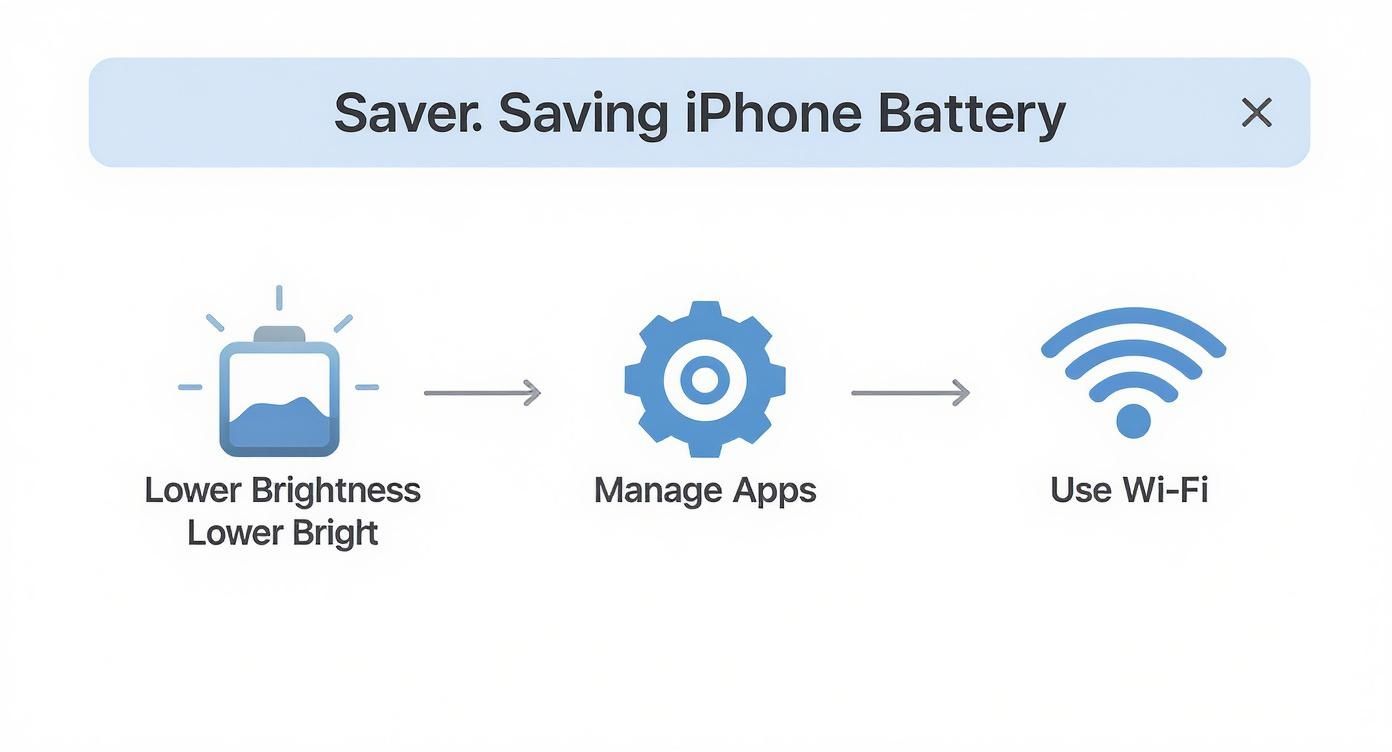
These are just a few of the basic tips, but they're very effective. The picture below sums up the key areas to focus on for a quick improvement.

A visual guide illustrating three steps to save iPhone battery: lower brightness, manage apps, and use Wi-Fi.

It really comes down to managing your screen, your apps, and how you connect. Get those right, and you're on your way to better battery life.

If you're short on time, here are the five most helpful changes you can make right now.

Top 5 Quick Battery Saving Actions

Action What It Does Estimated Battery Savings
Enable Low Power Mode Reduces background activity, email checking, and fancy visuals. Up to 50%
Lower Screen Brightness Reduces the power used by the display. Up to 30%
Switch to Wi-Fi Uses less power than cellular data for internet. 10-20%, depending on signal
Disable Background App Refresh Stops apps from updating content when you're not using them. 5-15%
Turn Off Push Mail Stops your phone from constantly checking for new emails. Up to 10%

Doing even a couple of things from this list will give you an immediate and noticeable boost in how long your iPhone lasts between charges.

Tweak These Settings to Stop Battery Drain

Besides the obvious stuff, your iPhone is running dozens of tasks in the background. A lot of these features are made for convenience, but that convenience costs you battery life. They're constantly sipping power, all day long.

The good news is you can go into your Settings app and make a few specific changes that have a huge impact. This isn't about turning your powerful smartphone into a basic phone; it's about making it work smarter, not harder. You'll probably be surprised by how many of these power-hungry features you can easily live without.

A hand holds an iPhone wirelessly charging on a stand, displaying 'Quick Battery Tips' text.

Tame Your Location Services

One of the sneakiest battery drainers is Location Services. It’s absolutely needed for apps like Maps, but countless other apps ask for your location when they have no good reason to. Really think about it—does that game you play or your social media feed really need to know where you are 24/7?

Every time an app checks your location, it uses a lot of power. You can easily take back control.

  • Go to Settings > Privacy & Security > Location Services.
  • Just go through the list and set as many apps as you can to Never or, at most, While Using the App.
  • Avoid the Always setting unless it's for something you truly need, like a weather widget that updates on your home screen.

Being a little more selective here can dramatically cut down on this background activity. It’s a simple change that saves a surprising amount of power without you even noticing a difference in your day.

Stop Unnecessary Background Refreshes

Another feature that loves to eat your battery is Background App Refresh. This lets apps pull in new content in the background so everything is up-to-date the moment you open them. It sounds great, and it is for things like messaging apps. But it's often turned on for apps that just don't need it.

For example, do you really need a news app updating itself every few minutes? It's burning through power for content you might not even look at. Some reports suggest that background refresh can be responsible for up to 15-20% of your battery drain over a single day. In one test, an iPhone with this feature fully enabled lost about 25% of its battery overnight—that number dropped to just 5-7% after it was turned off. You can discover more insights about iPhone battery drain on Vegerpower.com.

By turning off Background App Refresh for apps that aren't important, you're basically telling your iPhone to stop wasting energy on things you aren't actively looking at. This one change can solve a lot of "mystery" battery drain.

Fine-Tune Your Notifications

Every single notification you get wakes up your screen. It might only be for a few seconds, but when you're getting alerts hundreds of times a day from social media, news, and promotional emails, that screen time adds up fast.

Each buzz, chime, and screen wake-up uses a tiny bit of power. Take a minute to choose which apps are actually allowed to interrupt you.

  • Head to Settings > Notifications.
  • Scroll down your app list and just turn off notifications for anything that isn't essential.
  • For the apps you want to keep, you can get even more specific by turning off Sounds or disabling alerts on the Lock Screen.

This not only saves your battery but also helps cut down on digital noise. Making these simple, thoughtful adjustments is one of the most powerful ways to keep your iPhone's battery going when you really need it.

Better Charging Habits for a Healthier Battery

How you charge your iPhone is just as important as the settings you choose. Getting into the right habits can seriously extend your battery’s overall lifespan, keeping it healthy for years, not just a few months. It's all about working with your battery instead of fighting against it.

Let's talk about the big one: is charging your iPhone overnight really that bad? The simple answer used to be a definite yes, but Apple has built a pretty clever solution right into its software.

The Myth of Overnight Charging

The old worry about overnight charging was that leaving your phone at 100% for hours puts a lot of stress on the battery. Think of it like holding a muscle in a tense position for way too long—it’s just not healthy. That long period at a high charge is what makes the battery get older faster.

This is where Apple’s Optimized Battery Charging feature comes in.

When you turn this on, your iPhone starts learning your daily routine. It'll charge up to 80% fairly quickly and then just… wait. It cleverly pauses the charge, only adding that last 20% right before you typically wake up and grab your phone. This means your battery only sits at that stressful 100% level for a very short time. If you want to get into the details, you can learn more about how Apple's Optimized Battery Charging works in our guide. It's a real game-changer.

Embracing the 40-80% Sweet Spot

While Optimized Battery Charging is great for when you're asleep, the single best habit you can adopt for daily use is the "40-80% rule." The batteries in your phone are happiest when they’re kept in this middle zone, avoiding the extremes of a full charge or a complete drain.

Constantly pushing your battery to 100% or letting it die to 0% is what causes the most wear and tear. By keeping it within the 40-80% range as much as you can, you'll dramatically slow down how fast it ages.

This doesn't mean you have to watch your battery percentage all day. Just try to build a couple of simple habits:

  • Plug in around 40%: Instead of waiting for that low-battery warning, give your phone a quick charge during the day.
  • Unplug around 80%: If you’re charging at your desk, just try to remember to unplug it before it gets full.

It takes a little bit of awareness, but this approach pays off big time in keeping your battery healthy for longer. Small, regular top-ups are so much better for your battery than long, stressful full charges.

Use Quality Chargers and Cables

Finally, the gear you use actually matters. A lot. Not all chargers and cables are made the same, and using cheap, uncertified accessories can lead to uneven power that can quietly damage your battery over time.

You should always look for MFi (Made for iPhone) certified cables and stick to power adapters from well-known brands. These are designed to meet Apple's own safety and performance standards, giving you a stable and safe charge. If you want to keep things organized and charge multiple devices, a good multi-functional Magsafe wireless fast charging dock can be a great option. Using certified gear protects your phone and makes sure your battery gets the clean power it needs.

Why Keeping Your iPhone Cool Is Essential

If there's one villain in the story of your iPhone's battery life, it's heat. Heat is, without a doubt, the single most destructive thing for your battery.

Think of your battery as a tiny, sensitive power plant. When it gets too hot, the parts inside start to break down. And unlike a bad day you can recover from, this damage is permanent.

This isn't just about your phone feeling warm during a heavy gaming session. It's about the slow damage that builds up over time. Each time your iPhone overheats, it loses a tiny bit of its total ability to hold a charge. Over months and years, those small hits add up, leaving you with a battery that just can't make it through the day.

A smartphone charges on a white dock on a wooden nightstand in a bedroom, promoting smart charging habits.

Common Heat Traps and How to Avoid Them

The most common cause of overheating is also the most obvious: the sun. Leaving your iPhone on a car dashboard, even on a mildly warm day, can make its internal temperature shoot up into the danger zone—well past 95° F (35° C), the upper limit Apple considers safe.

But the sun isn't the only thing to watch out for. Other common heat traps include:

  • Charging with a thick case: Those heavy-duty, super-protective cases are great for drops, but they can be terrible for heat. They basically wrap your phone in a blanket, trapping the heat made during charging and slowly cooking the battery. It's a great habit to take off a bulky case before plugging in.
  • Intense tasks in direct sunlight: Trying to use GPS navigation or playing a demanding game while sitting in the sun is a perfect recipe for overheating.
  • Placing it near other heat sources: It might seem harmless, but don't leave your phone on top of a running laptop, a game console, or a cable box. That combined heat can be surprisingly damaging.

The link between heat and battery health is very important. High temperatures speed up the chemical processes inside a battery, causing it to wear out much faster than it would under normal conditions.

If you really want to get into the science, you can explore the impact of temperature on battery degradation in our detailed guide.

Don't Forget About the Cold

While heat is the main enemy, extreme cold isn't great, either.

Ever been outside on a freezing day and watched your phone suddenly die, even though it showed 30% battery just a minute ago? You've seen this happen firsthand.

Cold temperatures temporarily reduce a battery's ability to deliver power. The good news? This effect usually isn't permanent. Once your phone warms back up to a normal temperature, its battery should work normally again.

The key takeaway here is simple. Treat your iPhone like you'd treat a pet—don't leave it in a hot car, and bring it inside when it's freezing. Simply managing its temperature is a free and very effective way to protect your battery for the long run.

How to Find Which Apps Drain Your Battery

Your iPhone has a built-in detective, and it's located right inside your Settings app. This tool tells you exactly where every bit of your battery power is going, showing you which apps are behaving and which ones are secretly draining power behind your back. Learning to read this screen is the first step to taking back control.

Think of it like a detailed receipt for your battery. Instead of just seeing the final total, you get to see every single item.

To start your investigation, just head over to Settings > Battery. The first thing you'll see is a graph showing your battery level over the last 24 hours or the last 10 days.

This graph is more than just a line; it’s the story of your day. See any steep drops? Tap on that part of the graph, and the app list below will instantly update to show you exactly what was running during that time. This is how you connect a sudden battery drain to a specific activity, like that long video call or a navigation app you forgot to close.

Reading the App Usage List

Below the graph is where the real evidence is: a detailed list of every app that has used your battery. Each entry shows a percentage, which is that app's share of the total power used.

Don't panic if your most-used apps are at the top—that's totally normal. If you spend three hours on YouTube, it's going to use a lot of power. The real red flags are the apps you barely use, yet they're still showing up high on the list.

Interpreting Your Battery Usage Screen

To really make sense of this screen, you need to know what you're looking at. It's packed with useful information if you can understand it.

This table breaks down the key parts of the battery usage screen.

Metric/Graph What It Shows What to Look For
Last 24 Hours / Last 10 Days Switches the view between a short-term and long-term battery usage report. Use the 10-day view to spot sneaky, ongoing battery drainers.
Battery Level Graph A visual timeline of your battery percentage over the chosen period. Steep downward slopes, which show moments of rapid power use.
Activity Graph Bars showing when your screen was on versus when it was off. High activity when your screen was off—a clear sign of background tasks.
Battery Usage by App (%) A ranked list of apps and how much of the total battery they used. Apps with high percentages that you rarely use or that say "Background Activity" underneath.

Think of this screen as your main tool for finding battery problems before they get out of hand.

Spotting a Problem App in Action

Let’s walk through a real-world example. Imagine you check your battery stats and see that a social media app you only opened for five minutes somehow used 25% of your battery. Right under the app's name, you see the words "Background Activity." This is your proof.

This tells you the app was running constantly in the background, probably getting new content, tracking your location, or doing something else you never asked it to. This isn't normal usage; it's a problem app taking over your power.

Once you’ve found a power-hungry app, you've got a few options. You can go into its specific settings to turn off Background App Refresh or limit its access to Location Services. If that doesn't fix it, sometimes just deleting and reinstalling the app can clear up a bug that was causing the drain.
Ultimately, this simple screen gives you all the evidence you need to make smart choices and keep your iPhone's battery healthy.

Common Questions About iPhone Battery Life

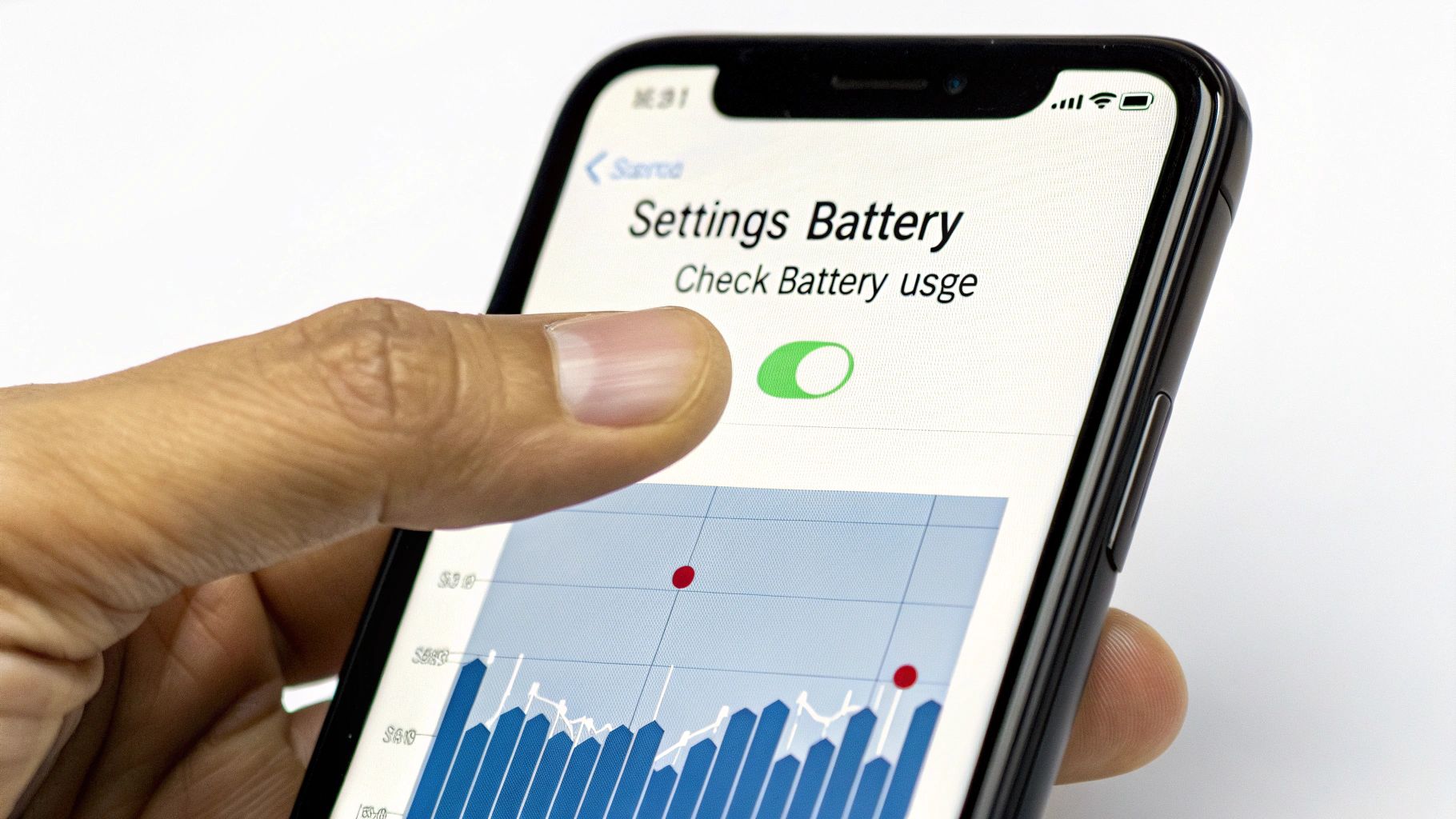
Close-up of a hand touching an iPhone screen displaying battery settings and a usage graph.

Even after learning about all the best practices, you probably still have a few questions. That's totally normal. Let's answer some of the most common concerns people have about their iPhone's battery so you can feel confident you're doing the right thing.

Does Closing Apps Really Save Battery Life?

This is one of the biggest debates in the iPhone world, and the truth might surprise you. Apple's official answer is a clear no—you should only force-quit an app if it’s frozen or not working right. The apps you see when you swipe up are mostly just paused, not actively draining your battery.

Now, there is a small exception. If an app is acting up and running in the background when it shouldn't, closing it will absolutely help. You can usually find the problem app by checking your battery usage in Settings. But for most of us, constantly swiping away every app is not only pointless but can actually use more battery, since the phone has to restart them from scratch every single time.

Will Using Low Power Mode All The Time Harm My Battery?

Not at all. Think of Low Power Mode as a perfectly safe way to get more juice out of your battery whenever you need it. It won't cause any physical damage to the battery's health, whether you turn it on at 90% or 20%.

Low Power Mode just temporarily turns down a few features that aren't essential. It reduces background app updates, tones down some fancy visuals, pauses automatic downloads, and might limit 5G. The only "catch" is a slight dip in performance, but it's a fantastic tool for saving power when you need it.

What Is Optimized Battery Charging And Should I Use It?

Yes, absolutely. If you do nothing else, make sure Optimized Battery Charging is turned on. This clever little feature learns your daily routine to reduce the time your battery spends sitting at a stressful 100% charge.

For instance, if you plug your phone in overnight, it will quickly charge to 80% and then just… wait. It smartly holds off on charging that final 20% until just before you usually wake up. This simple delay makes a huge difference in slowing down battery aging over time.

This is one of the most effective ways to protect your battery without lifting a finger. You can check that it's active by heading to Settings > Battery > Battery Health & Charging. Learning how to check battery health is a great first step to understanding what's going on inside your device.

Why Does My Battery Drain So Fast After An iOS Update?

If you've noticed your battery life gets worse right after a major software update, don't panic. Your battery hasn't suddenly failed. Your iPhone is just working overtime in the background, handling a bunch of one-time tasks.

It's busy with things like:

  • Re-organizing all your files for the search feature.
  • Scanning your entire photo library for new features.
  • Re-learning how to manage the battery itself.

This intense background work can last anywhere from a few hours to a day or two, making the phone run warmer and use more power. The best thing you can do is be patient. Keep it plugged in when you can, stay on Wi-Fi, and just let it finish its job. Your battery life should return to normal within a couple of days.


If you're serious about taking your battery management to the next level and want to automatically use healthy charging habits, Chargie can help. It's a smart little device that stops charging at a level you set, protecting your battery from the stress of sitting at 100% overnight and greatly extending its lifespan. You can learn more about taking control of your charging at https://chargie.org.

How Long Does a Cell Phone Battery Last? Tips to Extend Its Life

When you ask, "how long does a cell phone battery last?" you're really asking two different questions.

First, you want to know how long a single charge will last through the day. And second, you’re wondering how many years the battery will actually hold a good charge before you have to replace it. One is about daily use, and the other is about its total lifespan.

Your Phone's Two Battery Clocks

Think of it like a car. The first "clock" is like its gas tank—how far can you drive on a full tank of gas right now? This is your daily battery life, which might give you anywhere from 10 to 20 hours depending on what you're doing.

The second "clock" is the car's engine health. How many years will that engine run well before it starts having problems? This is your battery's lifespan, and it’s a completely different thing.

Understanding this difference is the first real step to making your phone last longer. One is about managing your daily habits, and the other is about protecting the battery's long-term health from the inside out.

Daily Charge vs. Total Lifespan

Your daily charge is pretty simple. It's the time from when you unplug your phone at 100% until it hits 0%. This can change a lot from day to day based on whether you're just texting or watching a movie marathon.

Total lifespan, on the other hand, is measured in charge cycles. A charge cycle is one full drain and recharge, from 100% down to 0% and back up again. This doesn't have to happen all at once; if you use 50% today and 50% tomorrow before plugging in, that still counts as one complete cycle. You can learn way more about what a battery cycle count is in our detailed guide.

A typical phone battery can handle about 300 to 500 full charge cycles before its ability to hold a charge starts to noticeably drop. After that, you'll find yourself looking for an outlet way more often.

This aging process is exactly why a two-year-old phone might only last half a day, even when it used to easily get through a full one. The battery's ability to hold power has permanently shrunk.

To quickly recap these two ideas, here's a simple breakdown.

Phone Battery Life At a Glance

Battery Metric Typical Duration What It Means
Daily Charge 10 – 20 hours The time your phone runs on a single full charge before needing to be plugged in.
Total Lifespan 300 – 500 cycles The total number of full recharges the battery can handle before it starts to wear out.

Understanding both is key, because what you do every day directly affects how long the battery lasts over the years.

How Long Should a Phone Realistically Last?

While many things play a part, the unfortunate trend is that the average lifespan of a smartphone is getting shorter. Globally, a phone's useful life is now estimated at just 2.53 years, and its battery is a huge reason for that.

Of course, brands matter. Apple devices tend to last longer, often staying usable for 4 to 10 years, while Samsung phones average between 3 to 6 years before performance and battery problems become too frustrating to ignore.

What Really Ages Your Phone's Battery

Ever notice how a brand-new phone feels like it lasts forever, but a year later you're looking for a charger by 3 PM? That’s not just in your head. Your battery is physically getting older, and a few key things are speeding up the process. Once you understand them, you can start fighting back.

At its core, a phone battery is a chemical device. Think of it like a banana you bring home from the store—it starts getting ripe right away. In the same way, your phone's battery begins a slow, permanent aging process from the moment it's made. This is called chemical aging, and it happens whether you use the phone or not.

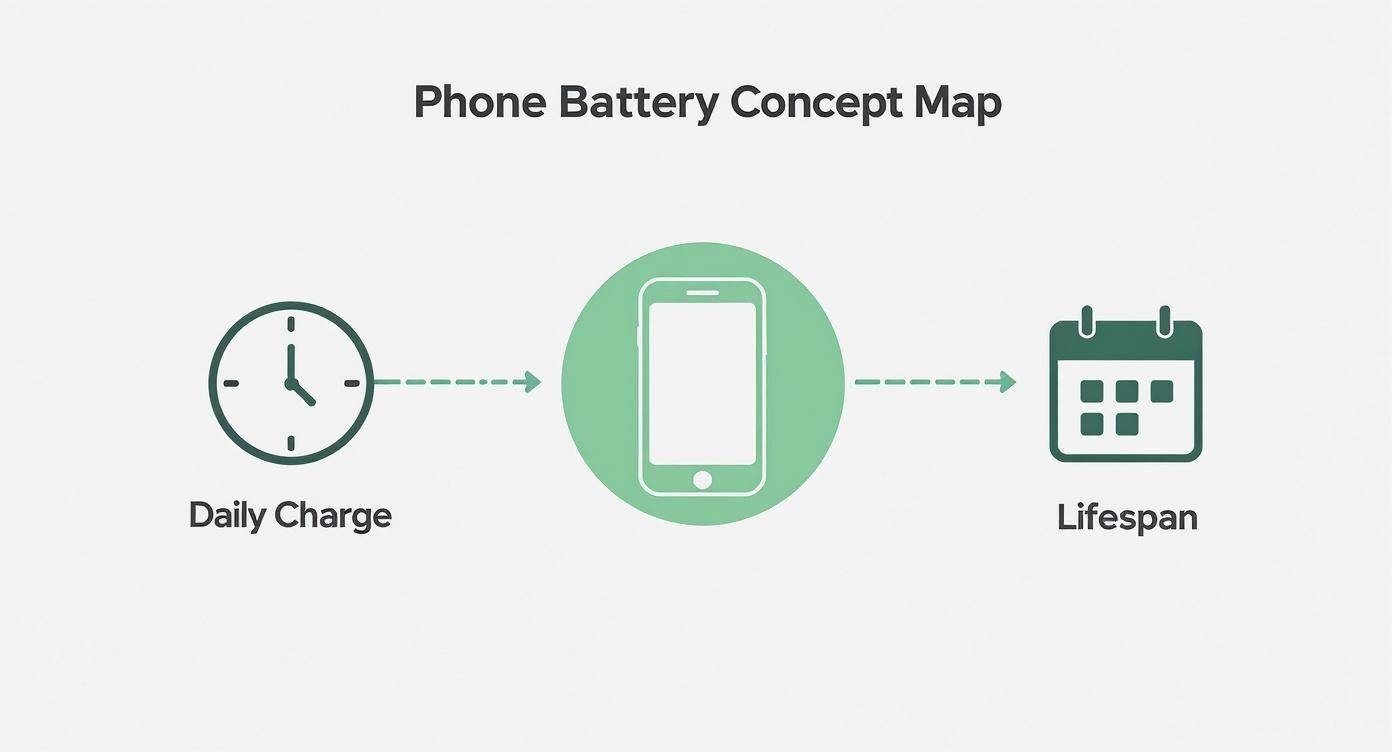
This diagram breaks down the two timelines we’re juggling: how long the battery lasts day-to-day versus how many years it stays healthy.

A concept map showing how daily phone charging impacts a smartphone battery's lifespan.

As you can see, what you do every day has a direct impact on how many years you'll get out of your battery before it wears out.

Charge Cycles: The Paperclip Analogy

Besides its natural shelf life, the single biggest factor wearing down your battery is its charge cycles. As we covered, one cycle is a full charge from 100% down to 0%.

Here’s a simple way to think about it: bend a paperclip. The first time, it’s fine. Bend it back and forth ten, twenty, fifty times, and you’ll feel the metal getting weaker. Eventually, it just snaps. Every single charge cycle does something similar to your battery on a tiny level, causing small amounts of damage that add up.

This is exactly why a battery that’s been through 500 cycles holds way less juice than one that’s only seen 100. The damage adds up and, unfortunately, is permanent.

Heat: Your Battery's Worst Enemy

If charge cycles are like bending the paperclip, heat is like holding a lighter to it. High temperatures speed up the chemical reactions inside the battery, causing it to wear out at a shocking speed.

Leaving your phone on a hot car dashboard is a classic example. That intense heat is like leaving a stick of butter in the sun—it causes damage that can't be undone. The same thing happens when you game for hours while plugged in, making the phone hot to the touch.

Consistently exposing your phone's battery to temperatures above 95°F (35°C) can permanently reduce its capacity. This damage happens silently, invisibly, and it adds up every time it gets too hot.

It’s also why you hear people say to avoid fast charging all the time. Sure, it’s convenient, but those high-speed chargers create more heat, putting extra stress on the battery’s insides.

The Problem with 100% and 0%

It feels natural to charge your phone all the way to 100% and then run it down until it dies, right? The thing is, these extreme states are the most stressful for a modern phone battery.

  • Staying at 100%: A fully charged battery is like a stretched rubber band. Holding it in that high-tension state for hours—like overnight while you sleep—causes it to lose its stretchiness much faster. This is especially damaging when mixed with the heat from charging.

  • Dropping to 0%: Hitting empty can be even worse. When a battery is fully drained, it can fall into a very low power state, which can sometimes make it unable to ever hold a charge again.

For the best health, your battery loves to live in the middle. Keeping your charge between 20% and 80% is the sweet spot that reduces stress and can dramatically extend its useful life. By avoiding the extremes, you're helping that "paperclip" bend less severely each time, saving its strength for years, not months.

The Sneaky Culprits Draining Your Daily Charge

We've talked about the long-term health of your phone's battery, but what about just getting through the day? You can follow all the best practices for a long life, but still find your phone dying by 3 PM. What gives?

The truth is, a handful of sneaky energy hogs are quietly using up your charge all day long. Getting a handle on these is the real secret to understanding how long your battery will last on any given day. Once you spot them, you can take back control and stop looking for a charger.

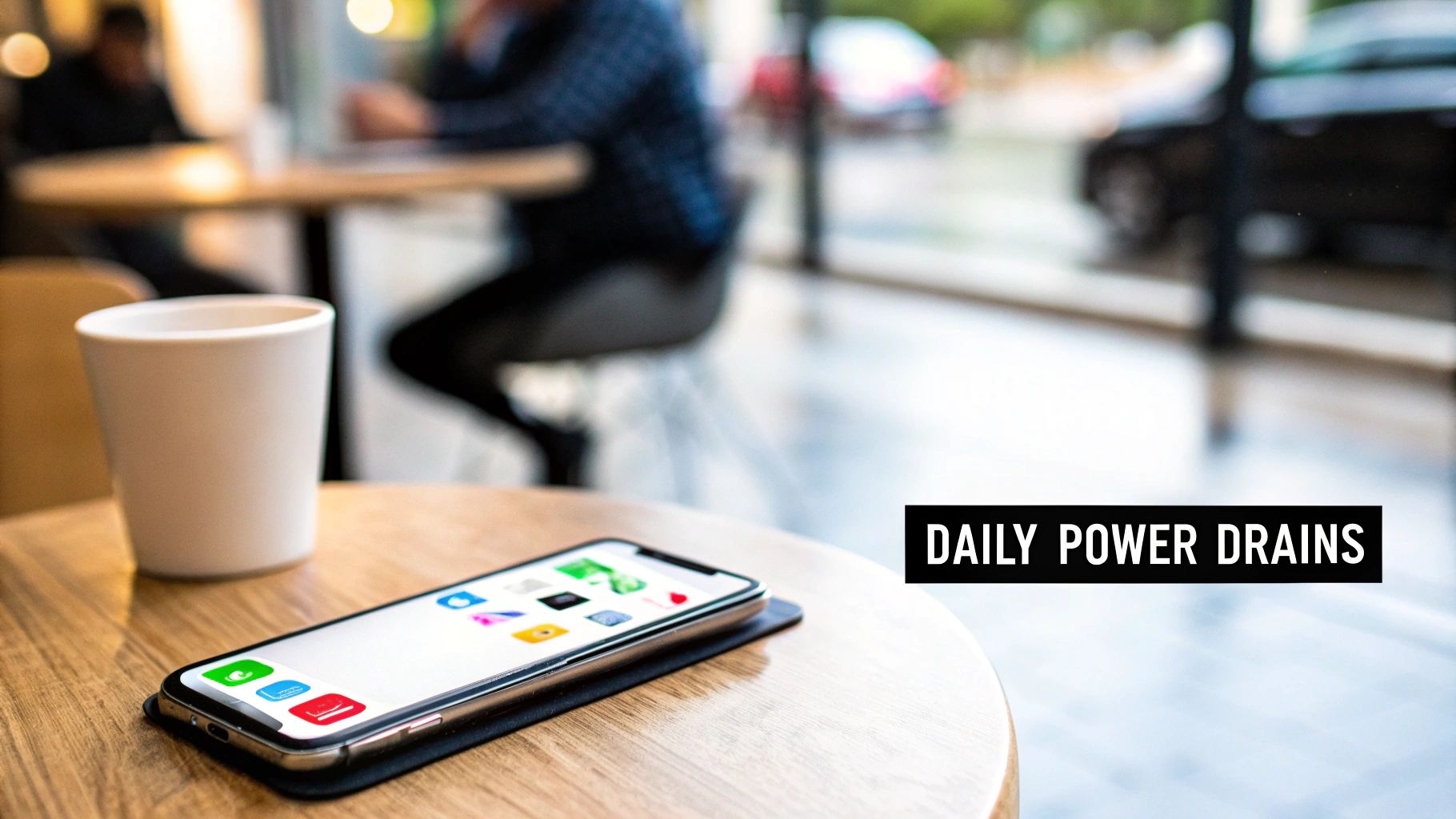
A smartphone on a wooden table displaying app icons next to a white coffee cup in a cafe.

Your Screen: The Undisputed Power Hog

Make no mistake: your screen is the single biggest drain on your daily battery. That bright, beautiful display needs a surprising amount of juice to light up millions of tiny dots. The brighter you set it and the longer it stays on, the faster you'll see that battery percentage drop.

Think of screen brightness like the volume knob on a stereo. You can keep it at a comfortable level, or you can crank it to the max—but that's going to use a whole lot more power.

Actionable Fix: The easiest win here is to turn on Auto-Brightness. Your phone will do the work for you, adjusting the screen's brightness to your surroundings. You'll save a ton of power without even thinking about it. Also, go into your settings and shorten the screen timeout to 30 seconds or one minute.

The Problem of Poor Signal

Ever notice your phone gets warm and the battery drains like crazy when you're in a basement or out in the middle of nowhere? That's not a coincidence. Your phone is working overtime.

When the cell signal is weak, your phone has to boost its power, constantly searching for the nearest tower. It’s like trying to have a conversation in a loud concert—it takes a lot of energy. If you're in a known dead zone for a while, this becomes a massive, hidden drain.

  • Actionable Fix: If you know you're in an area with bad or no service, just turn on Airplane Mode. This tells your phone to stop searching, instantly cutting off this major power drain.

Background Apps Snacking on Your Battery

Most apps don't actually close when you switch away from them. They hang out in the background, checking for new emails, refreshing your social media feed, or finding your location. This feature, known as Background App Refresh, is like having dozens of tiny programs constantly snacking on your battery all day.

While it’s convenient, it can be a real power-drainer, especially with apps like Facebook and Instagram. Things like constant GPS tracking on iPhones are especially tough on the battery.

  • Actionable Fix: Go into your phone’s settings and get selective. Turn off Background App Refresh for any app that doesn't absolutely need to be updated in real-time. Your weather app or that game you play once a week can wait.

Push Notifications Waking Your Phone

Every single buzz, ding, and on-screen alert forces your phone to wake up from its power-saving sleep, light up the screen, and use a little burst of power. One notification is nothing, but hundreds of them throughout the day really add up.

Each alert is like someone tapping your phone on the shoulder, preventing it from staying in a low-power mode. It’s a death-by-a-thousand-cuts for your battery. It's no wonder that while an older iPhone 8 might last 6 to 10 hours, newer models can stretch that to 10 to 13 hours partly because they're better at managing these little interruptions.

  • Actionable Fix: Be ruthless with your notifications. Turn them off for any non-essential app. You probably don’t need an instant alert every time someone you barely know posts something.

How to Check Your Phone's Battery Health

Knowledge is power, especially when it comes to your phone's battery. Instead of just guessing why your phone is dying so fast, you can look at a specific number that tells you exactly how much life it has left. This is the first step toward taking back control.

This magic number, usually called Battery Health or Maximum Capacity, is a direct measure of wear and tear. It shows how much juice your battery can hold today compared to the day you bought it. Think of it like a water bottle. When it’s brand new, it holds a full 16 ounces. But after a couple of years of use, tiny dents mean it can only hold 13 ounces. Its maximum capacity has permanently shrunk.

Checking Battery Health on an iPhone

Apple makes this incredibly easy. You don't need any special apps or secret codes; the info is built right into your phone's software.

Here’s how to find it in seconds:

  1. Open the Settings app.
  2. Scroll down a bit and tap on Battery.
  3. On the next screen, select Battery Health & Charging.

You’ll see a screen with the number you're looking for.

The most important number here is Maximum Capacity. A new iPhone will show 100%, but this number will slowly go down over time with every charge cycle.

As a general rule, once your battery’s maximum capacity drops below 80%, you'll start to feel it. Your phone might not reliably make it through the day, and that's usually the point where getting a new battery is worth considering.

What About Android Phones?

This is where things get a little tricky. Unlike iPhones, there isn't one standard way to check battery health that works for every Android model. Some phone makers, like Samsung, are good about including a battery health number in their settings, often in a "Device Care" or "Battery" menu.

But for many other Android phones, the number is completely hidden. In those cases, you’ll need an app to get a good estimate. Apps like AccuBattery can watch your charging habits over time to figure out an estimated health percentage. It’s not as exact as a built-in number, but it gives you a great idea of where your battery stands.

For a deeper dive, check out our complete guide on how to check battery health on different devices.

By regularly checking this single number, you can see the direct impact of your charging habits. It puts you in charge, helping you make smarter decisions that protect your phone's lifespan and save you from the frustration of a battery that just can't keep up.

Adopt Smarter Charging Habits Today

Taking real control of your phone's battery health is way easier than it sounds. It just comes down to forgetting a few old myths and picking up some new, smarter habits. The batteries in our phones today have totally different needs than the old batteries from a decade ago, and getting to know them is the secret to making your device last.

The single most powerful trick you can learn is the 40-80 Rule. It helps to think of your battery like a muscle—it gets seriously stressed when it's either fully flexed (at 100%) or completely worn out (at 0%). The sweet spot, where it's most relaxed, is right in the middle. If you can keep your battery's charge level between 40% and 80% as much as possible, you drastically cut down on that stress.

This one habit reduces wear and tear at a chemical level, which is what saves your battery's ability to hold a solid charge for years, not just a few months.

A smartphone charging on a wooden nightstand next to a smart speaker, illustrating smart charging technology.

Why Overnight Charging Is a Problem

We've all done it. Plugging your phone in overnight feels convenient, but it's one of the surest ways we accidentally harm our batteries. When your phone hits 100% and just sits there for hours, it’s stuck in that high-stress, fully-tensed state. This creates a tiny but constant amount of heat, which, as we know, is the number one enemy of a battery.

Night after night, this routine speeds up the aging process. Sure, modern phones have software to slow things down, but they still end up sitting at that damaging 100% mark for far too long.

Your Charger Matters More Than You Think

Here's another simple but effective strategy: think twice about your charger. Fast charging is a lifesaver when you're in a hurry, but all that high-speed power creates extra heat. Whenever you can, using a slower, standard charger is much gentler on your battery.

Think of it as sprinting versus jogging. Sprinting gets you there faster, but it puts way more strain on your body. For the long haul, a steady jog is always a better choice.

By making small tweaks—like not leaving your phone plugged in all night and using a slower charger when you have the time—you're tackling the two biggest stressors on your battery: high charge levels and excess heat. These simple changes can seriously extend how long a cell phone battery will last.

To get a deeper dive, you can explore some of the best lithium-ion battery charging best practices in our complete guide.

Making Smart Charging Effortless with Hardware

Let's be real: nobody wants to set an alarm for 3 AM to unplug their phone at 80%. That's where smart hardware comes in to do the work for you. A device like Chargie acts as a personal bodyguard for your battery.

You just plug it in between your charger and your phone cable, then use the app to set a charging limit—say, 80%. Simple. Once your phone hits that level, Chargie automatically cuts the power. Your phone is saved from the stress of sitting at 100% all night, and you don't even have to think about it.

Here’s a quick look at how typical charging habits stack up against smarter, automated ones.

Charging Habits Good vs. Bad

It's easy to fall into bad habits that wear out your battery without you even realizing it. Here's a comparison of common mistakes and the smarter alternatives that will keep your battery healthy for the long run.

Charging Habit Impact on Battery Lifespan Smarter Alternative
Charging to 100% overnight High stress and heat speed up battery aging, reducing its capacity over time. Use Chargie to automatically stop the charge at a healthier level like 80%.
Letting it drop to 0% often Puts the battery at risk of deep discharge, which can cause permanent damage. Try to plug it in before it dips below 20-30% whenever possible.
Always using a fast charger Creates excess heat that wears down the battery's internal parts faster. Use a standard, slower charger for overnight charging to keep temperatures low.
Manually trying to stop at 80% Inconsistent and easy to forget, leading to accidental overcharging. Let a hardware limiter like Chargie handle it for consistent, worry-free results.

By turning these best practices into a set-and-forget routine, you take all the guesswork out of battery care. A smart tool like Chargie ensures your phone is always charged in the healthiest way possible, actively extending its life and saving you from the frustration—and cost—of a premature battery replacement.

A Few Common Battery Questions

Even after getting the basics down, you probably still have a few questions. Let's tackle some of the most common ones so you can make smarter choices for your phone's battery.

Is It Bad to Charge My Phone Overnight?

Yes, leaving your phone plugged in all night, every night, isn't great for it. Once the battery hits 100%, it stays there for hours, creating a high-stress, high-heat situation that speeds up its aging. Your phone has some built-in protections, but they can't completely stop that slow-and-steady damage.

A much healthier habit is to stop the charge well before it hits that full mark. Just making that one small change dramatically reduces the time your battery spends under maximum strain, adding months or even years to its life.

Does Fast Charging Hurt My Battery?

Fast charging is a lifesaver when you're in a hurry, but there's a trade-off. Pushing all that power in so quickly creates a lot more heat than a standard, slow charge. Since heat is very bad for batteries, making a habit of fast charging will wear your battery out much faster.

Think of fast charging as a tool for emergencies. For your daily routine, especially overnight, sticking with a slower charger is a far gentler and healthier option for your battery in the long run.

When Should I Replace My Phone Battery?

A good rule of thumb is to start thinking about a replacement once your phone's Maximum Capacity (or battery health) dips below 80%. Around that point, you'll probably notice a real drop in how long a charge lasts. Your phone might even start shutting down unexpectedly when you're doing something that uses a lot of power.

But honestly, the right time is simply when the battery can't keep up with your day anymore. If you feel like you're constantly stuck to a wall outlet, a new battery will make your phone feel brand new again.

You can't just "reset" a battery's physical health. The wear and tear on a phone battery is a one-way street—it's a permanent chemical change. Those "recalibration" tricks you see online don't restore any lost capacity; they just help your phone get a more accurate reading of its current, worn-out state.

By getting a handle on these common issues, you can take the mystery out of battery care. It's really the small, daily habits that make the biggest difference over time.


Take the guesswork out of smart charging with Chargie. This simple device automatically stops your phone from charging at a healthier level you set, preventing overnight overcharging and extending your battery's life by up to 4x. Protect your investment and stop buying new phones so often by visiting https://chargie.org.

Is charging phone overnight bad: a quick guide to battery health

Leaving your phone plugged in all night isn't going to make it explode, but it’s definitely not good for its long-term health. While modern smartphones are smart enough to stop charging once they're full, keeping the battery at 100% for hours on end puts it under a lot of stress, slowly wearing it out.

So, Is Charging Your Phone Overnight Actually Bad?

Plugging in your phone before you go to sleep is a common habit. It's the easiest way to make sure you have a full charge for the next day. In fact, more than 80% of people around the world do this every night out of convenience. You can look at more data on user charging habits to see just how normal this is.

But does this nightly routine secretly kill our phone batteries? The answer isn't a simple "yes" or "no." Your phone has safety features to prevent major problems. The real issue is more subtle: you're making the battery age faster.

Understanding Battery Stress

Imagine holding a rubber band stretched all the way for hours. It can handle it, but if you do that every night, it will lose its stretch much faster. That’s a good way to think about what happens to your phone's battery when it stays at a 100% charge.

This high-stress state is caused by a few key things:

  • High Power Level: When a battery is fully charged, its internal parts are under the most strain.
  • Constant Top-Ups: Once your phone hits 100%, it doesn't just stop. It uses a little power for things like notifications. The charger then turns back on to "top it off," keeping it in that high-stress, full state all night.
  • Heat: Charging always creates some heat. Getting to 100% and the constant top-ups both create heat, which is the number one enemy of a healthy battery.

The real problem isn't "overcharging" like in the old days. It's the long time spent at a full charge. This slowly weakens the battery's ability to hold a charge, which is why your two-year-old phone doesn't last as long as it used to.

While today's phones have built-in software to help manage this, charging this way night after night still takes a toll. The good news is, you don't have to choose between a dead phone in the morning and a worn-out battery in a year. A few simple changes can make a big difference.

Let's clear up some common worries versus what's really happening inside your phone.

Overnight Charging Risks vs Reality

Concern What Could Happen How Modern Phones Protect You
Overcharging & Explosion The battery could get too hot, swell, or even catch fire if it kept taking in power past its limit. Modern phones have systems that completely cut off the main power once the battery reaches 100%.
"Topping Off" Damage The battery is constantly getting small bits of power, keeping it in a high-stress state. While the phone manages this, it can't prevent the stress from being full. Smart charging features try to delay hitting 100%.
Too Much Heat Heat is a major cause of battery aging, speeding up the breakdown of its internal parts. Phones will slow down or stop charging if they get too hot.
Faster Aging Keeping a battery at 100% for a long time wears it out faster than keeping it at a lower charge level. This is the main problem that built-in software only partly solves. To truly fix it, you need more control.

At the end of the day, while your phone is smart enough to protect itself from immediate danger, it can't stop the natural aging process. The long-term, slow damage from keeping it at 100% charge overnight is real, and it's what ultimately shortens your battery's useful life.

Why Your Phone Battery Hates Being Full

To understand the overnight charging debate, we need to look inside your phone's battery. It's a lithium-ion battery, and like anything, it has things it prefers for staying healthy. And here’s the surprise: these batteries are happiest when they’re not completely full or empty.

Think about a rubber band. You can stretch it, and it snaps back. But what if you pull it as far as it can go and leave it that way for hours? It starts to lose its spring. Your phone's battery goes through something similar when it’s held at a 100% charge all night.

This state is what experts call high-stress. When the battery is full, all its parts are under maximum strain. Keeping it in that tense state for hours speeds up its chemical aging—the natural process that makes a battery lose its ability to hold a charge over time.

The Problem with Staying at 100 Percent

Once your phone hits 100%, it doesn't just stop using power. It still needs a tiny bit of energy for background tasks, like checking for new emails. To make up for this, your charger keeps sending little "top-up" charges all night.

This constant top-off means your battery never gets a break from that high-stress, fully charged state. Over hundreds of nights, this process slowly wears down the battery's insides, reducing its total capacity. It’s the reason why a phone that once lasted all day might need a charger by mid-afternoon after a year or two.

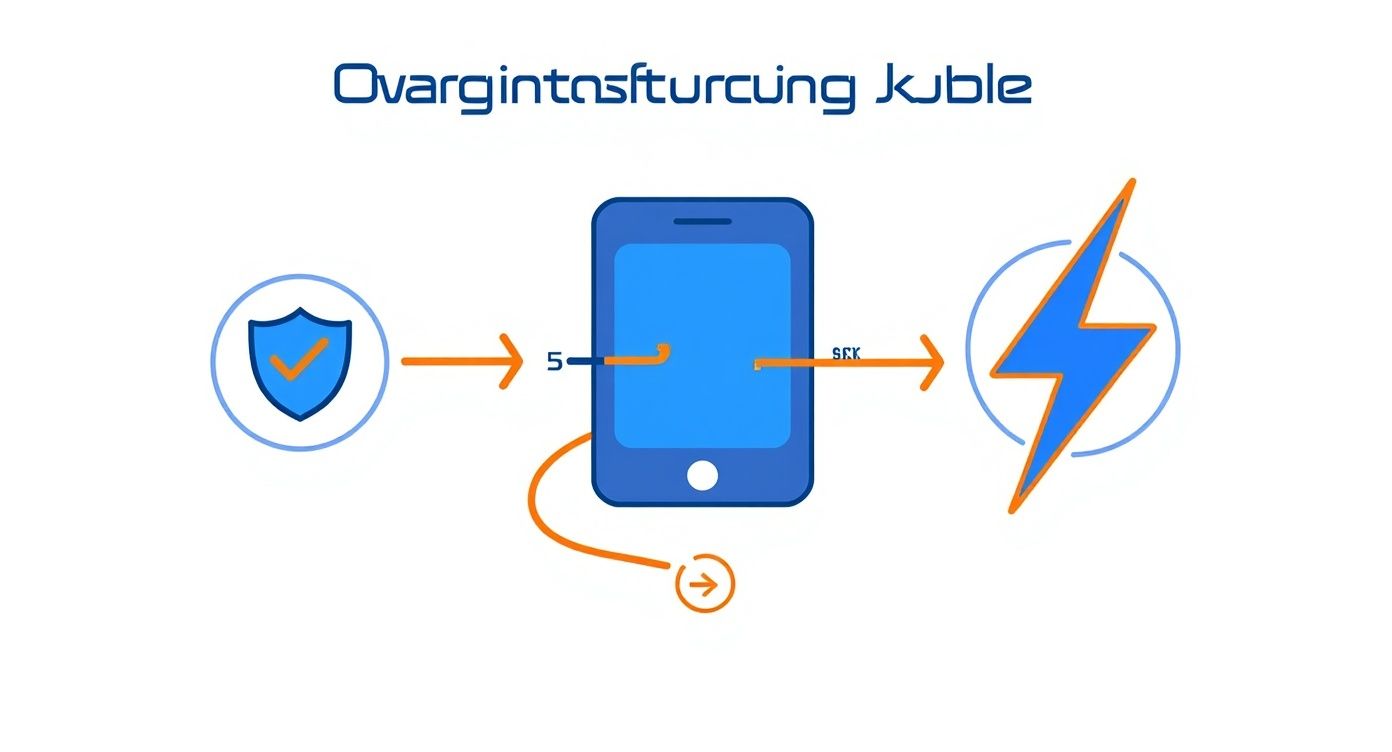
This diagram shows the key things at play when you charge overnight—stress, wear, and safety—which all affect your battery's long-term health.

A conceptual diagram depicting a secure shield icon connected to a smartphone, which then connects to a lightning bolt icon, symbolizing secure charging.

The image highlights how the long-term stress from sitting at 100% is a main cause of battery wear, something that even modern safety features can't completely solve.

The 20-80 Percent Sweet Spot

So, what's the solution? Battery experts have found a "sweet spot" for keeping these batteries happy. By keeping the charge level between 20% and 80%, you reduce that internal stress and help it stay healthy for much longer.

"A lithium-ion battery doesn't need to be fully charged, nor is it a good idea to do so. In fact, it is better not to fully charge, because a high power level stresses the battery and wears it out in the long run."

Studies show that always charging to 100% every night can reduce a battery’s useful life by as much as 20% in just a couple of years. It's like choosing between a full tank of gas for today's trip or making sure your car's engine runs well for years. By staying out of the extreme ends of the charging range, you give your device a much longer, healthier life. You can even discover more about fire risks from overnight charging and see why battery health is also about safety.

Understanding the Hidden Risks of Heat

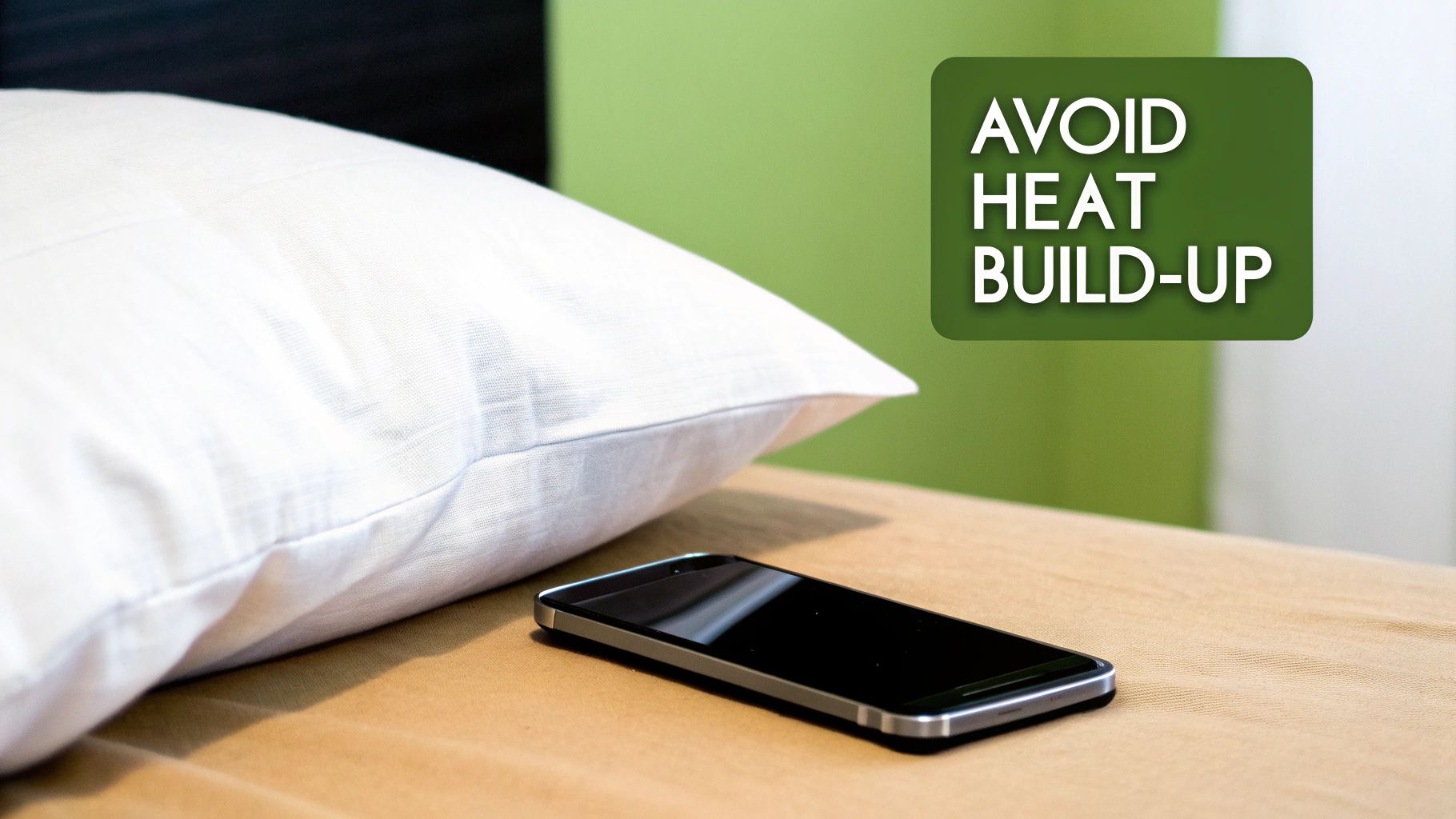
A smartphone resting on a bed next to a white pillow, with a warning to avoid heat build-up.

Besides the slow wear on your battery, leaving your phone plugged in all night brings a more immediate risk that most of us don't think about: heat. Every time you charge, your phone gets a bit warm, but your overnight habits can turn this into a real safety problem.

The trouble starts when that heat can't escape. Tucking your phone under a pillow, leaving it on a soft couch, or letting it get buried under blankets is like wrapping it in a winter coat. These surfaces block airflow, causing heat to build up to dangerous levels.

This trapped heat is bad for two reasons. First, it aggressively speeds up the aging of your battery, making it lose its ability to hold a charge much faster. You can get a deeper understanding of the impact of temperature on lithium-ion cells in our detailed guide on the topic.

From Bad Habit to Real Danger

A dying battery is annoying. But the more serious issue is the risk of fire. This danger becomes very real when people charge their phones in bed—a surprisingly common habit.

Experts warn that charging phones near or under pillows is a fire risk. In the UK, a staggering 74% of people charge their phones in their bedrooms, and about one-third of teenagers admit to sleeping with their phones under their pillows. This common practice greatly increases the danger of the device overheating and possibly catching fire. You can read more about these expert warnings on charging phones in bed.

In these situations, the trapped heat can cause the battery to swell or, in rare but real cases, even catch fire. It's a risk that is simple to avoid but very important to know about.

Why Your Charger Matters So Much

The quality of your charging equipment plays a huge role in your safety. Using certified, high-quality chargers and cables is absolutely necessary for safe overnight charging.

Here’s what makes cheap, knock-off accessories so risky:

  • No Safety Features: Good chargers have built-in parts that watch the temperature and power level, ready to cut the power if things get too hot. Uncertified accessories often skip these crucial safety features to save money.
  • Poor Quality: Low-quality materials can lead to electrical problems or unstable power, which only increases the risk of overheating.

While fires are not common, the chance of one happening is real and completely preventable. The answer to is charging phone overnight bad becomes a definite yes when you mix bad habits with low-quality gear. Always charge your phone on a hard, flat surface where it can get air, and please, buy accessories you can trust.

Smart Charging Solutions You Can Use Tonight

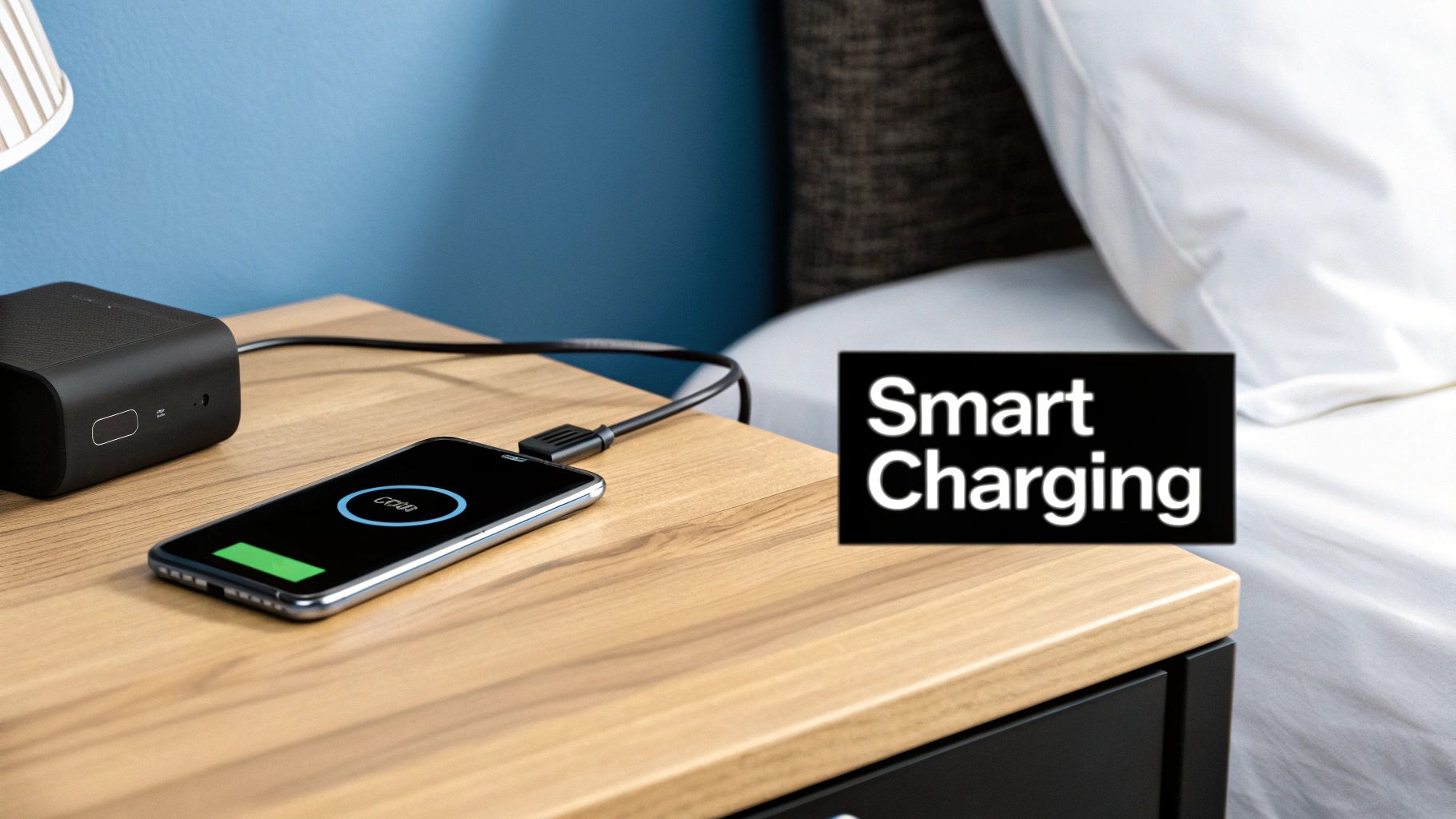
A smartphone is charging on a wooden nightstand, with "Use Smart Charging" text overlay.

Okay, so we've learned that letting your phone sit at 100% charge for hours, especially overnight, isn't great for its long-term health. The mix of high power levels and heat is a recipe for faster battery aging.

But knowing the problem is only half the battle. The good news is that you don't need to be an expert to fix it. Powerful tools are probably already built into your phone, and even better solutions are available for those who want full control.

These features are designed to reduce the time your phone spends in that high-stress, fully charged state. They offer a smarter way to charge.

Your Phone's Built-In Protections

Both Apple and Google have built smart charging features into their phones. Think of these as your phone's automatic defense system against early battery wear.

  • Apple's Optimized Battery Charging: If you have an iPhone, you've likely seen this work. It charges your phone to 80% and then pauses. The software learns your daily routine—like when you usually wake up—and aims to finish the last 20% right before your alarm goes off.
  • Android's Adaptive Charging: Many Android phones, especially Google's Pixel phones, have a similar feature. It uses your alarm settings to time that final charging push, which cuts down the time the battery sits at the stressful 100% mark.

These built-in features are a big step in the right direction. But they have one major drawback: they still push the battery to 100% every single day. While the time spent at 100% is shorter, the peak stress is still there. If you want to learn more about how this software works, we have a detailed guide on what is optimized battery charging.

Taking Control with a Hardware Limiter

For anyone who wants to go beyond the default settings and truly manage their battery's health, a separate hardware device offers a level of control that software alone can't match. This is where a little device like Chargie comes in, acting as a smart gatekeeper between your charger and your phone.

A hardware limiter gives you the power to set a specific charging limit—say, 80% or 85%. Once your phone hits that target, the device physically cuts the power. It completely stops your phone from ever reaching that high-stress state overnight.

This approach gives you a much safer strategy. It's like telling your charger, "Stop right here," ensuring your battery stays in its healthiest, low-stress comfort zone all night, every night.

It’s one thing to talk about it, but another to see it in action. Below is a simple table comparing the different approaches.

Comparing Smart Charging Methods

Method How It Works Level of Control Best For
Built-in Software Learns your routine and delays the final charge to 100% until just before you wake up. Low (Automatic) Casual users who want a simple, automatic improvement over regular charging.
Chargie (Hardware) You set a precise charge limit (e.g., 80%). The device physically cuts power when the limit is reached. High (You decide) Tech fans, business managers, or anyone wanting the longest possible battery life and total control.

While the built-in software is a great start, a hardware limiter like Chargie puts the power back in your hands. You make the rules.

By setting a hard limit, you remove all the guesswork. You're no longer just reducing the time at 100%—you're preventing it from happening at all during those long, idle overnight hours. This is the key to truly preserving your battery for the long haul.

How Businesses Can Protect Their Device Fleets

A dying phone battery isn't just a personal problem—for a business, it's a serious issue that costs time and money. Think about it: companies rely on lots of devices for everything from delivery scanners to employee smartphones. When those batteries start failing, it’s more than just an inconvenience.

A dead device during a shift means work stops. The costs of constantly buying new devices add up. Worse, a device failing at a critical moment can create safety issues for employees who need them to communicate. Suddenly, the question "is charging my phone overnight bad?" becomes a crucial business decision about protecting equipment and keeping things running smoothly.

Central Control for Better Battery Health

Realistically, you can't just ask hundreds of employees to manage their charging habits. It's impossible without a central system. That’s where a proper management solution comes in, letting an administrator set charging rules for every company device from one place.

This is exactly what the Chargie fleet system was built for. It gives businesses control, allowing them to apply universal charging policies like:

  • Setting a Maximum Charge Limit: You can make all devices automatically stop charging at a healthier level, like 85%, which prevents the high-stress state that ruins battery life.
  • Scheduling Charging Times: You can ensure devices only charge when they need to, avoiding all those unnecessary hours spent plugged in and getting hot.

For businesses that rely on these devices, even simple tasks matter. A good iPhone screenshot guide, for instance, can be a useful tool for employee training and support, making device management easier.

A Clear Return on Investment

Using a smart charging system for your company devices isn't just an expense; it's an investment that pays for itself. By making each device's battery last much longer, companies can cut down on replacement costs and delay expensive upgrades.

The image below shows the Chargie fleet management dashboard, where a manager can see and control the charging status of every connected device.

This overview makes it easy for managers to confirm that charging rules are being followed and to spot any devices with battery trouble before they cause a problem.

By taking control of battery health, businesses do more than just save money. They reduce wasted time and make their entire operation more efficient. It turns battery care from a forgotten task into an automated and cost-saving business strategy. This approach ensures your technology investments last longer and work more reliably when you need them most.

Your Action Plan for Healthier Phone Charging

Okay, let's put all this information into practice. Here’s a simple plan you can start using tonight to keep your battery healthy and your home safe.

It doesn’t have to be complicated. The secret isn't some crazy technical trick—it's just about forming a few small, consistent habits. And those habits can make a huge difference in how long your battery lasts.

The main idea is simple: avoid leaving your phone at 100% charge for hours, and keep it from getting hot. These two things are the worst for aging your battery too quickly.

A Simple Checklist for Better Charging

Here are the most important things you can do right away:

  • Charge on a Hard, Flat Surface: I can't say this enough—never leave your phone charging on your bed, under a pillow, or on the couch. Soft surfaces trap heat, and heat is the ultimate battery killer. A nightstand or a desk is the perfect spot.

  • Use Certified Chargers and Cables: Always stick with chargers and cables from your phone's maker or a trusted, certified brand. Those cheap, uncertified accessories you find at gas stations often lack the key safety features that protect your phone from overheating. It’s not worth the risk.

  • Don't Aim for 100% Overnight: This is the biggest takeaway. Letting your phone sit at 100% for hours puts the battery under stress. A good first step is to use your phone's built-in optimized charging feature. But for even better results, a hardware device like Chargie can automatically cut the power at a much healthier level, like 80% or 85%. You might be surprised to learn why a 65% charge makes sense for most people's daily use.

By making these small changes, you can easily double your battery's lifespan. The real goal is to make smart charging an easy, automatic part of your daily routine.

Got Questions? We’ve Got Answers.

We’ve covered a lot about battery health, but you might still have a few questions. Let's answer some of the most common ones to clear up any final confusion about charging your phone overnight.

Does Using a Fast Charger Overnight Make It Worse?

Yes, it can. Fast charging is great when you need a quick power boost during the day, but all that speed creates a lot of heat. And as we've learned, heat is one of the worst things for a phone battery.

When you’re plugging in for a long time like overnight, a standard, slower charger is a much better choice. It keeps the temperature down, which means less stress on your battery's internal parts. Think of it as a slow, relaxing meal versus a rushed, stressful one—your battery definitely prefers the first one.

Should I Let My Phone Die Completely Before Charging?

Nope! That's an old myth from the days of older batteries. Modern lithium-ion batteries are actually stressed out by being drained all the way to 0%.

It's much healthier for your phone to get partial charges. The sweet spot, as confirmed by experts, is keeping your phone between 20% and 80%. Letting it die completely is like making your battery run a marathon it wasn't prepared for.

If you remember one thing, make it this: lithium-ion batteries are happiest when they are neither totally full nor totally empty. Avoiding those extremes is the single easiest way to make them last longer.

Is My Phone's Built-In Optimized Charging Feature Enough?

Let's be clear: the optimized charging features on iPhones and Androids are a big improvement. They learn your routine and wait to charge to 100% until right before you wake up.

But here’s the catch—they still push the battery to that high-stress 100% mark every single day. For anyone who is serious about getting the longest possible life from their battery and wants to keep it at a healthier 80% or 85%, the software-only method doesn't offer enough control. You need something more direct.


For total control over your battery's health, Chargie physically cuts the power at whatever level you set, making sure your phone never sits in that high-stress zone overnight. Take back control of your charging routine at https://chargie.org.

Extend Laptop Battery Life with These Simple Tricks

If you want to get more hours out of your laptop battery, the game plan is pretty simple. It boils down to two things: using less power and charging smarter. Quick tweaks like dimming your screen, closing apps you aren't using, and turning on your laptop's built-in battery saver mode can give you a surprising amount of extra time away from the wall. But for the long haul, the real secret is breaking bad habits—like letting your battery die completely or leaving it plugged in at 100% all day long.

Why Your Laptop Battery Wears Out

Modern silver laptop and smartphone on a wooden cafe table, promoting 'More Battery Hours' for tech users.

Ever feel like your laptop is constantly begging for its charger? You’re not alone. That frustration of a battery that just can't hold a charge is a common problem, but once you understand why it's happening, you can actually do something about it.

The hard truth is that every laptop battery has a limited lifespan. From the moment you start using it, its ability to hold a charge begins to fade. It’s a completely natural process, like a slow aging process for the battery's insides.

I like to think of a new battery as a big water bottle. When it’s brand new, you can fill it to the brim. But over years of use, that bottle slowly shrinks. You can still fill it to the "top," but the total amount of water it holds is less. That’s exactly what’s going on inside your laptop’s battery. Every time you charge and use it, tiny changes happen inside that slowly reduce how much power it can store.

The Real Culprits Behind Battery Drain

While age is a factor, your daily habits are what really speed up your battery's decline. Three things are particularly tough on its health.

  • Keeping It Fully Charged: Leaving your battery at 100% for long stretches is like holding a rubber band at its absolute limit—it creates constant strain and wears it out fast.
  • Too Much Heat: Heat is the worst enemy of battery health. Leaving your laptop in a hot car or, more commonly, blocking its air vents by using it on a bed or couch, generates heat that permanently damages the battery.
  • Letting It Die Completely: Constantly running your battery down to 0% is just as stressful. Modern batteries are much happier when you keep them in that sweet spot, somewhere in the middle of their charge range.

Thankfully, the tech has gotten better. Over the last decade, the average power of laptop batteries has jumped from around 40 watt-hours to roughly 60 watt-hours. For many new models, that means you can get well over 10 hours of real-world use on a single charge. You can dig into more of the data on the evolution of laptop battery capacity if you're curious.

This guide will walk you through how to manage these factors, moving beyond general advice to give you practical, tested tips that actually work.

Quick Wins to Boost Your Battery Life Today

Feeling overwhelmed? Don't be. Here are some of the easiest changes you can make right now to see an immediate difference in your battery's daily performance.

Tactic Impact Level Time to Implement
Lower screen brightness to 50-70% High ~5 seconds
Turn on Battery Saver / Low Power Mode High ~10 seconds
Unplug unused devices (docks, drives) Medium ~5 seconds
Close background apps you're not using Medium ~30 seconds
Turn off Bluetooth and Wi-Fi when not needed Low-Medium ~10 seconds

Making even one or two of these changes a regular habit can add a noticeable amount of runtime to your day, buying you precious time when you're away from an outlet.

Change Your Built-In Power Settings

Your laptop is a lot smarter than you might think. Hidden away in its settings are some seriously powerful tools designed to manage power and extend laptop battery life. Most people never even look at them, but tweaking just a few things can give you hours of extra runtime.

Think of it like the "eco" mode in your car that uses less gas. Your laptop has the same kind of feature. By simply telling your machine to focus on saving power instead of going full speed when it's unplugged, you can make a massive difference.

These settings handle everything from how quickly your screen dims to how much power your computer is allowed to use. Let's get into the details of adjusting these for both Windows and macOS.

Master Windows Power and Battery Settings

Windows actually gives you a ton of control right out of the box. You don’t need to be a tech expert to find and adjust these settings, and a few clicks can set your laptop up for long stretches away from a power outlet.

The main control area for all this is the Power & Battery menu. On Windows 11, just head to Settings > System > Power & Battery. The first thing you'll see is a slider with a few power modes, usually "Best power efficiency," "Balanced," and "Best performance."

When you're running on battery, flipping that switch to Best power efficiency is the single most effective thing you can do. One click and Windows will automatically slow down background activity and dim the screen a bit to save energy.

But we can dig a little deeper for even more savings:

  • Turn on Battery Saver: This mode is a real lifesaver when you're running low. It usually turns on automatically (you can set the level, often 20%) and cuts down on background activity and notifications. You can also just turn it on yourself whenever you want.
  • Control Background Apps: Some apps are known for running in the background, constantly checking for updates and syncing data. In your battery settings, you can see a list of the worst power-drainers and stop them from doing this behind your back.
  • Adjust Sleep and Screen Timers: This one is huge. Set your screen to turn off after just a minute or two of inactivity and the laptop to go to sleep after five or ten. Those small gaps when you're not using it really add up over a day.

A common mistake I see all the time is people leaving their power mode on "Best performance" while on battery. This makes the computer work at full speed and burns through your battery, often for simple tasks like writing an email that don't need that much power.

By making a habit of this, you’re not just reacting to a low battery warning—you’re actively managing your power from the second you unplug.

Configure macOS for Maximum Efficiency

Apple users, you're not left out. macOS has its own excellent set of tools to help you squeeze every last drop out of a charge. The idea is the same as with Windows: cut out the unnecessary stuff and optimize for what you're actually doing.

The star of the show here is Low Power Mode. You'll find it under System Settings > Battery. Just like on your iPhone, turning this on lowers screen brightness and reduces system power for background tasks. It's a simple, one-click way to immediately extend laptop battery life.

If you want more control, click on "Options" within the Battery settings. This is where you can make some really helpful tweaks:

  • Optimize video streaming on battery: This great feature tells your Mac to play certain high-quality videos in a standard format when you're unplugged, which uses way less power.
  • Put hard disks to sleep when possible: If your Mac has an older-style hard drive (or you have an external one plugged in), this will power it down when it's not being used.
  • Wake for network access: Turning this off stops your Mac from waking from sleep just because another device on your network wants to connect to it. Keep it asleep until you need it.

One of the most useful tools on any Mac is the Activity Monitor, which is in your Utilities folder. Head over to the "Energy" tab, and you'll get a real-time list of which apps are the biggest power hogs. If you see an app with a high "Energy Impact" that you aren't even using, just quitting it can give you an instant battery boost.

Get Smart About Your Charging Habits

How you charge your laptop is a massive piece of the battery life puzzle. We’ve all been bombarded with conflicting advice over the years: drain it to zero, never unplug it, only charge to 80%. Let's cut through the noise and get straight to what actually works, based on how the batteries inside our laptops work.

The little habits you form around charging can make a world of difference, preventing your battery from aging too quickly and keeping your laptop dependable for years. This isn't about following a super-strict routine, but about making small, consistent changes that reduce the stress on your battery.

Live by the 20-80 Rule

Picture your laptop's battery like an athlete. It’s happiest and performs best when it’s not completely worn out or pushed to its absolute breaking point for hours on end. The same idea applies perfectly to the battery.

Keeping your battery at 100% or letting it die completely puts a ton of stress on it. The real sweet spot, where the battery is most comfortable, is somewhere in the middle. This is where the famous "20-80 rule" comes in, and it's your single best guideline.

  • Try to plug your laptop in when it hits around 20%.
  • Then, make a point to unplug it once it reaches about 80%.

That's it. This simple routine helps you avoid the stress of a full charge and the strain of a completely empty battery. You're basically keeping the battery in its happy place, which dramatically slows down the aging that kills its ability to hold a charge over time.

There's a common myth that you need to "train" a new battery by letting it die completely. While that was true for very old types of batteries, it's actually damaging to the modern batteries in every laptop made today. Sticking to the 20-80 range is a far, far healthier practice.

Heat Is the Enemy—Especially While Charging

If there’s one public enemy number one for battery life, it’s heat. When a battery gets hot, the processes inside speed up, which rapidly wears it out. Charging naturally creates a bit of heat, but you can easily keep it under control.

First rule: never charge your laptop on a soft surface like your bed, a couch, or a fluffy blanket. These materials trap heat and completely block the air vents on your device. It creates a mini-oven effect that literally cooks your battery.

Instead, always charge your laptop on a hard, flat surface like a desk or a table. This gives the vents room to breathe and allows air to flow freely, keeping the whole system—and your battery—cool. If your laptop often feels hot to the touch, propping it up on a simple laptop stand is a great way to improve airflow even more.

What if You're Always Plugged In?

A lot of us use our laptops like desktop computers, which means they're connected to the charger all day long. It's convenient, sure, but it also keeps the battery at a constant 100% charge—a high-stress state that's not great for its long-term health.

If this sounds like your daily setup, you've got a few solid options to protect your battery:

  1. Check for built-in battery care tools: Many manufacturers (like Dell, HP, and Lenovo) know this is an issue and include software that lets you set a maximum charge limit, often right around that ideal 80% mark. Look in your laptop’s system settings for features like "battery care," "conservation mode," or "charge threshold."
  2. Do it manually: Get into the habit of unplugging your laptop for a bit each day. Just let the battery run down to 40% or 50% before you plug it back in. It's a simple way to give it a break from that constant high-stress state.
  3. Automate it with a smart device: This is the set-it-and-forget-it solution. A tool like Chargie can manage this process for you automatically. You just tell it to stop the charge at 80%, and it handles the rest, giving you perfect charging habits without you ever having to think about it.

Real-world testing shows just how much these habits matter. One study found that laptops used by students could get anywhere from 5 to 8 hours of runtime. That huge difference wasn't just due to the hardware; it was a direct result of user habits like charging routines and screen brightness. You can see more on how personal habits impact battery performance on Laptop Mag. Adopting these smarter habits puts you firmly in control of which end of that range your laptop lands on.

Choose the Right Hardware and Accessories

While your daily habits and software settings are a huge part of the puzzle, the actual hardware you use plays a massive role in the battle to extend laptop battery life. From the charger you plug in every day to the parts inside your machine, making smart choices can either protect your battery or send it to an early grave.

It’s not just about what you do, but what you use. The right accessories can help you form good habits and protect your device, while the wrong ones can slowly damage your battery’s health without you even realizing it.

This simple cycle is the core idea of a healthy battery routine: actively manage the process rather than just leaving the device plugged in 24/7.

A diagram illustrating the steps: charge a battery, unplug the power, and then use a laptop.

Automate Healthy Charging with Smart Tools

We’ve already talked about how keeping your battery between 20% and 80% is the sweet spot for long-term health. The problem? Remembering to unplug your laptop at just the right moment is a real pain. It's far too easy to plug it in and completely forget, leaving the battery sitting at a stressful 100% charge for hours—or even days—on end.

This is exactly where a piece of smart hardware can be a game-changer. A device like Chargie was made to solve this specific problem. It's a small USB-C device that sits between your charger and your laptop, acting as a smart gatekeeper for the power flowing into your machine.

Using its app, you can set a hard charging limit—say, 80%. The second your laptop hits that level, Chargie simply cuts the power. It's a true set-it-and-forget-it solution that enforces perfect charging habits for you, day in and day out, preventing the high-voltage stress that wears out your battery over time.

Setting Up Chargie for Optimal Protection

Getting started with Chargie is designed to be super simple. The whole idea is to make healthy charging an automatic background process you never have to think about again.

Here's how you can use the 80% charge limit and other battery-saving features using the device.

Chargie Setup for Optimal Battery Health

Step Action Expected Outcome
1. Connect Hardware Plug the Chargie device into your charger's cable, then connect the other end to your laptop’s USB-C port. The device is now physically in line to control the power flow.
2. Install the App Download and install the Chargie app on your phone or computer. It works with Windows, macOS, and others. You now have the software needed to control the hardware.
3. Set the Limit Open the app and use the slider to set the maximum charge level to 80%. Chargie will now automatically stop charging once the battery reaches 80%.
4. Use Scheduling (Optional) In the app's scheduler, set the battery to stay at a lower level (e.g., 50%) overnight and then top up to 80% before your workday starts. This reduces the time spent at higher charge levels, further easing stress on the battery.

By following these steps, you're not just preventing overcharging; you're actively managing the battery's charge level to keep it in its happiest, healthiest range for as long as possible.

Why Your Choice of Charger Matters

When you lose or break your original charger, it's tempting to go online and grab the cheapest generic replacement you can find. Honestly, this is one of the riskiest things you can do for your laptop's battery.

Your laptop’s original charger isn't just a power cord; it's designed to talk to your device, delivering the exact, stable power the battery was made for. Cheap, uncertified chargers often cut corners on important safety features and quality parts.

An uncertified charger can deliver inconsistent power, sending "dirty" electricity into your battery. This can cause overheating, inefficient charging, and, in the worst cases, permanent damage to both the battery and the computer itself.

Think of it like this: you can survive on junk food, but you’ll feel and perform much better with high-quality food. Your battery feels the same way about the electricity it gets. You can dive deeper into the specifics of how many watts are needed to charge a laptop in our detailed guide, which breaks down why matching your charger to your device is so important.

Energy-Efficient Components and Other Accessories

When it's finally time to buy a new laptop, keep an eye out for models with modern, power-saving computer chips. Chips like Intel's Core Ultra series or Apple's M-series are built to use less power, which directly means more battery time for you. Learning about different battery technologies can also be useful—for instance, understanding the best battery types for trail cameras shows how different types are made for long life in other gadgets.

Finally, be mindful of the accessories you leave plugged in. Docks, external hard drives, and even some fancy USB mice can draw a surprising amount of power. Unplugging them when you're running on battery is a simple but effective trick to save energy and squeeze out a little more time before you need to find an outlet.

Keep Your Laptop in Fighting Shape with Essential Maintenance

Think of your laptop's battery like a car engine. You wouldn't skip an oil change for years and expect it to run smoothly, right? The same logic applies here. A little bit of maintenance goes a long way in preventing those frustrating moments when your laptop suddenly dies, even though the battery meter swore you had 20% left.

You don't need to be a tech expert to do this. By spending just a little time on two key tasks every few months—battery calibration and software updates—you can keep your machine running reliably. These are simple habits that pay off big in the long run.

A laptop displaying a battery calibration icon and progress bar with 'Calibrate & Update' text on a desk.

What Is Battery Calibration (And Why Bother)?

We've all been there. You're working on something important, glance at the battery icon, and see what looks like plenty of power left. Then, boom—the screen goes black. This is the classic sign of a battery meter that's out of sync.

The software that shows you that percentage is really just making an educated guess. Over time, as your battery naturally ages and its maximum power level decreases, that guess gets more and more inaccurate. Calibration is how you "re-teach" the software what "full" and "empty" actually mean for your battery right now.

It’s a simple reset that gives your computer a much more trustworthy estimate of your remaining runtime, stopping those sudden shutdowns.

Think of it like this: calibrating your battery is like resetting the fuel gauge in your car. It doesn't magically add more gas to the tank, but it ensures the gauge you're looking at is telling you the truth about what's left.

Doing a full calibration every two to three months is a solid routine. If you really want to get under the hood and track your battery's condition, our guide on how to check your laptop's battery health is a great next step.

How to Recalibrate Your Laptop Battery

The process itself is pretty simple and just involves running through a full charge cycle. While the exact menu options might be a little different between brands, the core idea is the same everywhere.

Here’s the game plan:

  • Charge It to 100%: Plug in your laptop and let it charge completely to 100%. Don't unplug it right away—leave it on the charger for another hour or two. This makes sure it's truly full and has had a chance to cool down.
  • Drain It Completely: Now, unplug the charger and just use your laptop normally until it shuts down on its own. You have to let it die completely. Pro-tip: you can speed this up by temporarily turning off your sleep and screen-off settings in your power options.
  • Let It Rest: Once it has shut itself down, leave it unplugged for at least three to five hours. This lets the battery fully settle while empty.
  • Recharge to 100% (Without Stopping): Finally, plug it back in and let it charge all the way to 100% in one go, without using it or unplugging it.

That’s it! Your battery meter should now be giving you a much more accurate picture of its real power, helping you better plan your time away from an outlet.

Don't Skip Your Software and Driver Updates

This is probably one of the easiest and most overlooked ways to extend laptop battery life. It might not seem directly related, but developers at Microsoft, Apple, and hardware companies like Intel are always tweaking their software to be more efficient.

These updates aren't just for new features; they often include important bug fixes and performance improvements aimed at reducing power use. An old, un-optimized program for your graphics, for instance, could be making your hardware work way harder than it needs to, secretly draining your battery.

Keep an eye out for these:

  • Operating System Updates: Both Windows and macOS release power-saving improvements all the time.
  • Driver Updates: Make sure the special software for your computer chips and graphics card are current.
  • Application Updates: Even your browser and other daily-use apps get updates that can make them use less power.

Making it a habit to install updates is more than just good for security. It’s a completely free way to ensure your laptop is running as efficiently as possible.

How IT Teams Can Streamline Battery Management

Managing your own laptop's battery is one thing. But when you're responsible for an entire fleet of devices, the challenge gets a lot bigger. For IT managers, the real goal is to extend laptop battery life across many computers. Get it right, and you’re directly protecting the company's hardware investment, cutting down on employee downtime, and getting fewer support tickets.

It's not as simple as sending out an email with a few "best practices." To really make a difference, you need a central, enforceable strategy that doesn't rely on individual users remembering to do anything. This is where special management tools really shine.

Use Central Tools to Enforce Smart Policies

Management tools give IT teams the remote control they need to set up and enforce power-saving rules across every single company-owned laptop. Instead of hoping employees adjust their settings, you can just push out a standard setup that creates a baseline for efficiency.

This approach means every device is optimized automatically, with zero extra effort from your team or the user. Some of the most effective policies you can set up are pretty straightforward:

  • Standardize Screen Timeouts: Set all screens to turn off after 2-3 minutes of inactivity. Have the devices themselves go to sleep after 10-15 minutes.
  • Restrict Background Apps: Block non-essential apps from quietly draining power in the background.
  • Disable Unused Hardware: If a user doesn't need Bluetooth, turn it off remotely. Same goes for other hardware features.

These automated rules create a consistent standard for power management. It takes all the guesswork out of the equation and ensures devices are always operating as efficiently as possible.

Deploy Hardware for Automated Fleet Health

Management policies are great for controlling how devices use power, but they can't touch the biggest factor in battery wear: physical charging habits. This is where a hardware solution like Chargie becomes a game-changer for an entire fleet.

By giving a Chargie to every user, you can automate healthy charging and stop early battery failure across the board. Imagine setting a universal charge limit of 80% across every device. This simple step protects the entire fleet from the high-voltage stress that comes from being left plugged in 24/7. It’s a proactive move that helps you break the costly cycle of replacing batteries—or entire laptops—every couple of years.

And this isn't a small problem. The global laptop battery market is valued at around $8.1 billion and is expected to climb to $12.1 billion in the next decade. That's a clear sign that preserving battery health is a massive priority. You can learn more about the expanding laptop battery market on persistencemarketresearch.com.

For any IT team, keeping a close eye on battery health reports is a must. A battery that's been charged and drained many times is a warning sign that it's aging and about to fail. Identifying these devices early lets you schedule maintenance instead of dealing with surprise failures that kill productivity.

Putting these hardware and software strategies together is a core part of any good device management plan. For a deeper dive, check out our guide on IT asset management best practices. By combining smart policies with automated hardware, IT teams can seriously extend the lifespan of their device fleet, cut replacement costs, and keep everyone working without interruption.

Got Laptop Battery Questions? We've Got Answers

Digging into the world of laptop batteries often feels like you're trying to separate fact from fiction. Everyone seems to have a strong opinion, but getting the real story can make a massive difference in how long your battery actually lasts. Let's clear the air and tackle some of the most common questions people have when they're trying to extend their laptop battery life.

Getting this right isn't just about tech trivia; it’s about building smarter habits that protect your laptop and keep you working away from a power outlet for as long as possible.

Is It Really That Bad to Leave My Laptop Plugged In All the Time?

In most cases, yes, it can be. While modern laptops are smart enough to stop charging once they hit 100%, holding a battery at that full-charge state puts it under constant high-voltage stress. A good comparison is a rubber band that's always stretched to its limit—eventually, it wears out. This state speeds up the aging process inside the battery.

Plus, there’s the issue of heat. A laptop that's always plugged in tends to run a bit warmer, and heat is the worst enemy of battery health, speeding up wear even further. It’s much healthier for the battery to be used a bit and not stay full all the time. If your laptop spends most of its life on a desk, the best thing you can do is use a tool to limit the charge to a healthier level, like 80%, to take that stress off.

How Often Should I Bother Calibrating My Laptop Battery?

Honestly, this isn't something you need to lose sleep over. For most laptops today, running a full calibration once every two or three months is plenty. The main point of calibration isn't to magically improve the battery's physical health, but to re-sync the software that tells you how much power is left.

The classic sign that you need to calibrate is when your laptop suddenly dies on you, even though the battery meter insisted you still had 10% or 20% left. That’s your computer telling you its guess is way off, and it's time for a reset.

Is It Safe to Use a Third-Party Replacement Battery?

It's a bit of a gamble, to be honest. While there are some decent third-party brands out there, the market is also full of low-quality knockoffs. These cheaper batteries often cut corners with lower-quality parts and might be missing the important safety and temperature control features you'd find in an official battery from the manufacturer.

Using a poor-quality replacement can lead to a host of problems:

  • A much shorter lifespan compared to the original.
  • Bad performance and a charge meter that’s never accurate.
  • In a worst-case scenario, it could overheat and damage your laptop's internal parts.

Whenever you can, sticking with an official battery from your laptop's manufacturer is the safest bet. It guarantees you're getting the quality, compatibility, and safety features your machine was designed for.


Tired of micromanaging your charging habits? Chargie is the set-it-and-forget-it solution that safeguards your battery by automatically keeping it at optimal charge levels. Find out how Chargie can extend the life of your devices.

How to Preserve Laptop Battery for Longer Life

Keeping your laptop battery healthy isn't a secret—it just comes down to a few good habits. If you can get the hang of smart charging, keep it from getting too hot, and use a few simple settings, you'll be set. The biggest wins come from keeping the charge level between 20% and 80%, making sure it doesn't overheat, and using the power-saving modes built right into your laptop.

Your Quick Guide to Better Laptop Battery Health

Think of your laptop's battery like a good tool. You wouldn't leave a power drill out in the rain, right? It's the same idea. It needs a bit of care to stay strong. Many of us have habits that slowly wear down the battery, like leaving it plugged in at 100% all day or using it on a blanket that blocks the air vents.

The goal is simple: reduce the stress on the battery.

Luckily, you don't need to be a tech genius to make a real difference. Small, steady changes to your daily routine can easily add months, or even years, of good performance to your device. This guide is all about helpful advice you can start using right away.

A silver laptop, documents, and a pen on a wooden desk, with 'QUICK BATTERY TIPS' text.

Core Strategies at a Glance

To get you started, let's jump straight to the most important things you can do. Each of these tips fights a common cause of battery wear, from chemical strain to heat damage. We'll go into more detail later, but this gives you a powerful starting point.

If you remember just one thing, make it this: avoid extremes. Extreme heat and extreme charge levels (both 0% and 100%) are the two biggest enemies of your battery.

By getting these core ideas in your head, you can switch from just reacting—plugging in when you see that scary low-battery warning—to actively protecting its health. It’s a change in thinking that helps your laptop stay the reliable, portable tool you need it to be for as long as possible.

Here’s a quick breakdown of these basic strategies, explaining what to do and why it matters for your device's long-term health.

Core Laptop Battery Preservation Strategies

This table sums up the best things you can do to preserve your laptop's battery, the simple steps to take, and the long-term benefit for your device.

Strategy Action Required Expected Benefit
Smart Charging Try to keep the battery between 20% and 80%. Avoid leaving it plugged in at 100% for long periods. Reduces stress on the battery, which can make its useful life last up to 50% longer.
Temperature Control Keep the laptop cool. Avoid direct sunlight and make sure air vents aren't blocked (for example, by blankets or pillows). Prevents permanent damage caused by heat, which is a leading cause of battery problems.
Software Optimization Turn on your laptop's built-in "Battery Saver" or "Low Power Mode" and lower your screen brightness. Uses less power right away, letting you get more done on a single charge and cutting down the total number of times you need to charge it over time.

Getting these three things right will put you way ahead of the game in keeping your battery in top shape.

Master Your Charging Habits for a Longer Lifespan

How you plug in your laptop is probably the single biggest factor in how long its battery will last. Most of us grew up thinking we should always charge our devices to 100% and keep them full. It just feels right. But for the kind of batteries inside our laptops, that habit is actually doing more harm than good.

Imagine a rubber band stretched as far as it can go. If you hold it there for a long time, it starts to lose its stretch. A fully charged battery is a lot like that. Keeping it at 100% puts its inner parts under constant stress, causing it to wear out much faster than it should.

Thankfully, there’s a simple change you can make that has a huge impact.

Embrace the 20 to 80 Rule

The "20-80 rule" is the best piece of advice for anyone looking to preserve their laptop battery. The goal is simple: try to keep your battery's charge somewhere between 20% and 80%. This is the sweet spot where the battery is most comfortable and under the least amount of strain.

So, instead of waiting for the low-battery warning to send you rushing for a charger, plug it in when it gets close to 20%. On the other hand, unplugging it once it hits 80% makes a huge difference. You're simply avoiding the high-stress conditions of a completely full or totally empty battery.

The core idea is simple: smaller charges are much healthier for your battery than full ones. It might feel a little strange at first, but this small change to your routine can add years to your device's usable life.

The facts back this up over and over. Keeping your charge in that middle zone really pays off. A study by battery experts showed that batteries constantly charged to full and drained completely wore out much more quickly. In fact, batteries left plugged in at 100% saw a 20-30% faster drop in their ability to hold a charge over two years compared to those kept in the 20-80% range. You can learn more about these best practices for charging lithium-ion batteries in our detailed guide.

Why You Should Avoid Leaving It Plugged In All The Time

I get it. A lot of us use our laptops like desktop computers, so they stay plugged into the wall for days. Modern laptops have features to prevent "overcharging," but that doesn't solve the main problem. Holding the battery at that high-power 100% state speeds up its aging process, permanently reducing how much charge it can hold.

A great habit to get into is just unplugging your machine when you're done for the day. If you know you won't be using it for a few hours, unplug it. This simple act gives the battery a much-needed break from that high-stress state.

Automating Smart Charging with Built-In Tools

Let's be honest, nobody wants to watch their battery percentage all day. The good news is that most laptop makers know this is a problem and have started building tools right into their software to help you out.

Look in your system's power settings for anything that lets you set a maximum charge limit. It goes by a few different names, so here's what to look for:

  • Dell Laptops: Open the "Dell Power Manager" app and find the "Custom" battery setting. You can set your own charge limit, and they usually suggest a limit around 80% or 85%.
  • Lenovo Laptops: The "Lenovo Vantage" app has a great feature called "Conservation Mode." It stops the battery charge at around 60%, which is perfect for when you're plugged in for long periods.
  • HP Laptops: Many HP models have a "Battery Care Function" or something similar in the BIOS settings. This lets you set a hard limit on the maximum charge.
  • Apple MacBooks: macOS has a clever feature called "Optimized Battery Charging." It learns your daily routine and will often hold the charge at 80%, only filling it up right before it thinks you'll need it.

Turning on one of these settings is one of the easiest wins you can get. It puts the 20-80 rule on autopilot, taking all the guesswork out of it and keeping your laptop's battery healthy for a long time.

Why Charge Cycles and How Much You Drain Matter

Beyond the simple 20-80% rule, it's helpful to understand how your battery keeps track of its use. You've probably heard the term charge cycle, and it’s a key measure of your battery's lifespan. Think of it as your battery having a limited number of "lives" before it starts to get weaker and hold less charge.

So, what counts as one cycle? A single charge cycle is counted every time you use a total of 100% of your battery's power. The key word here is total. It doesn't have to happen all at once. For example, if you use 60% of your battery today, charge it, and then use another 40% tomorrow, you've completed one full cycle. If you're curious, you can find out how to check the number of charge cycles your battery has already been through.

This brings us to another idea: Depth of Discharge (DoD). It’s just a way of saying how much battery you use before you recharge. Running your laptop down to 10% is a deep discharge, while only using it until it hits, say, 60% before plugging it in is a shallow one.

Shallow vs. Deep Discharges

It turns out, your battery really doesn't like being pushed to its limits. It's much happier with smaller, more frequent sips of power than being drained dry and then filled up with a huge charge. Every time you run the battery way down, you're putting more stress on its inner parts, which causes it to wear out faster.

It's like the difference between running a marathon and going for a few short jogs during the week. Deep discharges are the marathon for your battery—very tough. Shallow discharges are the easy jogs that keep it healthy without the strain.

This isn't just a theory. A study of over 10,000 student laptops found that devices that were always charged with shallow discharges still had 80% of their original battery life after 500 charge cycles. In contrast, laptops that went through deep discharges hit that same 80% mark after only 350 cycles. That's a huge difference in lifespan from just a simple change in habit.

A Real-World Scenario

Let's see how this works in a typical day. Your laptop is at 80%.

  • Scenario A (Shallow Discharge): You work for a few hours, and by lunchtime, your battery is down to 50%. You plug it in while you eat, and it tops back up to 75%. This is a small, low-stress recharge.
  • Scenario B (Deep Discharge): You work all day on battery power, ignoring the warnings until it's barely alive at 10%. You finally plug it in, forcing it to do the hard work of a massive recharge from nearly empty.

Over time, making a habit of Scenario A will do wonders for your laptop's battery health.

This chart makes the point clear, showing how different charging styles affect your battery’s lifespan.

Bar chart comparing battery charging practices: 20-80% Rule, Full Charge, and Plugged In, with associated battery health impacts.

As you can see, sticking to that 20-80% sweet spot gives you a major advantage. Both constantly charging to full and leaving it plugged in all the time speed up wear and tear. The takeaway is simple: small, mindful changes to when you plug in and unplug have a powerful, combined effect on how long your battery will last.

Keeping Your Cool: Why Temperature Is Your Battery's Worst Enemy

It's not just your charging habits that decide how long your laptop battery will last. There's a silent killer that can completely ruin its lifespan: heat.

Think of your battery like an athlete. It performs best at a comfortable, normal temperature. Forcing it to work in extreme heat is like making that athlete run a marathon in the desert. It leads to quick exhaustion and, worse, permanent damage.

When a battery gets too hot, the chemical reactions inside speed up, but not in a good way. This causes permanent damage that reduces the battery's ability to hold a charge. This isn't a temporary problem that fixes itself once things cool down; the damage adds up over time.

You might be putting your laptop through this kind of stress without even realizing it. Leaving it in a hot car, using it in direct sunlight, or even just playing a demanding game can push the internal temperature into the danger zone.

A silver laptop on a black cooling stand rests on a wooden desk, with the text "KEEP IT COOL" at the bottom.

The Real-World Impact of High Temps

The data on heat damage is pretty serious. Consistently using or even just storing a laptop above 30°C (86°F) can seriously shorten its life.

One study found that a battery stored at 40°C for a single year lost a massive 25% of its total ability to hold a charge. Compare that to a battery kept at a more reasonable 25°C, which lost only 4% over the same time. Every degree matters. The warmer the environment, the faster your battery's limited lifespan is used up.

Simple Habits to Beat the Heat

The good news is that keeping your laptop cool doesn't require any special skills. It really just comes down to good habits and being aware of where you are.

Here are a few practical tips you can start using today:

  • Avoid Soft Surfaces: Please, stop using your laptop on your bed, couch, or a blanket. These surfaces completely block the air vents, trapping heat and forcing the fans to work harder. Stick to a hard, flat surface like a desk.
  • Give It Breathing Room: Keep the area around your laptop clear. Piling books or papers next to it can block airflow and cause heat to build up.
  • Dodge Direct Sunlight: The sun can turn your laptop's case into a little oven. If you're working outside or by a sunny window, find some shade.
  • Clean Your Vents: Dust is the enemy of cool. Every few months, a quick blast of compressed air into the vents can clear out lint and dust, making a huge difference in cooling.

The easiest win here? Get a laptop stand. Just lifting your device allows for 360-degree airflow underneath, which can lower its temperature by several degrees without any extra effort from you.

What About the Cold?

While heat is the main problem, extreme cold isn't great for your battery either. If you've ever left your laptop in a car overnight during winter, you might have noticed it has less charge or struggles to even turn on.

Luckily, this effect is mostly temporary. The cold simply slows down the chemical reactions, reducing the battery's ability to provide power. Once it warms back up to room temperature, performance should return to normal. The key is to let a cold laptop warm up slowly before you start using or charging it.

Ultimately, it’s all about keeping a stable, normal temperature. By making a few small changes to how and where you use your laptop, you can protect it from one of its most damaging enemies. You can dig deeper into the impact of temperature and charging rates on battery degradation in our dedicated article.

Smart Software Settings to Extend Battery Life

While good charging habits and temperature control are key, your laptop’s own software is your secret weapon for protecting its battery. Both Windows and macOS have powerful, built-in tools designed to manage power use. You just need to know where to find them and how to use them.

These settings do more than just make a single charge last longer—they actually reduce the total number of charge cycles your battery has to go through. Think of it this way: every little adjustment that saves power means one less time you need to grab the charger, which adds up to better long-term health.

Activate Your Built-In Power Saving Modes

The single most effective software change you can make is to turn on your operating system's power-saving mode. It’s a one-click action that automatically adjusts a whole bunch of settings to cut down on energy use when you’re unplugged.

These modes work by slowing down performance just a bit, pausing background apps, and dimming your screen. Honestly, for everyday tasks like writing emails or browsing the web, you probably won't even notice the difference. But your battery definitely will.

  • On Windows: Go to Settings > System > Power & battery and just turn on Battery saver. You can even set it to turn on automatically when your battery drops to a certain level, like 20%.
  • On macOS: Open System Settings > Battery and enable Low Power Mode. This is great because it cuts down the system's energy use whether you're plugged in or on battery power.

Here’s a look at the kind of power management options you'll find built right into your operating system.

This screenshot shows how you can choose between different power plans like "Balanced," "Power saver," and "High performance," giving you direct control over how much power your laptop is using.

Tweak Your Display and Background Apps

Your laptop’s screen is one of its most power-hungry parts. A simple adjustment here can make a huge difference. Just lowering your screen brightness from 100% down to around 70% can make your battery last noticeably longer without making you squint.

Besides the display, a lot of applications are quietly draining power in the background, even when you aren't actively using them. Luckily, both Windows and macOS give you the tools to find and manage these energy-draining apps.

A quick look at your system’s activity monitor can be a real eye-opener. You might find an app you haven't used in hours is still one of the top energy users, quietly syncing data or checking for updates in the background.

For example, on a Mac, you can open Activity Monitor and click the "Energy" tab to see a real-time list of which apps are using the most power. On Windows, the Task Manager gives you the same kind of information. If you see something you don’t need running, just close it.

Use Manufacturer-Specific Software for Advanced Control

Many laptop makers like Dell, Lenovo, and HP include their own power management software that offers more detailed control than the standard OS settings. These apps often come pre-installed and can be a big help for battery health.

The key feature to look for is a charge limit setting. This lets you stop the maximum charge at 80%, basically automating the 20-80 rule we talked about earlier. This is incredibly useful if you, like me, keep your laptop plugged in most of the time.

  • Dell Power Manager: Look for a "Custom" or "Primarily AC Use" setting.
  • Lenovo Vantage: You'll want to enable "Conservation Mode" to limit the charge.
  • HP Battery Health Manager: This is often found in the BIOS and lets you set a maximum charge level.

These clever systems stop the battery from sitting at a stressful 100% charge for hours. It's a bit like how smart energy recovery systems in electric cars work, using smart design to get the most out of the battery. By using these simple software settings, you can do something similar for your laptop, helping it stay healthier for a whole lot longer.

Dealing With a Laptop You Won't Use for a While

Sometimes, you need to put a laptop away for a few weeks or even months. A little bit of prep before you store it can be the difference between a healthy battery and a dead one when you finally turn it back on. It's just like getting a car ready for winter storage—you don't just park it and hope for the best.

The single most important thing you can do is get the battery charge to the right level. Storing a laptop with a 100% full or completely drained battery is a recipe for disaster, as both states put a ton of stress on the battery. The sweet spot is right around 50% charge. This is the most stable state for this type of battery, which slows down its aging process a lot.

Once you've hit that 50% mark, shut the laptop down completely. Don't just close the lid and let it sleep. Find a cool, dry place away from sunlight, like a closet or a desk drawer, and leave it there. Keep it out of attics, garages, or cars, where big temperature changes will do serious damage.

The Truth About Battery Calibration

You've probably heard people talk about "calibrating" a laptop battery. It sounds complicated, but it's really just a term for re-syncing the battery's internal sensor with what your computer thinks is happening. The good news? With modern laptops, you almost never need to do this. The sensors they come with are very accurate from the start.

Calibration doesn't magically fix old batteries or give you more runtime. All it does is make sure the percentage you see on your screen is a true reflection of the power you have left. The only time you should even think about it is if your laptop starts acting strangely—like suddenly dying when the battery meter still says it has 30% left.

If your battery percentage drains evenly and seems accurate, there's absolutely no benefit to calibrating it. In fact, you're just forcing an unnecessary full charge and drain on the battery, which adds to its wear and tear.

When—and How—to Calibrate the Right Way

So, you're seeing those weird, sudden shutdowns or big percentage drops. A calibration might be needed. It's a simple process, but it does take some time. You’re basically just running the battery through one complete charge cycle from full to empty.

Here’s how it works:

  1. Charge it up to 100%: Plug in your laptop and let it charge all the way to 100%. To be safe, leave it plugged in for another hour or two after it hits the top.
  2. Run it down completely: Unplug it and use your laptop normally until it shuts itself off from a dead battery.
  3. Give it a rest: Leave the laptop powered down and unplugged for at least three to five hours. This lets the battery settle.
  4. Charge it back up: Plug it in again and charge it all the way back to 100% in one go, without interruptions.

Once that's done, your laptop's software should have a much more accurate read on the battery's true state. But remember, this is a tool for fixing problems, not regular maintenance. If you feel you absolutely must do it, once a year is more than enough.

A Few Common Laptop Battery Questions

Even when you follow all the best advice, some specific questions always seem to pop up. Let's run through a few of the most common ones to clear up any confusion.

"Is It Really That Bad to Leave My Laptop Plugged In All the Time?"

In a word, yes. It's not the best thing for your battery's long-term health.

Modern laptops are smart enough to stop charging once they hit 100%, so you don't have to worry about "overcharging" like in the old days. The real problem is keeping the battery stuck at that 100% mark. This high-power state puts the battery's internal parts under constant stress, which makes it age much faster. Think of it like holding a muscle in a tensed position for hours—it just causes unnecessary strain.

If your laptop spends most of its life on a desk, your best bet is to use a built-in battery care feature to stop the charge at 80%. Most major brands like Dell, HP, and Lenovo have this. If yours doesn't, just get into the habit of unplugging it when it's charged and plugging it back in when it drops to around 40%.

"Do I Need to Calibrate My Laptop Battery? And How Often?"

Probably not. This is an older practice that doesn't really apply to modern batteries in the same way. Calibration doesn’t actually improve the battery's physical health; it just helps your computer give you a more accurate percentage reading.

It's like re-syncing a clock. It doesn't magically add more hours to the day, it just makes sure the time you see is correct.

You should only really think about doing it if you notice your battery behaving strangely, like suddenly dropping from 40% to 5% out of nowhere.

If your battery percentage seems to drain evenly, there's absolutely no benefit to calibrating it. In fact, calibration forces a full charge-and-drain cycle, which adds a little extra wear and tear for no real gain. If you feel you absolutely must, once or twice a year is more than enough.

"Will a Cheap Third-Party Replacement Battery Wreck My Laptop?"

It's a gamble, plain and simple. While you can find some decent third-party batteries out there, many are made with lower-quality parts and might be missing the important safety features that an official battery has. This could not only give you poor performance but also be a real risk to your device.

For peace of mind and the best performance, I always recommend getting a replacement directly from your laptop's maker.

If you do decide to take a chance on a third-party option, please stick to a well-known brand with a reputation for quality. Read the reviews carefully before you even think about buying.


For the ultimate control over your charging, a hardware solution like Chargie can automatically limit your charge to healthier levels, schedule top-ups when you need them, and protect your battery from overheating. You can learn more about how it works over at https://chargie.org.

How long do cell phone batteries last: A quick guide

When you ask, "how long do cell phone batteries last?" you’re really asking two different questions at once. One is about today, and the other is about the next few years.

On a single charge, any new smartphone should get you through a full day of normal use. But the battery's total lifespan—how long before it gets tired and can't hold a charge anymore—is a different story. You're usually looking at about two to three years for that.

Two Sides of Battery Life: Daily Use vs. Total Lifespan

A smartphone on a charging stand on a wooden nightstand with a bed and window, featuring 'ALL-DAY BATTERY' text.

It’s easy to mix these two up, but knowing the difference is the secret to making your phone last longer. One is a sprint; the other is a marathon.

Think of it like a new pair of running shoes. Their daily performance is how far you can comfortably run today. Their total lifespan is how many miles you can rack up before the soles wear out and you have to buy a new pair. Your phone’s battery ages the same way.

To make this crystal clear, let's break it down.

Metric Average Timeframe What It Means
Daily Battery Life ~10-20 hours This is your phone's stamina on a single charge. It's how long you can scroll, text, and stream before you need to find an outlet.
Total Battery Lifespan ~2-3 years This is the battery's overall health. It’s the total time before it wears out and can't hold a decent charge anymore.

Understanding both sides of this coin is the first step toward better battery habits.

Daily Battery Life (Per Charge)

This is the one we worry about every day. It's the countdown from a 100% charge down to that dreaded 0%. Phone makers love to advertise "all-day battery life," and for the most part, they deliver—if your day involves texting, some web browsing, and a few photos.

But the moment you start a demanding game, stream Netflix for hours, or use Google Maps for a road trip, you'll see that battery meter drop much, much faster. This is your battery's daily runtime, and it changes completely based on what you’re doing right now.

Total Battery Lifespan (In Years)

Now for the long game. A battery’s total lifespan isn't measured in hours; it's measured in charge cycles, which add up over years.

A single charge cycle is one full drain and recharge—going from empty all the way up to full. This can happen in one go or over a few partial charges. The battery in a typical smartphone is built to last for around 300 to 500 of these full cycles. Once you pass that mark, its ability to hold a charge starts to noticeably weaken.

For most of us, that translates to about two or three years of real-world use before the battery just can't keep up anymore.

This predictable wearing out is a huge reason people feel forced to upgrade their phones. The average lifespan of a smartphone is around 2.5 years globally, and the battery getting weaker is a primary cause. You can see more data on how battery health drives phone upgrades over at BankMyCell.com.

This brings us to the most important takeaway: your daily charging habits have a direct and powerful impact on how quickly you use up those precious cycles. It’s not just about getting through today; it’s about making sure your battery is still healthy a thousand days from now.

Why Every Phone Battery Eventually Weakens

Ever notice how a brand-new phone feels like it can run forever, but a year later, you’re hunting for a charger by 5 PM? That’s not you doing something wrong—it's just a simple truth of modern batteries called battery aging. It's completely normal, and it happens to every single device.

Think of your battery like a brand-new water bottle. When you first get it, it holds a specific amount. You can fill it to the top and get that full amount out every single time.

Now, imagine that with every refill (charging) and every sip (usage), the bottle's material changes just a tiny bit. You don't notice it at first. But after hundreds of refills, that once-perfect bottle might only hold half as much. That’s exactly what's happening inside your phone.

The Science of a Shrinking "Tank"

Your phone is powered by a lithium-ion battery. It works by moving tiny charged particles from one side to the other. When you plug it in, the particles move to the "full" side. When you use your phone, they travel back to power your screen and apps.

But with every round trip, a few of those particles get lost or stuck. These tiny failures build up over time, causing permanent changes that reduce the battery’s total ability to store energy.

The result is a slow but steady loss of maximum capacity. A battery that started with a 4,000 milliamp-hour (mAh) capacity might only hold 3,200 mAh after a couple of years. It’s now effectively at 80% of its original stamina.

This is why an older phone doesn’t just seem to drain faster—it literally can't hold as much juice as it could when it was new.

Charge Cycles: The Real Measure of Battery Age

A battery’s age isn't best measured in years, but in charge cycles. One complete cycle is counted every time you've used a full 100% of its capacity. It doesn't have to happen in one go.

For instance:

  • Draining your phone from 100% all the way down to 0% is one full cycle.
  • Using it from 100% to 50%, charging back to full, and then using it down to 50% again also counts as one full cycle (50% + 50% = 100%).

Most smartphone batteries today are built to keep about 80% of their original capacity after 300 to 500 full charge cycles. For the average person who plugs in their phone every night, that works out to about two to three years before the decline really starts to get annoying.

It Happens to Every Battery

This aging process is just a part of how these batteries work. It’s happening in your phone, your laptop, and even in the massive batteries that power electric cars. You can't stop it, but you absolutely can slow it down. Understanding the factors that influence phone battery life is the first step to keeping your device healthy for the long haul.

Ultimately, it helps to think of your battery as a part that wears out, just like the tires on your car. It’s not meant to last forever, but with a little bit of care, you can make sure it gives you great performance for as long as possible.

The Four Biggest Enemies of Your Battery Health

Every battery ages and loses strength over time—that’s just chemistry. But some habits can drastically speed up that decline. Think of your battery’s health like a block of ice on a hot day; certain conditions will make it melt way faster than it should.

Understanding what causes this faster aging is the first step toward making your phone last longer. Four main culprits are silently wearing down your battery's ability to hold a charge. Let's dig into what they are and how you can fight back.

1. Extreme Heat

Heat is, without a doubt, the number one enemy of your phone's battery. Just like leaving food out in the sun makes it spoil, exposing your battery to high temperatures causes permanent damage.

We’ve all done it: left our phone on the car dashboard, on a sunny windowsill, or maybe used it for an intense gaming session while it was plugged in. These situations can easily push the internal temperature into the danger zone. Anything above 95°F (35°C) puts serious stress on a battery, causing it to wear out much faster.

Key Takeaway: Heat forces the parts inside your battery to work too hard, wearing them out early. Keeping your phone cool is the single most effective thing you can do for its long-term health.

This is a major reason why batteries in hotter climates often give up much sooner than those in cooler regions.

2. Harmful Charging Habits

How you charge your phone matters a lot more than you probably think. It’s tempting to just plug it in overnight and let it hit 100%, or run it all the way down to 0% before scrambling for a charger. But these habits put the most strain on the battery.

Think of it like repeatedly stretching a rubber band as far as it can go. It'll work for a while, but it will lose its stretchiness and snap much faster than if you were gentle with it.

  • The 20-80 Rule: The best range for a phone battery is keeping its charge between 20% and 80%. Staying in this range reduces stress and can dramatically slow down the aging process.
  • Avoiding the Extremes: Constantly pushing the battery to 100% or letting it die at 0% contributes to faster wear and tear on the delicate chemistry inside.

Diagram illustrating battery aging, showing a new battery undergoing charge cycles to become an old battery with reduced capacity.

This image nails it. Each full charge cycle is a small step toward a battery that just can't hold a charge like it used to.

3. The Double-Edged Sword of Fast Charging

Fast charging feels like magic when you're in a hurry, but it comes with a hidden cost. Forcing a high amount of power into the battery quickly generates a ton of heat—and as we just covered, heat is the ultimate battery killer.

Imagine filling a water balloon. You can turn the hose on full blast and get it done quickly, but you're putting a lot of pressure on the balloon itself. A slower, gentler flow is much less stressful.

Relying on a fast charger every single day, especially if you're in a warm room, will absolutely contribute to faster aging. The convenience you get today might mean you're buying a new battery (or a new phone) a year from now.

4. Leaving Your Phone at 0% or 100%

Storing your phone at either extreme of its charge level for long periods is another sure way to cause permanent harm. Both states put the battery in a highly stressed condition.

  • Leaving it at 0%: When a battery is left completely dead for too long, it can fall into a "deep discharge" state. From there, it can be difficult or even impossible to bring back to life.
  • Leaving it at 100%: Keeping a battery at a full 100% charge, like when it’s plugged in all night, is like holding a muscle in a tensed position for hours. This constant high-power state speeds up the loss of its ability to hold a charge.

Your daily habits play a huge role in your battery’s lifespan. Even with the massive batteries in modern phones, poor charging habits can slash their effective runtime. While most batteries are designed to keep about 80% of their capacity after hundreds of cycles, factors like heat and poor charging habits can speed that decline up dramatically. If you want to dive deeper, NGXP Tech has some great insights. By getting a handle on these four enemies, you can keep your battery going strong for much longer.

How to Check Your Phone's Battery Health

A person's hands holding a smartphone displaying a battery icon and 'Check Battery Health' text.

Sometimes, you can just feel it. Your phone's battery just isn't what it used to be. But is it just having an off day, or is it genuinely on its last legs? Knowing how to check your phone's battery health means you can stop guessing and start getting some real answers.

Before you even think about digging into your phone’s settings, you can often spot the warning signs just by paying attention. Think of these symptoms as your phone's way of telling you its power source is getting tired.

Telltale Signs of a Worn-Out Battery

A weakening battery doesn't just hold less juice; its performance gets flaky and unpredictable. It can start to cause some seriously frustrating problems in your daily routine.

Here are a few of the most common red flags to watch for:

  • Sudden Shutdowns: Your phone just dies out of nowhere, even when the battery meter says you have 20% or more left. This is a classic sign the battery can no longer provide stable power.
  • Constant Overheating: If your phone feels unusually warm during simple tasks like scrolling social media—not just intense gaming—the battery could be struggling to keep up.
  • Takes Forever to Charge: An old battery can have trouble accepting a charge, leading to painfully long charging times compared to when it was new.
  • Noticeably Shorter Life: This is the big one. You used to get through the day with power to spare, but now you're looking for an outlet by mid-afternoon.

If any of this sounds a little too familiar, it's time to play detective and check the actual health data stored on your phone.

Finding Your Battery Health on an iPhone

Apple makes it incredibly easy to see exactly where your battery stands. They give you a clear percentage that represents your battery's current maximum capacity compared to when it was brand new.

Here’s how to find it:

  1. Open the Settings app.
  2. Scroll down and tap on Battery.
  3. Select Battery Health & Charging.

Right there, you'll see a percentage next to Maximum Capacity. A new phone will show 100%. Apple generally considers a battery to be worn out once this number drops below 80%. It’s a simple, powerful number that tells you exactly how much your battery has weakened.

Your phone's battery health is a direct reflection of its chemical age. Knowing this number helps you understand how long your cell phone batteries last in real-world conditions and whether your charging habits are helping or hurting.

Checking Battery Health on an Android

Things are a bit different in the Android world. Unlike iPhones, most Android phones don't have a simple, built-in "Maximum Capacity" percentage. You can still find useful information, but you might need an app to get the full picture. For a detailed walkthrough, you can learn more in our comprehensive guide on how to check battery health on Android and iPhone devices.

Here's the general path you'd take on most Androids:

  1. Go to Settings.
  2. Tap on Battery or Device Care.
  3. Look for a section about battery usage.

This screen usually shows which apps are the biggest power hogs, but sometimes it will give you a general status like "Good" or "Needs attention." For a more precise reading like the one on an iPhone, third-party apps like AccuBattery can provide detailed health estimates after monitoring your charging patterns for a few cycles.

Practical Ways to Make Your Battery Last Longer

A flat lay shows a smartphone, charging cable, adapter, and notebook on a white and wood surface, with 'Extend Battery Life' text.

Knowing what kills your battery is one thing, but actually doing something about it is another. The good news? You don't need to be a tech expert to keep your battery healthy. A few small tweaks to your daily routine can dramatically slow down the aging process and keep your phone running like new for years.

Think of this as your playbook for better battery health. We'll break it down into simple, easy-to-follow tips that you can start using today. Each piece of advice directly counters one of the battery enemies we talked about, putting you back in control.

Smarter Charging Habits

This is the big one. How and when you charge your phone has the single biggest impact on its long-term health. Moving away from the old "plug it in all night" habit can genuinely add years to your battery’s life.

  • Embrace the 20-80 Rule: The absolute best range for a battery is between 20% and 80% charge. Keeping it in this zone minimizes the stress that happens at the extremes of fully charged or completely dead.
  • Enable Optimized Charging: Your iPhone or Android likely has a feature called "Optimized Battery Charging" or "Adaptive Charging." Turn it on. The phone learns your schedule and will hold the charge around 80% for most of the night, only topping it off to 100% just before you wake up. This massively cuts down on time spent at the high-stress, fully-charged state.
  • Avoid Draining to 0%: Letting your phone die is a bad habit left over from old battery tech. For modern batteries, it’s actually damaging. Whenever you can, try to plug it in before it dips below 20%.

These simple shifts help you avoid using up your battery's limited number of charge cycles. For a deeper dive, you can explore more expert advice on lithium-ion battery charging best practices.

Screen and Display Tweaks

Your phone’s screen is a known power hog. Thankfully, a few quick setting changes can make a huge difference in how long you last on a single charge, without really affecting your experience.

  • Turn on Dark Mode: If your phone has an OLED or AMOLED screen (which most modern phones do), Dark Mode is your best friend. These screens work by lighting up individual dots of color. So, when a dot is black, it's simply off—using zero power.
  • Lower Your Brightness: It sounds almost too simple, but max brightness is a massive battery killer. Use the auto-brightness setting to let the phone adjust for you, or just get in the habit of keeping it as low as you comfortably can.
  • Shorten Your Screen Timeout: Set your screen to turn off after 30 seconds or a minute of inactivity. It’s a tiny change that stops you from wasting power every time you put your phone down and forget to lock it.

By making these simple tweaks, you reduce the daily workload on your battery. This means you won’t have to charge it as often, which in turn slows down how quickly you use up charge cycles and extends its overall lifespan.

Smart App Management

You’d be surprised how many apps are using power in the background without you even knowing it. Taking a minute to manage what's running behind the scenes is a crucial step.

  1. Restrict Background App Refresh: Lots of apps are constantly checking for new data even when they're closed. Pop into your settings and turn this off for anything that doesn’t need to be updated 24/7, like games or utility apps.
  2. Turn Off Unnecessary Notifications: Every single notification wakes up your screen and uses a little bit of power. Taming your notifications isn't just good for your battery; it's good for your focus, too.
  3. Update Your Apps and OS: Developers are always finding ways to make their apps more efficient. Keeping your apps and phone software up to date ensures you’re benefiting from the latest battery performance improvements.
  4. Manage Location Services: GPS is a major power drain. For most apps, change location access to "While Using the App" instead of "Always." For apps that don't need your location at all, turn it off completely.

To really nail down your battery's longevity, don't forget your gear. When you invest in secure charging units, you protect against damage and ensure your phone gets clean, efficient power. It’s this complete approach—from software settings to hardware choices—that really makes a difference.

As we look toward 2025, smartphone batteries are getting bigger. Top models often land between 5,000mAh and 7,300mAh. Take the OnePlus 15; its massive 7,300mAh battery can last an incredible 25 hours and 13 minutes in standard tests. Even budget models like the Moto G 2025, with a 5,000mAh battery, can still pull an impressive 18.5 hours on a single charge.

Got Questions About Your Phone's Battery? Let's Clear Things Up.

Even with everything we know about battery health, a few common questions always seem to pop up. Years of conflicting advice and changing tech have created some stubborn myths that are hard to shake. It’s time to clear the air and give you straight answers.

By tackling these head-on, you can finally separate fact from fiction and build charging habits based on how modern batteries actually work, not how they used to.

Is It Bad to Charge My Phone Overnight?

This is the big one, the classic battery question. The answer has changed over the years. For modern smartphones, leaving your phone plugged in all night is not as destructive as it once was, but it’s still not the best idea.

Your phone is pretty smart. Once the battery hits 100%, safety features stop the charger from pumping in more power. The battery then dips slightly, and the phone "trickle charges" it back to full, a little cycle that repeats all night long.

The real enemy here is time. This process keeps your battery at a high-stress 100% state for hours, which generates a bit of heat and speeds up the aging process. While it won't kill your battery in a month, it's a major reason for that slow, steady decline. Using your phone's built-in "Optimized Charging" feature is a good first step to minimize this damage.

Does Fast Charging Ruin My Battery?

Fast charging is an amazing convenience, but it comes with a trade-off. While it won't instantly destroy your battery, making it your go-to charging method will almost certainly shorten its overall lifespan.

Fast charging works by pushing a lot of power into the battery very quickly, and that process generates a lot of heat. As we've learned, heat is the number one enemy of battery health. The hotter your battery gets, the faster its internal parts break down.

Think of it this way: slow charging is like sipping a glass of water, while fast charging is like chugging the whole bottle. You get hydrated either way, but one method is a lot more intense. Whenever you're not in a rush, using a standard, slower charger is one of the simplest things you can do to protect your battery for the long haul.

Should I Let My Battery Drain Completely Before Charging?

This is a harmful piece of advice left over from the old days of different battery types, which had a weird "memory effect." For the modern lithium-ion batteries in your smartphone, this isn't just outdated—it's actively damaging.

Letting your battery drain all the way to 0% puts a massive amount of stress on its internal parts. A full discharge can even push a battery into a deep sleep state where it struggles to wake back up.

The best practice today is the complete opposite. You should try to plug your phone in before it drops below 20%. This simple habit helps you avoid the most stressful state for your battery and can easily add months, or even years, to its useful life.

Do I Really Need to Use an Official Charger?

You don't necessarily need the exact charger that came in the box, but you absolutely should use a high-quality, certified charger from a brand you trust. Those cheap, no-name chargers you see at gas stations or checkout counters are a huge gamble.

Here’s why it matters so much:

  • Unstable Power: Cheap chargers often deliver shaky, inconsistent power. This can damage the delicate charging parts inside your phone and put a ton of strain on the battery itself.
  • No Safety Net: Certified chargers have built-in protections against overheating, overcharging, and other electrical problems. Uncertified ones almost always skip these critical safety features to save a few cents.
  • Poorly Made: They're often made with flimsy materials that can break easily or, in the worst-case scenario, become a serious fire hazard.

Spending a little extra on a quality charger is cheap insurance for a device that costs hundreds, if not thousands, of dollars. It’s a small investment in your phone's safety and the long-term health of its battery. Getting these common questions answered helps clarify how long cell phone batteries last and what you can actually do about it.


Take complete control of your battery's health with Chargie. This smart device and app system lets you set automatic charging limits, preventing the overnight damage and high-stress states that wear out your battery. Extend your phone's life and stop worrying about replacements by visiting https://chargie.org to learn more.

What Is Optimized Battery Charging & How It Works

Optimized battery charging is a feature that protects your phone's battery. It's smart about how it charges, especially when you plug it in overnight. Instead of rushing to 100% and staying there for hours, it pauses the charging around 80%. Then, it finishes charging to full just before you usually wake up. This simple trick helps your battery last much longer.

What Is Optimized Battery Charging and How Does It Work?

A person touches a plant while a smartphone wirelessly charges on a bedside table, promoting gentle charging.

Think of your phone’s battery like a muscle. If you hold a heavy weight for hours, your muscle gets tired and strained. Leaving your phone's battery at a full 100% charge does something similar—it puts the battery under constant stress, causing it to wear out much faster.

Optimized battery charging acts like a personal trainer for your phone. It learns your daily habits, especially when you plug it in for the night and when you grab it in the morning.

The 80% Rule

The secret behind this technology is avoiding the most stressful part of charging. For the batteries in our phones, that final push from 80% to 100% creates the most heat and strain.

Optimized charging avoids this by pausing at the 80% mark for most of the night. This lets the battery rest in a comfortable, low-stress state for hours. Then, based on your morning routine, it figures out the perfect time to start charging again, making sure it hits 100% right as your alarm goes off.

To give you a quick idea, here’s how normal charging compares to this smarter method.

Standard Charging vs Optimized Charging At A Glance

This table shows the main differences between just plugging your phone in and letting it charge smartly.

Feature Standard Charging Optimized Battery Charging
Charging Goal Reach 100% as fast as possible. Make the battery last longer.
Overnight Behavior Stays at 100% for hours, causing stress. Pauses at 80% and finishes just before you wake up.
Heat Generated Higher, especially during the last 20%. Lower, because charging is managed and timed.
Battery Lifespan Wears out faster due to long-term stress. Slows down aging, making the battery last longer.

Basically, optimized charging trades a little bit of speed for a lot more battery life.

Optimized battery charging is a protective step. It doesn't charge your phone faster; it charges it smarter to keep it healthy and extend its overall life.

This kind of smart technology is becoming more important. The demand for solutions that make our devices last longer is clear. The global market for battery chargers, including these smart systems, was valued at USD 26.9 billion in 2024. It's expected to grow to USD 39.8 billion by 2033, which shows how much people want to protect their devices. You can learn more about the growing battery charger market on imarcgroup.com.

The Main Goals of Smart Charging

At its heart, this smart approach has a few key goals:

  • Spending Less Time at 100%: It greatly reduces the time your battery spends at its most stressful, fully charged state.
  • Creating Less Heat: Slower, more careful charging for the final stage makes less heat, which is a big enemy of battery health.
  • Slowing Down Battery Aging: By handling both high-charge stress and extra heat, it slows down the natural breakdown inside the battery.

So, what is optimized battery charging? It’s a simple, automatic system built to make your battery last a lot longer—all without you having to do anything.

Understanding Why Your Phone Battery Wears Out

Have you ever noticed how a new rubber band is super stretchy, but after you use it a lot, it gets a little saggy? It loses its springiness. Your phone’s battery goes through a similar process, slowly losing its ability to hold a strong charge with every use.

This slow decline is a totally normal process called aging. It happens to every battery in the world. But here's the catch: some of our daily habits can speed up this process. Figuring out those habits is the first step to understanding why a smarter way of charging is so important.

The Main Things That Age Your Battery

Three things are especially bad for your battery's health. Each one puts a lot of strain on the sensitive parts inside, causing it to wear out way faster than it should.

  • Too Much Heat: Heat is the absolute worst enemy. Leaving your phone on a hot car dashboard or playing a demanding game while it's plugged in creates heat that messes up the battery's insides. That damage is permanent.

  • High-Charge Stress: Keeping your battery at 100% is like holding that rubber band stretched to its limit for hours. This high-charge state puts a ton of strain on the battery’s parts, leading to much faster wear and tear. Plugging it in overnight is the most common way this happens.

  • Running it Down to 0%: On the other hand, constantly letting your battery die is also a bad idea. Draining it completely can make the battery unstable, shortening its total lifespan.

Often, these problems happen together. Think about fast-charging your phone all the way to 100%. That creates both high heat and high-charge stress, creating a perfect storm for early battery aging. You can learn more about these factors that influence phone battery life on chargie.org.

Why Charge Cycles Aren't the Whole Story

You’ve probably heard that phone batteries are good for a certain number of "charge cycles"—usually around 500. A single cycle is counted every time you use up 100% of the battery's power. That could be one long use from 100% down to 0%, or it could be two separate uses, like going from 75% down to 25% twice.

But here’s the thing: it’s not just about the number of cycles, but how you use them.

A battery that lives its life mostly between 20% and 80% will last much longer than one that’s constantly pushed from 100% all the way down to 0%. The real damage comes from the stress of hitting those high and low extremes.

This is exactly where the idea of optimized battery charging comes in. It’s all about smartly managing those cycles by avoiding the most damaging levels of charge. By simply keeping the battery out of that high-stress zone above 80% for long periods, you can seriously slow down the aging process.

In the end, your daily charging habits have a direct and powerful impact on how long your phone’s battery stays useful. By avoiding the big three—heat, high charge, and running it to zero—you can keep it healthy and get a lot more life out of your device.

How Optimized Charging Works: Software vs. Hardware

When we talk about "optimized charging," we're not talking about one single thing. It’s a clever strategy that comes in two main types.

The first, and most common, is the software approach that’s already built into your phone. Think of it as a quiet guardian inside your phone's system, making smart decisions about how and when to fill up your battery.

The second approach uses an external hardware device—a physical gadget that manages the flow of electricity. This gives you much more direct, hands-on control. Both methods have the same goal—to slow down battery aging—but they get there in different ways.

The Software Approach: Learning Your Routine

Built-in features like Apple’s Optimized Battery Charging and Android’s Adaptive Charging are perfect examples of the software method. These systems work by watching your daily habits. They learn when you usually go to bed, when your alarm goes off, and when you grab your phone to start the day.

Using this information, the software makes a smart guess. For instance, if you plug in at 11 PM and your alarm is set for 7 AM, it will quickly charge your battery to 80% and then pause. It holds the charge at this "happy" level for most of the night, only starting again to top it off to a full 100% just before you wake up. To get this timing right, many of these systems use tools like predictive analytics to guess what you'll do next.

This is all designed to fight the main battery killers: heat, sitting at a full charge, and being completely empty.

Diagram illustrates heat energy affecting a battery, leading to a 0% empty and discharged state.

As you can see, the whole point is to keep the battery out of these high-stress states for as long as possible. That’s the key to its long-term health.

The Hardware Approach: Taking Direct Control

While the software approach is smart and easy, it has one big limit: it’s all based on guesses, and it can’t physically stop the electricity. It just asks the charger to stop. This is where hardware solutions like Chargie come in. A hardware device acts like a smart gatekeeper between your charger and your phone, giving you exact, direct command over the power.

Instead of your phone’s software politely asking for a pause, a hardware device simply cuts the power once a limit you’ve set is reached. No questions asked. This offers a much more reliable and guaranteed way to prevent your battery from sitting at 100%.

Software makes suggestions based on routines, but hardware enforces rules. A physical battery charge limiter provides a definite stop to the charging process, offering a level of protection that software alone cannot guarantee.

This direct control is incredibly powerful. You can set a strict limit—say, 85%—and the hardware will ensure your device never goes over, no matter your routine or how long you leave it plugged in. It puts you back in charge.

A Deeper Look Into Hardware-Based Solutions

While the optimized charging features built into your phone are a good first step, they’re more like a polite suggestion than a strict rule. They rely on learning your habits, which is clever, but not always perfect. When you want absolute, rock-solid control over your battery's health, nothing beats a physical hardware solution.

Let's look at a real-world example like Chargie. Instead of software simply asking the battery to stop taking power, a hardware limiter acts like a physical switch on the power cord. Once your battery hits the charge level you’ve set, the hardware simply cuts the electricity. It's a complete stop.

It’s the difference between asking the power to stop and literally turning off the faucet. This gives you a level of accuracy and reliability that software alone can't ever quite match.

Setting Firm Charging Limits

One of the most powerful things a hardware solution lets you do is set firm charging limits. Imagine drawing a "do not fill past this line" mark on your battery. You get to decide exactly how full it gets—whether that’s 80%, 85%, or another level that keeps it out of the high-stress zone where batteries age the fastest.

Once you pick a limit in the app, the hardware takes over. It watches the charge level, and the moment it hits your target, it completely disconnects the power from the charger. This simple but incredibly effective action prevents your battery from ever sitting at a damaging 100% for hours, no matter how long you leave it plugged in.

Hardware-based charging limits provide a guaranteed stop. They enforce your charging rules by physically cutting the power, ensuring the battery never goes above the safe, low-stress levels you set.

This kind of control is key if you're serious about managing battery health. If you want to dive deeper into the tech that makes this possible, you can learn more about what a Battery Management System (BMS) is and why it matters.

Using a Smart Top-Up Scheduler

The other huge advantage of a hardware system is smart scheduling that works around your life without hurting your battery. Chargie’s Top-Up Scheduler, for example, is like a smart alarm clock for your battery.

You can set it to hold your phone at a healthy, low-stress level (say, 60%) for most of the night. Then, you just tell it what time you need a full charge. The system does the math and figures out the perfect moment to start charging again, making sure your phone hits 100% right as you're about to wake up.

This approach gives you the best of both worlds:

  • Maximum Protection: The battery spends most of the night relaxing in a safe, non-stressful state.
  • Total Convenience: You still wake up to a fully charged phone, ready for the day.

It completely gets rid of the hours of damaging "trickle charging" that happens when a phone stays plugged in all night after it's already full. This kind of just-in-time power management is what makes hardware-based optimized charging so effective. By physically controlling the flow of electricity, it gives you a much deeper layer of protection and the final say over your device's long-term health.

To make it even clearer, let's look at how Chargie’s key features help your battery.

Chargie's Key Features And Their Benefits

Chargie Feature What It Does (Simple Explanation) Main Benefit
Charging Limits Lets you set a maximum charge level (e.g., 80%) and physically stops power when it's reached. Prevents high-charge stress, which is a major cause of battery aging.
Top-Up Scheduler Charges to a safe level overnight (e.g., 60%) then tops up to 100% just before you wake up. Reduces time spent at 100%, avoiding hours of damaging trickle charging.
Smart Pause & Resume Allows a small, natural drop in charge (e.g., from 80% to 77%) before starting to charge again. Stops the constant, tiny "mini-charges" that wear out the battery when left plugged in.
Physical Power Cut-off The hardware itself disconnects the electricity, it doesn't just rely on software commands. Provides a 100% reliable, guaranteed way to enforce your charging rules.

Ultimately, each feature is designed to fight a specific cause of battery wear, giving you a complete system for preserving your device's lifespan.

Where Optimized Charging Really Shines

A bedside table with a digital clock showing 12:30, a smartphone charging, and a white pillow.

The idea behind all this is solid, but where does it actually make a difference in our daily lives?

The most common example is something millions of us do every single night: overnight charging. We plug our phones in before bed and don't touch them again for seven or eight hours. That's a long time for a battery to be under stress.

Instead of letting the phone sit at a damaging 100% all night long, an optimized system steps in. It keeps the battery in a much safer, low-stress state for most of that time, preventing the slow damage that kills batteries early. You wake up to a full charge, but without having quietly harmed your device for hours.

Beyond the Bedside Table

But this goes way beyond just our personal smartphones. Think about all the devices in our lives that are always plugged in. These are perfect for optimized charging, since they're constantly being stressed at a high charge level.

  • Home Hubs and Smart Displays: Those tablets or smart screens that act as the brain for your smart home? They're always on and always charging.
  • Retail and Kiosk Systems: Point-of-sale tablets in a coffee shop or self-service kiosks at the airport are plugged in 24/7. Their batteries need help.
  • Fleet and Delivery Vehicles: The phones and tablets used for navigation in company vehicles are constantly plugged into a power source, leading to short device lifespans and high replacement costs for businesses.

For every one of these, optimized battery charging is a practical tool that turns a disposable item into a long-lasting one. It saves money and cuts down on electronic waste. By preventing these always-on devices from sitting at 100%, you can greatly extend their useful life. A hardware limiter with a feature like Chargie's new top up scheduler is a perfect fix for these situations.

Powering the Future of Transportation

The rules of optimized charging are most important in the electric vehicle (EV) world. An EV's battery isn't just another part; it's the heart of the vehicle, affecting its range, performance, and how much it's worth later.

The global shift to EVs makes this clear. In 2023, nearly 14 million electric vehicles were sold worldwide, making up 18% of total car sales. These numbers show just how important battery life has become in the car world. You can dig deeper into the rise of battery management systems on grandviewresearch.com.

Just like your phone, leaving an EV plugged in at 100% for long periods can seriously damage its expensive battery. That’s why smart charging systems in EVs often let owners set a charging limit—usually around 80%—for daily driving, saving a full charge only for long road trips.

This single strategy protects the most valuable part of the car.

From the phone in your pocket to the EV in your driveway, optimized charging isn't a gimmick. It’s a key technology for a more sustainable electronic future.

Got Questions About Optimized Charging? Let's Clear Things Up.

Even after you get the main idea of what optimized battery charging is, a few practical questions always seem to pop up. That's totally normal. We're talking about changing a habit as old as the smartphone itself—plugging it in and forgetting about it.

So, let's clear up the confusion and answer some of the most common questions people have. My goal is to explain how all this works in the real world so you can feel confident you're doing the right thing for your phone's battery.

Should I Just Leave Optimized Charging On All the Time?

For most of us, the answer is a big, loud yes. The whole point is to slow down battery aging, and who doesn't want that? If you have a fairly regular daily routine, and especially if you charge your phone overnight, leaving the feature on is an easy choice. You get serious long-term protection without doing a thing.

But there are exceptions. If your schedule is unpredictable or you often need to charge your phone as fast as possible, you might want to turn it off sometimes. For everyday, normal use, though? Keeping it on is the smartest move for your battery's health.

Is This Going to Make My Phone Charge Slower When I’m in a Rush?

This is probably the biggest worry people have, but you can relax. The answer is almost always no. Optimized charging is smart enough to know when to slow down. It's designed to turn on during those long, predictable charging times, like when you plug in before bed.

If you plug your phone in for a quick top-up in the middle of the afternoon, the system is clever enough to know this isn't a long charging session. It will let the power flow at the fastest speed your phone and charger can handle.

Optimized battery charging doesn't just slow down every charge. It specifically targets those long, idle periods where your battery would otherwise sit at a stressful 100% for hours.

This really gives you the best of both worlds: gentle, protective charging when it makes sense, and full-speed power when you're in a hurry.

Does It Matter What Kind of Charger I Use?

Nope! The software-based optimized charging built into your iPhone or Android phone works with pretty much any standard charger and cable. All the smarts are happening inside the phone's software; the phone itself is making the decisions, not the charger.

Now, when you use a hardware-based solution like Chargie, you get even more freedom and control. It works with any device that charges over USB, which is a lifesaver for gadgets that don't have a fancy built-in software feature. It gives you direct, physical control over the flow of electricity, no matter what charger you're using.


Ready to take real control over your device's long-term health? The Chargie hardware limiter gives you the power to set precise charging limits, schedule top-ups, and physically stop battery-damaging overcharging in its tracks. Extend your battery's life and cut down on e-waste by visiting https://chargie.org to get yours today.

How to Check Battery Health on Any Device

You probably know how to find the battery percentage on your screen, but that’s just a snapshot of today's charge. Knowing where to find the real health stats is key. For an iPhone, you can go right into Settings > Battery > Battery Health & Charging. On Android, it's a bit of a mix—some phones have it in the Settings app, but you might need a separate app. Laptops are a mixed bag too; Windows can create a very detailed report with a quick command, while macOS tucks it away neatly in System Settings.

If you just need to find the right screen quickly, here's a little cheat sheet.

Quick Guide to Finding Battery Health by Device

Device Type Built-in Method
iPhone/iPad Settings > Battery > Battery Health & Charging
Android Varies by maker; often in Settings > Battery (or use a separate app)
Windows Laptop Create a report using the powercfg /batteryreport command in Command Prompt
macOS Laptop System Settings > Battery > Battery Health

This table should get you to the right place, but the numbers you find there are what really matter.

Why Battery Health Is More Than Just a Percentage

Your device's battery is its lifeline, but just like the tires on a car, it wears down over time. The percentage you see at the top of your screen only tells you how much juice you have left for the day. True battery health, on the other hand, reveals how much charge the battery can hold in total compared to when it was brand new. This is a far more important number for understanding your device's long-term performance.

Smartphone with miniature tire on pavement symbolizing battery lifeline and mobile device maintenance

Think of it this way: a new phone with 100% battery health has a full-size gas tank. A year later, its health might drop to 85%, meaning the "tank" itself has physically shrunk. Even when your screen says "100% charged," you're actually starting the day with 15% less fuel than you used to. It's the reason an older phone seems to die so much faster, even after a full overnight charge.

Understanding the Key Numbers

To really get what's going on inside your device, you need to look past that simple icon on your screen. Two key things tell the real story:

  • Maximum Capacity: This is the most direct measure of health, shown as a percentage. It tells you the battery's current full charge ability compared to when it was brand new.
  • Cycle Count: This number tracks how many full charge-and-recharge cycles the battery has been through. It’s like an odometer for your battery.

A "cycle" isn't just charging from 0 to 100. It’s counted as you go. For instance, if you use 60% of your battery one day and then recharge, and use another 40% the next, that adds up to one full cycle. Most modern device batteries are built to stay healthy for about 300 to 500 charge cycles before they start to weaken seriously. You can learn more about why this number is so important in our detailed guide on what a battery cycle count is.

A good rule of thumb: once a battery's maximum capacity drops below 80%, it's often considered "worn out." At this point, you'll definitely notice shorter battery life, and you might also see performance slowdowns as the device struggles to get enough power for hard tasks.

Knowing these numbers gives you the power to take control. Instead of just guessing why your phone dies by 3 PM, you can check its health and make a smart decision about what to do next.

Checking Battery Health on Your iPhone or Android

Your phone is probably the most-used gadget you own, so its battery health is a pretty big deal for your day-to-day life. Thankfully, both Apple and Android give you ways to look under the hood and see how your battery is holding up.

For iPhone users, the process is very simple. For the Android crowd, it might take a little more digging, depending on who made your phone.

Two smartphones displaying battery status icons showing low and full charge levels on wooden table

Let's walk through how to find these numbers on your device so you can get a clear picture of its current condition.

Finding the Numbers on Your iPhone

Apple makes it incredibly easy to check your battery's status right from the settings menu. No extra apps needed—it's all built right in.

Just head over to Settings > Battery > Battery Health & Charging. Once you're there, you'll see a couple of key numbers that tell the whole story.

  • Maximum Capacity: This is the big one. It shows you how much charge your battery can hold compared to when it was brand new. A fresh-out-of-the-box iPhone will be at 100%, but this number will drop over time.
  • Peak Performance Capability: This little section lets you know if a worn-out battery is starting to slow down your phone. If everything is running smoothly, it'll say your battery is supporting normal peak performance.

If your capacity has taken a big hit, you might see a message about "performance management" being applied. That's just Apple's way of preventing your phone from shutting down unexpectedly by slowing its speed a bit. If you want to keep that capacity number high for as long as possible, some good iPhone battery-saving tips can make a real difference.

Keep a close eye on that Maximum Capacity percentage. Once it dips below 80%, Apple officially considers the battery "consumed." You'll definitely notice your phone doesn't last as long, and it’s probably a good time to think about a battery replacement.

Navigating Battery Health on Android Devices

Unlike the straightforward approach on iPhones, checking battery health on an Android can be a mixed bag. Some makers, like Samsung, have built-in tools, while others don't show you a specific health percentage at all.

If you have a Samsung phone, you can usually find this by going to Settings > Battery and device care > Diagnostics > Phone diagnostics and tapping on Battery status. It won't give you a percentage, but a simple "Life" reading like "Good" tells you the battery is still in decent shape.

But what if your phone doesn't have a built-in checker? Don't worry. You can grab a reliable app to get a much more detailed look. One of the best out there is AccuBattery.

Using AccuBattery for a Deeper Look

AccuBattery is a great app that watches your charging and usage habits to guess your battery's true health. It works by comparing the actual charge it measures against the battery's original design capacity.

Here’s what makes it so useful:

  1. Measures Real Capacity: After you've charged your phone a few times, the app calculates an estimated health percentage.
  2. Tracks Wear: It actually shows you how much "wear" each charge session puts on your battery, which is great for learning better charging habits.
  3. Provides Detailed Stats: You get a full screen with charging speeds, battery temperature, and how fast it's draining.

Using an app like this gives you the power to not just see your battery's current state but also understand how your daily habits are affecting its lifespan.

It’s easy to focus on your phone's battery health, but don't forget about your laptop. Its battery is the unsung hero of your productivity, and knowing its condition can save you from that dreaded "low battery" warning right in the middle of a big meeting.

Thankfully, both Windows and macOS have built-in ways to peek under the hood and see how your battery is holding up. Windows gives you a very detailed report, while Mac offers a quick, clean overview.

Digging Up the Battery Report on Windows

Windows has a great, slightly hidden feature that creates a full health report for your battery. It sounds a bit technical, but it's easy to do and the information you get is very valuable.

First, you need to open either Command Prompt or PowerShell. Just hit the Start button and search for either one. Once it's open, type in this little command: powercfg /batteryreport and press Enter.

That one command tells Windows to look through your battery's history and performance, then wrap it all up in a neat file. It will even tell you the exact file path where it saved the report, usually somewhere in your user folder.

Now, open that file. It might look like a lot of data, but you really only need to care about two numbers:

  • Design Capacity: Think of this as the battery’s original, brand-new maximum charge.
  • Full Charge Capacity: This is what it can hold now. It's totally normal for this number to go down over time as the battery gets older.

Just compare those two numbers. Let's say your laptop started with a Design Capacity of 50,000 mWh and its Full Charge Capacity is now 40,000 mWh. A little quick math tells you it's holding about 80% of its original charge. Simple as that.

When you see a big drop in the Full Charge Capacity, that's your clearest signal that the battery is on its way out. The report also gives you the cycle count and usage history, giving you a complete story of your battery's life so far.

Finding Battery Health on a Mac

Apple, in its usual style, makes checking your battery health very simple. It's built right into the system settings, no secret commands needed.

Just go to System Settings > Battery. You’ll see a little pop-up that shows the Battery Condition. Usually, it will just say "Normal." If you see "Service Recommended," however, that's Apple's polite way of saying your battery is getting tired and can't hold a charge like it used to.

If you want a few more details, click the little "i" icon next to the condition. This is where you'll find the good stuff:

  • Maximum Capacity: This is the same as on an iPhone. It’s a simple percentage showing how much charge your battery can hold compared to when it was brand new.
  • Cycle Count: This number tracks how many full charge-and-recharge cycles the battery has gone through. For most MacBooks, Apple designs the batteries to keep up to 80% of their capacity after 1,000 cycles.

Keeping an eye on these numbers helps you stay ahead of the game and know when you might need to think about a replacement. For some real, practical advice on making that battery last as long as possible, check out our guide on how to extend laptop battery life. Once you understand what these numbers mean, you're in a much better position to keep your machine running strong.

Decoding Your Battery Health Report

https://www.youtube.com/embed/Q8Cu_-yXlEk

Alright, so you've run the tests and now you're staring at a screen full of numbers. What does it all actually mean for your device day-to-day? Let's break down these stats into something you can actually use.

The two big players you need to understand are Maximum Capacity and Cycle Count. Think of them as the vital signs for your battery. They tell you just about everything you need to know about its current state and what to expect down the road.

What Is Maximum Capacity

Maximum Capacity is probably the easiest number to understand. It's a simple percentage that tells you how much juice your battery can hold today compared to the day it was made.

If your report says 90%, it means your battery now only holds 90% of the energy it could when it was fresh out of the box. A little bit of aging is perfectly normal, but there's a specific number you really want to keep an eye on.

Most makers, including Apple, consider a battery to be seriously worn out once its Maximum Capacity drops below 80%. When this happens, it's not just about shorter battery life. Your device might actually start to feel sluggish because the aging battery can't supply enough power for demanding apps or tasks.

Find yourself constantly looking for an outlet? Does your phone ever just die out of nowhere, even when it says it has 20% left? A low Maximum Capacity is almost always the reason why.

This little workflow shows just how simple it is to get these reports on your laptop.

Workflow diagram showing data transfer from Windows through Report validation to Mac system

As you can see, whether you're working on a Windows machine or a Mac, you're only a few clicks away from getting a detailed look at your battery's health.

Why Cycle Count Matters

Next up is Cycle Count. This is basically the odometer for your battery. It keeps a running tally of how many times you've used and recharged the total of 100% of your battery's capacity.

Now, a "cycle" isn't just charging from 0 to 100. It's added up over time. For instance, if you use 50% of your battery today, plug it in overnight, and then use another 50% tomorrow, that adds up to one full cycle.

Here's why this number is so important:

  • It’s a measure of physical wear: Every single charge and discharge cycle causes a tiny, permanent amount of wear and tear on the battery's insides.
  • It helps predict the future: Most modern phone and laptop batteries are made to keep at least 80% of their original capacity for around 500 cycles. A high cycle count is one of the strongest clues that your battery is getting old.

Keeping an eye on battery health is becoming a big deal, extending far beyond our personal gadgets. The market for EV battery health tools was valued at a whopping USD 2.2 billion in 2024 and is set to grow rapidly, partly because new rules will require electric vehicles to display this info. For anyone curious about how these reports work in the car world, it's worth reading up on the truth about battery health reports on used EVs.

Simple Habits to Extend Your Battery Lifespan

Person placing smartphone on wireless charging pad with power bank and cable on wooden desk

Okay, so you know your battery's health stats. That's the first step. But the real goal is making that battery last as long as possible.

The good news? You don't need to be a tech expert to slow down battery wear. A few small, consistent habits can make a huge difference, keeping your device running smoothly for years and saving you a trip to the repair shop.

It's all about reducing the stress on the battery. Over time, this gentler approach pays off by keeping your maximum capacity from dropping too fast.

Avoid Extreme Temperatures

One of the biggest enemies of any battery is extreme temperature—we're talking both blistering heat and freezing cold. Ever left your phone on the car dashboard on a sunny day? Or used it outside in the dead of winter? That puts a lot of stress on its internal parts and can permanently damage its ability to hold a charge.

Think of it this way: high heat is like forcing your battery to run a marathon it didn't train for, while a deep freeze makes its insides sluggish.

  • Heat: Anything over 95°F (35°C) can permanently weaken your battery's capacity.
  • Cold: Using your device in freezing temps can temporarily zap your battery life, though it's usually less damaging long-term than heat.

The sweet spot for most devices is somewhere between 62°F and 72°F (16°C to 22°C). Just being mindful of where you leave your gear can have a surprisingly big impact.

Master the 20-80 Rule

Forget what you might have heard about old-school batteries. You shouldn't always charge your modern devices to 100% or let them drain to empty. Today's batteries are happiest when they’re kept somewhere in the middle of their charge range. Constantly pushing them to the absolute limits—full or empty—is just asking for trouble.

This is where the 20-80 rule comes in. Try to keep your battery level between 20% and 80% as much as you can. It's one of the single most effective things you can do. Plug in when it gets low, but unplug it before it hits the top. This is exactly what smart charging tools like Chargie were built for—they can handle the whole process so you don't even have to think about it.

Leaving a device plugged in overnight to sit at 100% is particularly bad. It keeps the battery in a high-stress state for hours, which speeds up its aging. Your phone's built-in "Optimized Charging" feature is a good start, but actively managing the charge levels yourself is even better.

This isn't just a trick for phones; it's a key idea in industries that depend on long-lasting batteries. Take the electric vehicle world. A recent study of 10,000 EVs revealed that modern batteries now weaken at only 1.8% per year on average—a big improvement from 2.3% just a few years ago. You can dig into the data yourself in this EV battery health research. By adopting the same smart habits, you can give your personal devices a much longer, healthier life.

Common Questions About Battery Health

Even after digging into your battery’s stats, you probably have a few questions floating around. Let's tackle some of the most common ones, so you can get a clearer picture of what's really going on inside your device.

Getting a handle on these details helps you make smarter calls, like knowing when it's truly time for a replacement versus just dealing with a software issue.

When Should I Get a New Battery?

The magic number for most companies is 80% maximum capacity. Once your battery health drops below this point, it’s officially considered worn out. You’ll definitely notice it doesn't last as long, but other weird issues can start popping up, too.

Keep an eye out for these tell-tale signs:

  • Sudden shutdowns, even when the battery meter says you have plenty of juice left.
  • Noticeable slowness when you're opening apps or switching between them.
  • The device feels surprisingly warm to the touch, even when you're not doing anything intense.

If your main complaint is that your phone isn't charging as fast as it used to, that's not always a battery health problem. Sometimes, the issue is the charging process itself. If that sounds familiar, it's worth taking a moment to troubleshoot slow phone charging just to rule out other causes.

Can Battery Health Go Back Up?

I get this question all the time, and the short answer is no. The wear and tear on a battery is a physical process that you just can't reverse. Once that capacity is gone, it’s gone for good.

So, why do people sometimes see their battery health percentage tick up a point or two? It almost always comes down to the software re-checking its numbers. Your phone’s operating system is constantly estimating the battery’s health. After a software update or a full charge-and-drain cycle, it sometimes corrects its own math, resulting in a more accurate—and occasionally higher—reading.

Think of it like adjusting the fuel gauge in your car, not magically adding more gas to the tank. The reading changed, but the actual size of your tank (your battery's real-world capacity) hasn't grown.

Are Third-Party Battery Apps Safe?

For the most part, yes—but you have to stick with well-known apps. Apps like AccuBattery on Android have been around for years, are highly trusted, and give you a ton of useful data without asking for strange permissions.

When you're picking an app, look for a high number of positive reviews and a clear, easy-to-find privacy policy. A good battery app simply reads the data your device is already collecting; it has no business asking for access to your contacts or photos. They're a great way to check battery health on devices that don't give you deep-dive stats out of the box.


Extending your battery's life means fewer replacements and less e-waste. Chargie is a smart device designed to do just that by preventing the damaging effects of overnight charging. It intelligently manages your device's charge levels, which can extend its lifespan by up to four times. Join over 50,000 users and protect your battery at https://chargie.org.

Choosing Your Perfect Type C Adapter

Ever found yourself with a brand-new laptop and a thumb drive that just won't fit? That’s where the Type C adapter comes in, acting like a universal translator for your electronics. It's a small but mighty gadget that bridges the gap between that sleek, tiny USB-C port and all your older gear, from USB drives to monitors and keyboards.

What Is a Type C Adapter

White USB-C hub adapter connected to laptop with multiple ports on wooden desk

At its heart, a Type C adapter is a problem-solver. As our gadgets get smaller and faster, so do their connection ports. USB-C is the perfect example—it’s small, you can plug it in either way up, and it can handle charging, data, and video all at once.

But here’s the catch: the world is still full of devices that use the older, bigger USB-A ports, HDMI for video, and other types of connectors. An adapter is the essential middleman, letting these different kinds of technology talk to each other. Without one, you're stuck, unable to connect your new laptop to a TV or pull files from a regular thumb drive.

The Rise of a Universal Connector

The big push toward USB-C is all about making life simpler. For years, we’ve been tangled in a mess of cables—one for the phone, another for the camera, a third for the e-reader. The dream of USB-C is to have one single, powerful standard that just works for everything. This change has created a huge demand for adapters, making them an essential tool for just about anyone with a modern device.

The market for these little connectors has exploded. In 2024, the USB-C connector market was already worth over $4.7 billion. But it's expected to grow to more than $31.6 billion by 2033. This huge jump shows just how important the Type C adapter has become in our daily lives. You can look into the numbers yourself by checking out various market reports on industry growth.

Why Is an Adapter Essential Today?

A good Type C adapter doesn’t just connect things; it unlocks what your devices can truly do. It’s the key to making sure you’re not left behind as technology moves forward.

Here’s why you probably need one in your bag:

  • Compatibility: It’s the handshake between your new USB-C gear and all your trusty older accessories.
  • Versatility: A single adapter can magically add a bunch of ports—like HDMI, USB-A, and an SD card reader—to a laptop that only has one or two.
  • Portability: It lets you get rid of a bag of different cables and replace them with one tiny solution.

Finding the Right Type of Adapter for Your Needs

Picking the right Type C adapter can feel like a guessing game, but it gets a lot easier when you think about what you actually need it to do. Not all adapters are the same; they’re more like tools in a toolbox, with each one designed for a specific job.

The simplest one is the basic dongle. Think of it as a little translator. If your new laptop only has USB-C ports, but your favorite wireless mouse has an old-school USB-A plug, a tiny USB-C to USB-A dongle is your hero. It’s the perfect, cheap fix for connecting one older device.

From Simple Dongles to Powerful Hubs

Of course, sometimes you need more than just one extra port. That’s where a multiport hub comes in. Picture it as a power strip, but for all your data and accessories. A multiport adapter can take a single USB-C port on your laptop and turn it into a command center for your entire desk setup.

A good multiport hub, for instance, might give you:

  • An HDMI port to connect your laptop to a big monitor or a projector.
  • A few USB-A ports for your keyboard, mouse, and external hard drive.
  • An SD card reader so you can easily get photos off your camera.
  • An Ethernet port for when the Wi-Fi is slow and you need a solid internet connection.

This kind of adapter is a lifesaver for building a desk setup. It's also great for people who travel and don't want to carry a bag full of different dongles. It just bundles everything you need into one handy device.

To help you figure it out at a glance, here's a quick guide to choosing the right adapter for your daily grind.

Which Type C Adapter Do You Need?

A quick guide to help you choose the right adapter based on your daily tasks and needs.

Your Goal Adapter You Need Common Use Case
Connect one older device Single Dongle (e.g., USB-C to USB-A) Plugging in a wireless mouse or keyboard.
Connect to a TV or monitor Video Adapter (e.g., USB-C to HDMI) Streaming movies or giving a presentation.
Create a full desk setup Multiport Hub Connecting a monitor, keyboard, mouse, and more all at once.
Fast and reliable charging Power Delivery (PD) Charger Powering a laptop or fast-charging a phone.
Stable internet access Ethernet Adapter Getting a wired connection when Wi-Fi is weak.

Think of this table as your cheat sheet. The key is to match the tool to the task you do most often.

Adapters for Specific Tasks

Sometimes, all you need is to get one particular job done. For that, a dedicated adapter is often the most reliable choice. If you’re always connecting to external screens, a simple USB-C to HDMI adapter will work perfectly. If you're a musician or podcast editor, a USB-C to 3.5mm headphone jack adapter brings back that important port that’s missing from so many new devices.

Choosing the right adapter is all about matching its function to what you do every day. The goal isn’t to find one adapter that does everything, but to find the one that does exactly what you need, when you need it.

For example, many hubs offer charging, but the power they provide can vary. If your main goal is to charge a power-hungry laptop, you need to make sure the adapter can deliver enough juice. You can learn more about figuring out your laptop's power needs in our guide on how many watts it takes to charge a laptop.

Once you figure out your main goal—whether it's video, data, or just power—you'll be able to spot the perfect Type C adapter in no time.

Understanding Power and Charging Speeds

Ever plug your laptop into a random charger and watch the battery icon refuse to move? The secret to fast charging is a technology called Power Delivery, or PD. It's probably the most important feature of any modern type c adapter, and understanding it is the key to faster, smarter charging.

Think of it like filling a bucket with water. Your battery is the bucket, and the charger is the hose. An old, low-power charger is like a leaky garden hose—it’ll get the job done, eventually. A Power Delivery adapter, on the other hand, is a fire hose, blasting power into your device to fill it up in a fraction of the time.

This "flow" of power is measured in watts (W). More watts simply means a wider pipe, letting more power reach your battery, faster.

Matching Power to Your Device

Of course, not all your gadgets need a fire hose. A smartphone might only need 25W to charge up quickly, while a big laptop could need 100W or more. This is why matching your adapter to your device is so important. Trying to charge a big laptop with a weak adapter is like trying to fill a swimming pool with a squirt gun—it's going to be very slow, if it works at all.

On the other hand, you might worry about using a powerful 100W adapter on a little phone. Is it dangerous? Nope, it's perfectly safe. The USB-C Power Delivery system is surprisingly smart. Your adapter and your device actually "talk" to each other to figure out the fastest safe speed. Your phone will only ask for the 25W it needs, not the full 100W the adapter can offer.

To make things a bit clearer, here’s a quick flowchart to walk you through the first question you should ask when picking out a Type C adapter.

Flowchart diagram showing device connection options split between one device and many devices

As you can see, the decision really comes down to whether you need a simple dongle for one device or a more flexible multiport hub for several devices at once.

Why This Matters More Than Ever

Understanding power isn't just for tech experts anymore. The entire industry is moving toward USB-C. In fact, by 2026, it's predicted that nearly all premium mobile devices will have a USB-C port.

This big shift means we all need adapters to connect our new and old gear. The days of having a different charger for every device are ending, and a good PD adapter is the new universal key.

The whole idea behind Power Delivery is intelligent charging. Get an adapter powerful enough for your most demanding device, and let your gadgets handle the rest. They'll figure out the right speed to ensure both safety and a quick charge.

This smart communication is what prevents damage and makes your charging life so much easier. If you're curious about how this works, our guide explaining what fast charging is and how it works breaks it all down. By choosing an adapter with the right wattage, you can confidently power everything from your phone to your laptop with one reliable solution.

How to Choose a Safe and Reliable Adapter

White USB charging adapter with dual ports on desk with safety first presentation screen background

When you're picking out a type c adapter, especially one that handles power, safety should be your top priority. A cheap, poorly made adapter isn't a bargain; it’s a gamble with your expensive devices. The wrong one can overheat, short-circuit, or even permanently damage the battery you rely on.

Think of it as a small investment to protect a much larger one. A few extra dollars for a quality adapter can save you from a costly repair bill down the road. It’s all about making sure your gear gets clean, stable power—something that's important for both performance and a long lifespan.

Look for Safety Certifications

The simplest way to spot a safe adapter is to check for official safety certifications. These little logos, usually printed on the device or its packaging, are proof that it has passed tough, independent tests. They aren't just for show; they're your best defense against dangerous hardware.

Here are the key certifications to keep an eye out for:

  • UL (Underwriters Laboratories): This is a common mark in North America. It means the product meets strict safety standards for fire and electrical shock.
  • CE (Conformité Européenne): This logo shows a product meets the health, safety, and environmental standards for items sold in Europe.
  • FCC (Federal Communications Commission): This certification ensures the device won’t mess with your other electronics.

An adapter with these marks has been properly checked. On the other hand, an uncertified adapter from a no-name brand might be built with low-quality parts that could fail without warning, putting your gadgets at risk.

A study by Electrical Safety First, a UK charity, found that a shocking 98% of fake Apple chargers failed basic safety tests. This just goes to show the very real danger of trusting uncertified products with your valuable electronics.

Practical Tips for Making a Smart Choice

Beyond certifications, a little common sense goes a long way. Sticking with well-known brands is almost always a safer bet. They have a reputation to protect and usually offer better quality and customer support.

Before you click "buy," take a moment to run through this simple checklist:

  1. Read User Reviews: Look for common complaints about overheating, loose connections, or devices that stop charging. Real-world feedback is a great way to spot potential problems.
  2. Check the Warranty: A solid warranty (at least one year) shows the manufacturer stands behind its product. A short 30-day return window on a cheap adapter should make you cautious.
  3. Inspect the Build Quality: If you can, hold the adapter in your hand. It should feel solid, not light and flimsy. The connectors should be firm and fit snugly into your device's port.

Choosing a reliable type c adapter doesn't have to be complicated. By prioritizing safety certifications and sticking with trustworthy brands, you can make sure your devices charge safely and efficiently for years to come.

Going Beyond the Basics: Advanced Adapter Features

While most adapters are simple bridges for power and data, a new kind of smart accessory has appeared for people who want more control and a much longer life for their devices. These aren't just about connecting one thing to another; they’re about actively managing power to protect your gadgets and improve how you work.

One of the biggest new features is smart charging management. You might think keeping your laptop or phone at 100% is a good thing, but it’s actually one of the worst habits for battery health. Keeping a modern battery at full charge puts it under constant stress, causing it to wear out and lose its ability to hold a charge much faster.

Saving Your Battery from Itself

This is exactly where a special type c adapter like Chargie can help. Think of it as an intelligent gatekeeper between your charger and your device. Instead of letting your phone charge to 100% and stay there all night, Chargie lets you automatically stop the process at a healthier level that you choose—say, 80%.

By preventing your battery from sitting at that stressful 100% level for hours, a smart adapter can seriously extend its usable lifespan. It’s a simple change that can add years of good performance, saving you from the cost of replacing a battery too soon.

But it gets even smarter. With a system like Chargie, you can schedule your charging sessions. You could set it to hold your battery at a safe 50-70% level overnight, then have it finish charging to 100% just before your alarm goes off. You wake up to a full battery without the overnight damage. It’s the best of both worlds.

Pro-Level Power for Demanding Work

Beyond just protecting batteries, advanced adapters are for professionals and creators who push their hardware hard. These high-performance hubs have features that a simple dongle just can't match.

Here are a few game-changing features you'll find in higher-end gear:

  • Thunderbolt Support: This is like USB-C on steroids. It uses the same plug shape but delivers incredibly fast data transfer speeds of up to 40Gbps. It's essential for video editors working with huge files or anyone connecting an external graphics card for more power.
  • Multiple 4K Monitor Output: A basic adapter might struggle with one 4K display. Advanced multiport hubs, on the other hand, can easily run two or even three 4K monitors at once. This creates a huge digital workspace perfect for programmers, designers, and traders.
  • Data Passthrough: Smarter adapters, including Chargie, are built to let data pass through without being interrupted. This is a key feature if you use things like Android Auto on a long drive or need to share your phone's internet with a laptop, all while managing the charge to protect your battery.

Troubleshooting Common Adapter Issues

Even the best type c adapter can cause a headache sometimes. Before you search online forums or call tech support, you should know that most of these problems are easy to fix. Most of the time, you're just dealing with a bad connection, a small software glitch, or a power issue.

A classic example is when your external monitor won't show up. Your first move should be the simplest one: unplug the adapter from your computer, unplug the monitor cable from the adapter, and then plug it all back in. Make sure everything is pushed in firmly. It sounds too easy, but this simple "reboot" of the physical connection often does the trick.

If that doesn't work, a quick device restart is your next best friend. Rebooting your computer is like a fresh start, clearing out temporary software problems that might be preventing it from recognizing your adapter.

Diagnosing Deeper Problems

But what if the problem is a bit more stubborn? For instance, if your connection keeps flickering on and off, it could be a sign that the adapter isn't getting enough power, or that a specific port on your laptop has an issue.

Here are a few more things to try:

  • Try a Different Port: If your laptop has more than one USB-C port, switch the adapter to another one. It's not uncommon for a single port to fail or have its own software issues.
  • Check for Updates: Outdated software drivers are a common cause of hardware problems. Go into your computer’s system updates and make sure your operating system and all its drivers are up to date.
  • Isolate the Issue: If you're using a multiport hub, unplug everything except for the one device that's giving you trouble (like the monitor). If it suddenly starts working, another one of your gadgets might be causing a conflict.

Slow Charging and Power Issues

What about when your device is charging at a snail's pace? This almost always points to a power problem. The adapter might not be providing enough wattage for your device, or maybe the cable itself isn't designed for high-speed charging.

The most common cause of charging problems is a mismatch between the power source, the cable, and the device. You need to make sure all three parts of the puzzle fit together and are rated for the power your device needs to charge properly.

If you’ve tried all these steps and are still stuck, the problem might be with the charger itself. For a more detailed guide, check out our complete article on what to do if your charger is not working to help you get to the bottom of it.

Got Questions About Type C Adapters?

Diving into the world of USB-C can feel a bit confusing. You're not alone. Let's answer some of the most common questions we see, so you can plug in with confidence.

Can I Use a Big, Beefy Laptop Charger on My Tiny Phone?

We get this one all the time. You have a powerful 100W laptop adapter, but your phone only needs 25W. Is it going to fry your phone's battery?

The short answer is no, it’s completely safe.

Think of it like a conversation. When you plug in, your phone and the adapter have a quick chat to figure out the fastest, safest power level. Your phone is in charge; it will only pull the 25W it's designed for, no matter how much power the adapter could offer. The extra power is just ignored.

Will the Same Adapter Work on My Mac and My Windows PC?

For the simple stuff? Absolutely. If you're just plugging in a thumb drive, an external hard drive, or a mouse, almost any type c adapter will work with both MacBook and Windows laptops. The basic ways they transfer data are universal.

But when you want to connect a monitor, things get a little more complicated. Sending video requires both your laptop's port and the adapter to speak the same language. If video is your goal, always double-check the details on both your laptop and the adapter to avoid a frustrating black screen.

Here's the bottom line: for everyday data tasks, you're good to go. For anything more advanced, especially high-resolution video, you need to make sure your gear's features line up.

What's the Real Difference Between USB-C and Thunderbolt?

This is a huge point of confusion, and for good reason—they use the exact same plug! It's one of those "all squares are rectangles, but not all rectangles are squares" situations.

Here's the deal: all Thunderbolt 3 and 4 ports use the USB-C plug, but not every USB-C port has Thunderbolt's super-fast technology inside.

Thunderbolt is the high-performance version. It packs a serious punch with data transfer speeds up to a blistering 40Gbps. This is what lets you do demanding stuff like running multiple 4K displays or connecting high-speed external drives from a single port. USB-C is the versatile workhorse, but Thunderbolt is the race car.


Ready to take control of your battery and make your charging smarter? The Chargie device doesn't just stop your battery from overcharging to extend its lifespan. It also allows full data passthrough, so you can keep using Android Auto and USB tethering without a hitch. Learn more and grab yours today.

chargie-logo

Chargie is a smart charging device designed to extend the lifespan of your phone's battery by limiting overnight charging.

Company
Lighty Electronics SRL
42 Viorelelor st
305500 Lugoj, Romania
EU VAT: RO35245011
Lighty Gadgets LLC
1309 Coffeen Avenue Ste 1200
82801 Sheridan WY
USA

© 2019-2024 Lighty Electronics SRL. All Rights Reserved.

Add to cart