

In February 2027, a new EU regulation will require smartphones, tablets, and laptops sold in Europe to have user-replaceable batteries. The rule is part of a broader wave — the EU Right to Repair Directive, national repair bonus schemes, and the Ecodesign for Sustainable Products Regulation — all pushing the same idea: devices should last longer, and fixing them should be easier.
But there is a gap in the conversation. Most of the debate focuses on hardware design: screws instead of glue, modular parts, accessible battery compartments. Less attention goes to the behavioral side of longevity — the daily charging habits that determine whether a battery dies in year two or survives until year five. If the goal is to keep devices out of landfills, hardware repairability and battery longevity are two sides of the same coin. Chargie sits on the behavioral side.

The Regulatory Landscape in 2026
Several overlapping EU laws are reshaping how electronics are designed, sold, and maintained:
- EU Batteries Regulation 2023/1542: Mandates user-replaceable batteries on smartphones, tablets, and laptops from February 18, 2027. Prohibits adhesives and software obstacles that block replacement.
- Right to Repair Directive: Adopted June 2024, entered into force July 2024. Member states must transpose it into national law by July 31, 2026. Gives consumers a legal right to repair goods even after the legal warranty expires.
- Ecodesign for Sustainable Products Regulation: Expands requirements for durability, repairability, and recyclability across product categories, with digital product passports to trace a device’s environmental footprint.
- National repair bonuses: EU member states now offer €20–€200 subsidies for repairs, making it economically rational to fix rather than replace.
These laws are a response to a real problem. The European Environment Agency estimates that extending the lifespan of smartphones by just one year would cut the EU’s annual CO₂ emissions from phone production by roughly 2 million tonnes. Batteries are the single most common reason phones are discarded or sent for repair.
Why Batteries Fail Before the Rest of the Phone
Modern processors, displays, and cameras are engineered to last 5–7 years under normal use. The battery is the exception. A typical lithium-ion cell in a smartphone is designed to retain 80% of its original capacity after 500–1,000 full charge cycles. For a daily user, that translates to 18–36 months before noticeable degradation sets in.
The failure is not random. It is driven by three controllable factors:
- High state of charge: Holding the battery at 100% for long periods accelerates chemical wear at the cathode.
- Heat: Charging generates heat, and heat doubles or triples the rate of degradation. Extreme fast charging is the most common source of this heat stress.
- Deep discharge: Letting the battery drop below 20% stresses the anode and thickens the SEI layer.
These are not manufacturing defects. They are usage patterns. And they mean that a perfectly repairable phone, designed to the new EU standards, can still need a battery replacement within two years if the owner charges it to 100% every night.
Battery Longevity as a Form of Right to Repair
The right-to-repair movement has traditionally focused on physical access: can you open the device? Can you buy a replacement part? Can you install it without proprietary tools? These are essential questions. But they are incomplete without asking: can you delay the repair in the first place?
If a battery lasts four years instead of two, the owner avoids one full replacement cycle. That means:
- One fewer battery to manufacture, ship, and recycle.
- One fewer repair visit or DIY teardown.
- One more year the rest of the phone’s hardware remains in active use.
In other words, battery longevity is pre-emptive repair. It reduces the total repair burden rather than just making repairs easier. For sustainability advocates and policymakers, this is a multiplier effect: the same device lasts longer with fewer resources consumed.
What the Data Says About Charge Limiting
Battery University, the industry reference for lithium-ion behavior, publishes clear data on the relationship between state of charge and cycle life:
- A battery charged to 100% every cycle reaches 70% capacity in 300–500 cycles.
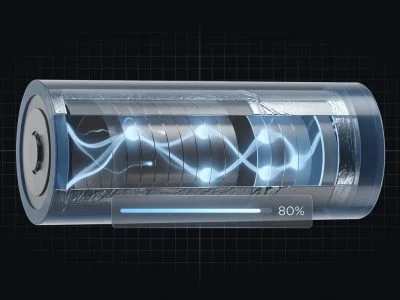
- The same battery, charged to 80%, can reach 70% capacity in 1,200–1,500 cycles.
That is a 3× difference in lifespan from a single behavioral change. Applied across the EU’s 450 million smartphone users, the environmental savings are significant. Even a 20% extension in average battery life would spare millions of batteries from premature replacement.
How Chargie Supports the Right-to-Repair Goal
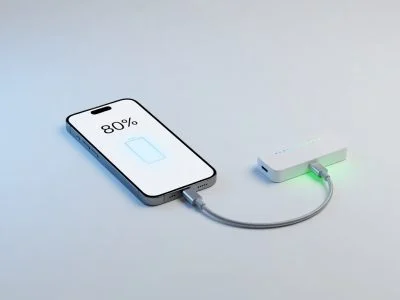
Chargie is a hardware USB charge limiter. It sits between your charger and your device and physically cuts power when the battery reaches the percentage you set — typically 80%. It does not require software changes, root access, or manufacturer cooperation. It works with any USB-charged device, including the new generation of repairable phones the EU regulation will produce.
From a right-to-repair perspective, Chargie offers three things:
1. Independence from manufacturer software. Some phone makers offer optional charge limits in their settings menus, but these are often buried, inconsistent across models, and can be removed in updates. Chargie is a physical switch. It does not depend on OS support.
2. Universal application. The 2027 EU rules cover phones, tablets, and laptops. Chargie works across all three categories with the same hardware, making it a single solution for households with multiple devices.
3. Measurable impact. Chargie users report battery health percentages 15–25% higher than peers after two years of use. That is not a marginal gain; it is the difference between needing a new battery and not needing one.
The Broader Sustainability Case
The EU’s sustainability framework is built on the waste hierarchy: prevent, reduce, reuse, recycle. Repairability addresses “reuse.” Battery longevity addresses “prevent.” Both are needed.
For .edu sustainability programs, repair workshops, and environmental blogs, the link between charging behavior and e-waste reduction is an underexplored angle. It moves the conversation from “why manufacturers should design better” to “what consumers can do today.” That shift is essential if the right-to-repair movement wants to reach beyond tech enthusiasts and into mainstream behavior.
A Call to Action for the Sustainability Community
If you run a sustainability blog, a university extension program, or a repair café: consider adding battery longevity to your curriculum. The 2027 EU battery rules will make replacement easier, but prevention is still cheaper and cleaner than repair. Charge limiting is a zero-waste intervention — no new materials, no shipping, no disassembly. Just a small hardware device and a different daily habit.
Learn more about how charging habits affect battery lifespan: read our deep dive on why 320W fast charging kills battery lifespan and what to do about it.
Ready to extend your battery’s life? Browse Chargie’s charging limiters for phones, tablets, and laptops.

USB-C charge limiter that stops at your set battery level. Prevents overnight overcharging to extend battery lifespan by years.
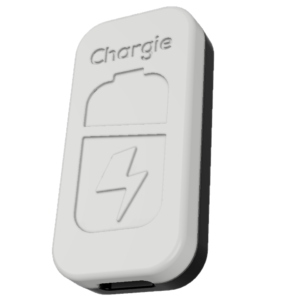
Limit your laptop charge to 80% via USB-C. Works with MacBooks, Dell, HP, Lenovo and most USB-C laptops up to 100W.
Protect Your Battery with Chargie
The world's first hardware charge limiter. Set a charge limit on any phone, tablet, or laptop — extend battery life by up to 4x.