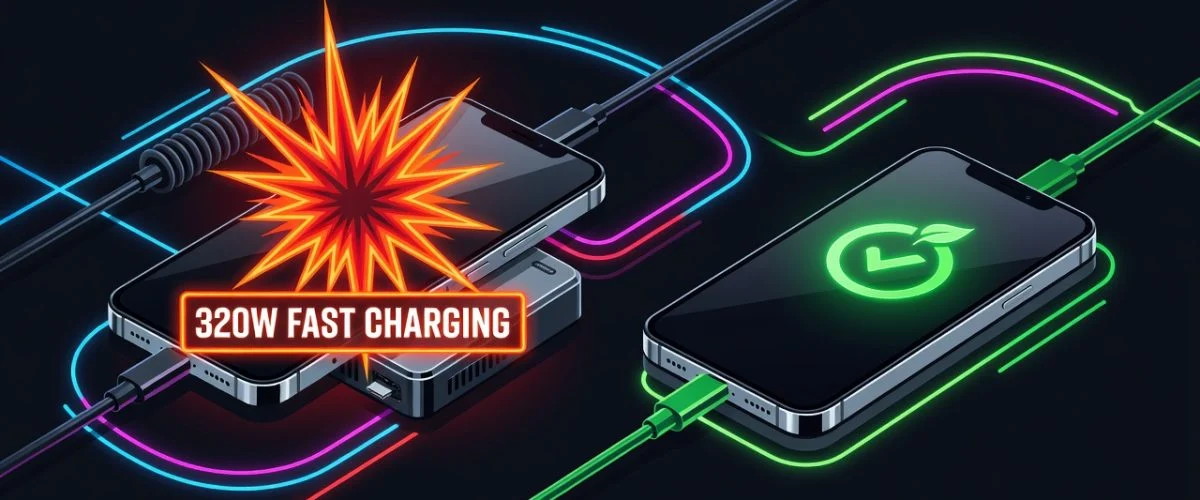
In 2025, several phone manufacturers announced charging speeds exceeding 300W — enough to fill a battery in under eight minutes. That sounds revolutionary until you understand what extreme fast charging battery damage actually looks like at the molecular level. The convenience of a full charge in minutes comes with a hidden cost: accelerated chemical degradation, thermal stress, and a dramatically shortened lifespan.
How 320W Charging Actually Works
To push 320W into a smartphone battery, manufacturers split the battery into multiple cells and charge them simultaneously — a technique called parallel charging. The charger also increases voltage while splitting current across multiple pathways to keep individual conductor temperatures manageable.
But physics doesn’t negotiate. Power is voltage times current, and higher power means higher heat. Even with advanced cooling and split-cell architectures, the internal temperature of the battery spikes during a 320W charge cycle. And heat is where the damage starts.
Why Speed Kills: The Chemistry of Fast Charging Battery Damage
Lithium-ion batteries store energy by moving ions between a graphite anode and a metal-oxide cathode. During charging, lithium ions leave the cathode and embed themselves into the graphite. The faster you force this migration, the more stress you place on both materials.
At 320W, the lithium ions rush toward the anode so quickly that they can’t distribute evenly. Instead of embedding smoothly in the graphite, some ions plate onto the surface as metallic lithium. This is called lithium plating, and it’s permanent. Each plated ion is a lithium ion that can no longer participate in energy storage. The result is immediate and irreversible capacity loss.
But that’s not the only fast charging battery damage mechanism at play. The high current also generates significant heat inside the cell. According to Battery University, a battery dwelling above 30°C experiences exponentially accelerated degradation. At the temperatures reached during a 320W charge — often 40-50°C internally — the chemical wear rate doubles or triples.
The Data Nobody Shows in Ads
Manufacturers marketing 320W charging typically quote laboratory cycle counts under ideal conditions — controlled temperatures, pristine cells, and partial discharge cycles. But real-world data tells a different story:
- Battery University data shows that charging at 1C (standard rate) yields 300-500 cycles to 70% capacity.
- Charging at 3C or higher — the rate implied by 320W on a typical phone battery — can cut that by 50% or more.
- A phone charged nightly at 320W may need replacement in 12-18 months instead of the 3-4 years possible with controlled charging.
The replacement cost? $100-200 for most flagship phones. Over a typical device ownership period, you are trading minutes of charging time for months of usable battery life.
What Happens Inside the Cell
Beyond plating and heat, fast charging stresses the battery in two additional ways:
Electrolyte decomposition: The electrolyte solution that carries lithium ions breaks down at high temperatures, releasing gases that can cause physical swelling. In extreme cases, this leads to the battery fire videos you see online. The decomposition products also increase internal resistance, making the battery work harder and generate even more heat — a compounding failure cycle.
SEI layer growth: The anode develops a protective layer called the Solid Electrolyte Interphase (SEI). Fast charging thickens this layer unevenly, which blocks lithium ion movement and permanently reduces capacity. Once the SEI layer grows past a certain point, the battery can’t recover — it just gets worse.
The Smarter Alternative: Controlled Charging
You don’t need to abandon fast charging entirely. The damage comes from habitual fast charging — making 300W your default every night. Here is a better approach:
- Use fast charging only when you actually need it. Missed your alarm? Plug in for 10 minutes before leaving. The occasional fast charge causes acceptable wear.
- Slow charge overnight. Ten or fifteen watts over eight hours generates minimal heat and no plating. This is where a charging limiter becomes valuable.
- Set a charge limit. Charging to 80% instead of 100% avoids the highest-voltage portion of the cycle, where both heat and plating are worst.
How Chargie Protects Against Fast Charging Battery Damage
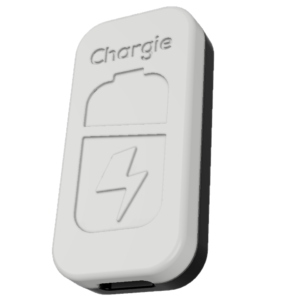
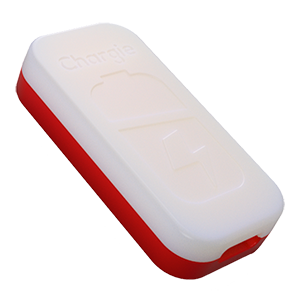
Chargie was designed to solve exactly this problem. It sits between your charger and your device, giving you physical control over the charging process regardless of what charger you use.
Dual power modes: Chargie C for laptops includes a “Low Power” mode that caps USB-C delivery at 10W. This eliminates the heat spike of high-wattage charging when you’re sleeping and don’t need speed. The same mode works for phones plugged into USB-C chargers.
Temperature-based cutoff: You can set Chargie to pause charging if the device exceeds your chosen temperature threshold — as low as 30°C. This directly addresses one of the root causes of fast charging battery damage.
Overnight scheduling: Chargie’s app lets you keep the battery at 60% overnight, then top up to your target level before you wake. You get the convenience of a full charge when you need it, without subjecting the battery to eight hours of sustained voltage stress.
The Bottom Line
320W charging is an impressive technical achievement. But it’s a tool for emergencies, not a daily habit. If you charge at 320W every night, you are accelerating the chemical wear that forces battery replacement — and potentially device replacement — within a year or two.
The alternative is simple: charge slowly when you have time, limit your peak charge level, and let your battery rest. Chargie automates all three, turning a destructive default behavior into a battery-preserving routine.
Extend your battery’s life with Chargie — the hardware charger that puts you in control.
USB-C charge limiter that stops at your set battery level. Prevents overnight overcharging to extend battery lifespan by years.
Limit your laptop charge to 80% via USB-C. Works with MacBooks, Dell, HP, Lenovo and most USB-C laptops up to 100W.
Protect Your Battery with Chargie
The world's first hardware charge limiter. Set a charge limit on any phone, tablet, or laptop — extend battery life by up to 4x.