
Why Your CPAP Depends on a Battery You Rarely Use
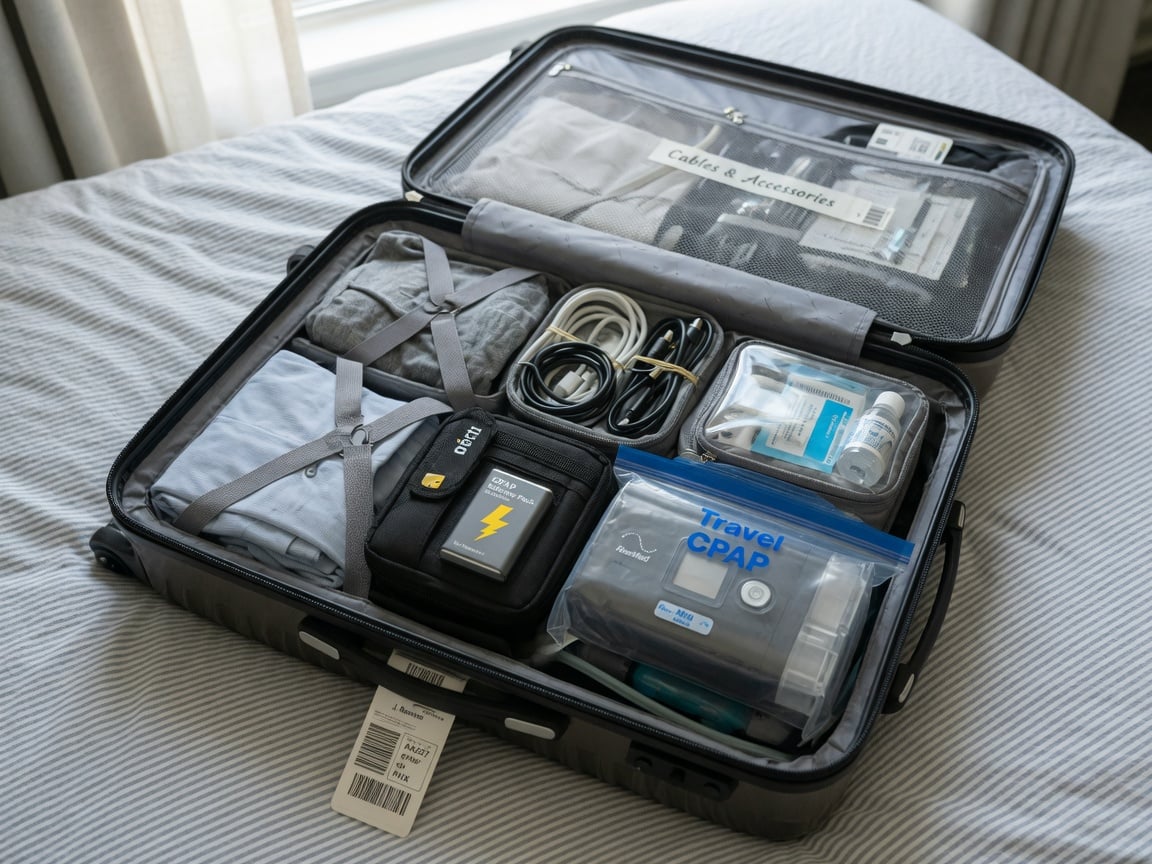
Continuous positive airway pressure (CPAP) therapy is the most effective treatment for moderate to severe obstructive sleep apnea, keeping the airway from collapsing during sleep by delivering a steady flow of pressurized air through a mask. For it to work, it has to be used every night — including naps and travel away from home, according to clinical guidance on the therapy. That’s exactly why millions of CPAP users own a dedicated travel battery pack: a lithium-ion power bank sized and wired specifically to run a CPAP machine (and often its humidifier) for one or more nights without wall power.
Unlike a phone battery you cycle daily, a CPAP backup battery lives a strange double life: it’s mission-critical medical equipment, but it might get used four times a year — a camping trip, a long flight, a hurricane power outage. The other 361 nights, it sits in a nightstand drawer, a travel bag, or a closet shelf, plugged into its own charger or simply parked at whatever charge level it was left at after the last trip. That idle time, not the actual usage, is what quietly destroys most travel CPAP batteries.
The Silent Killer: Calendar Aging at 100% Charge
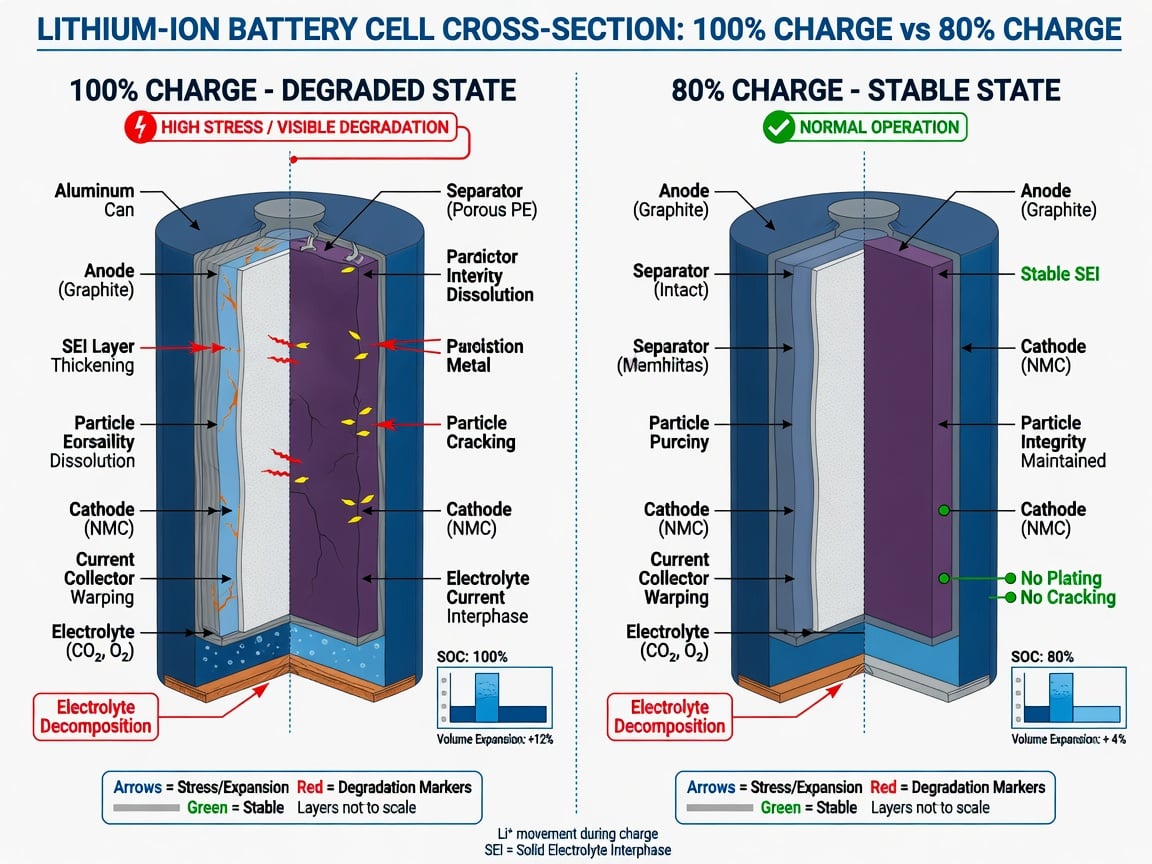
Travel CPAP battery packs use lithium-ion or lithium-ion-polymer cells, the same chemistry family used in phones and laptops, with a nominal voltage of roughly 3.6–3.7V per cell. Li-ion chemistry doesn’t just wear out from charge cycles — it degrades from calendar aging, a time-based capacity loss that accelerates sharply the closer the cell sits to 100% state-of-charge. A cell resting at full charge for months oxidizes its electrolyte and grows internal resistance far faster than the same cell stored at 40–60%.
This is precisely the trap most CPAP battery owners fall into: you charge the pack to 100% right after a trip “so it’s ready next time,” then it sits there fully charged for weeks or months until the next trip. Interestingly, some rechargeable battery chemistries already account for this in manufacturing — low self-discharge NiMH batteries, for example, are typically factory-shipped at only about 70% of rated capacity specifically because that’s a healthier long-term storage state, not 100%. Li-ion packs don’t get that courtesy from the factory; the owner has to manage the storage charge manually, or use a limiter that does it automatically. See our deep dive on why charging to 80% extends battery life for the electrochemistry behind this.
Heat Makes It Worse: Where You’re Actually Storing That Battery
Calendar aging doesn’t act alone — heat compounds it. A CPAP battery stored at 100% charge in a warm closet, a car during a summer road trip, or a checked suitcase in a hot cargo hold ages far faster than the same pack at the same charge level in a cool bedroom drawer. The two variables multiply: high state-of-charge plus high temperature is the single worst combination for lithium-ion calendar life, which is also why we cover the same failure mode for phones left in hot cars in our summer heat battery protection guide.
Real Stakes: What Happens When Backup Power Fails
Untreated obstructive sleep apnea is associated with a wide range of downstream health effects — increased risk of car crashes from daytime sleepiness, hypertension, cardiovascular disease, and stroke, among others, per clinical literature on the condition. That’s not a scare tactic; it’s the reason CPAP adherence guidance is so strict about using the machine for every single sleep period, including travel. If your travel battery has quietly lost 30–40% of its rated capacity from a year of full-charge storage, you may not find out until you’re on a 10-hour flight, at a campsite with no outlet, or in the middle of a multi-day power outage — the exact moments the battery exists for.
This is also a financial problem, not just a safety one. Dedicated CPAP battery packs are not cheap: a search of current listings shows dedicated units like the EasyLonger ES400 (a 148Wh lithium-ion pack rated for roughly 10 hours of CPAP runtime, compatible with ResMed S9, AirSense 10/11, AirMini, and Philips DreamStation machines) running well over $200, and compact options like the Zopec Explore Mini marketed for “up to 2 nights” of runtime priced similarly. Replacing one every 18 months because it silently degraded costs real money that better storage habits could avoid.
Comparison: How Travel CPAP Battery Packs Differ
| Battery Category | Typical Use Case | Storage-Aging Risk | Chargie-Relevant Note |
|---|---|---|---|
| Compact single-night packs (e.g. Zopec Explore Mini) | Short trips, backpack/purse carry, marketed for up to ~2 nights | High — small cell count means each % of capacity loss is felt sooner | Best candidate for a charge limiter since it’s rarely used but always “topped off” |
| High-capacity multi-night packs (e.g. EasyLonger ES400, ~148Wh) | Extended travel, camping, multi-day outages, ~10 hrs CPAP-only runtime | Moderate-high — large Li-ion packs still suffer full-charge calendar aging | Worth limiting to 60–80% between trips; still fully chargeable in minutes before travel |
| Machine-specific OEM battery accessories | Integrated fit with one CPAP model, cleanest cable setup | Moderate — same Li-ion cells inside, same storage rules apply | Often charged via the same USB-C port the CPAP uses — a limiter on that port protects both |
| General-purpose USB power banks repurposed for CPAP | Budget option, lower dedicated runtime, less regulated output | High — consumer power banks are optimized for cost, not longevity | Least predictable; a hardware limiter adds a safety margin the bank itself lacks |
How a USB Charge Limiter Protects Your CPAP Battery Investment
The fix is the same principle we cover across every always-plugged-in device on this site: stop charging to 100% and leaving it there. A hardware USB charge limiter sits between the wall adapter and the battery pack’s charging port and physically cuts the charge current once the pack reaches a healthier storage threshold — typically 60–80% — instead of letting it trickle at full charge indefinitely. Because it works at the hardware level, it doesn’t depend on the CPAP battery manufacturer building in smart-charging firmware, which most budget and mid-range travel battery packs simply don’t have. For the difference between that and phone-side software limits, see our comparison of built-in battery limits vs. hardware charge limiters.
The practical routine: after a trip, plug the battery in through a charge limiter and let it settle at 60–80% instead of topping it to 100%. Before your next trip, unplug the limiter and give the pack a normal full charge overnight — modern Li-ion packs charge to 100% in a few hours, so there’s no meaningful delay. You get the same fully-charged battery on travel day, but months of healthier storage in between. We’ve also tested whether limiters actually move the needle on real degradation curves in do battery charge limiters actually work? — short answer: yes, calendar-aging reduction is the mechanism, and it applies just as much to a CPAP battery pack as it does to a phone.
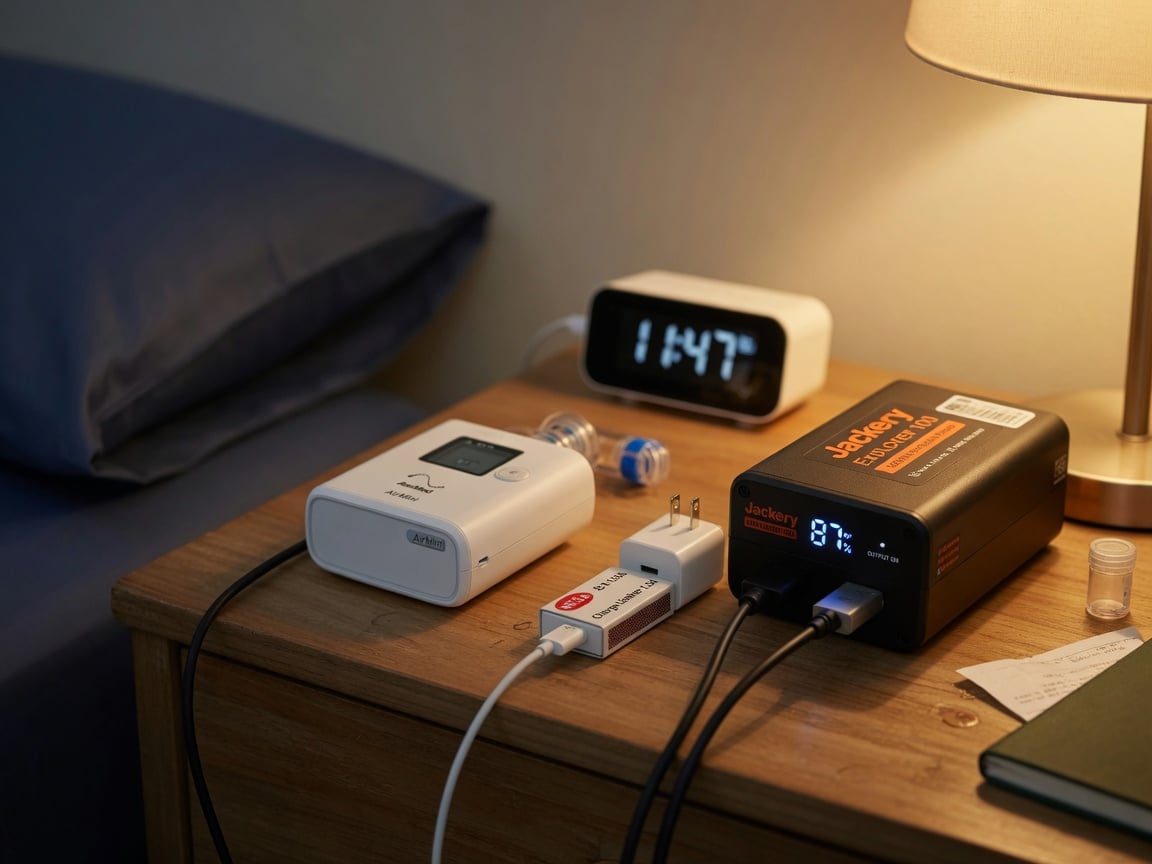
The same storage-at-full-charge trap hits bigger backup batteries too. If you keep a portable power station (Jackery, EcoFlow, Anker SOLIX) for home or outdoor backup, it faces the identical problem — those $200–$2,000+ units quietly lose capacity while sitting at 100% in a garage, and the same charge-limiter fix applies.
Best Practices for CPAP Battery Longevity
- Store at 50–80% charge between trips, not 100% — use a hardware charge limiter on the pack’s charging port if it lacks its own storage-mode setting.
- Keep the battery in a cool, dry location (a bedroom drawer, not a car trunk or a hot closet near a furnace).
- Do a full charge-and-verify cycle before every trip — charge to 100%, confirm the machine actually powers on and runs at expected duration, then pack it.
- Watch for warning signs of a swollen or failing cell — a pack that feels warm at rest, won’t hold charge, or is visibly puffy should be replaced immediately; see our guide on battery swelling causes and prevention.
- If you travel multiple times a month, skip the limiter and just cycle the battery normally — calendar aging only matters when a pack sits idle for weeks at a time.
FAQ
Does leaving my CPAP battery on the charger all the time damage it?
Yes, over time. Most travel CPAP battery packs use lithium-ion cells, and holding them at 100% state-of-charge for weeks or months accelerates calendar aging — a time-based capacity loss separate from cycle wear. A quality pack won’t fail overnight, but a year of full-charge storage typically costs noticeably more capacity than the same pack stored at 60–80%.
How long do travel CPAP batteries usually last?
It depends heavily on storage habits, not just usage. A pack used occasionally and stored properly at partial charge can retain usable capacity for 3–5 years. The same model left fully charged in a hot drawer between trips can lose a meaningful chunk of its rated runtime within 12–18 months, even with minimal actual use.
Can I use a USB charge limiter on any CPAP battery pack?
Most travel CPAP battery packs charge via a standard USB-C or barrel connector, the same way phones and power banks do, so a hardware charge limiter placed between the wall adapter and the pack works the same way. Check your specific pack’s charging port and voltage requirements before use, since some CPAP battery brands use proprietary charging cables.
Should I limit charge on the battery I use for nightly emergency backup at home?
This is the trickiest case: if the battery is your designated emergency-outage backup, you generally want it near 100% at all times for readiness, accepting the faster calendar aging as a tradeoff for guaranteed runtime. For a pack used only for occasional travel (not home emergency standby), storage at 60–80% is the better default.
Why does heat matter so much for a battery that isn’t even being used?
Lithium-ion calendar aging is a chemical process (electrolyte oxidation and side reactions at the electrodes) that speeds up at both higher temperature and higher state-of-charge, and the two effects compound each other. A battery resting at 100% in a hot car trunk ages far faster than the identical battery resting at 100% in a cool room — even though neither one is actively being charged or discharged.
Is it safe to fly with a lithium-ion CPAP battery?
Most airlines allow lithium-ion CPAP battery packs in carry-on luggage under standard portable-electronics rules, since CPAP is recognized medical equipment, but Wh capacity limits and airline-specific documentation requirements vary — always confirm with your airline before travel, and keep the battery pack in carry-on rather than checked luggage.
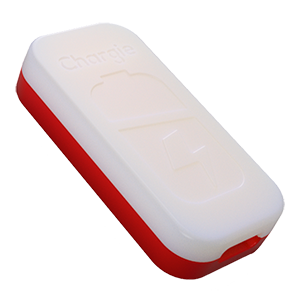
USB-C charge limiter that stops at your set battery level, so your battery never sits at 100% overnight. Extends battery lifespan by years. Works with any USB-C charger.
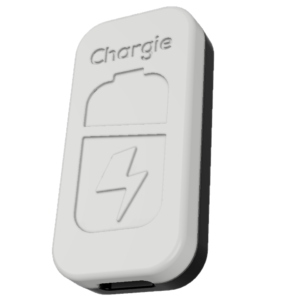
Limit your laptop charge to 80% via USB-C. Works with MacBooks, Dell, HP, Lenovo and most USB-C laptops up to 100W.
Protect Your Battery with Chargie
The world's first hardware charge limiter. Set a charge limit on any phone, tablet, or laptop — extend battery life by up to 4x.