
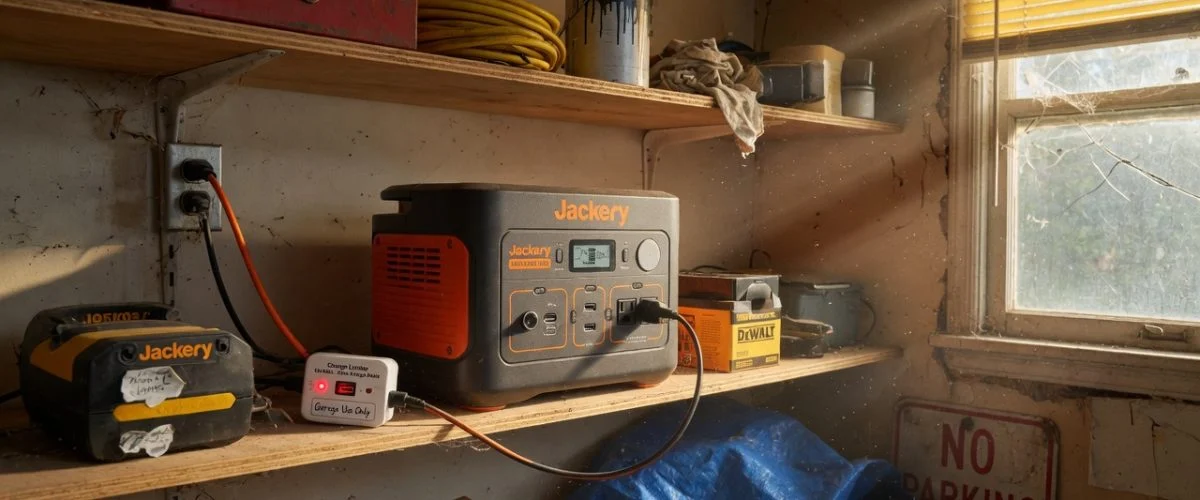

The $1,000 Paperweight Problem
You bought a portable power station for peace of mind. A Jackery Explorer 1000, an EcoFlow DELTA 2, or an Anker SOLIX F3800 — hundreds or thousands of dollars of battery backup sitting in your garage, ready for the next blackout or camping trip. You charged it to 100% the day it arrived, plugged it in once a month to “maintain” it, and never thought about it again.
Here’s the uncomfortable truth: your battery is degrading right now, whether you use it or not. Lithium-ion and lithium iron phosphate (LiFePO4) batteries age fastest when stored at full charge — exactly where every manufacturer tells you to keep them. A 2023 study published in the Journal of the Electrochemical Society confirmed that Li-ion cells stored at 100% state of charge (SoC) at 25°C lose 20% capacity in the first year alone, while cells stored at 60% SoC lose less than 4% under identical conditions.
Your emergency backup battery has a quiet expiration date — and it’s a lot sooner than you think.
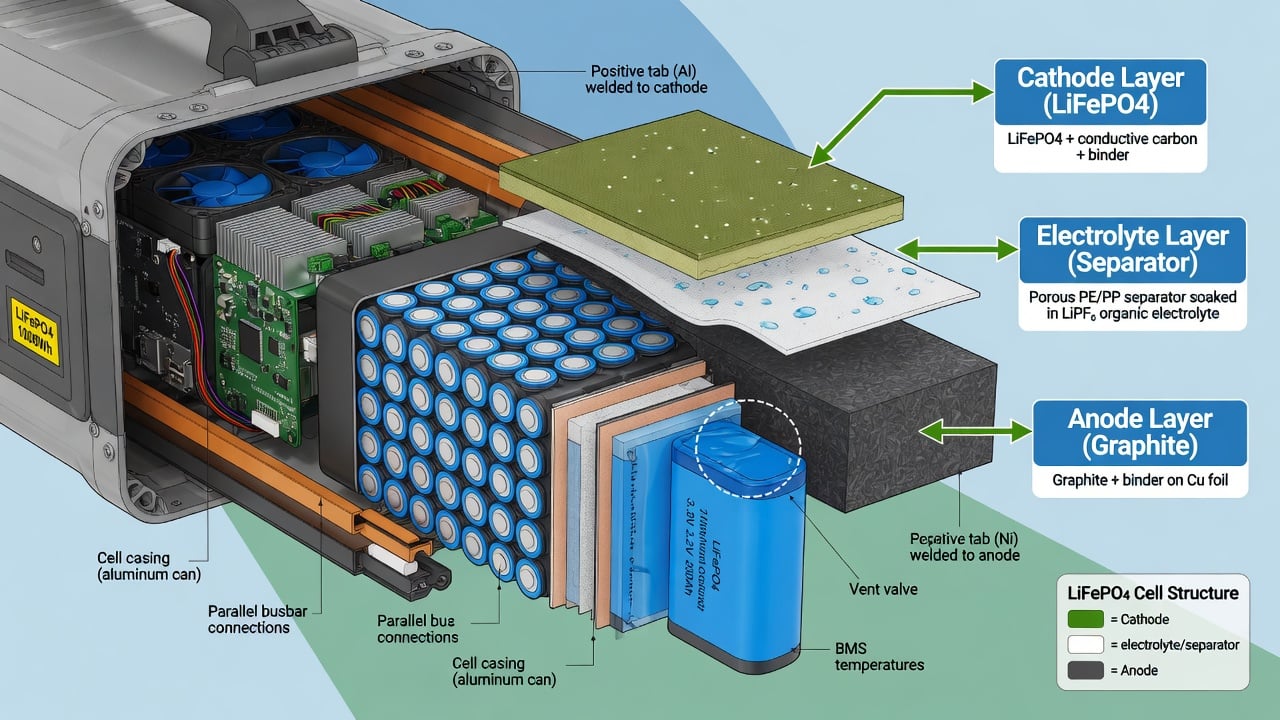
LiFePO₄ vs NMC — What’s Inside Your Power Station
Portable power stations use one of two lithium-ion chemistries, and the choice dramatically affects lifespan, safety, and storage requirements.
Lithium Iron Phosphate (LiFePO₄ / LFP)
LiFePO₄ is the gold standard for modern power stations. Used in the EcoFlow DELTA 2 and DELTA Pro, Anker SOLIX F3800, and Jackery Explorer 1000 Plus, LFP cells offer 3,000 to 10,000 charge cycles depending on depth of discharge — 3–5× the cycle life of older NMC chemistries. According to Wikipedia’s analysis of LFP batteries, they also experience a slower rate of calendar aging than cobalt-based lithium-ion chemistries, and their thermal stability makes them significantly safer. The trade-off is lower energy density: LFP cells deliver 95–172 Wh/kg versus 250+ Wh/kg for NMC, which is why LFP power stations are heavier for the same capacity.
Nickel Manganese Cobalt (NMC / Li-ion)
Older and cheaper power stations — and many still on the market — use NMC lithium-ion cells. These offer higher energy density (lighter units) but cycle life is typically 500–1,000 cycles to 80% capacity. NMC cells are also more sensitive to heat and full-charge storage. The 2025 EcoFlow DELTA Max 2000 recall, affecting 25,000 units due to fire risk, highlights the safety concerns with NMC-based power stations. If your power station is more than three years old, it almost certainly uses NMC chemistry.
The Three Killers: Heat, Full Charge, and Time
Portable power stations face a unique triple threat that consumer electronics don’t:
1. Heat — The Garage and Trunk Problem
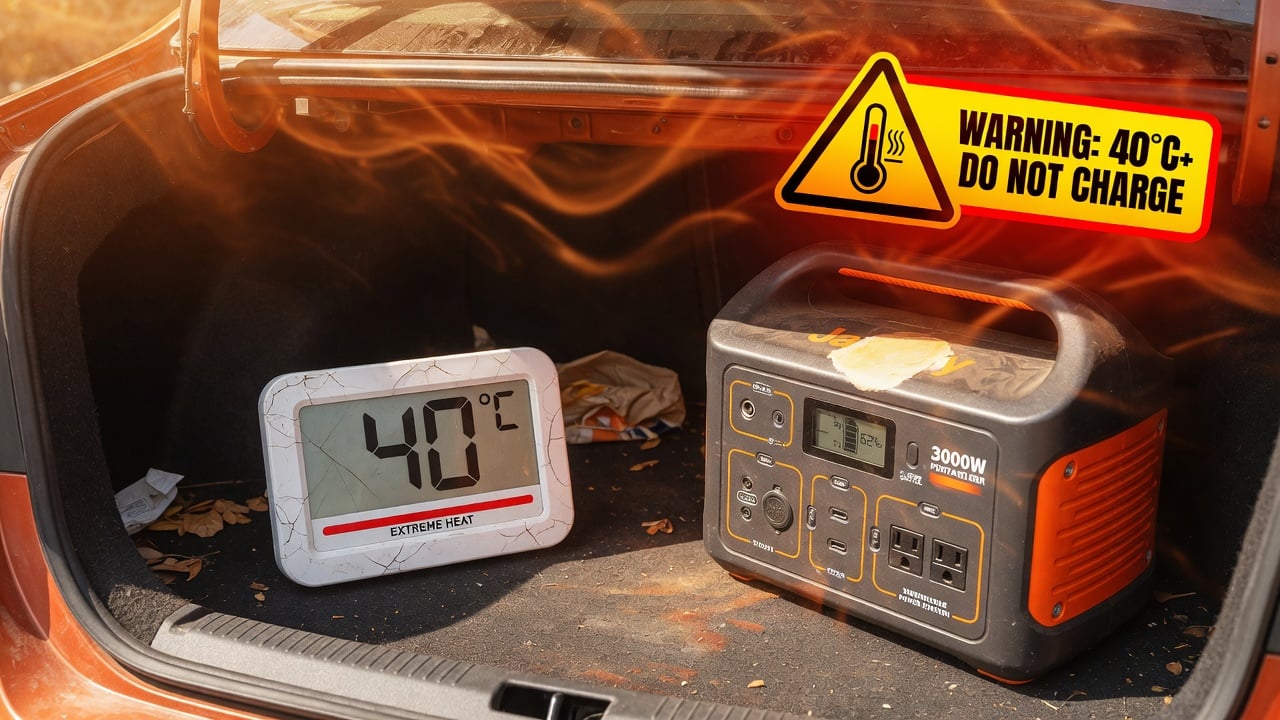
Most power stations live in garages, car trunks, or sheds — environments that regularly exceed 35°C (95°F) in summer. Lithium-ion batteries degrade exponentially with temperature. At 45°C, calendar aging accelerates by roughly 2× for every 10°C above 25°C. A power station stored at 100% charge in a 40°C garage can lose 30% of its capacity in a single summer — before you’ve used it once.
2. Full Charge — The 100% Trap
Every lithium-ion cell has a nominal voltage of 3.6–3.7V (or 3.2V for LFP). Charging to 100% means holding the cell at its maximum voltage — 4.2V for standard Li-ion, 3.65V for LFP. At this voltage, the electrolyte oxidizes at the cathode interface, consuming lithium ions that can never be replaced. This is called calendar aging, and it’s the dominant degradation mechanism for batteries that spend most of their life plugged in or stored at full charge. The effect is well documented: storing at 100% SoC causes roughly 4–5× more capacity loss per year than storing at 60% SoC.
3. Time — The Silent Drain
Even under ideal conditions (25°C, 50% charge), lithium-ion batteries lose 1–2% capacity per year to irreversible chemical reactions inside the cells. At 100% charge and 35°C, that rate jumps to 15–25% per year. A power station bought today for $1,000 could have 20–30% less usable capacity by the time you need it for an emergency three years from now.
Comparison: Top Portable Power Stations and Their Battery Chemistry
| Model | Chemistry | Capacity (Wh) | Cycle Life | Weight | Storage Recommendation |
|---|---|---|---|---|---|
| Jackery Explorer 1000 v2 | LFP (LiFePO₄) | 1,070 | 4,000 cycles | 11.5 kg | 50–80% charge, cool dry place |
| EcoFlow DELTA 2 | LFP (LiFePO₄) | 1,024 | 3,000 cycles | 12 kg | 60% charge, 10–30°C |
| Anker SOLIX F3800 | LFP (LiFePO₄) | 3,840 | 5,000 cycles | 38 kg | 50–80% charge, avoid >35°C |
| Bluetti AC200L | LFP (LiFePO₄) | 2,048 | 3,500 cycles | 27 kg | 80% max for storage |
| EcoFlow DELTA Pro | LFP (LiFePO₄) | 3,600 | 3,500 cycles | 45 kg | 50–80% charge |
| Jackery Explorer 500 | NMC (Li-ion) | 518 | 500 cycles | 6 kg | 50% charge, cool storage |
| Goal Zero Yeti 1500X | NMC (Li-ion) | 1,516 | 500 cycles | 20 kg | 50% charge, avoid heat |
Note: All LFP-based models above support 3,000+ cycles, but cycle life is only half the story. Calendar aging at high SoC affects LFP too — just more slowly than NMC. A charge limiter benefits both chemistries.
The Emergency Backup Paradox
Here’s the contradiction at the heart of every portable power station: you buy it for emergencies, but the way you store it for emergencies is slowly destroying it.
Manufacturers recommend keeping the unit at 100% charge so it’s ready when the power goes out. But that recommendation ignores the calendar-aging reality: a battery stored at 100% charge for 11 months of the year will have significantly less capacity when the blackout finally comes. You’re trading long-term capacity for short-term readiness — and most owners don’t realize they’re making that trade.
The solution is simple in theory: store at 50–80% charge, then top up to 100% when you know a storm is coming or before a camping trip. But most power stations don’t have a “storage mode” that stops charging at a user-defined percentage. The built-in charge controller always goes to 100%.
This is where a hardware charge limiter changes everything.
The same storage trap hits medical travel batteries too. A travel CPAP battery — your sleep apnea backup power — sits fully charged in a drawer for months between trips and quietly loses capacity the same way, so the same charge-limiter rule applies at a much smaller scale.
How a Charge Limiter Changes the Game
A USB charge limiter like Chargie sits between the wall charger and your power station’s AC or DC input. It monitors the battery voltage and disconnects charging when it reaches a preset level — typically 60–80% for storage. When you need full capacity, you simply remove the limiter or set it to 100% and let the power station charge fully.
The impact on battery lifespan is dramatic:
- Storing at 60% instead of 100% reduces calendar aging by roughly 4×, based on published data from lithium-ion battery research.
- Keeping the battery cool (below 25°C) while stored at partial charge can extend usable life from 3–5 years to 8–10+ years for LFP packs.
- For NMC-based power stations, the improvement is even more pronounced — storing at 50% instead of 100% can prevent the most aggressive capacity fade in years 2–4.
This isn’t theoretical. The same principle applies to every lithium-ion device: charging to 80% extends battery life because it reduces the voltage stress on the cathode. For a power station that sits unused 95% of the time, the savings are enormous.
Compare this to built-in battery limits vs hardware charge limiters — most power stations don’t offer software charge limits at all. The ones that do (like some EcoFlow models with their app) only limit the discharge, not the charge. A hardware limiter like Chargie is the only way to truly stop charging at a safe storage level.
FAQ
Should I store my portable power station at 100% charge?
No. While manufacturers recommend 100% for “readiness,” storing at 100% charge accelerates calendar aging by 4–5× compared to 60% charge. For emergency backup, store at 50–80% and top up to 100% before anticipated use. A charge limiter makes this practical.
How long does a LiFePO₄ power station last?
LFP cells are rated for 3,000–10,000 cycles, but calendar aging limits total lifespan to 8–15 years regardless of cycle count. Storing at partial charge and cool temperatures maximizes both cycle and calendar life. Even the best LFP chemistry loses capacity over time at high voltage.
Can I use a Chargie charge limiter with a portable power station?
Yes. Chargie connects to the power station’s AC or DC charging input and disconnects charging at a user-set voltage threshold. For power stations with a USB-C input (many modern models support 100W+ USB-C charging), Chargie’s USB-C variant works directly. For AC-input models, Chargie can be used on the DC side if the power station has a solar/DC input.
What temperature is safe for power station storage?
Ideal storage temperature is 15–25°C (59–77°F). Avoid temperatures above 35°C (95°F) or below -10°C (14°F). Every 10°C above 25°C roughly doubles the calendar aging rate. A garage that hits 45°C in summer can age your battery 4× faster than indoor storage. See our summer heat battery protection guide for more on temperature effects.
Is LiFePO₄ safer than NMC for power stations?
Yes. LFP is thermally and chemically more stable than NMC — it doesn’t release oxygen during heating, which dramatically reduces fire risk. The 2025 EcoFlow DELTA Max 2000 recall (25,000 units) involved NMC cells. LFP is now the preferred chemistry for stationary storage and backup power. Battery swelling causes and prevention covers the safety differences in more detail.
How often should I cycle my power station?
For LFP batteries, a full discharge cycle every 3–6 months is beneficial to keep the battery management system (BMS) calibrated. For NMC batteries, avoid deep discharges — shallow cycles (20–80%) are gentler. Battery charge limiters help maintain optimal charge ranges automatically.
Conclusion: Your Backup Battery Deserves Better Storage
A portable power station is an investment in peace of mind — but that investment is quietly degrading every day it sits at 100% charge. The chemistry is unforgiving: full charge + heat + time = permanent capacity loss that no warranty will cover.
The fix is simple: store at 50–80%, keep it cool, and top up before use. A hardware charge limiter like Chargie automates this process, giving you the readiness of a full battery with the longevity of partial-charge storage. Whether you own a $500 Jackery or a $3,000 EcoFlow DELTA Pro, the same rules apply — and the same solution works.
Don’t let your emergency backup become a paperweight. Learn how charge limiters work and start treating your power station’s battery the way it deserves.
USB-C charge limiter that stops at your set battery level, so your battery never sits at 100% overnight. Extends battery lifespan by years. Works with any USB-C charger.
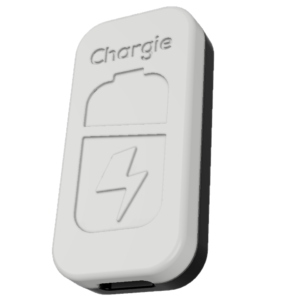
Limit your laptop charge to 80% via USB-C. Works with MacBooks, Dell, HP, Lenovo and most USB-C laptops up to 100W.
Protect Your Battery with Chargie
The world's first hardware charge limiter. Set a charge limit on any phone, tablet, or laptop — extend battery life by up to 4x.