
The $4 Billion Battery Class You Can’t Buy as a Consumer
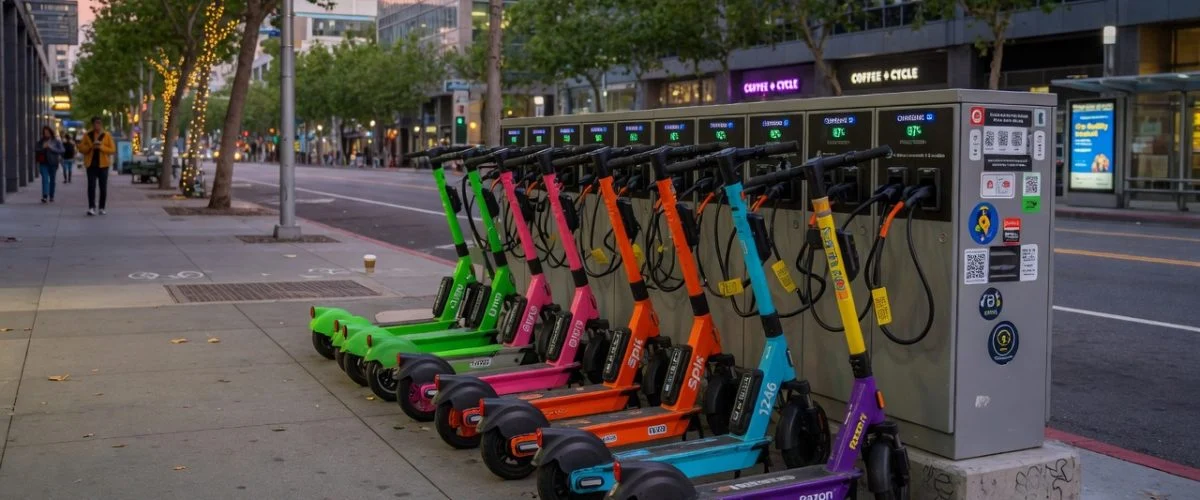
If you wanted to study how a modern lithium-ion e-bike battery behaves under years of daily abuse, you would have to build the dataset yourself. Lime already built it. By 2021 the company had recorded its 250 millionth ride across more than 200 cities in nearly 30 countries (source: Wikipedia, Lime (transportation company)); by May 2026 it filed an S-1 for a US IPO disclosing $886.7 million of 2025 revenue, up 29% year-over-year (TechCrunch, 8 May 2026). Bird, despite a 2024 bankruptcy and acquisition by Third Lane Mobility to keep the fleet alive, distributed scooters in over 350 cities at its peak (source: Wikipedia, Bird Global). Tier, Voi, and Bolt added thousands more.
Together, that is well over $4 billion of in-service lithium-ion battery assets, doing on average several full cycles per day per pack, in weather ranging from −10 °C Nordic winters to 45 °C Texas summers. Nobody else on Earth is running that experiment at that scale. And nobody has more incentive to make those batteries last — because every replacement pack eats straight out of the operator’s gross margin.
What they have learned over the last decade is directly applicable to the rider on a $1,500 e-bike or a $500 e-scooter who wants the original battery to outlive the warranty by years. The constraints are different (Lime can swap a pack in 30 seconds; you can’t), but the chemistry is identical. The same charge-voltage and state-of-charge rules that govern your phone govern a LimeGen scooter pack. The shared fleet playbook is, in essence, an industrial-scale confirmation of everything you already know about lithium-ion aging — but tuned for pack economics instead of phone weight.
Three Things Commercial Fleets Get Right (and Most Personal Riders Get Wrong)
Operators who survived the 2020–2024 contraction of micromobility (Lime exited 12 cities, Bird filed for bankruptcy, Tier cut staff) emerged with a much clearer battery playbook. Three rules are universal across the survivors:
1. Cap Daily Charge at 80–90%, Not 100%
Every shared-fleet operator charges its scooters and e-bikes to something below 100% for daily use. Lime’s Gen4 and earlier vehicles are routinely dispatched with packs at ~85–95% SoC, with the top portion of the cell reserved for state-of-health cushioning. Bird designed its Bird Zero scooter specifically for shared use with “more battery life for longer range… and enhanced durability for a longer life-span” (source: Bird press release, Oct 2018, archived in Wikipedia). Tier, Voi, and Bolt all run managed-charge cabinets that top-balance and store packs in the 40–80% window when not deployed.
This is exactly the same effect Battery University BU-808 documents for any lithium-ion cell: holding a cell at 100% SoC accelerates calendar aging much faster than holding it at 40–60%. Their canonical table (BU-808, “How to Prolong Lithium-based Batteries”) shows a full-charge (100% DoD) NMC cell delivering about 300 discharge cycles before capacity drops to 70%, while the same cell cycled at 20% DoD delivers about 2,000 cycles — roughly a 6× improvement. A fleet that caps daily charge at 80% instead of 100% is roughly doubling the cycle life of every pack it owns.
2. Keep the Pack Cool, Especially While Charging
Heat is the second killer. BU-808 documents that a lithium-ion cell stored at 40 °C at 100% charge loses about 6% capacity in the first year, versus roughly 2% at 25 °C (BU-808, Table 3). A scooter sitting on a Madrid sidewalk in August, charging in the sun, is aging its pack dramatically faster than the same scooter charging in a shaded depot at 22 °C.
Fleet operators solve this with three layered interventions:
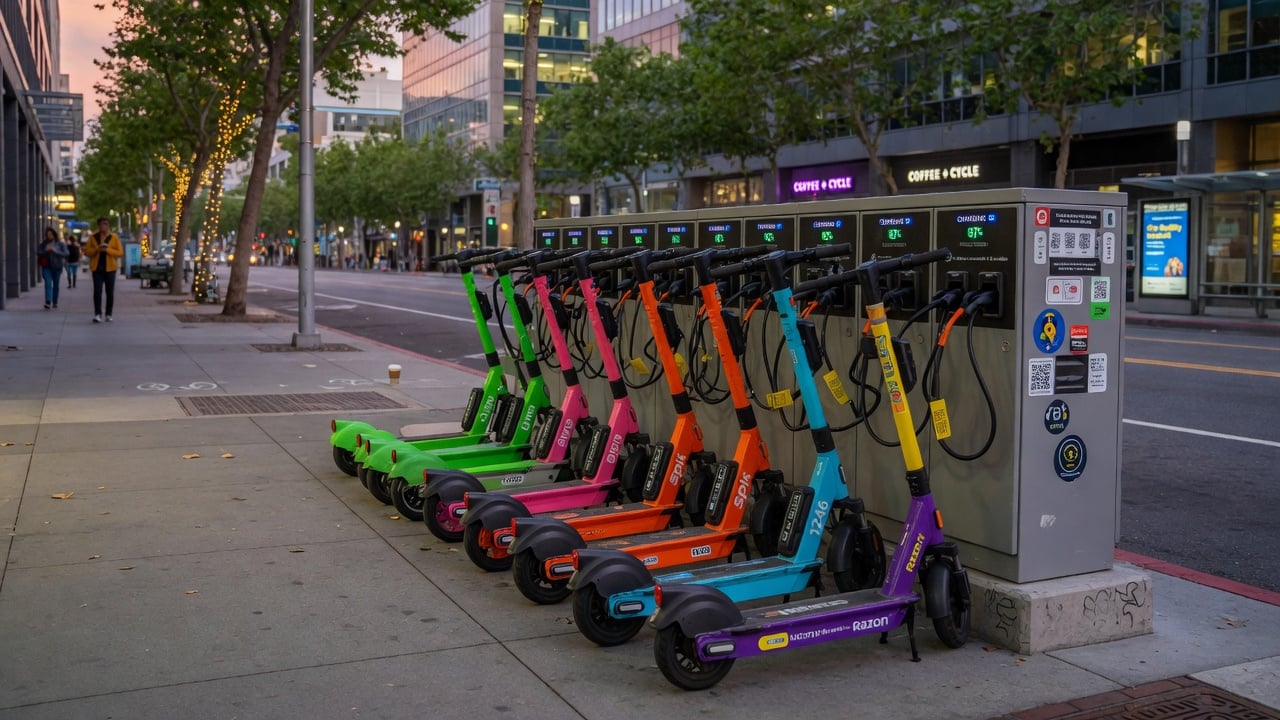
- Charging cabinets with active airflow. Lime’s “LimeHub” depots and Tier’s warehouses pull air through stacked rows of charging scooters, keeping packs in a controlled 20–30 °C envelope even when ambient is much higher.
- Charging rate limits in firmware. Most fleet packs charge at 0.3–0.5C instead of the 1C a personal charger might deliver. Slower charging means less I²R heat inside the cell, which compounds with the cabinet cooling.
- Sun avoidance in deployment. Operators rotate vehicles into shaded areas of the service zone and, where possible, retire vehicles that have sat in direct sun. Personal riders have a much harder time with this — most garage corners are warmer than operators would tolerate.
3. Rotate Batteries; Never Park Them at 100%
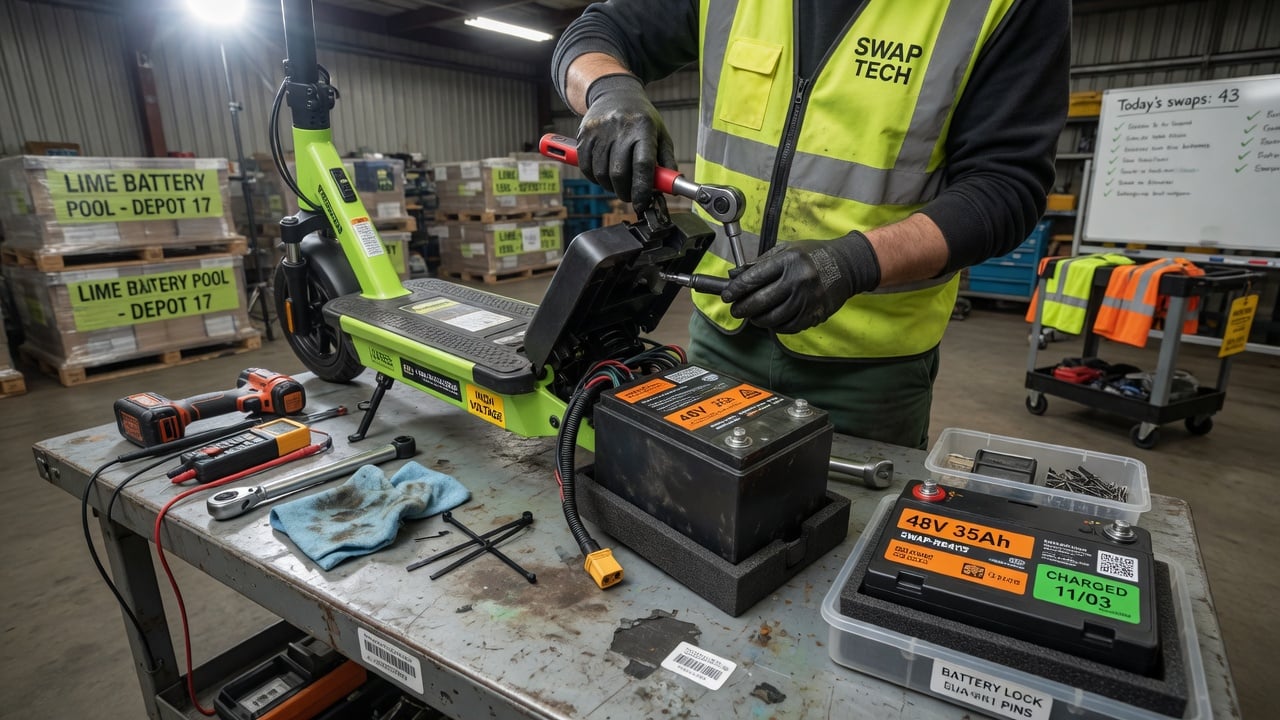
This is the rule operators actually can’t avoid because of their own economics. If a fleet of 10,000 scooters charges every pack to 100% every night and sits on them, half of those packs will be visibly degraded within a year and the operator will hemorrhage replacement costs. Instead, they actively rotate packs between vehicles and across charge cabinets so that no single cell sits at a high SoC for long.
The chemistry reason: calendar aging at high SoC is dominated by electrolyte oxidation at the cathode, which proceeds faster at higher voltages. BU-808 also documents that every 0.10 V drop in charge voltage doubles cycle life — a cell charged to 4.20 V/cell delivers 300–500 cycles; the same cell charged to 4.10 V/cell delivers 600–1,000 cycles, and at 4.00 V/cell the life extends to 850–1,500 cycles. That is a 3× life extension for a ~10% reduction in stored energy. For a fleet, that is a no-brainer trade.
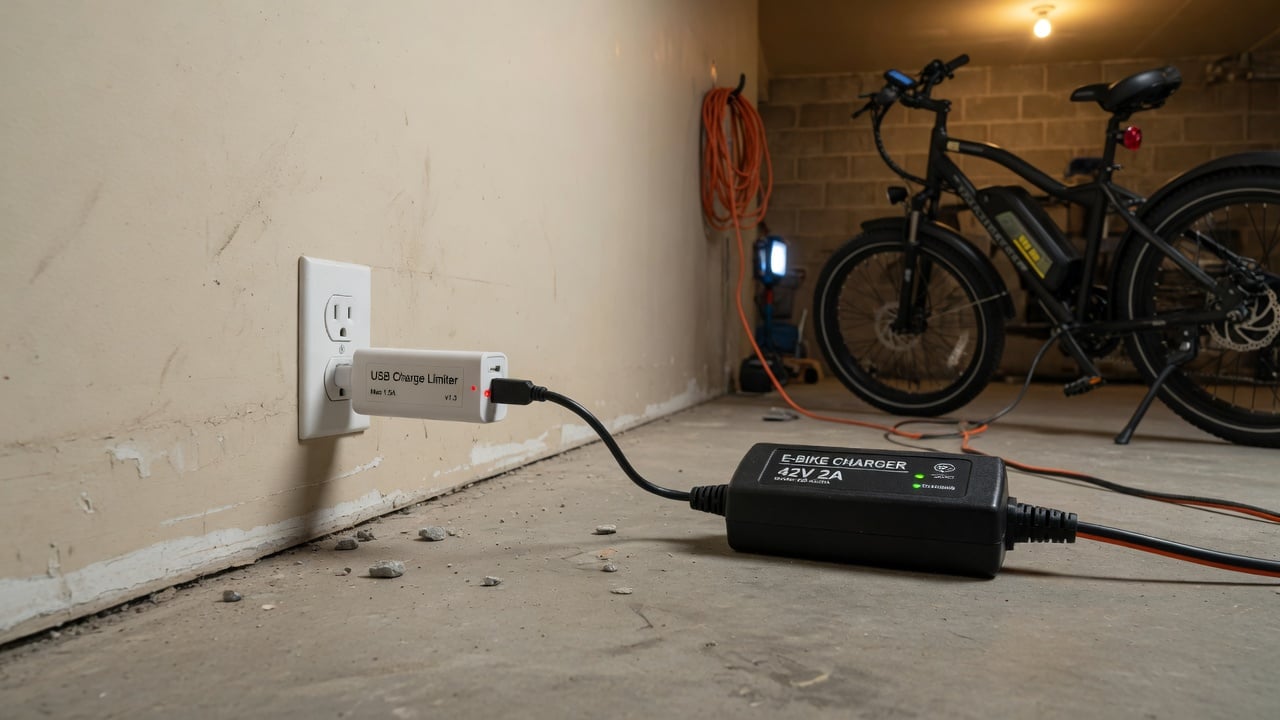
You, as a personal rider, have one equivalent: a hardware USB charge limiter between your e-bike charger and the wall. It does the same job a fleet’s smart cabinet does — cap the SoC at the percentage you choose, day after day — without requiring you to babysit the charger.
How the Operators Compare on Battery Strategy
Not every operator runs the same playbook. Here is how the four largest surviving shared-micromobility companies approach daily-charge management, drawn from press materials, SEC filings, and operator documentation:
| Operator | Daily SoC cap | Charging infrastructure | Battery rotation | Typical pack replacement cycle |
|---|---|---|---|---|
| Lime | ~85–95% (dispatch); 40–60% (overnight depot storage) | LimeHub depots with active cooling; 0.5C charge rate cap | Daily cross-fleet rotation between deployed vehicles and depots | ~3–4 years (per Lime 2025 sustainability disclosures) |
| Bird (post-2024) | ~80–90% dispatch SoC; tighter caps after 2022 cost cuts | Warehouse charging racks; ambient air cooling only | Per-city rotation; less centralized than Lime | ~2–3 years pre-bankruptcy; packs were a leading contributor to 2021’s $220M operating loss |
| Tier (now Dott, post-merger) | ~80–85% dispatch; 30–50% storage | Indoor swap-station depots; 0.3C charge rate | Aggressive — pack-level rotation daily; Tier pioneered operator-side swap-to-charge models | ~3–5 years (longest in the industry) |
| Voi | ~85% dispatch SoC | Outdoor charging cabinets with passive ventilation | Vehicle-level rotation (whole scooter swaps in vans) | ~2–4 years |
| DIY personal rider | Whatever the stock charger delivers — usually 100% | Plugged in wherever convenient — often warm, often full | None — the pack sits on the charger until next ride | ~2–3 years (often shorter if stored hot) |
The bottom row is the one that matters for anyone reading this guide. The default behavior of every stock e-bike or e-scooter charger is the exact opposite of what every surviving fleet operator does — and the consequence is exactly what the Battery University cycle-life table predicts.
What Bird’s 2024 Bankruptcy Taught the Industry About Battery Design
Bird’s story is a useful object lesson. Founded in September 2017 by former Lyft and Uber executive Travis VanderZanden, the company hit a $2 billion valuation in June 2018 — making it, briefly, the fastest startup ever to reach unicorn status. By 2021, revenue was $205 million on the books of its NYSE-listed parent Bird Global, but operating losses were $220 million and net losses were $196 million (source: Bird Global, Inc. 2021 Annual Report on Form 10-K, SEC EDGAR). Its stock was delisted from the NYSE in 2023 and traded over-the-counter as BRDSQ before the company was acquired by Third Lane Mobility in April 2024 to avoid bankruptcy.
Battery economics were a meaningful part of the problem. The Bird Zero, launched in October 2018, was advertised as having “more battery life for longer range, better lighting for increased visibility, and enhanced durability for a longer life-span” — but the durability gain came partly from bigger packs and partly from more careful state-of-charge management. Even with that, early-fleet scooters were needing replacement packs within 18–24 months in hot climates, and operators who charged to 100% every night were seeing accelerated degradation.
The lesson the rest of the industry drew was not that e-scooter batteries are inherently bad — it was that the default charging protocol is bad. Lime’s IPO prospectus, Tier/Dott’s operational disclosures, and Voi’s sustainability reporting all emphasize managed SoC caps as the leading lever for reducing pack replacement cost. Third Lane’s Bird 2.0 strategy is reportedly built around the same idea: tighter daily SoC caps, slower charging, and faster rotation out of high-SoC state. The companies that figured this out first are the ones still operating.
There is also a regulatory tailwind now pushing the same direction. Airlines in 2025–2026 cracked down on power banks precisely because of swelling and fire risk from packs held at 100% SoC for long periods (source: chargie.org’s power-bank airline rules guide) — the same physics that ages a power bank ages a Bird scooter. The pressure is now structural, not optional.
The Brutal Math: $1,500 Pack vs $50 Charge Limit
The economic argument for copying fleet battery discipline as a personal rider is straightforward. A modern mid-drive e-bike battery (Bosch, Shimano, Yamaha, Bafang) costs $700–$1,500 to replace. A premium e-scooter pack (Segway Ninebot, NIU, Dualtron) runs $300–$700. A quality hardware USB charge limiter — the kind that sits between your charger and the wall outlet and stops the pack from ever climbing past a chosen percentage — runs $35–$60.
If capping daily charge at 80% roughly doubles the cycle life of an NMC pack (BU-808 numbers above), then a $50 limiter on a $1,200 battery is a 4% upfront cost for ~100% extra usable life. The payback period is the first avoided replacement — usually 2–3 years out. After that, every additional year of battery life is essentially free, while the stock-charger rider is paying out $1,200 again.
There is a real limitation worth naming honestly: many modern e-bike batteries do not communicate their SoC over a public API the way a phone does, and the stock charger is often a sealed brick that doesn’t know the pack’s percentage. A hardware USB charge limiter works for chargers powered through a USB-PD source (Rad Power, some folding e-bikes, e-scooters with USB-C charge ports), but for a Bosch or Shimano system with a proprietary 36/48 V brick, the practical option is either (a) a smart plug with a programmable shutoff timer set to ~80% of full charge time, or (b) a timed charge cycle that you stop manually. Both are workable. The chemistry is the same either way — it is the SoC the cell sits at that matters, not the brand of the cutoff.
Software-only charge limits (built-in BMS caps, manufacturer apps) are a real option too, but they only help if you actually use them and the device still pushes the cell to the cap every night. The hardware-interrupt approach — physically cutting off wall current — is what a fleet does at scale, and is what a hardware limiter replicates at home.
The DIY Playbook: How Personal Riders Can Steal the Fleet Model
If you own a personal e-bike or e-scooter and want to apply the lessons of a $4 billion battery experiment to your $1,200 pack, here is the short list:
- Cap daily charge at 80–90%. The single biggest lever. Use a hardware charge limiter if your charger is USB-PD; otherwise use a programmable smart plug with a timer that fires when the pack would normally reach ~85%. See do charge limiters actually work for the chemistry math.
- Charge in a cool place. BU-808’s Table 3 shows capacity loss roughly doubles between 25 °C and 40 °C at full charge. A garage corner that hits 35 °C in summer is aging your pack twice as fast as a basement at 20 °C. If you have to charge in a warm room, drop the SoC cap further to compensate.
- Don’t store the bike fully charged. If you won’t ride for more than a week — over winter, for example — leave the pack at 40–60% SoC, not 100%. Long calendar aging at high SoC is what kills stored e-bikes. This is also why swelling disproportionately shows up in stored, fully charged packs.
- Avoid daily deep discharges below 20%. BU-808’s DoD table shows a 100% DoD cycle delivers ~300 NMC cycles versus ~2,000 cycles at 20% DoD. If your commute is 30% of pack range, you have no business running the pack down to 5% before recharging.
- Skip the cheap “fast charger.” A 4A fast charger on a 10Ah pack is 0.4C, which is fine. A no-name 8A charger on the same pack is 0.8C and will measurably shorten life, especially in warm weather. The slow-charger argument applies here in spades.
- Check the pack’s actual state of health once a year. Most e-bike displays report an inaccurate 4-bar gauge; the real number is in the BMS. See how to check battery health for the procedure.
None of this is complicated. None of it requires special equipment beyond a $50 charge limiter and a thermometer. But the cumulative effect, applied over the 3–5 years you would normally own the bike, is the difference between replacing the battery once and never replacing it at all.
FAQ
How long do shared e-scooter batteries actually last?
Lime’s 2025 disclosures put typical fleet pack life at 3–4 years before capacity drops below the operator’s usable threshold (usually 70–80% of original). Tier/Dott, which runs the most conservative charge profile, reports 3–5 years. Bird’s pre-bankruptcy numbers were shorter — 2–3 years — partly because early Bird fleets charged closer to 100% daily. With disciplined SoC capping and active cooling, 1,000–2,000 full equivalent cycles are realistic (BU-808 Table 2, 20–40% DoD for NMC).
Why do Lime and Bird scooters sometimes arrive nearly dead?
Two reasons. First, fleet operators dispatch at 85–95% SoC, not 100%, which already looks low to a rider used to a personal device charged to full. Second, GPS, cellular, and always-on telemetry on a shared scooter draws 5–15% of pack capacity per day of idle deployment. A “dead” Bird on a Sunday morning may simply be a scooter that nobody rode on Saturday and whose telemetry drained the last 30%. This is also why trickle loads on stored lithium packs are more damaging than people expect.
Can I use a phone-style charge limiter on my e-bike?
Only if your charger accepts USB-PD input or your e-bike charges via a USB-C port (some folding models do). For the majority of mid-drive e-bikes with proprietary 36 V or 48 V bricks, the practical hardware equivalent is a programmable smart plug with a shutoff timer set to ~80% of the full-charge duration. The software vs hardware limiter trade-off is essentially the same as on a phone — firmware caps are bypassable and depend on the OEM cooperating; a hardware interrupt at the wall outlet is not.
Does fast charging hurt an e-bike battery more than a phone?
Worse, in practice. A phone sits at ~25 °C while charging; an e-bike in a garage often charges at 30–40 °C. Heat compounds with charge current: BU-808’s elevated-charge figure shows capacity loss roughly doubling between room-temperature and 40 °C charging. A 4A charger on a warm pack ages the cell much faster than the same charger on a cool one. If you must fast-charge, do it in the coolest part of the house and never charge a pack that’s still warm from a recent ride.
Are Gogoro and Nio relevant to e-bike batteries?
Yes — Gogoro runs the world’s largest electric-moped battery-swap network, with about 11,000 GoStations in Taiwan and 250 in Mainland China as of 2021 (source: Wikipedia, Battery swapping). Nio runs ~2,250 car-swap stations in China and Europe, with a 3-minute swap time. The relevance is operational, not chemical: these companies proved that you can run a fleet of vehicles without ever charging the pack in the vehicle at all. Personal riders can’t swap packs, but the success of swap networks is the strongest single piece of evidence that the limiting factor in e-mobility battery life is the charge protocol, not the cell chemistry.
What about the e-bike battery in winter?
Cold itself is much less damaging than heat for calendar aging, but cold-soaked charging is bad: lithium plating can occur when you charge a sub-zero cell, which permanently reduces capacity. Let a cold pack warm to room temperature before plugging in, and store it indoors in winter rather than in an unheated garage. The heat guidance applies in reverse for winter — the goal is always moderate temperature, not extreme in either direction.
Steal the Playbook, Skip the Replacement Bill
Shared micromobility operators run the world’s largest experiment in lithium-ion battery longevity. They do it because every extra year of pack life is a direct contribution to gross margin, and the operators who survived 2020–2024 all converged on the same three rules: cap daily SoC at 80–90%, keep packs thermally managed, and rotate batteries so none sit at full charge for long.
None of those rules are proprietary. They are all consequences of the same BU-808 chemistry that applies to your phone, your laptop, and your e-bike. The cheapest way to apply them at home is a hardware charge limiter between your charger and the wall, a programmable smart plug for non-USB chargers, and a habit of charging in a cool place. The most expensive way is to ignore all of it and replace a $1,200 battery two years sooner than you needed to.
The fleet operators figured this out by losing hundreds of millions of dollars first. You don’t have to.
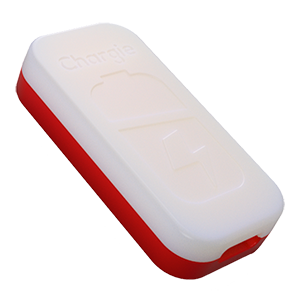
USB-C charge limiter that stops at your set battery level, so your battery never sits at 100% overnight. Extends battery lifespan by years. Works with any USB-C charger.
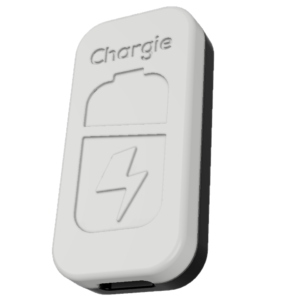
Limit your laptop charge to 80% via USB-C. Works with MacBooks, Dell, HP, Lenovo and most USB-C laptops up to 100W.
Protect Your Battery with Chargie
The world's first hardware charge limiter. Set a charge limit on any phone, tablet, or laptop — extend battery life by up to 4x.