10 min read 0 views

Portable Tire Inflator Battery Care: Charging and Storage

Ovidiu Sandru by Ovidiu Sandru, Founder & CEO

TL;DR: Portable tire inflator battery care is mostly about sensible storage, charging within the manufacturer’s temperature limits, and checking readiness before you need the pump. Do not deliberately flatten a lithium-ion battery to “train” it. A changing battery indicator during inflation does not automatically mean the battery is failing. For emergency equipment, dependable usable charge matters more than chasing an exact storage percentage.

A rechargeable tire inflator is easy to forget until a bicycle tire feels soft or a dashboard warning appears. Unlike a phone, it may spend long stretches unused, then need to run a motor under load. That makes its care routine different from simply plugging in a device every evening.

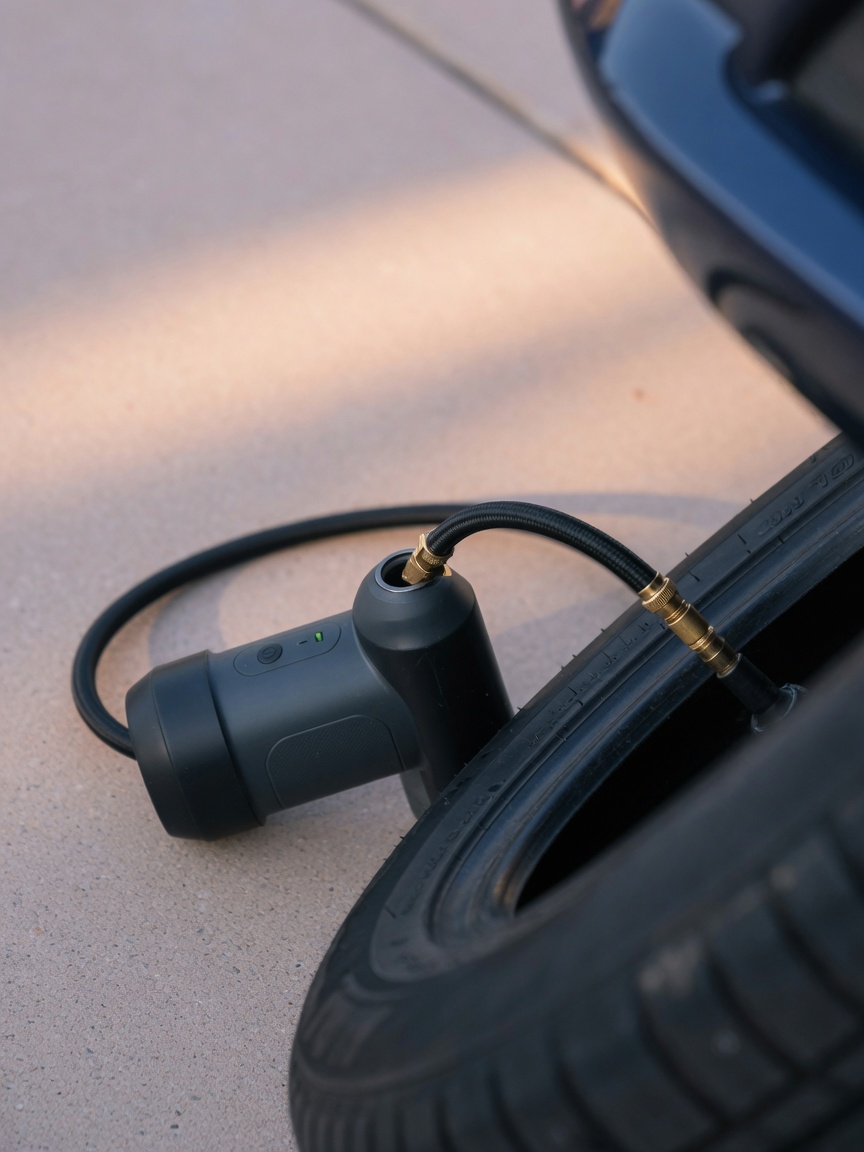
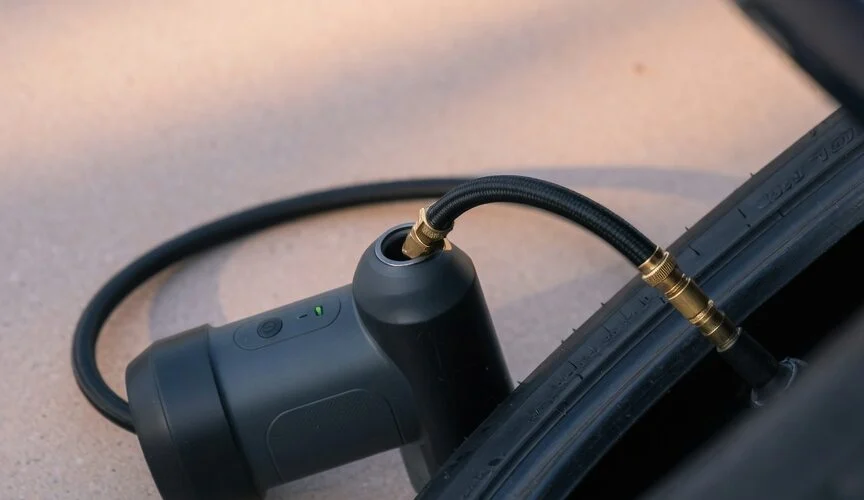
This guide uses the Xiaomi Portable Electric Air Compressor 2 as a documented example, not as a specification for every cordless pump. Its manufacturer publishes charging limits, maintenance advice and explanations for confusing indicator behavior. Check your own model’s manual before applying those details to another inflator.

Start with the charging specification, not the connector shape

A USB-C socket tells you where the cable connects. Your inflator’s charging specification tells you what power source it requires. For the Xiaomi example, the official specifications list a lithium-ion battery, a Type-C port, a rated charging input of 5V at 2A, and an approximate charging time of three hours.

The manufacturer’s FAQ also says this model does not support fast charging. Buying a charger with a much larger advertised wattage is therefore not evidence that it will fill this particular pump faster. Match the manufacturer’s requirements rather than judging suitability from the largest number on the adapter.

Xiaomi says a power bank can charge this model if its output meets the required interface and power specification. That can be useful when preparing equipment away from a wall socket. It is still worth testing your actual cable and power source before a journey instead of discovering an incompatible combination when a tire needs attention.

Keep the distinction between charging and inflation clear. An input rating is not a promise that the motor can run directly from that charger. Do not assume pass-through operation is supported just because the cable fits; follow the operating instructions for your specific model.

Charging temperature and operating temperature are different

Xiaomi lists an operating range of -10°C to 45°C for this inflator, but a narrower charging range of 5°C to 40°C. Those are separate limits. A pump that is within its stated operating range after a cold ride may still be too cold to charge according to its manufacturer.

Let the device return to an appropriate temperature naturally before connecting power. Do not try to accelerate the process with a heater or another improvised heat source. Equally, bringing a hot device indoors does not instantly establish that its battery is ready for charging. Check its condition and follow the manual rather than relying on the room temperature alone.

The same specification page lists a storage range of -10°C to 45°C. Treat that as a permitted range, not a recommendation to spend months at either boundary. Battery University’s lithium-ion aging guide describes elevated temperature and prolonged high state of charge as stresses that can accelerate capacity loss.

For a pump kept with vehicle equipment, consider whether its storage location stays within its documented limits. If you cannot establish that, a more temperature-controlled location is the sensible choice. Our guides to protecting batteries from summer heat and cold-weather battery behavior explain the broader issue, although an inflator’s own limits remain the ones to follow.

Choose readiness over an arbitrary charge target

Battery-care advice often focuses on avoiding long periods at full charge. That has a basis in lithium-ion aging research, but an emergency tool also needs enough energy to perform its job. A lower stored charge is not an improvement if it leaves your only pump unable to finish the inflation you need.

Separate routine storage from preparation for use. Before a planned drive or ride, check and charge the pump according to its instructions. During longer periods of inactivity, follow the manufacturer’s maintenance interval. For the Xiaomi Air Compressor 2, the FAQ recommends recharging at least once every three months.

That interval is not a guarantee that a forgotten pump will always remain ready until the next reminder. Make a pre-trip check part of your routine too. Nor does the recommendation mean leaving the inflator permanently attached to a charger. A periodic check and recharge is a different practice from continuous connection.

Do not deliberately run the battery flat before putting it away. Battery University explains that lithium-ion batteries do not need periodic full discharge cycles to prolong life and that partial discharge is acceptable. There is no reason to run the motor unnecessarily just to reach an empty indicator.

SituationPractical approachWhat to avoid
Preparing for a journeyCheck operation and charge as directed before departure.Assuming last season’s charge is sufficient.
Long periods unusedFollow the maintenance interval; Xiaomi specifies at least every three months.Storing an exhausted battery and forgetting it.
Cold deviceWait until it is within its stated charging range.Confusing the operating range with the charging range.
Hot after inflationAllow cooling and observe the manufacturer’s instructions.Continuing solely to test how long it lasts.
Indicator changes under loadCompare with the model’s documented behavior.Diagnosing battery failure from one color change.

A changing indicator does not necessarily mean battery failure

One useful detail in Xiaomi’s FAQ concerns the battery indicator. The manufacturer explains that lithium batteries experience a voltage drop during discharge, so the indicator color can differ between inflation and standby. It describes that behavior as normal rather than a fault.

In other words, a color change while the motor is working does not by itself measure lost capacity. Avoid turning a momentary display observation into a conclusion that the battery needs replacing. Read the indicator explanation for your model and consider whether the pump actually completes its normal task.

Make comparisons under similar conditions if you are keeping notes on performance. A different tire, starting pressure, target pressure or ambient temperature makes the comparison less informative. Xiaomi explicitly notes that ambient temperature and load affect runtime. Its quoted no-load operating time should not be treated as a promise of continuous real-world tire inflation.

A simple record of ordinary use is more helpful than repeated full-discharge testing: note the task, whether the pump completed it, and any unusual behavior. Our guide to checking battery health provides broader context, but do not assume a basic inflator exposes the same diagnostic information as a phone or laptop.

Check the hose and settings before blaming the battery

Slow inflation is not exclusively a battery symptom. Xiaomi’s troubleshooting guidance tells users to check battery charge, hose leakage, secure hose connections and leakage from the item being inflated. Start with those checks rather than immediately buying a replacement pump or experimenting with its battery.

If the pump turns on but does not inflate, the FAQ also recommends checking whether the current pressure is already above the preset value. A stop caused by the selected target is different from an electrical failure. Confirm the appropriate pressure and mode using the equipment’s instructions; do not increase the target simply to force the motor to run.

Heat needs its own attention. Xiaomi warns that the compressor and high-pressure hose can become very hot after extended operation and should be allowed to cool. Do not use repeated back-to-back inflation attempts as a homemade battery stress test. A charging routine cannot compensate for ignoring the device’s operating guidance.

Keep moisture out of the equation too. The manufacturer states that this model is not waterproof and should not be used in a humid environment or immersed. Store the pump and cable somewhere suitable rather than treating a storage pouch as proof of weather protection.

Where charge limiters fit—and where they do not

If you use charging limits on a phone, it is tempting to copy the same routine to every USB-powered device. Start instead with the inflator’s supported charging method and its readiness requirements. Xiaomi says this model does not connect to the Mi Home app or support networking; its documentation does not establish app-based battery-percentage control.

A USB connector alone does not establish compatibility with a particular charge limiter, or prove that an accessory can stop this inflator at an accurate battery percentage. This guide does not claim tested Chargie compatibility with the Xiaomi Air Compressor 2. Read what a USB charge limiter does, then verify support for the exact device and intended setup before buying one for that purpose.

The useful habits here do not depend on an accessory: use the specified charging equipment, respect temperature limits, avoid unnecessary deep discharges and remember maintenance checks. If the pump is your emergency backup, do not sacrifice necessary charge just to imitate a phone’s daily charging target.

FAQ: portable tire inflator battery care

Charging and storage

How often should I charge an unused tire inflator? Follow its manufacturer’s interval. Xiaomi recommends recharging the Air Compressor 2 at least once every three months. Check before trips as well; the interval is not a substitute for confirming readiness when the pump matters.

Should I drain it completely before charging? Not as a routine lithium-ion care practice. Battery University says these batteries do not need periodic full discharges to prolong life. Recharge according to the manual and your expected use rather than running the motor to empty the pack.

Temperature and performance

Can I charge it immediately after a cold ride? Only when the device is within its specified charging conditions. Xiaomi lists 5°C to 40°C for charging this model, even though its operating range extends lower. Allow it to return naturally to suitable conditions first.

Does a lower battery indication while pumping mean it is worn out? Not necessarily. Xiaomi documents indicator-color differences between standby and inflation because voltage drops under load. Investigate persistent inability to perform normal tasks, but do not diagnose capacity loss from that behavior alone.

Accessories and replacement

Will a more powerful USB charger make it charge faster? Not necessarily. Xiaomi specifies 5V at 2A and says the Air Compressor 2 does not support fast charging. Use a compliant source that meets the model’s requirements; a charger’s headline wattage is not a charging-speed guarantee.

Should I open the inflator to replace its cells? Xiaomi tells users not to disassemble this model themselves. Seek manufacturer or qualified service guidance if it becomes unreliable or damaged. For visible battery-related damage, consult our battery swelling safety guide; for retirement, check battery disposal guidance and your local collection requirements.

The practical takeaway

Treat your cordless inflator as maintained equipment, not a forgotten accessory. Keep its charging requirements with the cable, set a maintenance reminder based on its manual, and check it before a journey. When performance changes, inspect connections, settings and conditions before declaring the battery finished. The goal is a pump that remains useful when needed—not a perfect-looking charge percentage.

Sources

Recommended for you
Chargie C Basic - USB-C low power charging limiter

USB-C charge limiter that stops at your set battery level. Prevents overnight overcharging to extend battery lifespan by years. Works with any USB-C charger.
€40.00 €34.99
View product
Chargie for Laptops — 100W USB-C charging limiter

Limit your laptop charge to 80% via USB-C. Works with MacBooks, Dell, HP, Lenovo and most USB-C laptops up to 100W.

€60.00 €49.99
View product

Protect Your Battery with Chargie

The world's first hardware charge limiter. Set a charge limit on any phone, tablet, or laptop — extend battery life by up to 4x.


Ovidiu Sandru

Founder & CEO, Lighty Electronics

Ovidiu Sandru is the founder and CEO of Lighty Electronics, the company behind Chargie — the world's first hardware USB charge limiter. With a background in electronics engineering from Politehnica University of Timișoara, he has spent over a decade working on battery technology, Android development, and hardware design. Since launching Chargie in 2019, over 60,000 customers worldwide rely on his technology to extend their device battery lifespan.

🔍

Which Chargie?

Not sure which Chargie fits your device? Take our quick quiz.

Find Out →
📱

Get the App

Control your charging with our free app

Download →
🛒

Ready to Buy?

Free shipping on qualifying orders

Shop Now
Which one? Shop · from €29.99
Protect your battery automaticallyChargie limits charging to extend battery lifespan by up to 4x
Find your Chargie →