
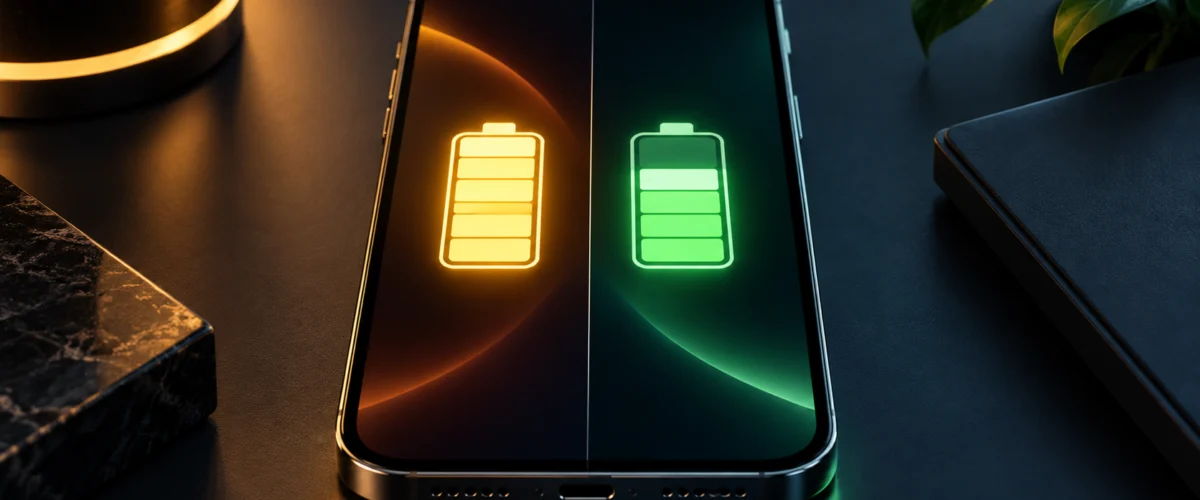

You plug your phone in at night. By morning it reads 100% — and that’s exactly the problem.
For the eight hours your phone sits at full charge, the battery is held at its maximum voltage. That sustained high-voltage state is what accelerates the chemical wear inside a lithium-ion cell, quietly shaving off capacity night after night, year after year. It’s why a phone that used to last a full day now dies by 3 p.m. after just two years.
The good news: you don’t need to buy a new phone, and you don’t need to live at 40% charge. You just need to stop the charging before it hits 100%.
What the research says about charging to 100%
The relationship between charge level and battery life is one of the best-documented effects in lithium-ion science. According to Battery University’s widely cited guide How to Prolong Lithium-based Batteries (BU-808), cutting the peak charge voltage by just 0.10V per cell roughly doubles the number of charge cycles:
- 4.20V (100%) → 300–500 cycles
- 4.10V (~85%) → 600–1,000 cycles
- 4.00V (~73%) → 1,200–2,000 cycles
In plain language: a phone charged to 100% every night runs out in roughly two years. The same phone, limited to about 80%, can keep a full day’s charge going for three to four years. That’s the 80% rule — and it’s not a myth, it’s the same logic the battery industry already uses.
EVs already do this. Your phone should too.
Tesla defaults Supercharger sessions to stop at 80% and recommends 80% for daily use. BMW, Rivian, and the rest of the EV world follow the same discipline. Their batteries routinely retain ~88% capacity after 200,000 miles — and are projected to last 300,000–500,000 miles.
The same cells, the same science, the same 80% limit — just at the scale of a phone. If a $50,000 car is worth protecting this way, your phone is too.
Heat is the hidden multiplier
Charge level is only half the story. Heat is the other half. Battery University notes that “a battery dwelling above 30°C (86°F) is considered elevated temperature,” and degradation accelerates sharply from there. A widely cited rule of thumb, consistent with Arrhenius reaction kinetics, is that every 10°C increase roughly doubles the rate of aging.
So a phone left at 100% in a warm bedroom loses meaningfully more capacity per year than the same phone in a cool one. The fix is two-part: cap the charge and keep it out of the heat. Both matter.
Why built-in “optimized charging” isn’t quite enough
Apple, Samsung, Google, and Microsoft all ship some form of charge limiting. That’s genuinely good for the industry — it means the science is mainstream now. But built-in software has limits:
- Most phones cap at 80% or 85% — not the exact level you want
- They depend on the OS running, so a crashed or off device can’t be protected
- They’re locked to a single device — move to a new phone and you start over
- Most don’t respond to temperature the way you’d want them to
The hardware fix: control power at the source
Chargie solves this in hardware. It sits between your charger and your device and physically stops current flow when it hits your limit — then resumes automatically when the battery drops a few percent (a gentle “hysteresis” pattern that mimics how healthy batteries should be cycled).
Because it works at the source, Chargie:
- Lets you set any limit from 20–100%, not just 80%
- Works with any phone, any OS, any charger — including wireless pads
- Stays protective even when the phone is off
- Adds overtemperature protection you can tune yourself
- Keeps full USB data passthrough, so Android Auto, CarPlay, and tethering all still work
It’s the same 80% rule the EV world runs on, applied to your phone with more precise control and zero dependence on your phone’s operating system.
What that means for you
Extending your phone’s battery life by 2–4× means one of two things: you avoid the $150+ battery replacement, or you avoid replacing a phone that’s otherwise perfectly fine — plus the carbon cost of manufacturing the replacement. (Manufacturing a single smartphone carries roughly 55–85 kg of CO₂.) Protecting the battery you already have is quietly the most sustainable thing you can do with your tech.
The bottom line
You’ve already changed how you eat, sleep, and train to extend your own battery — your body. Your phone’s battery follows the same physics. Stop charging at 100%. Aim for 80%. Keep it cool. Three habits, a few hours a day, and you’ll have a phone that lasts years longer than the one on the desk next to it.
Get Chargie and set your phone to 80% tonight → — free worldwide shipping on qualifying orders, with a 30-day money-back guarantee.
Curious about the full data? Read the research behind Chargie →
More ways to keep your battery healthy for longer
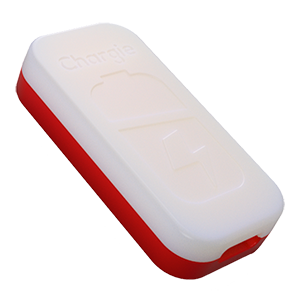
USB-C charge limiter that stops at your set battery level, so your battery never sits at 100% overnight. Extends battery lifespan by years. Works with any USB-C charger.
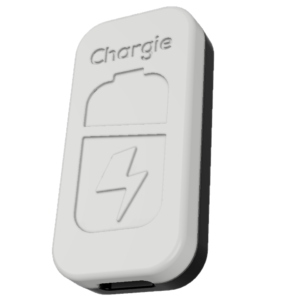
Limit your laptop charge to 80% via USB-C. Works with MacBooks, Dell, HP, Lenovo and most USB-C laptops up to 100W.
Protect Your Battery with Chargie
The world's first hardware charge limiter. Set a charge limit on any phone, tablet, or laptop — extend battery life by up to 4x.