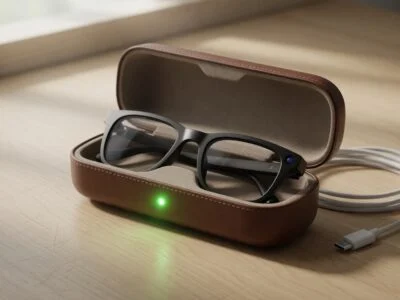


The best surge protectors pack a punch with over 2,000 joules of protection, a quick-acting voltage level of 400V or less, and the all-important UL 1449 safety seal. You'll also want to see a "Protected" indicator light and have plenty of outlets for all your gear, giving you a solid defense against damaging power spikes.
Your Quick Guide to Picking the Right Surge Protector
You've spent good money on your electronics—your TV, your computer, your sound system. The last thing you want is for a random, invisible spike in your home's electricity to fry them. It happens more often than you'd think. A nearby lightning strike is the obvious culprit, but even your own refrigerator or air conditioner kicking on can send potentially damaging power spikes through your wiring.
Even the small, everyday power fluctuations you never notice can quietly wear down the delicate components inside your gadgets, slowly but surely shortening their lifespan. This is exactly why a good surge protector is non-negotiable. It acts as a gatekeeper, absorbing and diverting that harmful excess electricity before it ever gets a chance to touch your valuable tech.
What to Look for Immediately
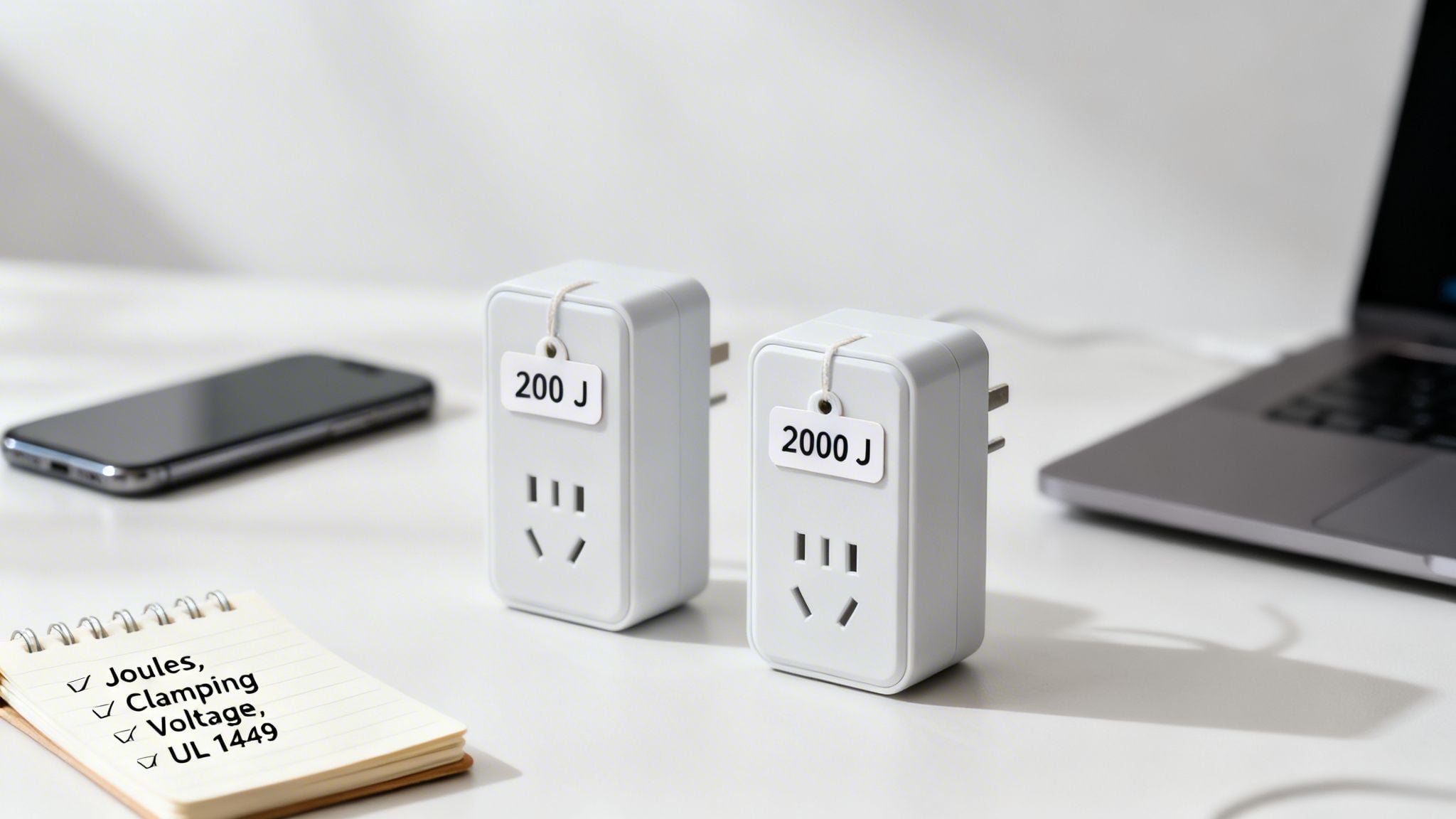
When you're staring at a wall of surge protectors, it's easy to get overwhelmed. Let's cut through the noise and focus on the three specs that truly matter. Think of these as the vital stats that tell you just how tough a surge protector really is.
- Joule Rating: This is all about endurance. It tells you how much energy the device can absorb over its lifetime before it's "used up." A higher number is always better. For your expensive gear, look for a rating of 2,000 joules or more to ensure it can take plenty of hits.
- Clamping Voltage: This number tells you when the protection kicks in. It’s the voltage level that triggers the protector to start diverting the power spike. Here, lower is better because it means the protector reacts faster to smaller spikes. You want a clamping voltage of 400 volts (V) or less.
- UL 1449 Certification: This is your proof of safety and performance. If you see the UL mark, it means the device has been independently tested to meet specific safety standards. Never, ever buy a surge protector without it.
A surge protector is a sacrificial device. It gives its life to save your electronics. Every power spike it blocks wears it down, which is why a high joule rating is so crucial—it means a longer service life.
Now, while a surge protector is your first line of defense against outside threats, it’s also smart to think about protecting your devices from the inside out. For example, leaving your phone or laptop plugged in all night puts constant stress on their batteries. A smart charging limiter like Chargie works hand-in-hand with your surge protector. It limits the charging process to preserve your battery for the long run.
To make picking the right model even simpler, we've put together a quick-reference table. It matches different types of electronics to the surge protector specs you should be looking for.
Quick-Reference Surge Protector Specs for Your Devices
Use this table as a starting point to find the perfect level of protection for everything from a simple desk lamp to a high-end gaming PC.
| Device Type | Recommended Joules | Recommended Clamping Voltage | Key Features |
|---|---|---|---|
| Small Electronics (Lamps, clocks, chargers) | 500 – 1,000+ | 400V or less | Basic protection, multiple outlets |
| Home Office (PCs, monitors, printers) | 2,000 – 3,000+ | 400V or less | "Protected" indicator light, power filtering |
| Home Theater / AV (TVs, receivers, speakers) | 2,500 – 4,000+ | 330V or less | Coaxial/Ethernet protection, power filtration |
| High-End Gaming Rigs / Workstations | 3,000 – 5,000+ | 330V | Power conditioning, fast response time |
This should give you the confidence to choose a surge protector that isn't just a power strip, but a genuine bodyguard for your most-loved electronics.
The Hidden Danger Lurking in Your Walls
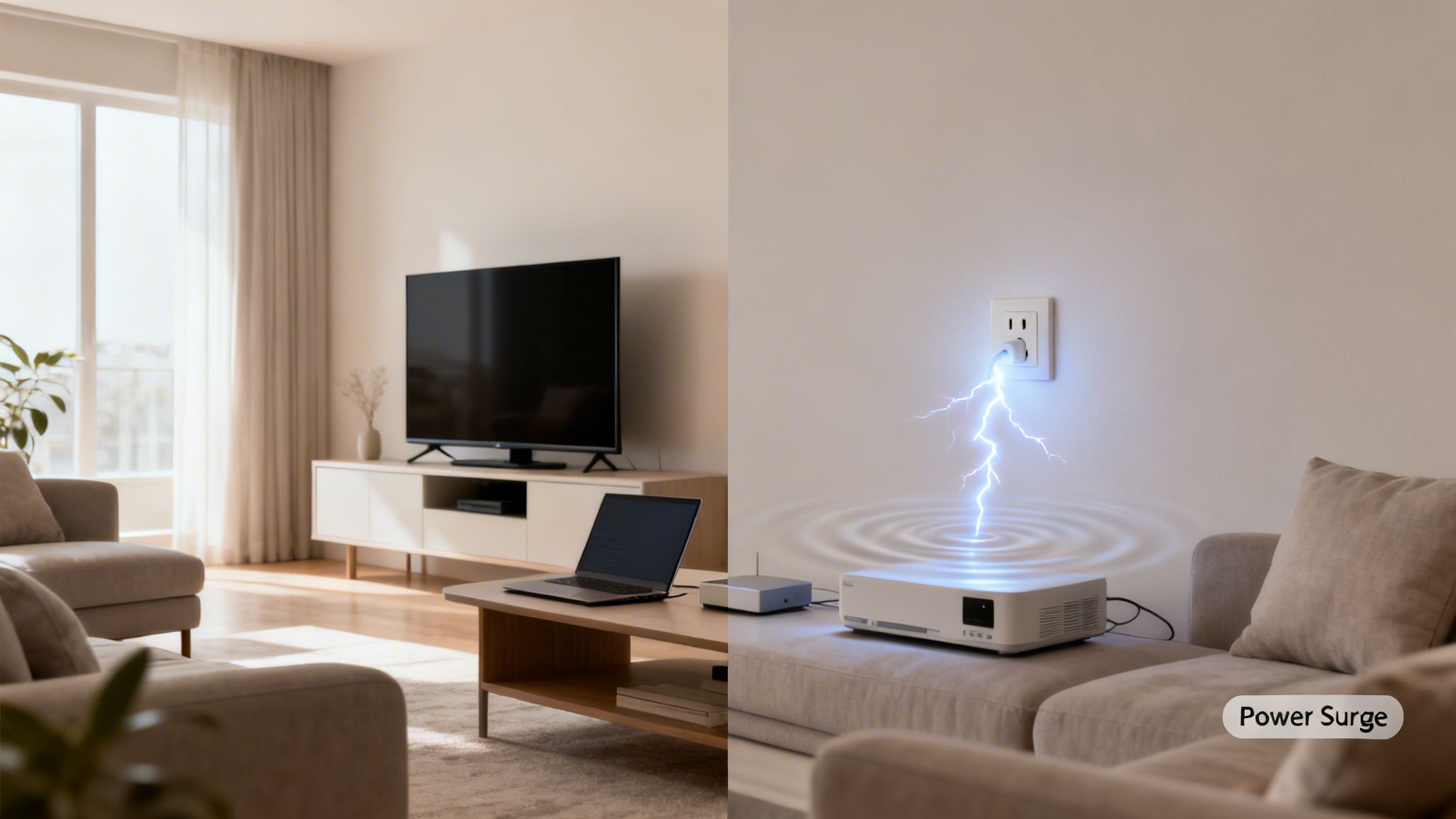
Think of your home's electrical system as a river. Most of the time, it flows calmly and predictably, delivering a steady stream of power to everything you plug in. But a power surge is like a sudden flash flood—a violent, unexpected wave of high-voltage electricity that can overwhelm your devices and cause serious damage.
And it’s not just dramatic lightning strikes you have to worry about. While lightning is a powerful and obvious culprit, the majority of these surges actually start right inside your own home. Every time a large appliance like your air conditioner or refrigerator cycles on or off, it can create small but destructive electrical spikes.
Death by a Thousand Tiny Cuts
Here's the scary part: it's not always the big, spectacular zap that kills your gear. The real danger often comes from the countless tiny fluctuations, or micro-surges, that happen every single day. You won't see or hear them, but they're taking a toll.
Imagine these micro-surges as invisible rust, slowly eating away at the delicate circuits inside your expensive electronics. One tiny spike won't brick your new 4K TV, but hundreds of them over a few months will gradually degrade its internal components, leading to a much shorter lifespan.
This is why a device might suddenly die for no apparent reason. The fatal damage was done over time, one tiny electrical jolt after another. It’s this slow, cumulative damage that makes a good surge protector an absolute necessity, not just a nice-to-have.
Your Power Strip Is Not Protecting You
So many people grab a basic power strip from the hardware store, thinking they're covered. They are fundamentally different from surge protectors. A simple power strip is just an extension cord with a few extra outlets. It offers zero protection.
A power strip's only job is to turn one outlet into many. It has no special parts inside to stop or absorb a voltage spike, leaving your expensive gadgets completely exposed.
A real surge protector has specific components designed to absorb that dangerous excess voltage and divert it safely away from your electronics. Without them, you’re plugging your valuable tech directly into the path of that electrical flash flood, armed with nothing but a false sense of security.
A Broader Look at Electrical Health
Guarding against power surges is a huge first step, but it's part of a bigger picture. A surge is just one kind of disturbance that can mess with your home's power. Understanding the basics of overall electrical power quality—which includes issues like sags, swells, and line noise—gives you a complete view of how to protect your sensitive electronics.
This knowledge makes it crystal clear why protecting your investments is so critical. A surge protector is your frontline defense against outside threats. But what about threats from within?
That’s where you can get even smarter by creating a complete defense system. By pairing a surge protector with a tool like our own Chargie charging limiter, you protect your devices from both external and internal stress. While the surge protector guards against voltage spikes, Chargie prevents battery overcharging, stopping the constant strain of being held at 100%. This preserves your battery's lifespan from the inside out.
How to Decode Surge Protector Specifications
Trying to make sense of the specs on a surge protector's box can feel like you're reading a foreign language. You're hit with a wall of numbers and acronyms that seem designed to confuse. But once you know what to look for, you can cut through the noise and confidently pick the right shield for your valuable electronics.
Think of it this way: you wouldn't buy a car without knowing its safety rating. The same logic applies here. For a surge protector, there are a few key numbers that tell you everything you need to know about how well it will perform when things go wrong. Let’s crack the code together.
Joules: The Shield's Endurance
The joule rating is the first number I always look for. It tells you how much energy the surge protector can absorb over its lifetime before it's "used up." Every time it takes a hit from a power surge, big or small, it sacrifices a bit of itself to protect your gear.
- A higher joule rating simply means it can take more hits and will last longer.
- Once all the joules are gone, it stops being a surge protector and becomes a plain old power strip, offering zero protection.
- For expensive equipment like your gaming PC or home theater setup, you should be looking for a rating of at least 2,000 joules.
A protector with a low rating, say around 600 joules, might be okay for a desk lamp, but it’s completely out of its league for a powerful computer. It would be like trying to stop a flood with a paper towel.
Clamping Voltage: The Trigger Point
If joules are about endurance, clamping voltage is all about reaction time. This number tells you how high the voltage has to get before the surge protector wakes up and diverts the excess power.
When it comes to clamping voltage, a lower number is always better. A lower trigger point means the protector will jump into action on smaller, more subtle surges, giving your sensitive electronics a much safer buffer.
A surge protector with a high clamping voltage is a lazy guard. It might let a damaging amount of electricity slip through before it even bothers to react. For the best protection, look for a clamping voltage of 400 volts (V) or less. For really delicate hardware, a 330V rating is even better.
Response Time: How Fast It Moves
Finally, there’s response time. This measures, in nanoseconds (ns), how quickly the protector can detect a surge and clamp down on it. Just like with clamping voltage, faster is better. The whole point is to stop the surge before it has a chance to do any damage.
Fortunately, this is one area where most modern surge protectors really shine. You'll find that almost any decent model has a response time of one nanosecond or less, which is virtually instant. It's still a spec worth checking, but you're less likely to find a bad apple here.
The Non-Negotiable Seal of Safety
Beyond the performance numbers, there's one label you absolutely must find on the box: the UL 1449 certification. This isn't just a sticker; it's your proof that the device has been independently tested and meets strict safety and performance standards.
A surge protector without UL 1449 certification is a total gamble. It might not work as advertised, and in a worst-case scenario, it could even be a fire risk. I never buy—and you should never buy—a surge protector that isn't UL listed.
Extra Features for Cleaner Power
Some of the best surge protectors for electronics offer a little something extra. Power filtering is a great example. It helps clean up the "noise" on your power line—interference from other appliances—that can cause glitches or poor audio/video quality.
While you're protecting your devices from external threats, it's also smart to understand their internal needs. If you're ever unsure about how much power your laptop needs, our guide on how many watts it takes to charge a laptop can help you match the right charger with the right protection.
Matching the Right Protector to Your Electronics
Picking out a surge protector isn't a one-size-fits-all deal. It's tempting to grab the first one you see, but the little power strip that’s perfect for your bedside lamp is completely out of its league when faced with a massive home theater system. The real secret is matching the level of protection to how much your gear is worth and how sensitive it is.
Think about it: a top-tier gaming PC, with its pricey graphics card and multiple monitors, needs a serious shield. On the other hand, a simple kitchen toaster doesn't face nearly the same risk. When you tailor your choice, you make sure your most valuable electronics get the Fort Knox treatment they deserve without wasting money on overkill for less critical gear.
For Your Home Office or Gaming PC
Your computer is the heart of your workspace or your gaming sanctuary. It holds your work, your precious data, and your entertainment, making it one of the most vital things you own. For a standard home office or a powerful gaming rig, you need a protector that can handle a whole ecosystem of sensitive components.
- Joules: Don't settle for less than 2,500 joules. A higher rating means it can soak up bigger hits and will last you a whole lot longer.
- Outlets: Go for a model with 8 to 12 outlets. This gives you enough room for your PC, monitors, printer, and speakers without resorting to daisy-chaining.
- Extra Features: Look for power filtering. This is your secret weapon for clean, stable power, which translates to better performance and crystal-clear audio. Spaced-out outlets are also a lifesaver for those big, awkward power bricks.
For Your Home Entertainment System
That beautiful 4K TV, the booming soundbar, the receiver, and your game consoles—they all add up to a serious investment. More importantly, they're packed with delicate circuits that can get fried by even a tiny power flicker. Protecting this setup calls for a top-of-the-line surge protector.
When you're dealing with a home theater, you're not just preventing damage. You're preserving the experience. A protector with good power conditioning or advanced filtering can genuinely make your movies look and sound better.
You'll want a protector rated for over 3,000 joules with a low clamping voltage of 330V to ensure it reacts in a split second. Also, keep an eye out for models that include coaxial and Ethernet ports. A surge can just as easily sneak in through your cable or internet line, and you need to be ready for it.
For Kitchens and Specialty Setups
Even the kitchen is turning into a tech hub, with smart fridges, microwaves, fancy coffee makers, and air fryers. While they might not hold your personal data, their control boards are just as vulnerable to getting zapped. A solid mid-range protector with 1,000 to 2,000 joules is a smart move for a kitchen power station.
And what about charging all our phones and tablets? Many of the best surge protectors now come with USB ports built right in, which is incredibly handy. But remember, those ports only protect the charger itself from surges. To go a step further and protect your device's battery from the slow wear of overcharging, you can pair your setup with a smart device like Chargie. It actively manages charging to keep your battery healthy for the long haul.
If you're a business owner, reliable power for your point-of-sale systems or digital signs is non-negotiable. One power surge can knock a terminal offline, bringing sales to a grinding halt. It’s no surprise that the demand for these plug-in protectors is booming, with a projected 6.05% growth rate through 2031. Some insurers even offer discounts if you can prove you have proper protection in place—a smart investment when a single surge can cause over $1,000 in laptop repairs alone. You can dig into the numbers and trends in recent industry reports on global surge protection devices.
This flowchart makes it much simpler to figure out what specs matter most when you're shopping around.
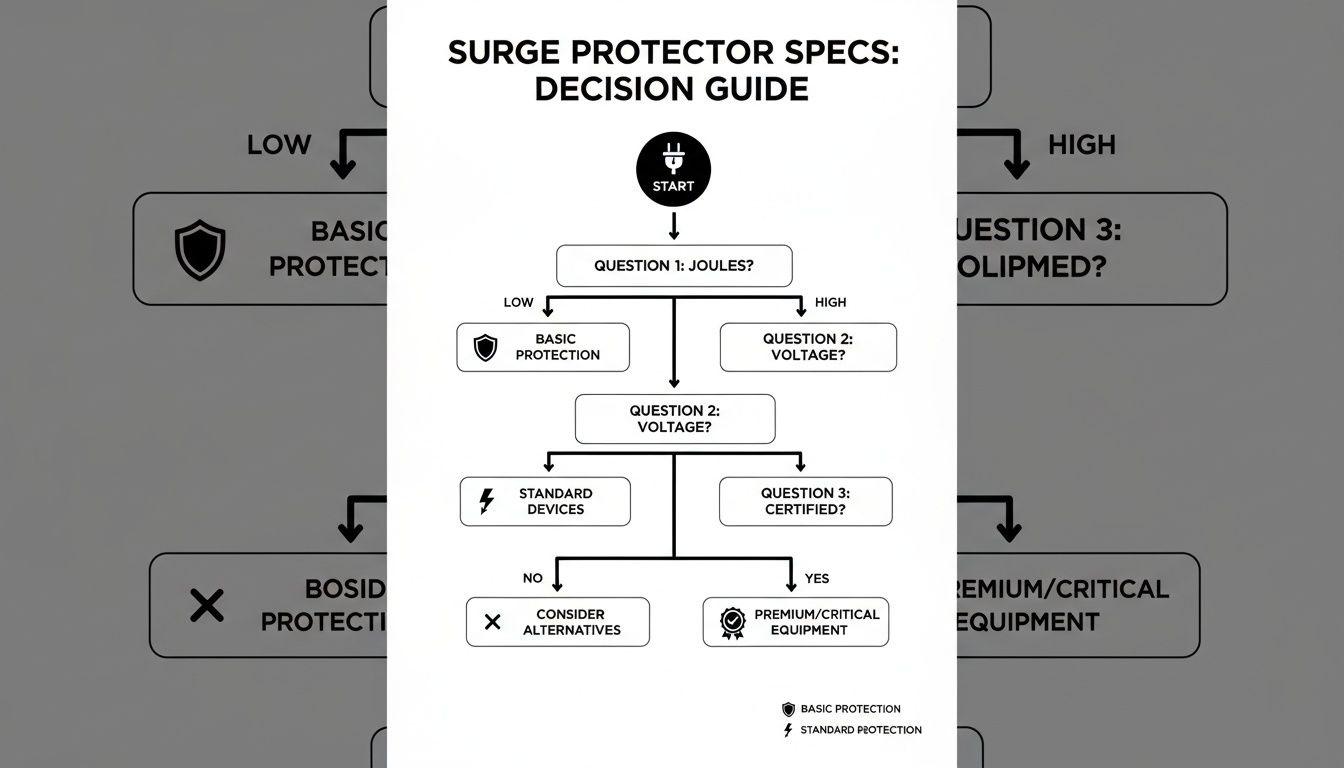
As you can see, the path is clear: focus on a high joule rating, a low clamping voltage, and make sure it has safety certifications. That's the trifecta for effective protection. And for those of us juggling a dozen different gadgets, our guide on charging stations for multiple devices has some great tips for keeping everything organized and powered up safely.
The Complete Strategy for Device Longevity
Grabbing one of the best surge protectors is a great move. You’ve basically built a fortress to defend your expensive electronics from outside attacks like lightning strikes or weird flickers from the power grid. But what if the real long-term danger isn't coming from the wall outlet, but from inside the device itself?
To truly make your gadgets last, you have to look beyond the power cord and think about the battery. While a surge protector is standing guard against electrical haymakers, your everyday charging habits can be landing a thousand tiny jabs, slowly wearing down your electronics from the inside out.
The Hidden Threat of 100% Charge
The quiet killer of our modern devices is the battery’s mortal enemy: sitting at a full 100% charge for hours on end. When your phone, tablet, or laptop is plugged in all night, long after it's full, the battery is under constant high-voltage stress. Think of it like stretching a rubber band to its absolute limit and just leaving it there for hours.
This constant tension causes chemical damage inside the battery. It permanently chips away at its ability to hold a charge, which is exactly why a phone that used to last all day suddenly needs a top-up by lunchtime after only a year or two.
This slow drain on battery health is a huge reason we feel pushed to replace our devices so often. The gadget itself works perfectly, but the battery just can't keep up anymore.
Doubling Down on Protection
This is where you need a two-pronged defense. It’s about protecting your gear from both the sudden, external shocks and the slow, internal wear and tear.
External Protection: Your surge protector is the first line of defense. It's the bouncer at the door, stopping massive voltage spikes that could instantly fry your electronics.
Internal Protection: This is where a smart charging limiter comes in. It’s your second line of defense, preventing the silent damage caused by keeping your battery pinned at full charge.
With this layered approach, you’re covered from all angles. You're not just protecting the power adapter; you're maximizing the lifespan of the entire device.
The Chargie Solution
This is precisely the job Chargie was built for. It works hand-in-glove with your surge protector to give you a complete system for device longevity. While the surge protector handles the big, scary electrical events, Chargie deals with the slow-moving threat of battery degradation.
By physically stopping the charge at a healthier level you choose (like 80%), Chargie keeps your device from sitting at that stressful 100% mark for hours. It’s a simple, set-it-and-forget-it tool that actively preserves your battery’s health every single time you plug in. You can learn more about this concept in our detailed article on how to extend battery life.
Going beyond just surge protection, a full strategy for making your tech last involves good habits and smart tools. It's all part of a wider approach to preventive maintenance and downtime prevention that can save you a lot of money and headaches. By pairing a quality surge protector with a battery-saving tool like Chargie, you’re not just protecting your tech—you're making a real investment in its future.
Proper Setup and Knowing When to Replace Your Protector
You can buy the best surge protector on the market, but it won't do you any good if it’s not set up right. And worse, it's useless if you keep it plugged in long after it has done its job and died. Getting the installation right is step one, but knowing when to retire it is just as critical.
Think of a surge protector as a piece of safety equipment, not just a fancy extension cord. There are a few golden rules you absolutely have to follow for it to work. Ignoring them is like installing a new alarm system but leaving your front door unlocked.
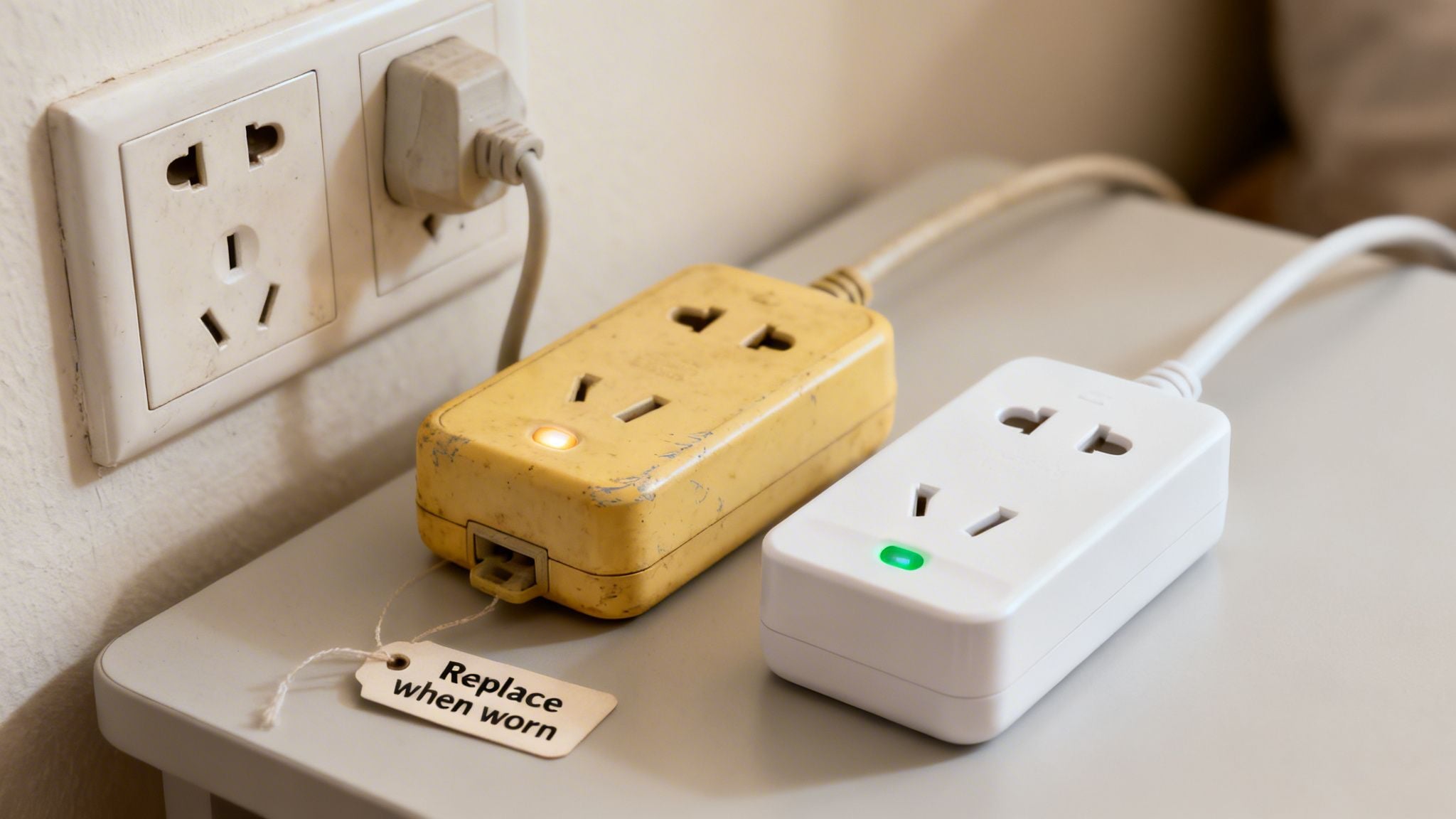
Installation Dos and Don’ts
Getting the setup right is simple, but there's no room for error. Your protector needs a direct, clean path to the ground so it can safely shunt any dangerous voltage away from your valuable gear.
These are the non-negotiable rules for installation:
- Do plug directly into a grounded wall outlet. A surge protector is useless without a ground wire. Most have an indicator light to confirm the outlet is properly grounded. If that light isn't on, the protector can't do its job.
- Don't ever "daisy-chain" them. Plugging one surge protector into another is a massive safety no-no. It creates a serious fire hazard, can overload the circuit, and will instantly void the warranty on your protector.
Daisy-chaining is like building a dam on top of another dam. It doesn't make the protection stronger; it just creates an unstable, unpredictable system that's more likely to fail catastrophically when a real flood of voltage hits.
The Sacrificial Nature of Your Protector
Here’s the thing most people don't realize about surge protectors: they are all sacrificial. Every time it absorbs a power surge—big or small—it takes a hit. That joule rating is basically its health bar, and with every surge, that bar depletes. It literally gives its life to save your electronics.
This is a huge deal when you consider that major events like lightning are responsible for about 30% of all power issues. And with lightning striking somewhere on Earth 100 times every second, the risk is constant. Unprotected electronics can easily have their lifespans cut in half by these events. It’s no wonder the market for lightning surge protectors is projected to hit $3.07 billion by 2035. You can read more about this growing demand in these lightning surge protector market trends.
Once the protective components inside are toast, it stops protecting. The scary part is that it might still pass power to your devices, turning it into a simple power strip with zero defense. Your gear is left completely exposed.
Spotting a Worn-Out Protector
Since a dead surge protector won't just stop working, you have to know the signs that it's time for a replacement. A "dead" protector that still provides power gives you a false sense of security, which is the most dangerous situation of all.
Look for these telltale signs that your protector is ready for retirement:
- The "Protected" light is off. This is the big one. If that little green or amber light is out, dim, or flickering, the protective circuitry is fried. Game over.
- Visible scorch marks or a burning smell. Any sign of physical damage or overheating means the unit has taken a major hit. Unplug it and replace it immediately.
- It’s just old. As a rule of thumb, you should replace your surge protectors every 3 to 5 years. If you live in an area with frequent thunderstorms or shaky power, you should do it even sooner.
Don't gamble with thousands of dollars of equipment. Checking your protectors and replacing them on a schedule is the only way to be sure your devices stay safe.
Common Questions About Surge Protectors
When you start digging into how to protect your expensive gadgets, the same few questions always seem to surface. It's only natural. Getting straight answers is the only way to feel confident you're buying the right gear. Let's tackle the most common ones I hear.
What Is the Difference Between a Power Strip and a Surge Protector?
This is the big one, and the difference is night and day. A simple power strip is just a glorified extension cord. All it does is turn one wall outlet into several—that's it. It offers zero protection against a power surge.
A real surge protector, on the other hand, is an entirely different beast. It has dedicated electronic components inside that act like a sponge, absorbing and redirecting dangerous voltage spikes away from your devices.
To tell them apart, always check the box for two key things: a joule rating and the UL 1449 certification logo. If you don't see those, you're holding a simple power splitter that leaves your electronics completely exposed.
How Many Joules Do I Really Need?
The joule rating is basically the size of the surge protector's shield. The more valuable or sensitive the equipment you're plugging in, the bigger the shield you'll want.
Under 1,000 Joules: This is fine for small, inexpensive things where a loss isn't catastrophic. Think desk lamps, alarm clocks, or a simple phone charger in a low-risk area.
1,000 to 2,000 Joules: This is the sweet spot for most home office gear. It's solid protection for your desktop computer, monitor, printer, and other everyday essentials.
Over 2,000 Joules: Don't even think about plugging in your expensive home theater system, a high-end gaming PC, or a critical work-from-home setup without at least this much protection. For this gear, data loss or damage is a disaster, so you need the strongest defense you can get.
Do I Need a Surge Protector for My Phone and Laptop?
Absolutely, and here's why. Your phone and laptop charging bricks have some tiny, basic protections built-in, but they are designed to handle minor fluctuations, not a real power surge. A nasty spike can fry the charger and, in a worst-case scenario, travel right through to your device's motherboard.
Plugging that charger into a quality surge protector adds a crucial line of defense.
But a surge protector is only one side of the coin for total device health. It protects against external power grid threats, but what about the internal stress on your battery? That’s where a smart hardware limiter like Chargie comes in. It prevents your battery from slowly dying by stopping the overcharging process. This one-two punch defends your gear from both outside surges and inside battery strain, giving your devices the longest life possible.
By pairing the external shield of the best surge protectors for electronics with the internal battery defense of a smart limiter, you're building a complete safety net for your gadgets. The Chargie device is built to work right alongside your existing charger, intelligently managing charge levels to halt the degradation that happens when a battery sits at 100% for hours on end. See for yourself how Chargie can help you get years more life out of all your portable electronics.
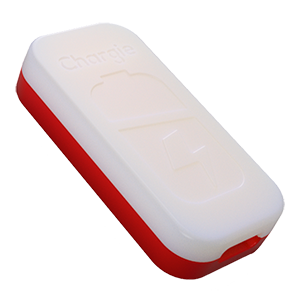
USB-C charge limiter that stops at your set battery level, so your battery never sits at 100% overnight. Extends battery lifespan by years. Works with any USB-C charger.
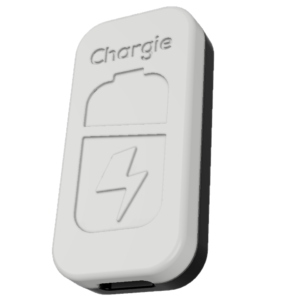
Limit your laptop charge to 80% via USB-C. Works with MacBooks, Dell, HP, Lenovo and most USB-C laptops up to 100W.
Protect Your Battery with Chargie
The world's first hardware charge limiter. Set a charge limit on any phone, tablet, or laptop — extend battery life by up to 4x.