
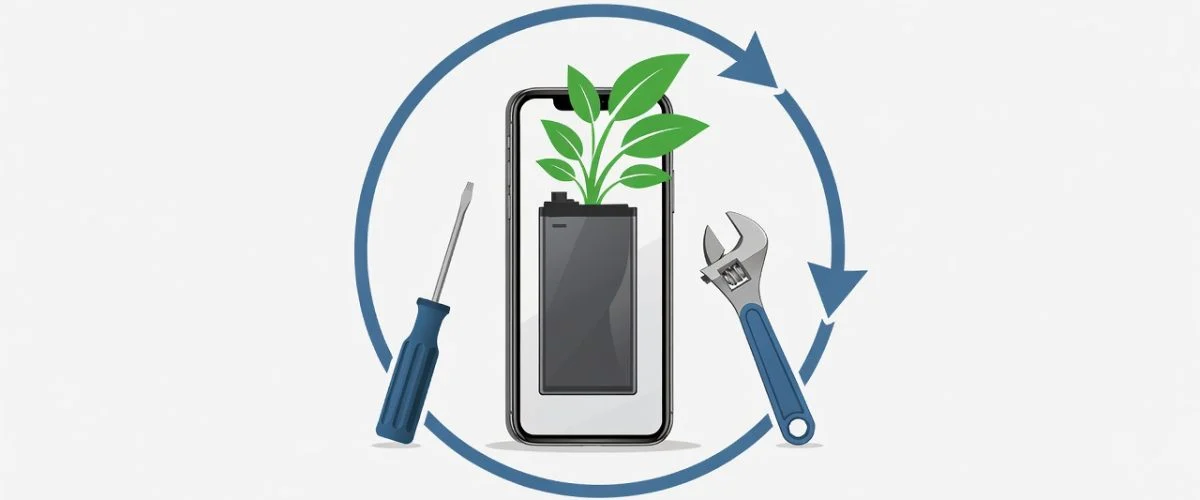

In 2025, New York became the first US state to pass a comprehensive right-to-repair law, following years of advocacy from iFixit, the Repair Association, and the Electronic Frontier Foundation. The legislation requires manufacturers to make parts, tools, and repair documentation available to consumers and independent shops. Similar laws are now active in Colorado, Minnesota, and Oregon, with more states introducing bills every legislative session.
But passing a law is only half the battle. The other half is the reality of what happens when you actually try to fix your phone. And the single biggest obstacle standing between you and a working device is the battery.
The Battery Is the Gatekeeper of Repair
Across smartphones, laptops, wireless earbuds, and tablets, the lithium-ion battery is the component most likely to fail first. It is also the component most aggressively designed to resist user replacement. Modern devices use adhesive, proprietary screws, metal shields, and software pairing schemes that make a battery swap technically difficult and sometimes impossible without manufacturer support.
The iPhone battery replacement — one of the most common repairs — requires heating the adhesive, removing fragile screen cables, dealing with pull-tab adhesive that often tears, and sometimes re-pairing the battery in software to restore health reporting. Samsung and Google devices have adopted similar designs. Even some laptop manufacturers now glue batteries into the chassis and require specialized tools to remove metal brackets.
Right-to-repair laws address access to parts and manuals, but they do not eliminate the physical design barriers that make batteries hard to replace. Nor do they change the economic reality: even when parts are available, a battery replacement can cost $70–120 in parts and labor, which is a significant fraction of a mid-range phone’s resale value.
The Economics of “Just Replace It”
Device manufacturers have spent a decade normalizing a two-to-three-year upgrade cycle. The battery is the silent engine of that cycle. When your phone holds 70% of its original charge and dies by mid-afternoon, the temptation to upgrade becomes practical, not psychological.
Right-to-repair advocates argue that consumers should be able to fix that problem for a fraction of the cost of a new device. And they are right — in theory. In practice, many users:
- Lack the tools or confidence to open a sealed device
- Live far from independent repair shops with the equipment to handle modern adhesives and waterproofing seals
- Worry that third-party battery replacement will trigger software warnings, resale value loss, or voided warranties
- Find that after the repair, other components (screen cables, waterproofing) are degraded, reducing device longevity anyway
The result is that right-to-repair helps those who are technically equipped and geographically lucky. It does not help everyone. A broader solution needs to address the problem upstream: stopping the battery from degrading so fast in the first place.
Battery Longevity as a Pre-emptive Repair Strategy
If the battery is the main reason people give up on otherwise functional hardware, then extending battery life is itself a form of repair advocacy. It is the repair you never have to perform.
A lithium-ion battery charged to 100% every night and left plugged in for eight hours degrades measurably faster than one consistently limited to 80% and disconnected once charged. The difference in cycle life can be 2× to 4× depending on device and usage, according to battery health literature from institutions including the US National Renewable Energy Laboratory and research published by Dahn et al. on voltage stress and calendar aging.
The practical implication is significant. If a phone battery that would normally degrade to 70% capacity in 18 months can be kept above 85% for three years, the user keeps the device longer without any repair event at all. The right-to-repair toolkit becomes irrelevant because the failure mode that triggers replacement is delayed beyond the typical ownership window.
The Political Angle
Right-to-repair advocates are now making this connection explicitly. In testimony before state legislatures, representatives from US PIRG and iFixit have started citing battery-replaceability as a key design metric — and conversely, citing intentional battery degradation from poor charging practices as a form of planned obsolescence that users can resist.
From a policy perspective, this creates two parallel paths:
- Regulatory: Mandate that batteries be replaceable with standard tools, as the EU is now doing under its new battery regulation (effective 2027) and as the FTC has encouraged in the US.
- Behavioral: Educate consumers that charging behavior determines device lifespan regardless of design — and give them the tools to act on that knowledge.
Chargie sits at the intersection of both paths. It does not change device design, but it changes the outcome: batteries last longer, devices stay functional, and the upgrade-or-repair dilemma arrives later or not at all.
What Chargie Actually Does in This Context
Chargie is a hardware USB charge limiter. It physically interrupts charging when the battery reaches a user-set threshold — typically 80% — and resumes only when the battery falls below a second threshold, such as 40%. This prevents the high-voltage, high-heat state that accelerates lithium-ion degradation.
In the context of right-to-repair, Chargie offers three specific advantages:
1. It neutralizes the sealed-battery problem without opening the device.
If you cannot or do not want to replace a glued-in battery, the best strategy is to make sure you never need to. Chargie does exactly that.
2. It extends the window during which repair is a rational choice.
A four-year-old phone with 85% battery health is worth keeping. A four-year-old phone with 65% battery health is a candidate for replacement, even if every other component works perfectly.
3. It reduces e-waste volume.
The electronics recycling chain is already overwhelmed with devices discarded for battery-related reasons. Extending battery life upstream delays entry into that waste stream, which is a goal shared by right-to-repair, environmental, and consumer-advocacy organizations.
The Bottom Line
Right-to-repair legislation is necessary and overdue. But it is not sufficient to solve the problem of device longevity by itself. The combination of sealed designs, repair complexity, and economic trade-offs means that many users will still replace rather than fix their hardware.
The most effective complementary strategy is to prevent the failure that drives replacement in the first place. Battery longevity does not replace the right to repair, but it makes the right far more usable — by making the repair event less urgent, less frequent, and sometimes unnecessary altogether.
Chargie is a tool for that strategy. It is not a political statement or a legal mechanism. It is a physical device that changes how your battery experiences daily use, and in doing so, changes how long the rest of the device remains viable.
Protect your battery life with Chargie — and keep your hardware in service longer.
Sources: iFixit State Repair Legislation Tracker / EFF — Right to Repair advocacy archive / US PIRG — Designed to Last reports / EU Regulation 2023/1542 (batteries and waste batteries) / NREL lithium-ion battery degradation research summaries

USB-C charge limiter that stops at your set battery level, so your battery never sits at 100% overnight. Extends battery lifespan by years. Works with any USB-C charger.
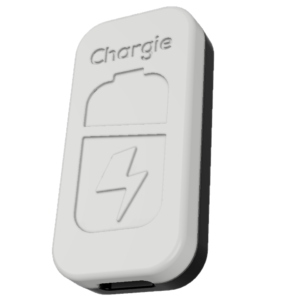
Limit your laptop charge to 80% via USB-C. Works with MacBooks, Dell, HP, Lenovo and most USB-C laptops up to 100W.
Protect Your Battery with Chargie
The world's first hardware charge limiter. Set a charge limit on any phone, tablet, or laptop — extend battery life by up to 4x.