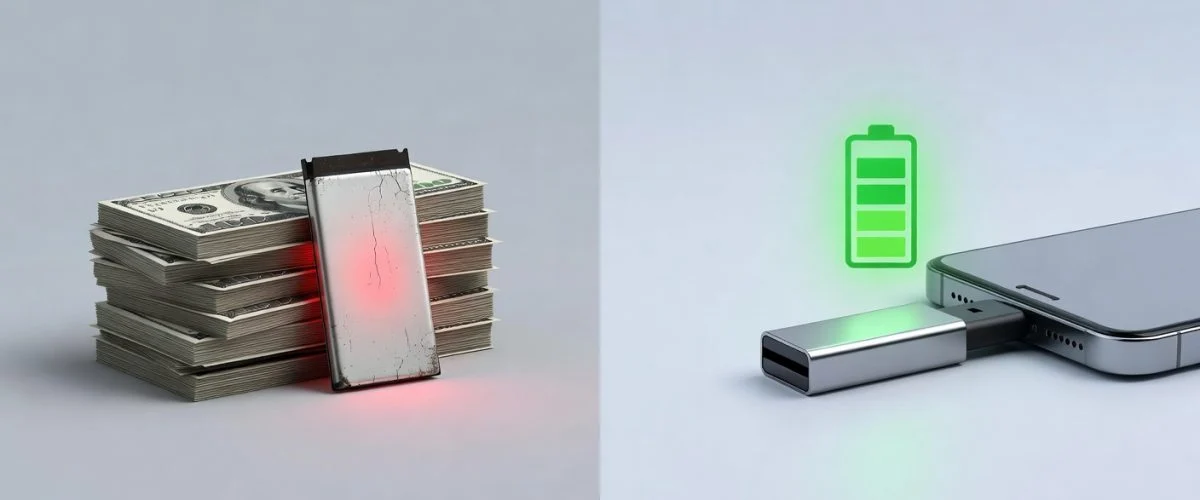

Phone batteries degrade. It’s chemistry, not a conspiracy. But what actually stings is the repair bill — and the realization that a $30 accessory could have prevented it entirely.
Here’s what a battery replacement costs across every major brand in 2026, plus the math on why a charge limiter pays for itself before your first battery fails.
Battery replacement costs by brand (2026)
Apple iPhone
| Model | Out-of-Warranty (Apple) | Third-Party Shop (Avg.) |
|---|---|---|
| iPhone 16 Pro Max | $119 | $85–110 |
| iPhone 16 / 16 Pro | $99 | $75–95 |
| iPhone 15 series | $99 | $70–95 |
| iPhone 14 series | $99 | $65–90 |
| iPhone SE (3rd gen) | $69 | $50–70 |
Apple charges a flat rate per model tier. Third-party shops are cheaper but may trigger “Unknown Part” warnings in iOS. Either way, you’re looking at $70–120 for a phone you bought less than two years ago.
Samsung Galaxy
| Model | Samsung Service Center | Third-Party Shop (Avg.) |
|---|---|---|
| Galaxy S25 Ultra | $99–109 | $80–100 |
| Galaxy S25 / S25+ | $89–99 | $70–90 |
| Galaxy S24 series | $89–99 | $65–85 |
| Galaxy Z Fold 6 | $129–149 | $110–140 |
| Galaxy Z Flip 6 | $99–119 | $85–110 |
Samsung’s foldables are the most expensive to repair — the battery is split across two halves of the device.
Google Pixel
| Model | Google Repair | Third-Party Shop (Avg.) |
|---|---|---|
| Pixel 9 Pro / Pro XL | $89–99 | $70–90 |
| Pixel 9 | $79–89 | $60–80 |
| Pixel 8 series | $79–89 | $60–80 |
| Pixel 8a | $69–79 | $55–70 |
OnePlus, Nothing, Motorola
| Brand | Official Repair | Third-Party Shop (Avg.) |
|---|---|---|
| OnePlus 13 | $69–89 | $55–75 |
| Nothing Phone (2) / (2a) | $65–85 | $50–70 |
| Motorola Edge / Razr series | $79–129 | $60–110 |
Motorola’s foldable Razr series approaches Samsung Z Flip pricing — the hinge and split battery design drive costs up.
The part nobody talks about: you don’t just pay once
A phone battery typically drops below 80% health between 18 and 30 months with normal use. Fast charging and charging to 100% every night accelerate that. This means:
- Over a 4-year device lifespan, you’ll likely pay for 1–2 battery replacements.
- At $80–100 per replacement, that’s $160–200 total.
- On a $999 phone, battery replacements alone add 16–20% to your total cost of ownership.
And that’s before considering:
- The time without your phone during repair (hours to days)
- Data migration risk if the shop resets your device
- Waterproofing degradation after the phone is opened
- The fact that a phone with a third-party battery has lower resale value
The alternative: stop degrading the battery in the first place
Chargie costs roughly the same as one battery replacement. But instead of paying every 18–24 months to fix a dead battery, it prevents the damage that makes the replacement necessary.
The math (conservative scenario)
| Without Chargie | With Chargie | |
|---|---|---|
| Battery health at 18 months | ~78% (needs replacement) | ~92% (healthy) |
| Battery health at 36 months | ~72% (second replacement) | ~88% (still healthy) |
| Replacement costs over 4 years | $160–200 | $0 |
| Chargie cost | $0 | ~$40–70 (one-time) |
| Net savings | — | $90–160 |
The math (worst-case fast-charger scenario)
| Without Chargie | With Chargie | |
|---|---|---|
| Battery health at 12 months | ~75% (needs replacement) | ~94% (healthy) |
| Battery health at 24 months | ~70% (second replacement) | ~90% (healthy) |
| Battery health at 36 months | ~65% (third replacement) | ~87% (healthy) |
| Replacement costs over 4 years | $240–360 | $0 |
| Chargie cost | $0 | ~$40–70 (one-time) |
| Net savings | — | $170–320 |
If you use 65W+ fast charging daily and charge to 100% every night, the worst case is closer to reality. Chargie pays for itself after the first avoided replacement — usually within 12–18 months.
Why software “optimized charging” isn’t enough
Both iPhones and recent Android phones offer “optimized” or “adaptive” charging. These features try to learn when you wake up and delay the final 20% charge until just before. But:
- They learn from patterns you may not have (shift workers, travelers)
- They cap at fixed percentages you can’t customize
- They’re software — not a physical power interruption
- They don’t stop trickle charging once full
- If you plug in at 3 PM, they don’t help at all
Chargie is a hardware switch. It physically cuts USB power when the battery hits your set limit. No guessing. No learning period. No exceptions.
The bottom line
Phone battery replacements cost $70–150 per event and most phones need one before year three. A charge limiter costs less than one replacement and prevents the damage entirely. The ROI is simple: buy Chargie once, skip every battery replacement forever.
Prices sourced from Apple, Samsung, Google, and OnePlus official service pages as of June 2026. Third-party pricing based on average quotes from iFixit, uBreakiFix, and independent repair shops. Battery degradation estimates based on NREL data and manufacturer cycle-life specifications.
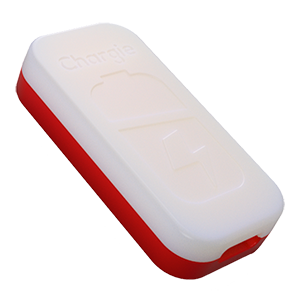
USB-C charge limiter that stops at your set battery level, so your battery never sits at 100% overnight. Extends battery lifespan by years. Works with any USB-C charger.
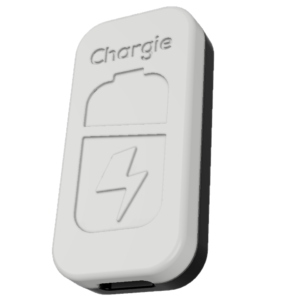
Limit your laptop charge to 80% via USB-C. Works with MacBooks, Dell, HP, Lenovo and most USB-C laptops up to 100W.
Protect Your Battery with Chargie
The world's first hardware charge limiter. Set a charge limit on any phone, tablet, or laptop — extend battery life by up to 4x.