


A phone adapter for your car seems simple enough. It’s a little gadget that plugs into the cigarette lighter or USB port so you can charge your phone on the go. But the quality of that adapter makes a world of difference. A cheap, basic charger can pump unstable power into your phone, slowly ruining its battery.
Why Your Car Charger Might Be Harming Your Phone
It feels so productive, doesn't it? Topping up your phone’s battery during your commute so you arrive with a full charge, ready to tackle the day. But what if that daily habit is secretly causing long-term damage?
The hard truth is that many standard car chargers are a direct threat to your phone's battery.
Your car’s electrical system was never designed with delicate electronics in mind. The power it provides is often called “dirty power” because it’s filled with invisible spikes and dips. This happens because the car's alternator is constantly working to power everything from the headlights to the air conditioning, which causes the voltage to shift around.
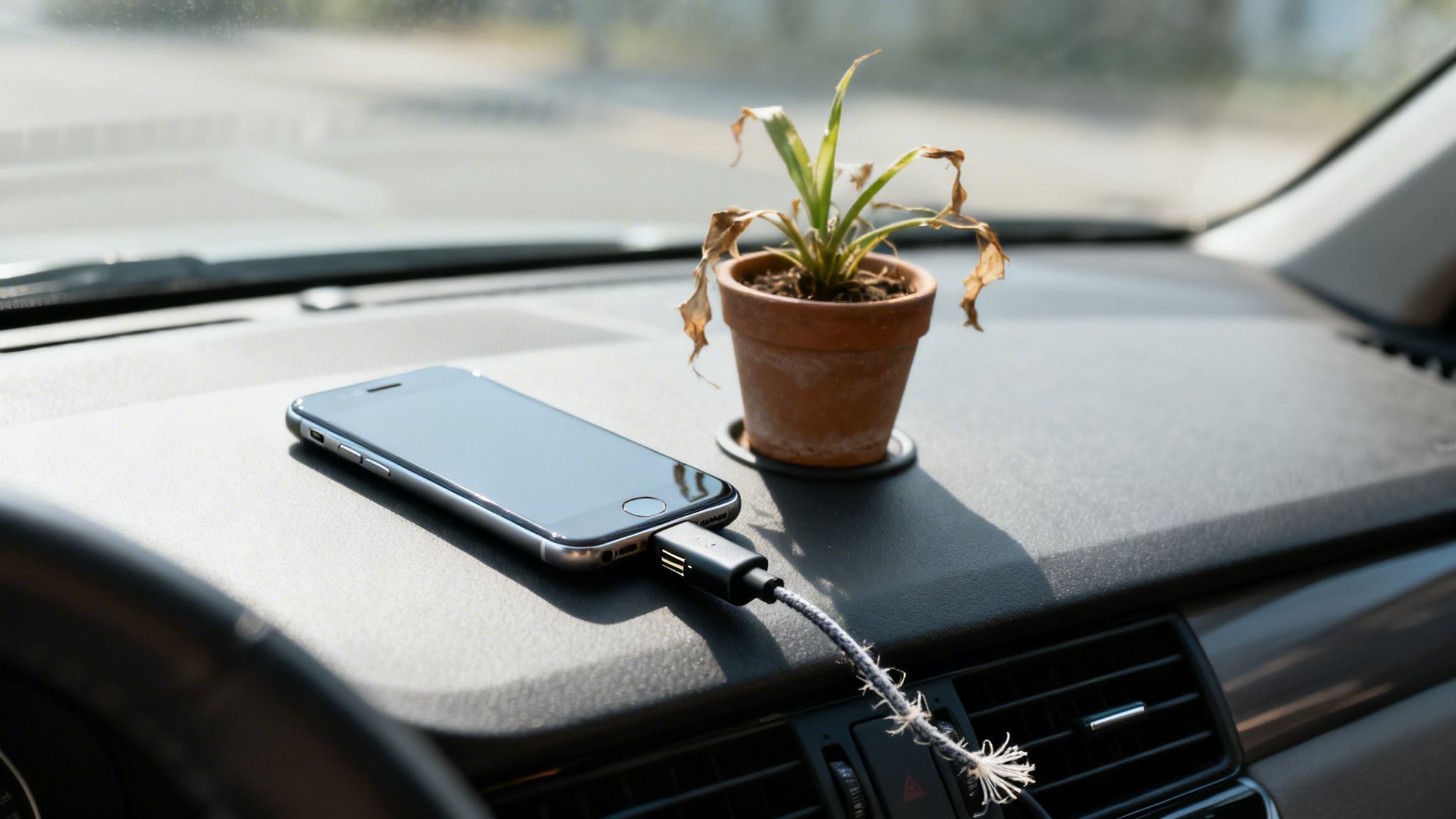
The Unfiltered Water Analogy
Think of your phone’s battery like a delicate houseplant. If you give it clean, filtered water at just the right times, it will thrive.
Using a cheap phone adapter for car charging is like blasting that same plant with unfiltered, sludgy water from a firehose—sometimes it's a trickle, other times it's a damaging torrent. This constant stress wears down the battery’s insides, and over time, you’ll notice it just can't hold a charge like it used to.
The Dangers of "Dumb" Chargers
Most generic car chargers you find at gas stations or online are completely “dumb.” Their one and only job is to shove power into your phone, with zero regard for its battery’s current state or its future. They don't regulate the voltage spikes from your car, and they’ll keep force-feeding the battery long after it hits 100%.
This is a huge problem. Holding a phone battery at a 100% charge, especially inside a hot car, is one of the fastest ways to wear it out.
This is exactly why a "smart" charging system is a wise investment, not just a fancy accessory. A smart device acts as an intelligent gatekeeper, shielding your phone from the car's chaotic electrical system. It filters out the dirty power and stops the charge at a healthy level. You can learn more about how this works in our guide that explains what is optimized battery charging.
To really see the difference, let's put a standard adapter head-to-head with a smart solution like Chargie.
Standard Car Adapter vs Smart Charging Solution
The table below breaks down the crucial differences between a generic phone adapter for car use and an intelligent system designed to actually protect your battery.
| Feature | Standard Car Adapter | Smart Adapter (e.g., Chargie) |
|---|---|---|
| Charge Limiting | No. Charges to 100% and keeps it there, causing battery stress. | Yes. Automatically stops charging at a healthy level (e.g., 80%). |
| Power Stability | No. Passes on "dirty power" with spikes and dips to your phone. | Yes. Filters and stabilizes the electrical current for clean power. |
| Data Passthrough | Often no. May block Android Auto or Apple CarPlay from working. | Yes. Allows seamless use of in-car systems while charging. |
| Long-Term Value | Low. Initial savings are quickly erased by battery replacement costs. | High. Helps your phone last longer, saving you money on repairs. |
Ultimately, choosing the right phone adapter for car charging is about more than just convenience. It’s a conscious decision to protect your expensive smartphone from the hidden dangers lurking in your car's power outlet.
The Hidden Electrical Dangers Lurking in Your Car
Plugging your phone into your car seems harmless, right? It’s something we all do without a second thought. But what most people don't realize is that the dashboard is a surprisingly hostile place for your phone’s sensitive battery.
Without something to stand guard, you’re exposing your device to a trio of silent killers that are slowly but surely destroying its ability to hold a charge.
The Problem of "Dirty Power"
Think of your car's electrical system not as a smooth river of power, but more like a choppy, unpredictable sea. This is especially true for the power coming from your alternator.
Your car’s alternator has a tough job. It has to generate electricity for everything from your headlights to your radio, all while recharging the car's own battery. Because it's constantly adjusting to these demands, the power it puts out is often unstable and "dirty."
Charging your phone with this dirty power is like trying to drink from a sputtering, surging firehose. One moment it's a trickle, the next it’s a powerful blast. This chaos puts immense stress on your phone's delicate internal parts, especially the battery.
Sudden Jolts and Power Spikes
The most dangerous moments happen when you least expect them. Every time you turn the key to start your car, you create a significant electrical spike that surges through the vehicle's system. If your phone is already plugged in, it gets hit with that jolt of energy head-on.
This initial power surge is like giving your phone’s battery a small electrical shock. A single jolt might not seem like a big deal, but repeating this hundreds of times a year—every single time you start a trip—is a recipe for a worn-out battery.
These repeated micro-shocks gradually weaken the battery's internal structure. It’s a slow burn that you won't notice at first, but it’s why your phone might suddenly struggle to make it through the afternoon without needing another charge.
The Double Threat of Heat and High Charge
It’s not just the electricity, either. The physical environment inside your car is just as hazardous. On a sunny day, the cabin can quickly soar past 100°F (38°C). Charging a phone in those conditions is incredibly destructive.
This combination creates a perfect storm for battery problems. Here’s why it’s so bad:
- Extreme Heat: Heat is the absolute worst enemy of phone batteries. It speeds up the chemical reactions inside, causing them to age much faster and lose their ability to hold a charge.
- 100% Charge Level: Keeping a battery pegged at a 100% charge already puts it under a ton of stress. Think of it like an overinflated balloon—the materials inside are stretched to their breaking point.
Leaving your phone plugged in at 100% inside a hot car is the equivalent of leaving an ice cream cone on the dashboard in July. You’re just melting its lifespan away.
Imagine a daily commuter, Sarah. She drives 30 minutes to work and 30 minutes back, plugging her phone in each time. Over a year, that's more than 500 short trips, each one starting with a power spike and often ending with her phone sitting at 100%, baking in a hot car. Unknowingly, she's created this perfect storm of heat and chaotic power, and now she wonders why her expensive smartphone needs a new battery after just one year.
This is exactly where a smart device like Chargie becomes essential. It acts as a crucial bodyguard, standing between your car's hostile environment and your phone's vulnerable battery.
Essential Features for a Modern Phone Adapter for Car Use
So, you now know your car's power system can be a bit of a wild west for your phone's battery. The question is, how do you choose the right sheriff for the job? Picking a modern phone adapter for your car isn't about grabbing the cheapest one off the shelf; it's about finding the smartest one.
There's a world of difference between a basic charger and a true battery guardian. Let's walk through the absolute must-haves for any adapter you plan on plugging into your vehicle.
Regulated Fast Charging with USB-C Power Delivery
Your first line of defense is picking an adapter with USB-C Power Delivery (PD). This is about more than just speed; it's about charging with intelligence. Old-school USB-A chargers are brute force—they just dump a fixed amount of power. USB-C PD, on the other hand, is a conversation.
Your phone and the charger actually talk to each other, allowing the adapter to supply the exact amount of power your phone needs at any given moment. It’s the difference between using a sledgehammer and a surgeon's scalpel.
And this isn't some niche tech. The automotive world is all-in on USB-C. The market for in-car USB-C adapters is set to grow from about $19 million in 2026 to nearly $120 million by 2035. Why the jump? Because 75% of drivers plug in every day, and with 60% of new cars integrating USB-C for things like Android Auto and CarPlay, the standard is here to stay.
Data Passthrough for Seamless Connectivity
In a modern connected car, your phone adapter needs to multitask. It's not just about power anymore; it has to handle data, too. This is where data passthrough becomes non-negotiable.
A lot of cheap adapters cut corners by only connecting the power pins. If you plug into one of those, you can say goodbye to in-dash systems like Apple CarPlay or Android Auto. Those systems need a data connection to work, period.
A proper phone adapter for car use must support data passthrough. It ensures that while your phone is safely charging, you can still seamlessly use your navigation, stream music, and take calls directly on your car's main display. It's a critical feature for a modern, integrated driving experience.
This flowchart paints a clear picture of the chaos a smart adapter helps you sidestep.
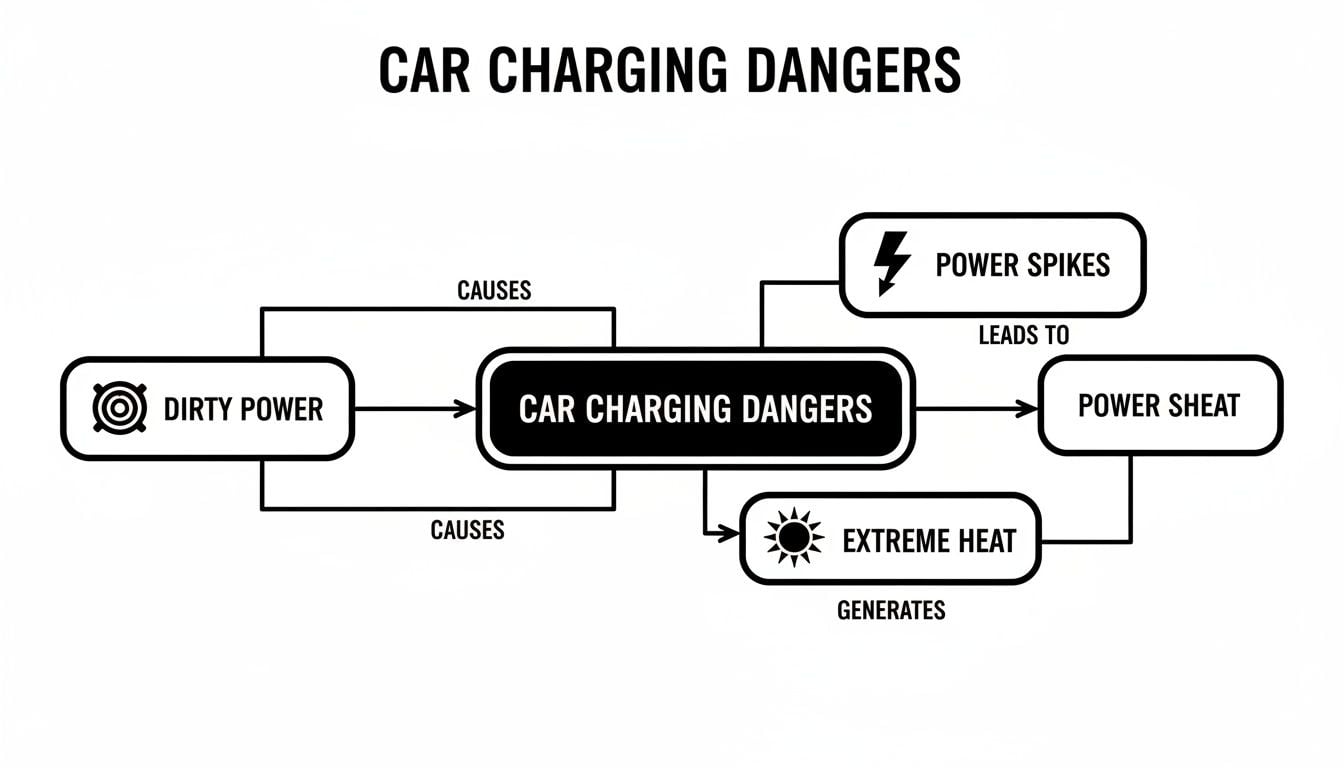
You can see how unstable power from the alternator, coupled with power spikes and brutal heat, creates a truly hostile environment for your phone's battery.
Intelligent Charge Limiting
This might be the single most important feature for keeping your battery healthy for the long haul: intelligent charge limiting. We've already covered how keeping a phone battery pegged at 100%—especially in a hot car—is a fast track to ruin. In fact, a staggering 40% of drivers experience battery swelling because of this exact scenario.
A smart adapter puts a stop to this. It automatically cuts power at a healthier, preset level, like 80%. This one change dramatically reduces the chemical stress on your battery, preventing the damage that permanently kills its capacity.
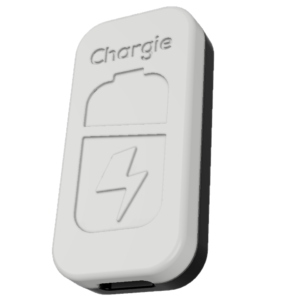
This is where the Chargie device really shines. It’s a small, clever adapter that sits between your car charger and your phone's cable. Through its app, you set your desired charge limit. Chargie's hardware then physically cuts the power when it hits that target—it works even if your phone is off or the app is closed. It's the "set it and forget it" protection your battery has been begging for. You can get all the specifics on the Chargie Type-C adapter page.
Critical Safety Protections
Finally, any adapter worth its salt needs built-in armor to handle a car's brutal environment. Two protections are absolutely essential:
- Overtemperature Protection: This acts like a thermostat, monitoring the ambient temperature. If your car turns into a greenhouse on a sunny day, it automatically cuts power to prevent your battery from charging under the worst possible conditions.
- Overcurrent and Overvoltage Protection: Think of this as a sophisticated filter. It shields your phone from the "dirty power" and sudden voltage spikes that are all too common in a vehicle's electrical system.
A generic, off-the-shelf adapter has none of this intelligence. It just passes along whatever chaotic energy the car throws at it. A smart solution like Chargie, however, upgrades any basic car charger into a powerful battery guardian, giving you all these layers of protection in one small package.
How Chargie Acts as Your Phone's In-Car Bodyguard
We’ve seen the electrical chaos lurking inside your car and what it takes for a modern phone adapter to survive it. The solution isn’t a new car or a different phone. You just need a smart bodyguard for your battery—a little gatekeeper that stands between your device and the car's wild power supply.
This is exactly the job Chargie was built for.
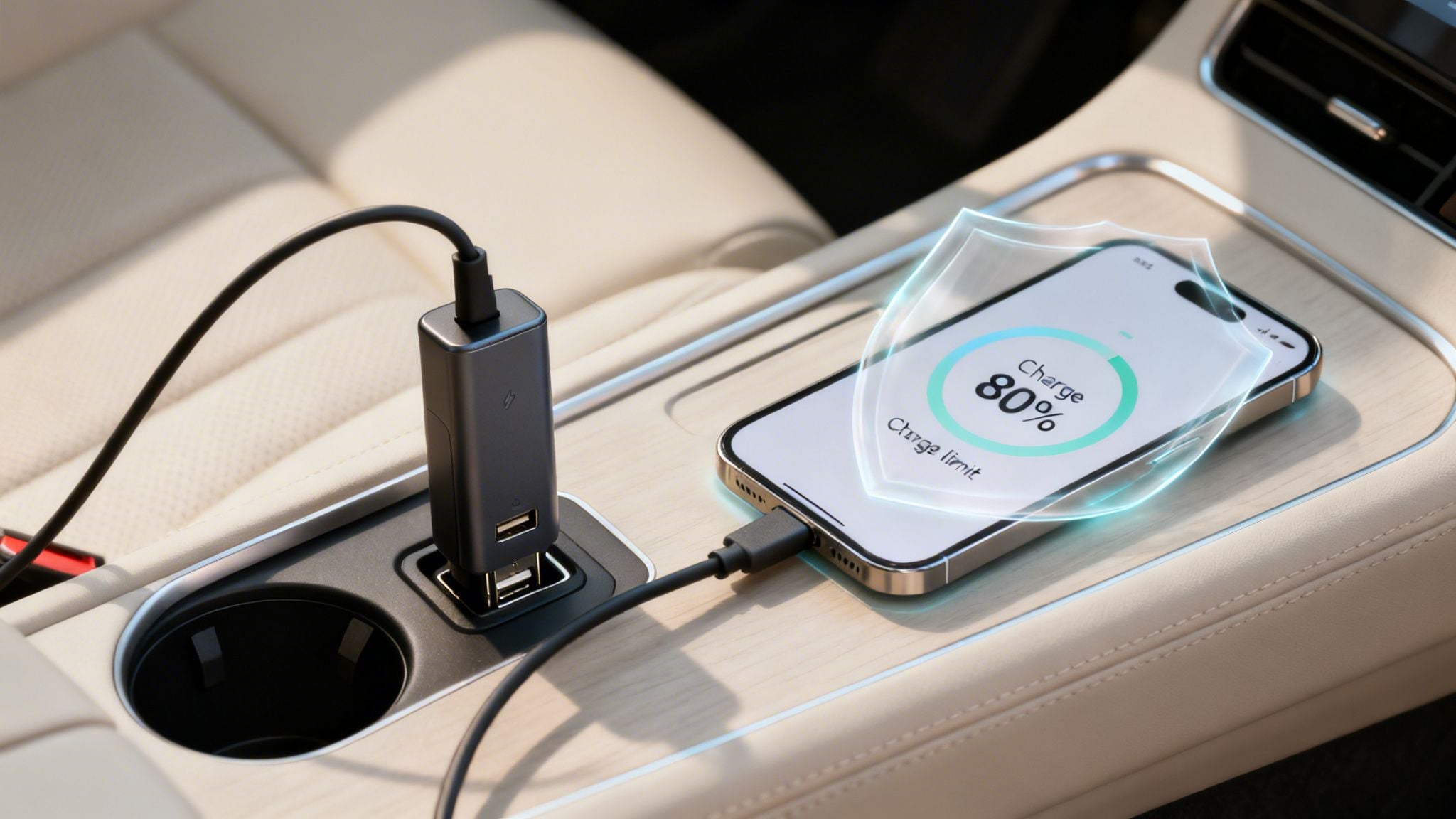
Setting Up Your Digital Gatekeeper
Chargie is designed to turn any standard car charger into an intelligent battery protector, and the setup couldn't be simpler. It's a true plug-and-play solution that takes just a few seconds.
- Plug your normal car charger into the cigarette lighter or USB port.
- Plug the Chargie device directly into your car charger's USB port.
- Connect your phone's charging cable to Chargie.
- Open the companion app and set a healthy charge limit—most people find 80% or 85% is the sweet spot.
That's it. You've just installed a powerful bodyguard that will actively shield your phone's battery every time you get in the car. We talk more about why capping the charge is so important in our deep dive on the battery charge limiter function.
The Hardware Limiter Advantage
What really makes Chargie different is its hardware-based limiter. This isn't just some app that pings you with a notification to unplug your phone. The Chargie device itself physically cuts the power the moment your battery hits the limit you set.
This is a crucial difference. Because the control happens in the hardware, it works 100% of the time. It doesn't matter if your phone is off, the app is closed, or you lose the Bluetooth connection. It's a foolproof, set-it-and-forget-it system.
The Smart Algorithm That Prevents Topping Off
Chargie’s intelligence goes even deeper. It uses a smart algorithm to avoid the constant "topping off" that wears batteries down. Instead of kicking the power back on the second the charge drops from 80% to 79.9%, Chargie is much smarter about it.
Think of it like a modern thermostat. It doesn't flick the furnace on and off every few seconds. It lets the temperature drop a few degrees before it kicks back in, efficiently keeping you comfortable.
Chargie does the same thing for your battery. It allows the charge to fall by a few percentage points before it re-engages the power. This simple step prevents the stressful little charging cycles that silently age your battery. It's a big deal, especially when you consider how much we rely on our phones in the car. The mobile chargers market hit USD 36.1 billion in 2023 and is projected to reach USD 55.6 billion by 2030, a growth fueled by commuters who need their phones for everything from navigation to music. A report from Grandview Research highlights this trend.
This constant use makes phone batteries more vulnerable than ever, turning a smart solution like Chargie from a nice-to-have into a necessity. By acting as a filter, a limiter, and a smart manager all in one, Chargie provides a real solution to the dangers lurking in your car's power outlets. It turns your daily commute from a battery-damaging chore into a safe, healthy, and productive charging session.
Real-World Scenarios Where Smart Charging Is a Must
All the talk about "dirty power" and "charge limiting" can feel a bit abstract. But when you see what happens out on the road—in your own car—it all suddenly clicks. Let's look at a few real-world stories where intelligent charging isn't just a nice-to-have feature; it's absolutely essential.

These situations show just how much we depend on our phones in the car. It's no surprise the USB car charger market is set to grow from $1.21 billion in 2025 to $1.54 billion by 2035. We're leaning on power-hungry navigation apps that can chew through 20-30% of a battery per hour, especially in heavy traffic.
The Rideshare Driver
Think about a full-time rideshare driver like Alex. His phone is his entire business—it’s his GPS, payment system, and lifeline to customers. It stays plugged into his car for 10 to 12 hours a day, constantly running apps and using data.
Without any protection, that phone is cooking at 100% charge all day, getting hit with random power spikes from the car's alternator. Just six months into the job, his battery is toast. The phone dies the second it’s unplugged. That means buying a new phone and losing a full day of income.
Now, give Alex a Chargie. He sets a charge limit of 75%. His phone’s battery is no longer maxed out and stressed. Chargie's hardware limiter cuts the power reliably, shift after shift, and its data passthrough keeps his navigation working perfectly on the car’s big screen. He’s no longer staring down the barrel of a costly mid-year phone replacement.
For professionals like long-haul truckers who basically live out of their vehicles, keeping devices powered is just as vital as having a solid internet connection. This need for reliable power and connectivity is a common thread in demanding mobile environments, a point also driven home in guides like the Semi Truck WiFi The Ultimate Guide to Staying Connected.
The Fleet Manager
Now, let's picture Maria, who manages a fleet of 200 delivery vans. Each van has a tablet for routing and proof-of-delivery, and her IT department is constantly buried in tickets for swollen or dead batteries.
It’s an obvious problem: drivers leave the tablets plugged in 24/7. They bake in hot vans and are perpetually force-fed a 100% charge. The replacement costs and operational headaches are a massive budget killer.
Maria’s solution? She deploys Chargie across the whole fleet. Using the app, she sets up a universal charging rule: an 80% charge limit and a temperature cutoff at 95°F (35°C). The hardware limiter enforces these settings no matter what the drivers do. Within a year, battery-related IT tickets plummet by over 80%, and the tablets last nearly three times as long. For Maria, Chargie wasn’t just a gadget; it was a strategic move that paid for itself many times over.
The Family Road Trip
The Miller family is on a classic cross-country road trip. The kids are in the back, streaming movies on a tablet. Up front, the parents are using their phone for navigation with Android Auto, connected to the car’s display.
This is usually a recipe for battery abuse. The tablet in the back hits 100% and starts to get hot, while the parents’ phone is also getting cooked. But the Millers are using a Chargie.
- The kids’ tablet has its charge capped at 80%, so it runs cool and safe for the entire drive.
- The parents’ phone gets the power it needs for Android Auto, but without the stress of overcharging.
Everyone’s device stays healthy, and the trip is a success. No drama, no dead batteries.
The EV Owner
Finally, meet Ben, a new electric vehicle owner. He loves that his car's USB ports are always on, even when the car is off. But he quickly discovered a new problem: if he forgets his phone plugged in overnight, it just sits there at a damaging 100% charge for hours on end.
Ben’s fix is a Chargie. Its hardware limiter is the perfect safeguard. It stops the charge automatically, protecting his phone from sitting at full capacity even if it’s left in the car for days. It’s a simple solution to a modern problem, letting him enjoy his EV's convenience without wrecking his phone’s battery.
Answering Your Questions About Smart Car Charging
Even with all the benefits laid out, it's understandable to still have questions. When it comes to something as vital as your phone's battery, you want to be absolutely sure you’re making the right call. So, let's tackle some of the most common questions about using a smart phone adapter for car charging.
Can’t I Just Unplug My Phone Myself at 80%?
This is a common thought, and on the surface, it makes sense. If you know that charging to 100% is the problem, why not just unplug it when it hits a healthier level, like 80%? The honest answer is that trying to do this manually is a recipe for failure.
Think about it. Are you really going to watch your phone’s battery percentage like a hawk every single time you drive? What about when you're focused on navigation, taking a call, or just trying to enjoy the ride? It's incredibly easy to forget. Next thing you know, you've arrived, and your phone has been sitting at a stressful 100% for the last 20 minutes of your trip.
More importantly, just unplugging the phone does absolutely nothing to protect it from the car’s “dirty power.” It won't stop the voltage spikes when you start the engine or filter out the unstable current from the alternator. You’re only solving one tiny piece of the puzzle, leaving your battery exposed to all the other dangers lurking in your car's electrical system.
A dedicated solution like Chargie takes care of the entire process for you. Its hardware limiter acts as a foolproof gatekeeper, cutting off the charge at your set limit, every single time. You don't even have to think about it.
Are Fast Car Chargers Bad for Batteries?
This is a popular myth that needs a bit of clearing up. Fast charging itself isn't inherently bad for your phone's battery. Modern batteries are actually designed to handle it, especially when they're at a low state of charge. The real damage comes from unregulated fast charging when the battery is almost full.
When a battery is nearly topped off, it can't accept energy as quickly. A "dumb" fast charger doesn't know this and will just keep trying to force power into it. This generates a ton of excess heat and puts serious stress on the battery's internal parts. It’s like trying to top off an already-full glass of water with a firehose—messy and destructive.
A smart phone adapter for car use manages this process with intelligence. It allows for fast charging when your battery is empty and needs it most, then gently tapers off the power as it gets closer to your limit. This ensures the whole process is both quick and perfectly safe.
Does a Device Like Chargie Work with an Older Car?
Absolutely. One of the best things about a device like Chargie is its universal compatibility. It doesn’t matter if you’re driving a brand-new EV or a trusty 15-year-old sedan.
As long as your car has a USB port—whether it’s built-in or from a simple cigarette lighter adapter—Chargie can work its magic. It just sits between your power source and your phone, adding a layer of intelligent protection that older vehicles never had. In effect, it modernizes any car's charging system.
Will Chargie Block Android Auto or Apple CarPlay?
This is a critical point for any modern driver, and the answer is a firm no. We specifically designed Chargie with a full data passthrough feature for this exact reason.
This means it doesn't just manage power; it also allows all data to flow freely between your phone and your car's infotainment system. You can run Android Auto or Apple CarPlay for navigation, music, and calls without any interruption. All the while, Chargie is working silently in the background to protect your battery. You get the best of both worlds: seamless connectivity and smart, safe charging.
Answering these questions makes it clear that a dedicated smart charger is far more than a convenience—it’s an essential tool for protecting your investment. Ready to give your phone the in-car bodyguard it deserves?
Learn more about Chargie and order yours at https://chargie.org
USB-C charge limiter that stops at your set battery level, so your battery never sits at 100% overnight. Extends battery lifespan by years. Works with any USB-C charger.
Limit your laptop charge to 80% via USB-C. Works with MacBooks, Dell, HP, Lenovo and most USB-C laptops up to 100W.
Protect Your Battery with Chargie
The world's first hardware charge limiter. Set a charge limit on any phone, tablet, or laptop — extend battery life by up to 4x.