


Have you ever plugged your phone in overnight and just… trusted it? Trusting it not to overcharge, get too hot, or worse? That trust isn't blind; it’s placed in a tiny, unsung hero working inside your battery pack: the Battery Management System (BMS).
Think of it as a tiny, full-time supervisor living inside the battery of your phone, laptop, or even your electric car. Its entire job is to be the responsible adult in the room, constantly watching over the delicate battery cells to make sure they behave. It's the electronic brain that makes today's powerful batteries safe enough for us to carry in our pockets.
The Brain of the Battery
A BMS is the central nervous system for a battery pack. It’s a small circuit board packed with electronics that acts as a guardian, watching over every important part of the battery's operation in real time. Without it, the powerful chemistry of a modern battery would be far too risky for everyday products.
It’s constantly checking a list of vital signs:
- Voltage: It stops the cells from being overcharged (a major cause of wear) or drained too low (which can cause permanent damage).
- Current: It protects against dangerous power surges or short circuits.
- Temperature: It makes sure the battery doesn’t get dangerously hot or cold, preventing safety issues or performance drops.
- State of Charge (SoC): This is the magic that calculates and reports how much juice is left. It’s how your phone knows it has exactly 47% battery remaining.
This constant supervision isn’t just a nice-to-have feature; it's a critical safety requirement. The BMS is there to prevent immediate, serious problems.
Core Functions of a Battery Management System
To put it simply, the BMS has three critical jobs. We've summarized them here so you can see at a glance what this little circuit board is handling every second of the day.
| Function | What It Does | Why It Matters |
|---|---|---|
| Monitoring | Tracks voltage, current, temperature, and calculates the State of Charge (SoC). | Provides real-time data to keep the battery within safe operating limits and tells you how much power is left. |
| Protection | Disconnects the battery if it detects dangerous conditions like over-voltage, under-voltage, over-current, or extreme temperatures. | This is the primary safety net that prevents fires, overheating, and other serious failures. |
| Balancing | Ensures all the individual cells in a battery pack are charged and discharged evenly. | Prevents certain cells from wearing out faster than others, which improves the overall performance and useful life of the pack. |
These functions are what make modern lithium-ion batteries possible, but as you can see, their focus is on immediate safety and basic functionality, not necessarily long-term health.
The Crucial Difference: Safety vs. Longevity
Here’s the key thing to understand: the primary job of a BMS is to act as a safety net. It prevents disasters. For example, it allows your phone to charge to 100% and will only step in if the voltage gets dangerously high.
However, it won't stop you from doing things that, while "safe" in the short term, are slowly shortening your battery's useful life. Keeping a battery constantly at 100% creates high-voltage stress that wears down the cells. In fact, research shows this single habit can cause a battery to lose its capacity 20-30% faster. You can find more insights on the battery management market and its challenges online.
A BMS prevents the house from burning down, but it won’t remind you to perform the regular care that keeps it in great shape for years to come. That’s where smart charging habits and tools like Chargie come in. They work with your device's BMS to focus on long-term health, not just preventing an emergency.
The BMS: Your Battery's Unseen Guardian and Its Four Core Duties
Every modern battery pack has a tiny, unsung hero working tirelessly inside: the Battery Management System, or BMS. Think of it as your battery's dedicated guardian, a vigilant brain on a circuit board that juggles four critical jobs to keep things running safely and smoothly. It’s the reason our powerful lithium-ion batteries don’t just fail unexpectedly.
This map gives you a high-level look at how a BMS acts as the central command for everything happening inside your battery.
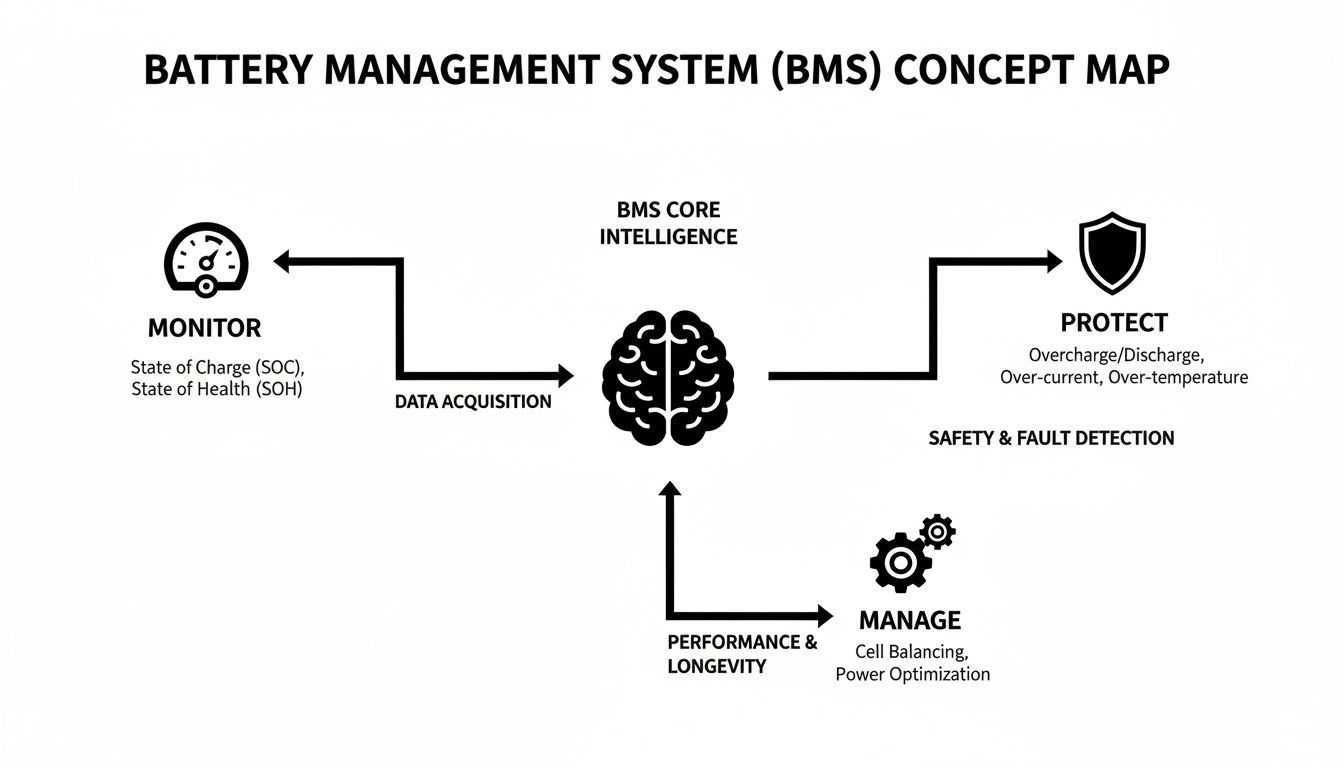
As you can see, it's an interconnected system. The BMS is constantly watching, protecting, and balancing—so let's pull back the curtain on each of these roles.
Job #1: Monitoring the Vitals
First and foremost, a BMS is a relentless watchdog. It’s like having a doctor attached to your battery, constantly taking its vital signs 24/7. This isn't a casual glance; it's a careful check of all important details.
It keeps a close eye on a few key metrics:
- Cell Voltage: It watches the voltage of every individual cell, making sure none get pushed too high during charging or drop too low when you're using your device.
- Current Flow: It measures the electricity flowing in and out, preventing dangerous surges that could damage the cells.
- Temperature: With built-in sensors, it tracks heat to ensure the battery operates in its sweet spot—not too hot, not too cold.
This constant stream of data is the bedrock for everything else the BMS does. Without it, the system would be working blind.
Job #2: Protecting Against Disaster
With all that data pouring in, the BMS is ready to act as a bodyguard. This is its protection function. If any measurement strays into the danger zone, the BMS doesn't hesitate—its response is instant and decisive.
The number one job of the protection circuits is to prevent a serious failure. It slams the door shut by disconnecting the battery before a problem can escalate into something dangerous like a fire.
Let's say you plug in a cheap, faulty charger that's pumping out way too much voltage. The BMS will cut the power before your battery overcharges. Similarly, if a short circuit happens internally, the BMS will immediately trip the connection to stop a dangerous overheating event in its tracks. It's your ultimate safety net.
Job #3: Balancing the Cells for Teamwork
The third job is more subtle but absolutely critical for the battery's long-term health: cell balancing. A battery pack isn't a single unit; it's a team of individual cells. And just like any team, some members can get out of sync.
Over time, tiny variations from manufacturing or exposure to different temperatures can cause some cells to charge and discharge at slightly different rates. This imbalance forces the weaker cells to work harder, causing them to wear out much faster and ultimately dragging down the performance of the entire battery pack.
The BMS acts like a coach to get everyone on the same page, using one of two methods:
- Passive Balancing: It gently bleeds a tiny bit of energy from the most-charged cells as heat, allowing the weaker ones to catch up.
- Active Balancing: A more advanced method where it moves energy from the strongest cells to the weakest ones, making the whole team more efficient.
This balancing act ensures all the cells age together gracefully, which maximizes the battery's total capacity and useful life.
Job #4: Communicating Status and Health
Finally, the BMS has to translate all its complex internal data into something we can actually understand. This is its communication role. All the raw numbers—voltage, current, temperature—would be useless if they just stayed on the circuit board.
The BMS reports this information to your device's operating system in a simple format. When your phone’s screen shows you have 23% battery left, you're looking at data straight from the BMS. It calculates the State of Charge (SoC) and tells your phone what to display.
It also provides a State of Health (SOH) estimate, which gives you a rough idea of how much the battery has worn down over time. But here’s the catch: a BMS is built for safety, not necessarily for optimal longevity. While it prevents immediate disaster, an external tool is far more effective for managing long-term health. A dedicated battery charge limiter like Chargie works with your BMS to enforce healthier charging habits, like stopping at 80%—a simple yet powerful action that a standard BMS just isn't designed to do on its own.
Internal BMS vs. External Smart Charging
It’s a common mix-up to think that your device's built-in Battery Management System (BMS) does the same job as an external smart charging solution. But they have fundamentally different goals. Getting this difference is the key to understanding what a battery management system is truly for—and what it isn't.
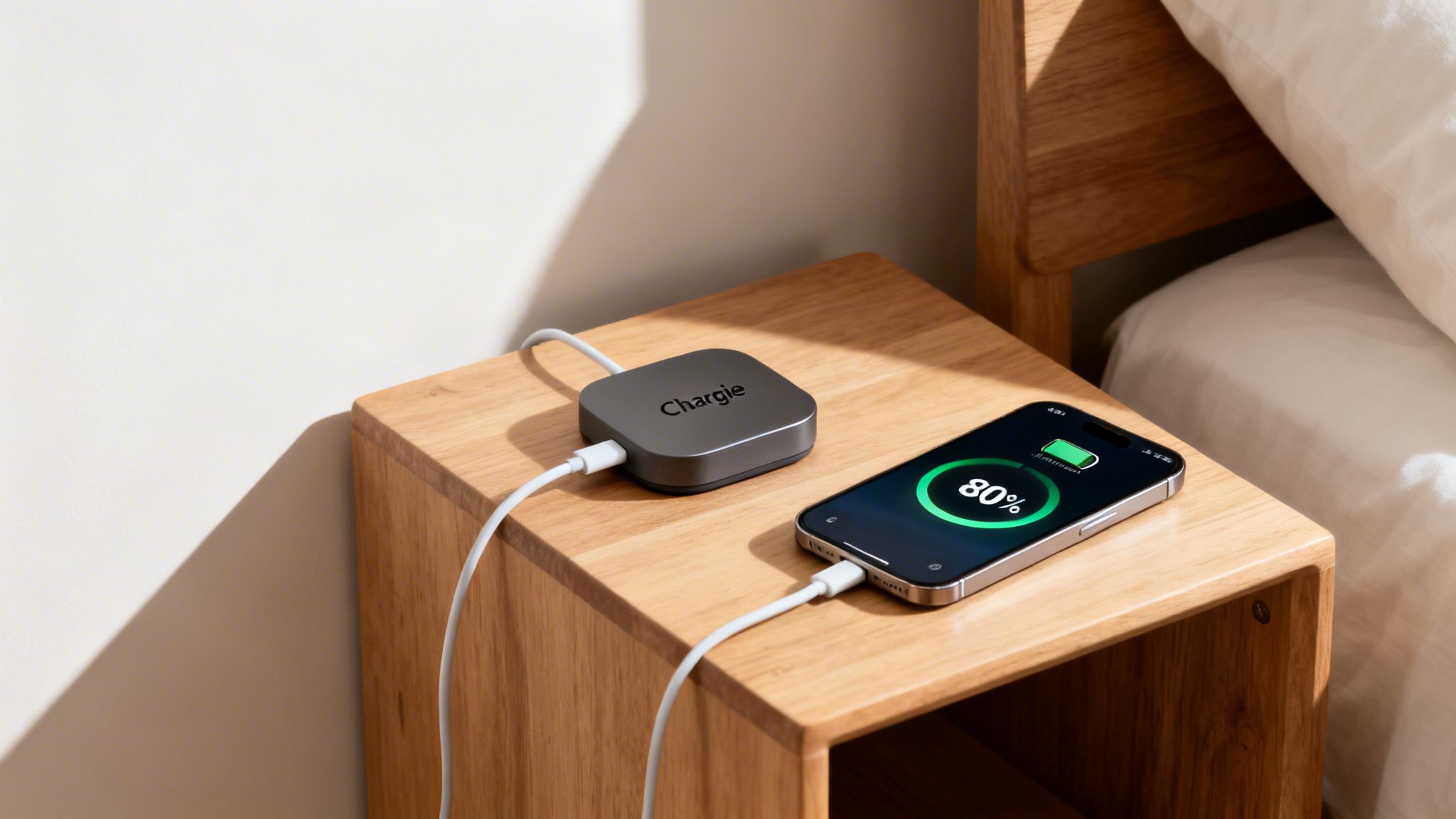
Think of the internal BMS as the battery's security guard. Its one and only job is to be a safety net, preventing things from going horribly wrong. It’s there to stop major events like over-voltage, short circuits, or extreme temperatures that could spark a fire. It draws hard lines in the sand for safety.
But here’s the thing: that guard doesn't care about long-term wear and tear. It will absolutely let your device charge all the way to 100% and sit there for hours. From a disaster-prevention standpoint, that's fine. But for the battery's chemistry, staying at that high-voltage state is incredibly stressful and a primary cause of premature aging.
The Longevity Manager for Your Battery
This is where an external smart charger like Chargie comes into the picture. If the BMS is the security guard, think of Chargie as the battery’s personal wellness coach. It works with the BMS, adding a layer of intelligence that’s laser-focused on one thing: extending the battery's useful life.
Chargie smartly manages the power flow before it even gets to your phone. Instead of just letting the battery cram itself to a stressful 100%, you use the app to set a healthier ceiling, like 80% or 90%. Once your battery hits that goal, Chargie’s hardware physically cuts the power. No more sitting at full charge all night long.
It’s the perfect partnership:
- The Internal BMS focuses on immediate, critical safety (preventing explosions).
- The External Chargie focuses on long-term health (preventing premature aging).
Chargie isn't trying to replace your BMS. It’s an intelligent partner that adds a function the BMS was never designed for. It gives you direct, hardware-level control over your battery’s health in a way that built-in systems simply don’t offer. While your phone might have some software tricks for "optimized charging," Chargie provides a guaranteed hardware cutoff.
An internal BMS is reactive—it only steps in when a safety line is about to be crossed. An external smart charger like Chargie is proactive, implementing a strategy from day one to keep your battery healthy for years.
Practical Applications and Real-World Impact
The benefits of this tag-team approach are crystal clear, especially for any device you plug in for long periods. Leaving a phone at 100% overnight degrades its cells 2-3 times faster—much like how keeping an EV fully charged all the time wears down its expensive battery pack.
By enforcing healthier 50-70% charging sweet spots, Chargie's hardware limiter and scheduler can deliver up to four times more charging cycles and save users 80-85% on battery replacement costs down the road. That's why it's trusted by over 50,000 people and even endorsed by labs like Nokia to help cut down on e-waste. If you're curious about the industry as a whole, this Battery Management System market report offers a broader look.
This idea of smart power management pops up in other fields, too. For instance, a Load Balancing Laadpaal does something similar for EV charging stations by managing power distribution efficiently. The core principle is the same: intelligently controlling power flow leads to better performance, safety, and longevity.
How BMS Technology Powers Our World
The Battery Management System isn't just a tiny circuit board hiding inside your phone. It's the unsung hero that makes our modern, battery-powered lives possible. The same core ideas of monitoring, protecting, and managing battery cells scale from pocket-sized gadgets all the way up to massive industrial systems, with each step presenting its own unique puzzles to solve.
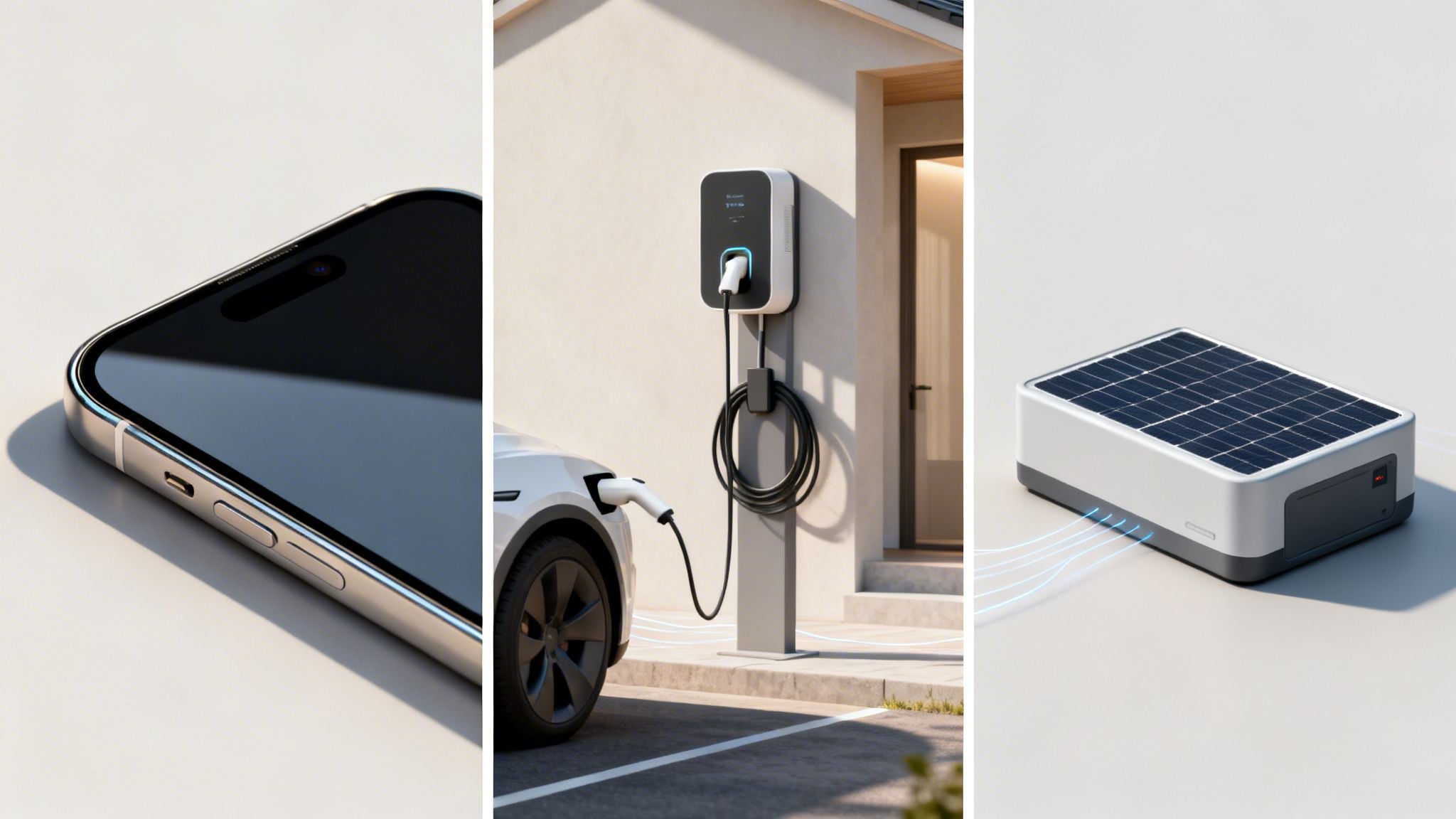
Think about the journey this technology takes. It starts with the devices we carry every day, scales up to the cars we drive, and even supports the vast power grids that light up our communities. It’s this incredible versatility that has allowed batteries to take over the world.
From Your Pocket to the Pavement
For consumer electronics like our phones and laptops, the BMS works on a tiny scale. The biggest headaches for engineers here are size and heat. The system needs to be incredibly small and efficient to squeeze into a slim device without making it feel warm to the touch. Its main job is simple: protect a handful of cells from immediate harm in a very tight space.
Then you get to electric vehicles (EVs). Suddenly, the BMS graduates from a simple bodyguard to a full-blown command center. It's no longer watching over a few cells; it's coordinating thousands of them, all working together to unleash huge amounts of power.
An EV’s BMS has some serious responsibilities:
- Keeping you safe: It’s constantly on the lookout for any hint of a problem, like overheating or an imbalanced cell, that could spell disaster at high speeds.
- Telling you how far you can go: It’s what calculates that all-important "miles to empty" number, a critical piece of info for any driver.
- Managing the charge: It carefully controls the high-voltage electricity flowing in from a charging station to make sure the battery pack refills safely and effectively.
The jump in complexity is just massive, and it really shows you how adaptable this technology has to be.
Powering the Future Grid
The BMS’s job gets even bigger when we look at grid-scale energy storage. We’re talking about colossal battery banks, some as large as several shipping containers, built to soak up extra power from renewable sources like solar and wind farms.
When the sun goes down or the wind stops blowing, these giant battery systems kick in, feeding their stored energy back to the grid to keep things stable. A highly sophisticated BMS is the brain behind this entire operation, ensuring a reliable stream of power for whole towns and cities.
In the booming EV world, a top-notch BMS is non-negotiable. It has to manage battery packs that can exceed 100kWh and prevent the kinds of cell imbalances that can lead to dangerous overheating events. The market shows just how critical this is, growing from $8.48 billion in 2024 to an expected $9.15 billion in 2025 as carmakers bake advanced systems into their designs to support long-term warranties.
For applications in extreme environments like space or military tech, the reliability of a BMS is everything. These systems often depend on specialized parts, like radiation-hardened microcontrollers, to guarantee they work perfectly under the most brutal conditions.
The world of BMS applications is incredibly diverse, with different goals and challenges depending on the scale.
BMS Applications Across Different Scales
| Application | Primary BMS Goal | Key Challenge |
|---|---|---|
| Consumer Electronics | User safety and maximizing useful life in a small space | Size constraints, heat dissipation, and cost |
| Electric Vehicles | Safety, accurate range estimation, and fast charging | Managing thousands of cells and high-voltage systems |
| Grid Storage | Grid stability, efficiency, and long-term reliability | Enormous scale, integration with the grid, and longevity |
From a tiny chip in your phone to the massive systems that will one day power our cities, the Battery Management System is truly the silent hero enabling our electrified future.
The Future of Battery Management
The world of battery technology isn't sitting still, and the Battery Management System is right in the middle of all the action. The next generation of BMS tech is moving beyond simply reacting to problems—it's learning to predict and even prevent them. We're stepping into a new era where our batteries are cared for by systems that anticipate our needs and adapt on the fly.
Two major advancements are paving the way: wireless systems and artificial intelligence.
Smarter Systems with AI and Machine Learning
Picture an electric vehicle without that tangled, heavy web of wires connecting thousands of individual battery cells. That's the promise of wireless BMS (wBMS). By allowing cells to communicate without physical links, it simplifies car design, cuts down on weight, and boosts reliability. It’s a game-changer for EVs and other complex battery packs.
But the even bigger leap forward is adding artificial intelligence (AI) and machine learning into the mix. Future battery management systems won't just be watching voltage and temperature. They'll be digging through huge amounts of data to learn your specific habits. They'll be able to spot potential battery failures weeks or even months before they happen, giving you a heads-up to get things checked out.
This turns a BMS from a simple bodyguard into a personal wellness advisor for your battery. It can tweak charging strategies based on your daily commute, the weather, and the battery's age to squeeze every last bit of performance and life out of it.
This kind of smart management is becoming essential. With the growth of renewable energy, we need massive battery storage systems to keep the power grid stable. In these giant setups, a BMS uses AI for predictive maintenance, which can extend the battery's useful life by up to 50% and ensure the lights stay on. It's no wonder the market for battery energy storage systems (BESS), which leans heavily on smart BMS tech, is expected to reach $81.6 billion by 2026. You can dive deeper into the BMS market and its drivers to see just how fast things are moving.
Future systems won’t just react to what has already happened. They will use smart algorithms to make intelligent decisions about what’s going to happen next, optimizing for both safety and longevity.
The Future of Charging Is Already Here
While these super-advanced, predictive internal systems are still finding their way into the phones and laptops we use every day, you don't have to wait to get this next-gen intelligence for your own gadgets. External smart charging tools are bringing these principles to everyone, right now.
A device like Chargie is the perfect example of this forward-thinking approach. It works right alongside your device's existing BMS, adding that intelligent, proactive layer that most internal systems are only just starting to dream about. Using a clever app and a small hardware piece, Chargie learns your schedule and applies healthy charging limits that a standard BMS simply isn't programmed to do.
For instance, you can use its "Top Up Scheduler" to keep your phone at a stable, low-stress 50-70% charge overnight. Then, just before you wake up, it finishes the job, topping it off to a much healthier 90% instead of keeping it pinned at 100% for hours. This is exactly the kind of smart, pattern-based optimization that future BMS technology is aiming for.
Chargie gives you a head start on the future of battery care, turning these big-picture concepts into simple, practical actions you can take to protect your devices today.
Your Guide to Smart Battery Habits
Okay, so you know what a Battery Management System is and what it does. Now, let's talk about what you can actually do with this knowledge to protect your gadgets and cut down on e-waste.
Here’s the most important thing to remember: your internal BMS is a safety guard, but you are the longevity manager. It’s there to stop an immediate fire or explosion, but it’s perfectly happy to let you charge in ways that slowly shorten your battery's life over time.
The good news is, you can take back control of your device's long-term health with just a few small changes. These habits directly tackle the chemical stresses that a basic BMS isn’t built to handle, giving you a real, tangible way to make your gadgets last longer.
Simple Habits for a Healthier Battery
Changing your charging routine just a little can make a massive difference. Each of these tips is designed to fight the two biggest enemies of a lithium-ion battery: high voltage and too much heat.
Here are a few practical steps you can start with today:
- Avoid Overnight Charging to 100%: This is, without a doubt, the most destructive habit. Leaving your device at 100% for hours on end puts constant high-voltage stress on the battery, which rapidly eats away at its capacity. The BMS allows this, but your battery is paying the price.
- Keep Your Charge Between 20-80%: This is the sweet spot for lithium-ion chemistry. Staying within this range dramatically reduces stress on the cells, and you’ll see a huge increase in the number of charge cycles your battery can handle.
- Don't Charge in Extreme Heat: Charging already generates heat. If you add a hot car or direct sunlight to the mix, you can easily push temperatures into the danger zone, causing permanent damage to the battery cells.
- Use a Smart Scheduler: Plan your charging. Instead of leaving your phone plugged in all night, give it an hour or two before bed and then top it off in the morning if you need to.
The goal isn’t to be perfect. It’s to be consistent. Just shifting away from the old 0% to 100% charging mindset is the key to making a real difference in your battery’s useful life.
Automate Your Success with Chargie
Let's be honest—remembering all these rules can feel like a chore. This is where Chargie comes in and becomes your best friend for effortless battery care. It turns these smart habits into a simple, set-and-forget routine.
Chargie's hardware and app work together to physically cut the power at whatever level you choose—say, 80%. This means you can plug your phone in overnight without a single worry. The scheduler can even hold the battery at a stable 50% all night and then finish charging it right before you wake up. It’s simply the easiest way to make sure your devices are always treated right.
This intelligent charge limiting mimics the advanced systems used in high-value tech, like EVs and large-scale energy storage. In fact, the global BMS market is projected to rocket from $14.24 billion in 2025 to $80.74 billion by 2035, all driven by this exact need. Tools like Chargie bring those same advanced principles right to your personal gadgets, delivering up to 4x more cycle life and saving you a ton on replacement costs. You can dig into these market trends and their drivers to see the bigger picture.
For even more tips, check out our full guide on lithium-ion battery charging best practices.
Frequently Asked Questions About BMS
We've gone deep on what a battery management system is, from its core jobs to how it differs from external tools. But a few common questions always pop up that really bring these ideas home.
If My Device Has a BMS, Why Do I Need Something Else?
This is a great question. Think of your device’s built-in BMS like the airbags in your car. It’s an amazing safety feature designed to prevent a total catastrophe—like a fire or an explosion—but it's not there to prevent the daily wear and tear on your engine.
The BMS will happily let you charge to 100% and keep it there for hours, which is one of the fastest ways to wear out a battery. It's purely a safety guard.
An external tool like Chargie is more like a wellness coach for your battery. It steps in to enforce healthier habits, like stopping the charge at 80%. This is a proactive strategy focused on one thing: getting the absolute maximum useful life out of your battery. The built-in BMS just wasn't designed for that job.
Can a Battery Management System Fail?
Yes, it can, though it’s pretty rare in modern, well-made devices. When a BMS does fail, it can cause the battery to stop working entirely, give you wildly incorrect charge levels, or—in the worst-case scenario—fail to stop a dangerous overheating event.
But what most people think of as a BMS "failure" is often just the battery reaching the natural end of its life. A BMS is great at monitoring and reporting on a battery's declining health, but it can’t stop that decline without smarter charging habits in the mix.
Is the BMS in a Laptop Different From One in an EV?
While they share the same basic principles, the scale and complexity are worlds apart. It’s like comparing the manager of a local coffee shop to the CEO of a massive global corporation.
- A laptop BMS is looking after a handful of cells packed into a tiny space. Its main worries are heat and physical size.
- An EV BMS is a hugely sophisticated computer system. It’s coordinating thousands of individual cells, managing massive amounts of power, dealing with extreme temperatures, and, above all, guaranteeing the driver's safety.
Ready to take control of your battery's long-term health? Join over 50,000 users who are extending the life of their devices with Chargie. It's the simple, set-and-forget solution for smarter charging. Get yours at https://chargie.org.
USB-C charge limiter that stops at your set battery level, so your battery never sits at 100% overnight. Extends battery lifespan by years. Works with any USB-C charger.
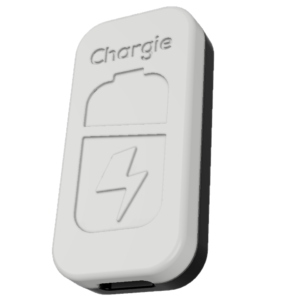
Limit your laptop charge to 80% via USB-C. Works with MacBooks, Dell, HP, Lenovo and most USB-C laptops up to 100W.
Protect Your Battery with Chargie
The world's first hardware charge limiter. Set a charge limit on any phone, tablet, or laptop — extend battery life by up to 4x.