
What 22,700 EVs Teach Us About Saving Your Phone Battery
Your electric vehicle battery will almost certainly outlast your phone battery — and the surprising reason has nothing to do with the battery itself.
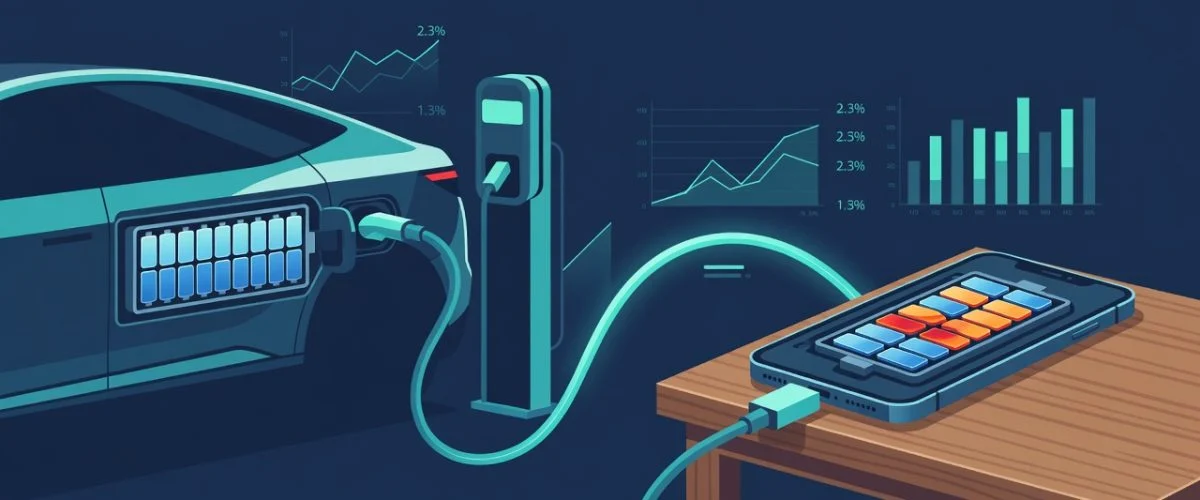
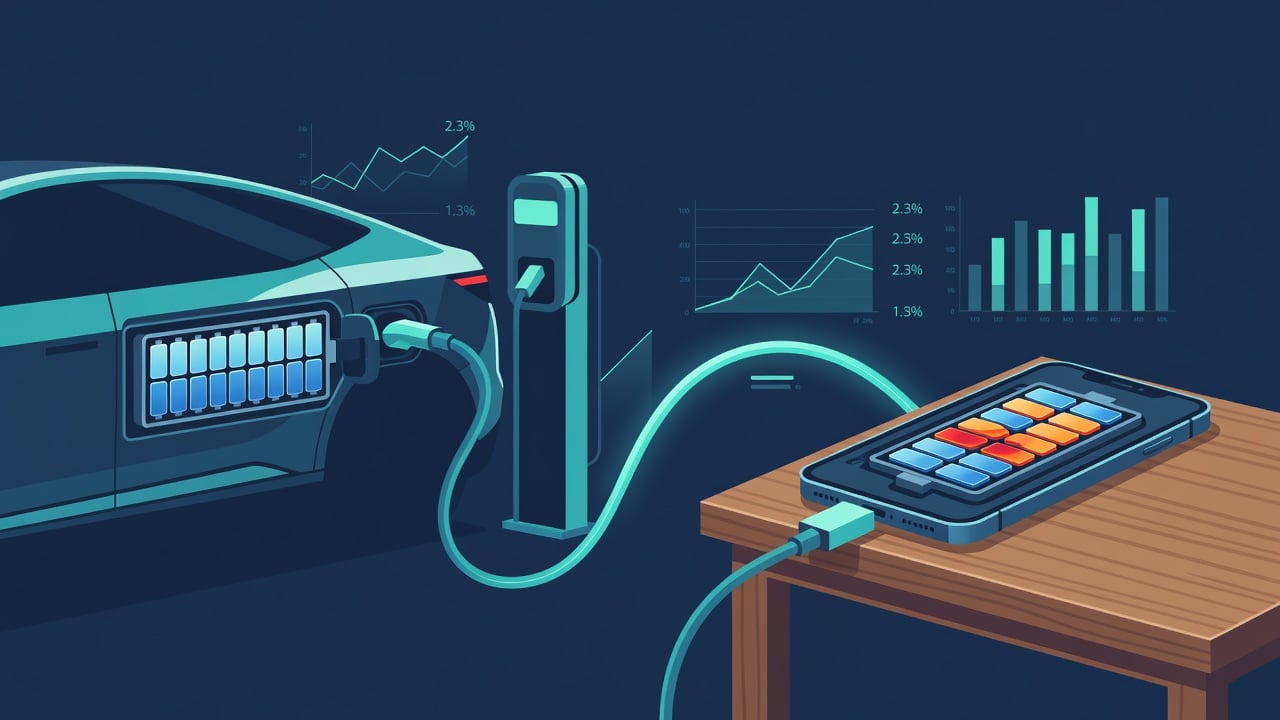
In January 2026, Geotab dropped one of the largest real-world battery studies ever conducted: 22,700 electric vehicles across 21 makes and models, tracked over several years. The finding that grabbed headlines was straightforward enough — modern EV batteries degrade at about 2.3% per year on average. But buried deeper in the data is something every smartphone owner should understand: EVs last because they are actively managed. Your phone is not.
Both devices run on the same chemistry (lithium-ion). Both face the same enemies (heat, high voltage, time spent at 100%). But EV manufacturers pour billions into battery management systems, active cooling, and built-in charge limits — protections your phone simply doesn’t have.
Here’s what Geotab’s massive dataset reveals about the habits that preserve battery health — and how to apply them to the device that matters most: your phone.
The Geotab Study: By the Numbers
Geotab’s updated analysis sampled more than 22,700 EVs, making it one of the most statistically robust battery health datasets available. Key figures from the January 2026 update:
| Factor | Impact on Annual Degradation |
|---|---|
| Overall average | 2.3% per year |
| Up from 2024 | 1.8% → 2.3% (more fast charging) |
| Low-power AC charging | ~1.5% per year |
| High-power DC fast charging (>100 kW) | Up to 3.0% per year |
| Hot climate penalty | +0.4% per year |
The data also challenged old assumptions: vehicles that used a wide state-of-charge range did not show meaningfully higher degradation unless they habitually spent more than 80% of their time near full or near empty. The lesson? Avoid the extremes.
EV Habit #1: Cap Daily Charging at 80%
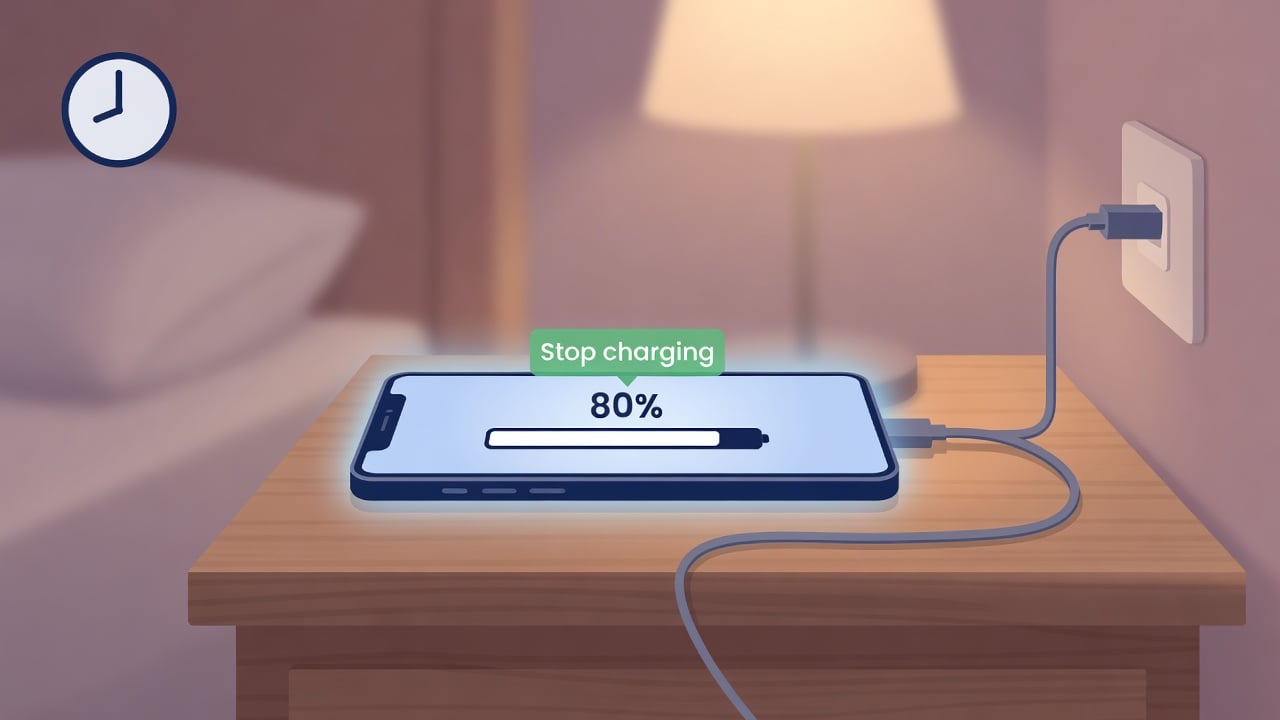
Walk into any EV owner forum and you’ll find the same advice repeated endlessly: “Set your daily charge limit to 80%. Only go to 100% before road trips.” This isn’t superstition — it’s engineering reality.
Keeping a lithium-ion battery at 100% state of charge (SOC) keeps it at its highest voltage, which stresses the electrolyte and accelerates chemical degradation over time. Geotab’s data confirmed this indirectly: the worst degradation happened when vehicles routinely sat at the extremes.
Most modern EVs have this feature built into their software. A single setting. One tap. Your phone? Unless you own a recent Samsung with the “Protect battery” toggle (which locks you at 85% with no customization) or an iPhone relying on Apple’s “Optimized Battery Charging” (which guesses your schedule and might delay the final 20% — or might not), you have no real control.
EV Habit #2: Active Thermal Management
EVs pump liquid coolant through their battery packs during fast charging, keeping cells in a tight temperature window (typically 15–35°C / 59–95°F). Geotab found that EVs in hot climates degraded about 0.4% faster per year even with this cooling — now imagine your phone, with its zero active cooling, charging on a summer nightstand at 40°C (104°F).
Phones passively radiate heat through their chassis. Many users compound the problem with insulating cases, charging face-down on blankets, or leaving them in car mounts baking under windshields. An EV battery in that scenario would throw thermal alarms and throttle charging; your phone just gets slower and hotter.
| Protection | EV | Phone |
|---|---|---|
| Charge limit (80% daily) | Built-in software | Often unavailable |
| Active cooling during charging | Liquid thermal management | Passive only; case makes worse |
| Temperature monitoring & alerts | Real-time BMS dashboards | Hidden from user |
| Taper curve (slow as battery fills) | Automatic, aggressive taper | Modest taper after 80% |
| Time at 100% | Minutes (charging cutoff) | Hours (overnight) |
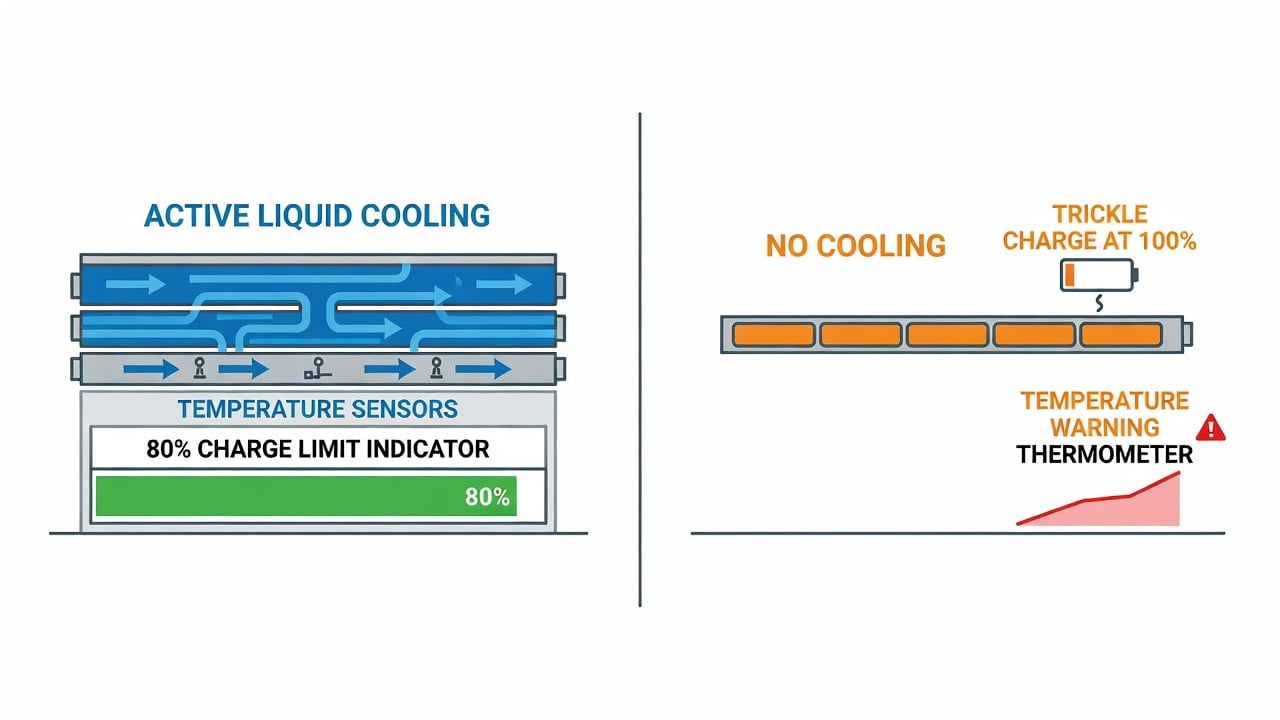
EV Habit #3: Avoid Prolonged Time at 100%
Here’s a detail Geotab emphasized: degradation accelerates when vehicles spend more than 80% of their time at very high or very low SOC. In real-world EV operation, that rarely happens — charging stops at the set limit, and the battery drains normally through driving.
Phones, however, routinely sit at 100% for 6–8 hours every night. The charger tops off, the phone hits 100%, and then — because most users don’t unplug — it trickle-charges for hours to maintain that 100% state. That’s exactly the prolonged high-SOC exposure Geotab flagged as damaging.
EV Habit #4: Smart Fast Charging
Geotab found that high-power DC fast charging (>100 kW) almost doubled degradation rates compared to AC charging. This confirmed what battery scientists already suspected: faster charging = more heat = more stress.
But EVs handle this better than phones in two ways:
- Aggressive taper curves: An EV might accept 150 kW at 20% SOC but drops to 50 kW by 50% and below 20 kW by 80%. Your phone charger tends to deliver flat wattage until about 80%, then only slightly reduces.
- Battery-to-battery sizing: EV battery packs are enormous (50–100+ kWh) compared to chargers. A 150 kW DC charger represents maybe 1.5–3x the pack’s hourly capacity. Your 65W phone charger relative to a 5,000 mAh battery? That’s a much higher multiple, and it’s sustained far longer.
We’ve covered the fast-charging angle in depth already — read the full fast-charging comparison here.
The Real Numbers: What This Means for Your Phone
Phone batteries are smaller, hotter, and less managed than EV batteries. Conservatively, applying the same degradation patterns from Geotab’s data plus the additional stress of no active cooling and hours at 100%:
| Charging Habit | Estimated Capacity at 2 Years |
|---|---|
| Slow charging, 80% limit, cool | ~92% |
| Standard fast charging, 100% nightly | ~78% |
| Ultra-fast (120W+), hot environment, 100% | ~70% |
That’s the difference between a phone that comfortably lasts a full day in year two and one that has you hunting for chargers by 3 PM.
What You Can Do Right Now
The good news: lithium-ion chemistry is durable when properly managed. EVs proved that. Here are four smartphone habits borrowed directly from EV best practices:
- Don’t charge to 100% every night. Aim for 80% if your phone supports it. If not, unplug before bed.
- Charge in a cool spot. Nightstand away from direct sunlight, case removed if possible.
- Use the slowest charger that fits your schedule. Overnight? A 5W or 10W charger is gentler than 65W.
- Avoid leaving your phone at 100% for long stretches. If you see 100% and the charger is still plugged in, unplug it.
The Missing Tool: Hardware Charge Limiting
EVs give drivers charge limiting because the battery is the single most expensive component to replace. It took legislation and consumer pressure, not charity, to get it built in.
Phones don’t have this — not because the physics is different, but because planned obsolescence is profitable. A phone that dies at 2 years generates a replacement cycle. A phone that lasts 4+ years doesn’t.
Chargie bridges that gap. It is a physical USB charge limiter: a small device that sits between your charger and your phone and cuts power at exactly the percentage you choose. No software hacks. No guessing. No battery-draining background apps. Set it to 80%, plug in at night, and wake up to a phone that’s charged — but not overcharged.
It’s the EV-style charge limit your phone never shipped with.
Not sure which one you need? Take the 60-second quiz →
The Bottom Line
Geotab’s 22,700-vehicle dataset makes one thing abundantly clear: lithium-ion batteries can last. Not because the chemistry is magic, but because the management is intelligent. EV owners get active cooling, thermal monitoring, and charge limits built in. Phone owners get none of that — unless they take it into their own hands.
The data is optimistic. A well-managed phone battery can last years longer than a neglected one. And the fix is simpler than you think: charge less aggressively, avoid the extremes, and if your phone won’t let you set a limit — make it.
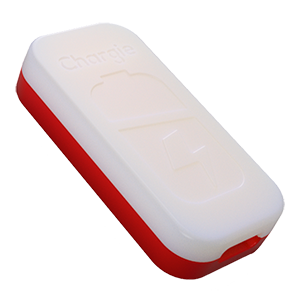
USB-C charge limiter that stops at your set battery level, so your battery never sits at 100% overnight. Extends battery lifespan by years. Works with any USB-C charger.
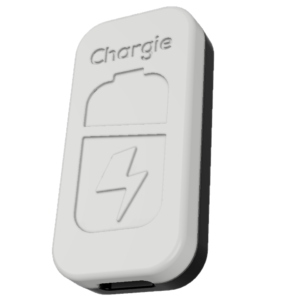
Limit your laptop charge to 80% via USB-C. Works with MacBooks, Dell, HP, Lenovo and most USB-C laptops up to 100W.
Protect Your Battery with Chargie
The world's first hardware charge limiter. Set a charge limit on any phone, tablet, or laptop — extend battery life by up to 4x.