
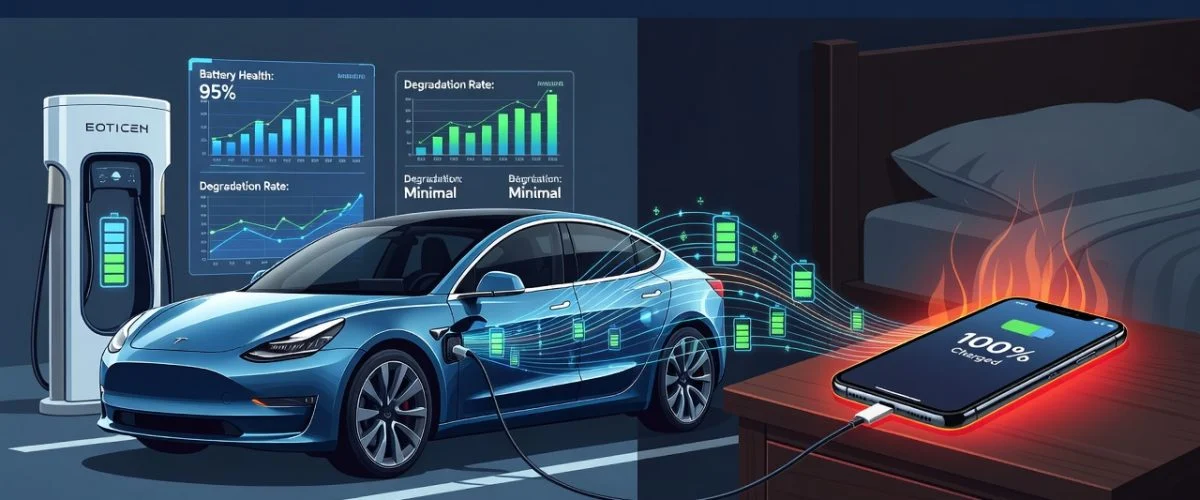

The 8-Year vs. 2-Year Battery
A Tesla Model 3 driver plugs in every evening and stops at 80%. Eight years later, the battery still holds 88% of its original capacity.
You plug your phone in every night. It charges to 100%, trickle-charges to stay there for six hours, and sits under your warm pillow. Two years later, your battery health reads 78%.
The cells in both devices are lithium-ion. The degradation mechanisms are identical: solid electrolyte interphase (SEI) growth, lithium plating, cathode dissolution, and mechanical stress from expansion and contraction. The 300-pound EV battery and the 2-ounce smartphone battery obey the same chemical rules.
So why does the EV last four times longer?
Because EVs manage their batteries aggressively, and phones barely manage them at all.
The Data: 22,700 EVs Tell a Predictable Story
In early 2025, Geotab published a major analysis: 22,700 electric vehicles across 21 makes and models, tracked across millions of real-world miles. Here are the numbers that matter.
The Baseline Degradation Rate
The average EV in the study lost 2.3% of capacity per year. That’s up from 1.8% in Geotab’s 2024 report — a jump researchers attribute to newer, higher-density battery chemistries that trade some longevity for energy density.
At that rate, an EV battery drops from 100% to 80% capacity in roughly 8–9 years. It doesn’t hit “end of life” until well past a decade.
What Speeds It Up
| Degradation Factor | Impact on Annual Capacity Loss |
|---|---|
| Baseline (mixed driving, moderate climate) | ~2.3%/year |
| High-power DC fast charging (>100 kW) | Up to 3.0%/year |
| Low-power AC charging | ~1.5%/year |
| Hot climate operation | +0.4%/year additional |
The gap between habitual DC fast charging and slow AC charging is nearly 2x. Temperature adds another compounding layer. A vehicle in Arizona doing regular fast charging degrades close to 3.5% per year — still slower than most phones under daily fast charging and overnight 100% habits.
The Critical Finding: SOC Distribution Matters More Than Anything
Geotab’s most important finding wasn’t about fast charging. It was about state-of-charge (SOC) distribution. Vehicles that spent more than 80% of their plugged-in time at very high SOC (>90%) or very low SOC (<10%) degraded dramatically faster than vehicles kept in the middle of the range.
After 8 years, the difference was stark:
- Best-care EVs (limited to ~80%, moderate climate, AC charging): ~88% capacity remaining
- Worst-care EVs (frequent 100% charging, hot climate, habitual fast charging): ~76% capacity remaining
The worst EV in the dataset still outlasted the average smartphone.
EV Habit #1: Charge Limits — The 80% Rule
Every major EV manufacturer caps daily charging at 80% by default. Tesla, BMW, Rivian — they all recommend it. The battery management system (BMS) enforces it. The user can override it for road trips, but the vehicle actively discourages full charging.
The reason is voltage stress. A lithium-ion cell at 100% sits at roughly 4.2V per cell. At 80%, it’s closer to 4.0V. Research from the Journal of the Electrochemical Society and Battery University shows that every 0.1V reduction above nominal voltage roughly doubles cycle life. The difference between 100% and 80% isn’t 20% less wear — it’s approximately half the wear.
Phones, by default, charge to 100% every single time you plug them in. Some manufacturers now offer an 80% software limit (Apple on iPhone 15+, Samsung on select models), but it’s opt-in, buried in settings, and disappears the moment your phone powers off or updates.
Your phone needs a charge limit. Your charger doesn’t care what percentage you’re at — it just keeps feeding current. Only an external limiter can enforce the same 80% rule EVs use by default.
EV Habit #2: Temperature Management — Active Cooling
EV battery packs weigh hundreds of pounds and cost thousands of dollars. Manufacturers protect them with liquid cooling loops, thermal pads, and heating systems that actively keep the pack between 15°C and 35°C.
The Geotab data quantified the benefit: operating in a hot climate added +0.4% annual degradation on top of the baseline. EVs mitigate this with active thermal management.
Phones have no active cooling. They rely on passive heat dissipation through the frame and screen. During fast charging, internal temperatures routinely hit 35–45°C. Under a pillow, on a car dashboard in summer, or while gaming and charging simultaneously, temperatures can spike to 50°C or higher. Battery University data shows that every 10°C increase roughly doubles the rate of chemical degradation.
An EV’s BMS would throttle charging or pause entirely at those temperatures. Your phone just keeps charging.
EV Habit #3: Avoid Prolonged Storage at 100%

EV software warns owners if a vehicle is left plugged in at 100% for extended periods. Fleet managers are trained to store vehicles at 40–60% SOC. Why? Because calendar aging — the chemical degradation that happens even when the battery isn’t cycling — accelerates exponentially at high voltage.
Battery University BU-808 data shows a battery stored at 100% and 40°C drops to 65% capacity in one year. The same battery stored at 40% and 25°C retains 96% capacity over the same period.
Your phone, plugged in overnight, spends 6–8 hours per day at 100% SOC — the most chemically aggressive condition possible. There is no warning. There is no automatic discharge to a safer level. The phone simply trickle-charges at 4.2V until you unplug it.
EV Habit #4: Smart Fast Charging — Tapering and Curves
EV fast chargers don’t deliver constant power. They ramp up to a peak, then taper the current as SOC rises to prevent lithium plating and overheating. Above 80% SOC, most DC fast chargers slow dramatically or stop altogether because the charge acceptance of the cells drops.
Smartphones do taper — eventually. But the thresholds are higher and the tapering less aggressive than in EVs. A 65W phone charger might still deliver significant current at 90% SOC, pushing the cell into its highest-stress voltage region while it’s already warm from the earlier fast phase.
We covered the mechanics of fast-charging degradation in detail in our earlier breakdown of the Geotab EV data and its direct smartphone implications. The short version: fast charging to 100% combines current stress with maximum voltage stress — the worst of both worlds.
The Smartphone Gap: What Your Phone Lacks
Here’s the direct comparison. The EV industry treats these as essential safety and longevity measures. The smartphone industry treats most of them as optional software features, if it addresses them at all.
| Protection | EV Battery Management System | Default Smartphone Behavior |
|---|---|---|
| Daily charge limit | Configurable (default: 80%) | Charges to 100% unless user manually enables a limit |
| Active thermal management | Liquid cooling/heating loops to maintain 15–35°C | Passive dissipation; no throttling during fast charging |
| Storage SOC management | Warnings and auto-discharge from prolonged 100% | No alerts; trickle-charges indefinitely when plugged in |
| Charging curve taper | Aggressive reduction above 80% SOC | Minimal tapering; pushes current into high-SOC region |
| Real-time degradation data | Visible to driver; fleet-tracked | Hidden or delayed; “Battery Health” is a rough estimate |
| User education | Built into vehicle UI and manuals | Buried in settings or not mentioned at all |
The gap isn’t technological. It’s structural. EV manufacturers have a financial incentive to preserve battery life — warranty claims, resale value, brand reputation. Phone manufacturers benefit when you replace your device every two to three years.
Translation to Phone Habits: What You Can Actually Do
The good news: you don’t need a liquid cooling loop or a $10,000 battery pack to apply EV-grade battery management to your phone. You need three habits and one piece of hardware.
1. Cap your daily charge at 80%
This is the single biggest lever. If you do nothing else, do this. Our Battery Science page breaks down the research: stopping at 80% instead of 100% can extend cycle life by roughly 2x.
2. Avoid heat, especially while charging
Don’t charge on a pillow, in a hot car, or while gaming. If your phone feels warm to the touch during charging, move it to a cooler surface or switch to a slower charger.
3. Don’t let it sit at 100% overnight
If you must charge to 100%, unplug as soon as it hits the target. Better yet, schedule charging to finish at your wake-up time, not six hours before. Less time at 4.2V means less SEI growth.
4. Use slower charging when time allows
Not every charge needs to be a 65W sprint. A 10W overnight charge generates less heat and puts less stress on the anode.
The Chargie Solution: EV-Grade Battery Management for Your Phone
Chargie was built to close exactly this gap.
It’s a hardware charge limiter that sits between your charger and your device. It reads your battery level via Bluetooth and physically cuts USB power when you hit your set limit — just like an EV’s BMS. No software override. No reliance on your phone’s OS.
- Charge limiting: Set any limit from 20% to 100%. Based on the same BU-808 research that EV manufacturers cite.
- Temperature protection: Monitors battery temperature and pauses charging if it exceeds your threshold — the active thermal management your phone lacks.
- Overnight scheduler: Hold the battery at a safe mid-charge level through the night, then top up to your target before your alarm. No more six hours at 100%.
- Slow-charging mode: Optional 10W mode for overnight charging — less heat, less lithium plating risk.
- Appless Mode: The limit is stored on the device itself. Works even when your phone is powered off.
One Chargie covers every USB-charged device you own — phones, tablets, laptops, earbuds, power banks. It doesn’t care if your next phone is iPhone, Samsung, or something that doesn’t exist yet.
Not sure which model you need? Take the Which Chargie Do I Need? quiz — it takes about 60 seconds.
Ready to protect your battery like an EV fleet manager? Browse the Chargie shop →
Conclusion: The Same Battery, Different Outcomes
Geotab’s 22,700-vehicle dataset confirms a principle battery researchers have preached for decades: lithium-ion degradation is predictable, preventable, and primarily driven by voltage, temperature, and time.
EVs manage all three aggressively. Your phone manages none of them by default.
The result is baked into the numbers. After eight years, a well-managed EV battery still has 88% capacity. After two years of fast charging to 100% overnight, your phone battery is already past that threshold.
The chemistry isn’t the problem. The management is.
Fix the management, and you fix the lifespan.
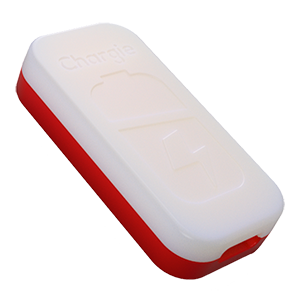
USB-C charge limiter that stops at your set battery level, so your battery never sits at 100% overnight. Extends battery lifespan by years. Works with any USB-C charger.
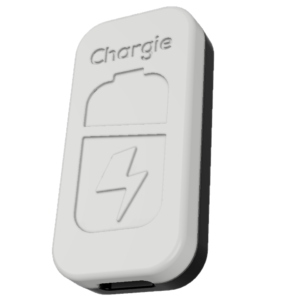
Limit your laptop charge to 80% via USB-C. Works with MacBooks, Dell, HP, Lenovo and most USB-C laptops up to 100W.
Protect Your Battery with Chargie
The world's first hardware charge limiter. Set a charge limit on any phone, tablet, or laptop — extend battery life by up to 4x.