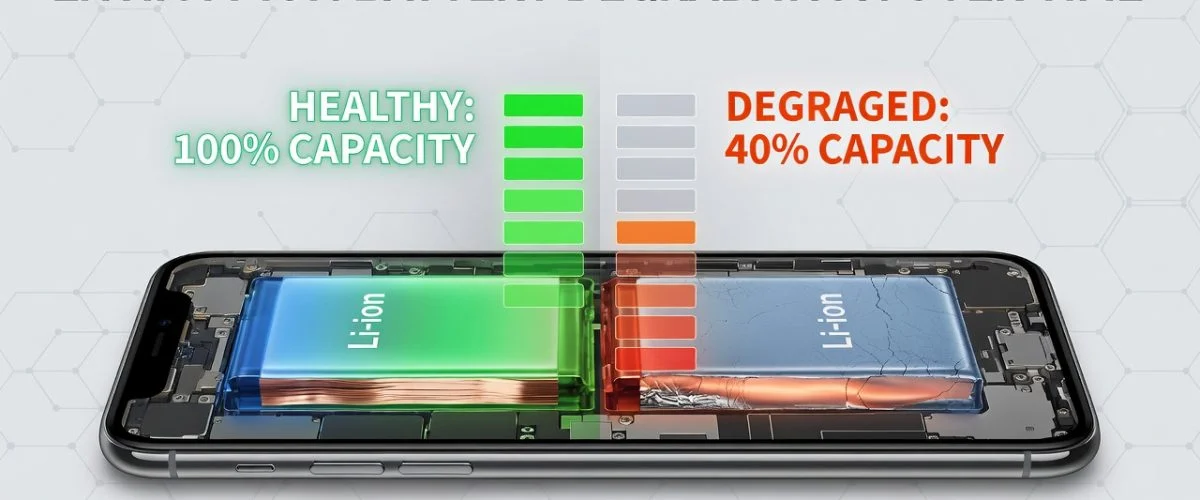

Lithium-ion batteries degrade through a combination of chemical and mechanical processes — solid electrolyte interphase (SEI) growth, lithium plating, cathode dissolution, and mechanical stress from expansion and contraction. The primary accelerants are high voltage (charging to 100%), high temperature, and high charge/discharge rates. Keeping a battery between 20% and 80% charge and below 30°C can extend its useful lifespan from ~500 cycles to over 1,500 — a 3x improvement. A hardware charge limiter like Chargie automates these protective boundaries without requiring you to monitor or unplug anything.
How Lithium-Ion Batteries Work (the 60-Second Version)
A lithium-ion cell stores energy by moving lithium ions between two electrodes through an electrolyte. When you charge, ions flow from the cathode (typically a lithium metal oxide like NMC or LFP) to the anode (typically graphite). When you discharge, they flow back.
That’s it. Lithium-ion batteries have no memory effect — you can top up whenever without degrading the battery. However, calibration is chemistry-dependent: NMC batteries (most phones and laptops) don’t need calibration, but LFP batteries (used in newer EVs and some phones) have a notoriously flat voltage curve across 40-80% state of charge. This flat curve causes the battery management system’s (BMS) percentage estimate to drift over time. LFP batteries benefit from an occasional full charge to 100% so the BMS can reset its voltage reference point and restore accurate percentage readings. The battery degrades because every trip leaves microscopic damage behind.
The Four Mechanisms of Battery Degradation
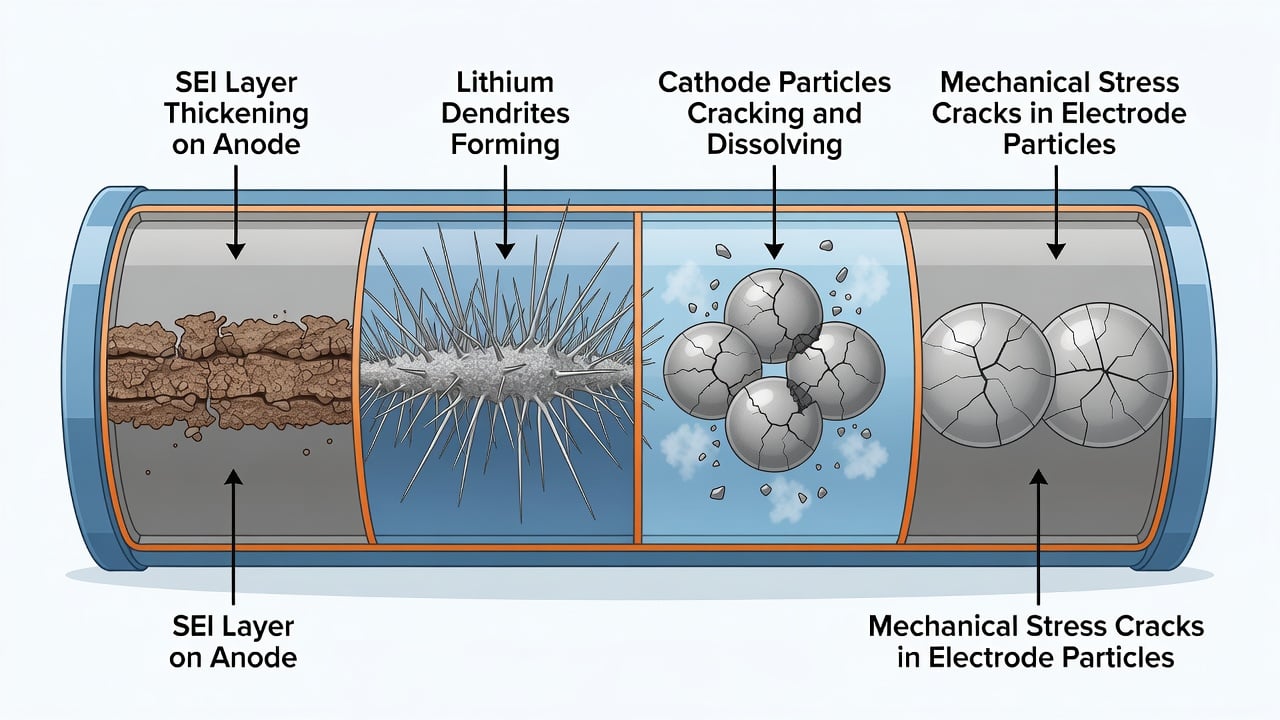
Battery researchers categorize degradation into four primary mechanisms. They all happen simultaneously, and they compound each other.
1. Solid Electrolyte Interphase (SEI) Growth
On your battery’s very first charge cycle, a thin film forms on the anode where the electrolyte meets the graphite. This is the SEI layer — it’s essential. Without it, the electrolyte would keep reacting with the anode until the battery died.
The problem: the SEI layer never stops growing. Every charge cycle adds a few more molecules. As it thickens, it consumes lithium ions that should be shuttling back and forth. This is the primary cause of gradual capacity loss.
What accelerates it: High voltage (charging above 4.0V per cell), high temperature, and time. A battery stored at 100% charge at 40°C loses roughly 35% of its capacity in one year. The same battery stored at 40% charge at 25°C loses about 4%.
2. Lithium Plating
When you charge too fast or at low temperatures, lithium ions can’t intercalate into the graphite anode fast enough. They plate onto the surface as metallic lithium instead — forming needle-like structures called dendrites.
This is dangerous for two reasons. First, the plated lithium is chemically dead — it can’t participate in future cycles, so capacity drops immediately. Second, dendrites can grow through the separator and short-circuit the cell, causing thermal runaway.
What accelerates it: Fast charging (especially above 1C), charging below 10°C, and charging to high voltages. This is why fast charging at 65W or 100W — while convenient — carries a real degradation cost if done habitually.
3. Cathode Dissolution and Structural Degradation
The cathode material (NMC, LFP, etc.) slowly dissolves into the electrolyte, particularly at high voltages. Transition metals like manganese leach out and deposit on the anode, where they catalyze further SEI growth. The cathode’s crystal structure also cracks and disorders from the repeated expansion and contraction of charging cycles.
What accelerates it: High voltage (above 4.1V), high temperature, and deep cycling (0% to 100%). The top 20% of the charge curve is chemically the most stressful region for the cathode.
4. Mechanical Degradation
Lithium-ion electrodes physically swell and contract during charge and discharge. Traditional graphite anodes expand by about 10% — enough to create micro-cracks in electrode particles over hundreds of cycles. The cracks expose fresh surfaces to the electrolyte, which then form new SEI — consuming more lithium and further increasing internal resistance.
A newer subcategory of mechanical degradation has emerged with silicon-carbon (Si-C) anode batteries, now shipping in flagship phones like the Honor Magic 6 Pro, Xiaomi 14 Ultra, and select OnePlus 12 variants. Silicon anodes can store roughly 10x more lithium than graphite — but they expand up to 300% during charging, compared to ~10% for graphite. This massive volume change creates a novel mechanical degradation pathway: the silicon particles physically fracture, pulverize, and lose electrical contact with the current collector. This isn’t the slow crack-propagation of graphite — it’s an active material disintegration problem that can cause faster-than-expected capacity fade in the first year. For a 2026 guide, silicon-carbon anode degradation deserves recognition as an emerging fifth mechanism or a severe subcategory of mechanical stress.
What accelerates it: Deep depth of discharge (cycling from 0% to 100% instead of, say, 30% to 80%), high charge/discharge rates, and thermal cycling.
Voltage, Temperature, and Cycles: The Degradation Triangle
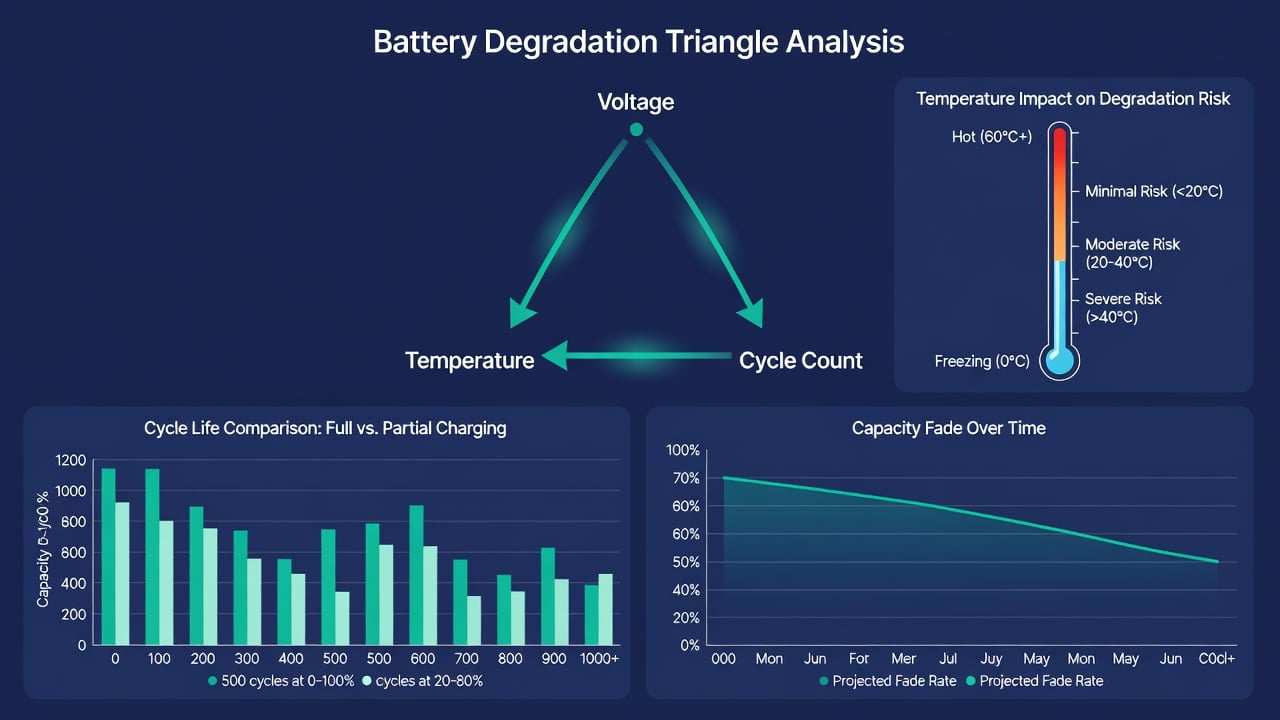
All four mechanisms above are driven by the same three variables. Here’s what the research says about each.
Voltage: The Single Biggest Lever
Every lithium-ion chemistry has a nominal voltage (3.6-3.7V for NMC, 3.2V for LFP) and a maximum voltage (4.2V for NMC, 3.65V for LFP). The closer you push to the maximum, the faster all four degradation mechanisms accelerate.
A widely cited study from the Journal of the Electrochemical Society demonstrated that cycling an NMC cell between 3.0V and 4.2V (0-100% charge) resulted in 500 cycles to 80% capacity. Cycling the same cell between 3.0V and 4.0V (roughly 0-75% charge) extended that to over 2,000 cycles.
The practical takeaway: The difference between 80% and 100% isn’t linear. The top 20% of the charge range causes disproportionate damage. Every time you charge to 100%, you’re running your battery in its most chemically aggressive state.
Temperature: The Silent Accelerator
Heat doesn’t directly degrade the battery — it accelerates every degradation mechanism that’s already happening. The Arrhenius equation tells us that chemical reaction rates roughly double for every 10°C increase. SEI growth, cathode dissolution, and electrolyte decomposition all follow this pattern.
- Below 0°C: Charging risks lithium plating. Most EVs and quality electronics restrict charging current below freezing.
- 0-25°C: Safe, moderate degradation rates.
- 25-35°C: Accelerated degradation. This is the range of a phone fast-charging on a desk, or a laptop running intensive workloads while plugged in.
- Above 35°C: Rapid degradation. Battery University estimates that every 8°C above 25°C halves the battery’s calendar life.
Leaving a phone on a car dashboard in summer — where temperatures routinely hit 50-60°C — can degrade the battery by 20-30% in a single afternoon. Combine that with charging to 100% and you have a perfect storm.
Cycle Count and Depth of Discharge
A “cycle” isn’t one plug-in event — it’s one full discharge worth of energy. Charging from 50% to 100% twice counts as one cycle. Charging from 30% to 80% (50% depth of discharge) counts as half a cycle.
But depth of discharge dramatically changes how many cycles a battery can deliver. Here’s how it breaks down for NMC chemistry (the dominant chemistry in phones and laptops):
| Depth of Discharge (DoD) | Approximate NMC Cycles to 80% Capacity |
|---|---|
| 100% DoD (0% to 100%) | ~500 |
| 50% DoD (e.g., 25% to 75% or 30% to 80%) | ~1,500 |
| 25% DoD (e.g., 60% to 85%) | ~2,500+ |
This is the core argument for charge limiting. If you keep an NMC phone between 30% and 80% (50% DoD), you triple its cycle life. For context, LFP at the same DoD levels delivers radically different numbers: 3,000-4,000+ cycles at 100% DoD, and over 10,000 cycles at shallow DoD (Preger et al., 2020, J. Electrochem. Soc.). LFP’s cycle life advantage is one reason it’s the default chemistry in stationary storage and increasingly common in EVs.
NMC vs. LFP: Same Mechanisms, Different Timelines
While all four mechanisms apply to both chemistries, the timelines differ dramatically.
NMC (Nickel Manganese Cobalt — most phones and laptops) operates at higher voltages (3.6-3.7V nominal, 4.2V max), which makes it chemically more aggressive. It offers higher energy density (more runtime in a smaller package) at the cost of faster degradation. NMC is the chemistry where 20-80% charging makes the biggest difference.
LFP (Lithium Iron Phosphate — newer EVs, power tools, some phones) operates at lower voltage (3.2V nominal, 3.65V max), which makes it inherently more stable. It trades lower energy density for much longer cycle life — typically 3,000 to over 10,000 cycles depending on depth of discharge, compared to 500-2,500 for NMC (Preger et al., 2020, J. Electrochem. Soc.). LFP is also more tolerant of being held at 100% charge, though it still degrades faster at elevated temperatures. One quirk of LFP: its flat voltage curve between 40% and 80% SOC makes percentage estimates drift over time — periodic full charges to 100% help the BMS recalibrate.
Practical Strategies That Actually Work
1. Charge Limit to 80% (or Somewhere Close)
The single highest-impact change you can make. Most phones now offer built-in charge limiting: iPhones have Optimized Battery Charging (iOS 13+) and an 80% hard limit option (iPhone 15+); Samsung has Protect Battery (85%); Google Pixels have Adaptive Charging. These all work, but they’re software-based and can be overridden or inconsistent.
Hardware charge limiters like Chargie sit between the charger and the phone, physically cutting power at the threshold you set. No software to fail, no OS updates to break it, no “adaptive” algorithm to second-guess.
2. Keep It Cool While Charging
Fast charging generates heat — some phones hit 35-40°C during a 65W charge session. Remove the case while fast charging. Don’t charge under a pillow or on a fabric surface. If you’re gaming while charging, you’re combining high discharge heat with high charge heat — the worst-case thermal scenario.
3. Shallow Cycles Beat Deep Cycles
Two 30-80% charges cause less degradation than one 0-100% charge, even though both represent one full cycle worth of energy. The depth of discharge matters more than the number of cycles. Top-up charging throughout the day is actually better for the battery than running it down and doing one big charge at night.
4. Don’t Leave It at 100% in Hot Environments
A phone left at 100% on a wireless charger on a nightstand isn’t a problem. A phone left at 100% on a car dashboard in July is. The combination of high state of charge and high temperature is the degradation equivalent of smoking and drinking at the same time.
5. Avoid Deep Discharge Below 20%
Just as the top 20% of charge is chemically stressful for the cathode, the bottom 20% stresses the anode. Running a lithium-ion battery to 0% regularly accelerates copper dissolution from the anode current collector, which can cause internal short circuits over time.
What About Battery Replacement?
Even with perfect care, batteries degrade — they’re consumable components. Phone battery replacements cost $49-99 (Apple) to $70-120 (Samsung authorized service) and are the single most cost-effective way to extend a phone’s useful life by 2-3 years. Laptop batteries are similarly affordable ($50-150 for most models).
The environmental case is stronger than the financial one: keeping a phone for 5 years instead of 2 reduces its annual carbon footprint by roughly 60%, and a battery replacement at year 2-3 is usually all it takes to get there.
The Bottom Line
Lithium-ion battery degradation is physics, not mystery. The same three variables — voltage, temperature, and depth of discharge — drive all four degradation mechanisms. Control those three variables, and you control your battery’s lifespan.
A hardware charge limiter automates two of the three (voltage and depth of discharge) without requiring you to think about it. For the third — temperature — common sense and a cool spot on the desk cover most of the risk.
The difference between 500 cycles and 1,500+ cycles isn’t luck or brand — it’s charge management. And that’s something you can control.
Related Battery Science & Degradation Reading
- Battery Longevity & E-Waste: The Numbers (Charge-Limiting Data)
- What 22,700 EVs Teach Us About Saving Your Phone Battery
- Is Your Phone Case Killing Your Battery? The Heat Trap Nobody Talks About
- When Nokia Labs Met Chargie: A Tale of a Bulging Battery and an Unexpected Hero
- The Link Between COVID-19 and Phone Batteries
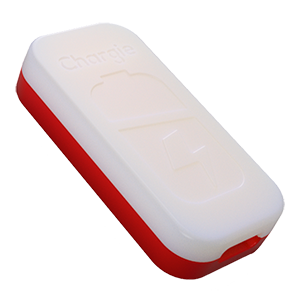
USB-C charge limiter that stops at your set battery level, so your battery never sits at 100% overnight. Extends battery lifespan by years. Works with any USB-C charger.
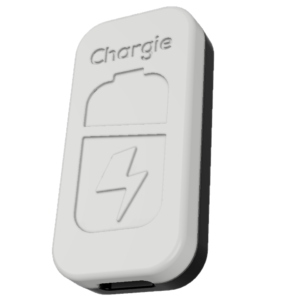
Limit your laptop charge to 80% via USB-C. Works with MacBooks, Dell, HP, Lenovo and most USB-C laptops up to 100W.
Protect Your Battery with Chargie
The world's first hardware charge limiter. Set a charge limit on any phone, tablet, or laptop — extend battery life by up to 4x.