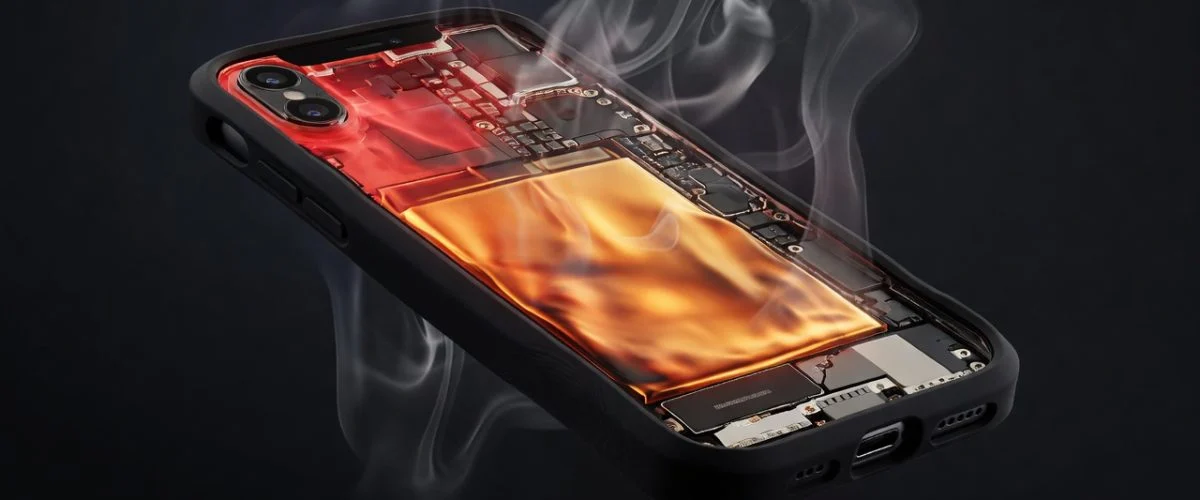

We buy phone cases to protect our devices from drops, scratches, and the occasional tumble off the kitchen counter. Most of us feel naked without one — that sleek $1,000 glass sandwich in our pocket needs armor, right? But what if that very armor is quietly destroying the one component your phone can’t live without: the battery?
The science is clear, and the data is alarming. Phone cases — especially the thick, protective ones we trust most — act as thermal blankets, trapping the heat your phone naturally generates and baking the lithium-ion battery inside. And heat, far more than charge cycles or fast charging alone, is the #1 accelerator of battery degradation.
The Science: Why Heat Is a Battery’s Worst Enemy
Lithium-ion batteries, the kind powering every modern smartphone, work through the movement of lithium ions between positive and negative electrodes. In theory, this mechanism could run nearly forever. In practice, elevated temperatures accelerate chemical side-reactions — the breakdown of electrolytes, the growth of resistive films on electrodes, and the irreversible loss of active lithium.
The authoritative Battery University at Cadex Electronics puts it bluntly:
“All batteries achieve optimum service life if used at 20°C (68°F) or slightly below. If, for example, a battery operates at 30°C (86°F) instead of a more moderate lower room temperature, the cycle life is reduced by 20 percent. At 40°C (104°F), the loss jumps to a whopping 40 percent, and if charged and discharged at 45°C (113°F), the cycle life is only half of what can be expected if used at 20°C (68°F).”
— Battery University, “BU-502: Discharging at High and Low Temperatures”
A mere 10°C increase above room temperature costs you 20% of your battery’s lifespan. At 40°C — a temperature your phone can easily reach while fast-charging inside a thick silicone case — you’ve lost nearly half of what the battery could have given you. At 45°C, you’ve cut its life in half.
The Data: What Temperature Does to Capacity Over Time
Even when your phone is just sitting there — not being cycled, not being used — elevated temperature steadily eats away at its capacity. Battery University’s testing of Li-ion cells stored for one year at different temperatures reveals the mathematics:
| Temperature | Charge Level | Remaining Capacity After 1 Year |
|---|---|---|
| 0°C (32°F) | 40% | 98% remaining |
| 25°C (77°F) | 100% | 80% remaining |
| 40°C (104°F) | 100% | 65% remaining |
| 60°C (140°F) | 100% | 60% remaining after just 3 months |
— Battery University, “BU-808: How to Prolong Lithium-based Batteries,” Table 3
At a comfortable 25°C room temperature, a fully charged battery retains only 80% of its capacity after a year — and that’s before you factor in the extra heat from a protective case. Push the temperature to 40°C — common inside a case-wrapped phone during a summer charging session — and you’re down to 65% in the same year. At 60°C, you lose 40% in just three months.
These aren’t hypothetical scenarios. Your phone’s processor generates heat. Fast charging generates significant heat — modern chargers pump 15W to 45W through a battery the size of a playing card. The glass back of your phone is designed as a heat spreader, radiating that warmth away. Until you wrap it in insulating material.
Your Case Is a Thermal Blanket — And Not the Good Kind
Most phone cases are made from materials with exceptionally low thermal conductivity: silicone (~0.2 W/m·K), TPU (~0.15–0.25 W/m·K), polycarbonate (~0.19–0.22 W/m·K), and leather (~0.14 W/m·K). Compare that to the aluminum frame (~200 W/m·K) and glass back (~1.0 W/m·K) of your phone and the problem becomes obvious.
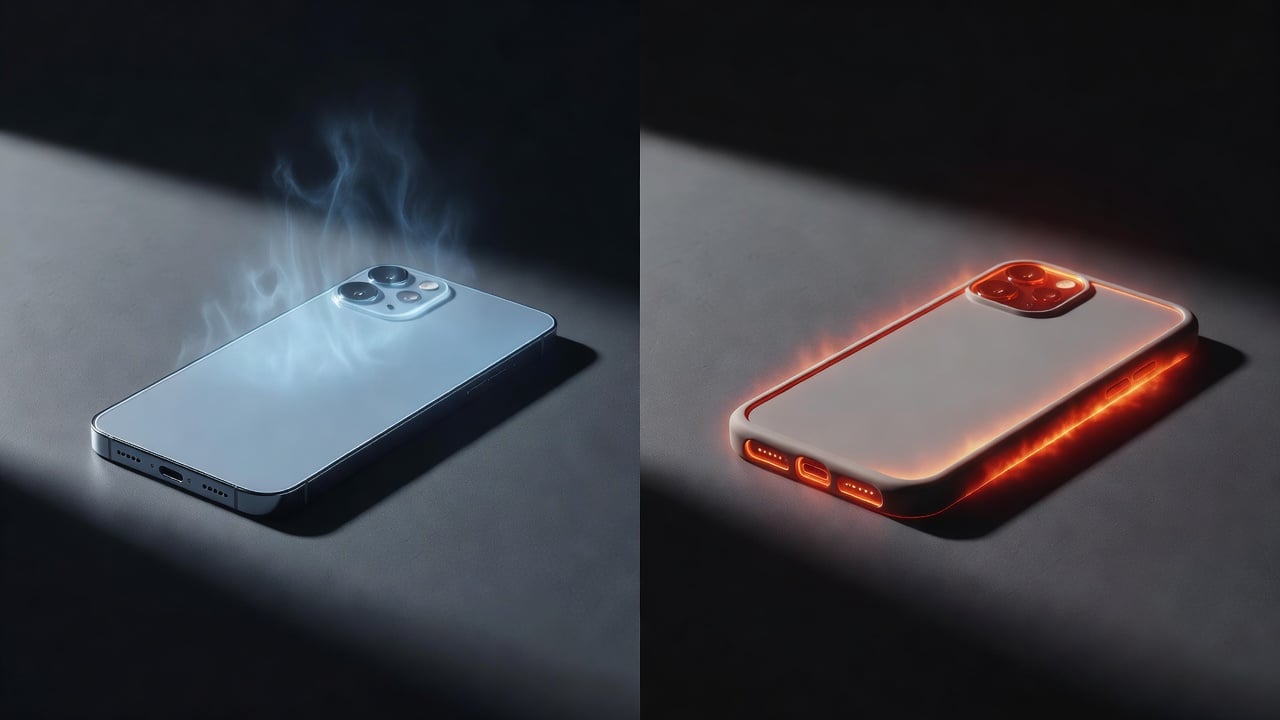
Your phone’s engineers designed it to shed heat through its chassis. The metal frame and glass back act as a passive radiator — heat flows from the battery and processor to the outside world. When you slap a 2-3mm layer of silicone or a “rugged” case with air-pocket bumpers around it, you’re wrapping that radiator in insulation.
Think of it this way: your phone in a thick case is like running a marathon in a winter coat. The heat your body generates has nowhere to go. Except unlike you, your phone can’t sweat.
The Charging Heat Spiral
The problem compounds during charging. When you plug in, the battery’s internal resistance converts some electrical energy to heat — and the faster you charge, the more heat gets produced. Modern fast-charging standards push 20W, 30W, even 45W through smartphone batteries. With no case, much of that heat dissipates through the back glass. With a case, it accumulates.
Here’s the spiral: sustained heat accelerates the chemical side-reactions that permanently degrade the battery’s electrolyte and electrodes. Each cycle leaves the battery with marginally higher internal resistance, which generates more heat during the next charge, which speeds up further degradation. The case is the accomplice that never leaves the scene.
Apple is aware enough of this to have built thermal protection into iOS: when battery temperatures exceed safe thresholds during charging, the iPhone may pause charging at 80% to protect battery health. Apple’s battery documentation warns that high ambient temperatures while charging can reduce battery lifespan, and that iOS includes thermal management features that automatically limit charging when the battery gets too hot — throttling charging above 80% until the temperature drops to safe levels. The phone itself is protecting you from heat — your case just makes the problem worse.
The Greenhouse Effect for Your Pocket
A useful analogy: a phone in an insulating case behaves like a miniature greenhouse. Solar radiation (in our case, heat from the processor, display, and charging circuit) enters the system. The insulating case slows its escape. The internal temperature rises until a new, higher equilibrium is reached — one that happens to be squarely in the battery-destroying zone.
Independent thermal-imaging tests by tech reviewers have demonstrated that the same phone running an identical benchmark can register 5–8°C higher surface temperatures when enclosed in a thick protective case versus being tested bare. One recent study on smartphone thermal behaviour found that case materials with low thermal conductivity measurably increase the operating temperature of both the battery and the processor during sustained use. That temperature gap is exactly the difference between “moderate” and “aggressive” degradation on the Battery University scale.
What You Can Do About It
The answer isn’t to toss your case in the trash — drops still kill more phones than battery degradation ever will. But there are practical steps that meaningfully reduce the thermal burden on your battery:
- Remove your case while charging — especially during fast charging or overnight charging. This alone is the single highest-impact habit change.
- Choose thinner, more thermally conductive cases. Some manufacturers now offer cases with integrated graphite sheets or metal inserts designed to aid heat dissipation. Even a thin polycarbonate shell is better than a chunky dual-layer silicone-and-TPU brick.
- Avoid wireless charging with a case on. Wireless charging is inherently less efficient than wired, with much of the lost energy turning into heat — and that heat gets trapped between the phone and charger with your case acting as a lid.
- Use a charging limiter like Chargie. By stopping the charge at 80% instead of letting it sit at 100%, you reduce both the thermal stress and the voltage stress on the battery. Less time at high voltage and temperature means a significantly longer lifespan. Here’s the full science behind why 80% is the sweet spot.
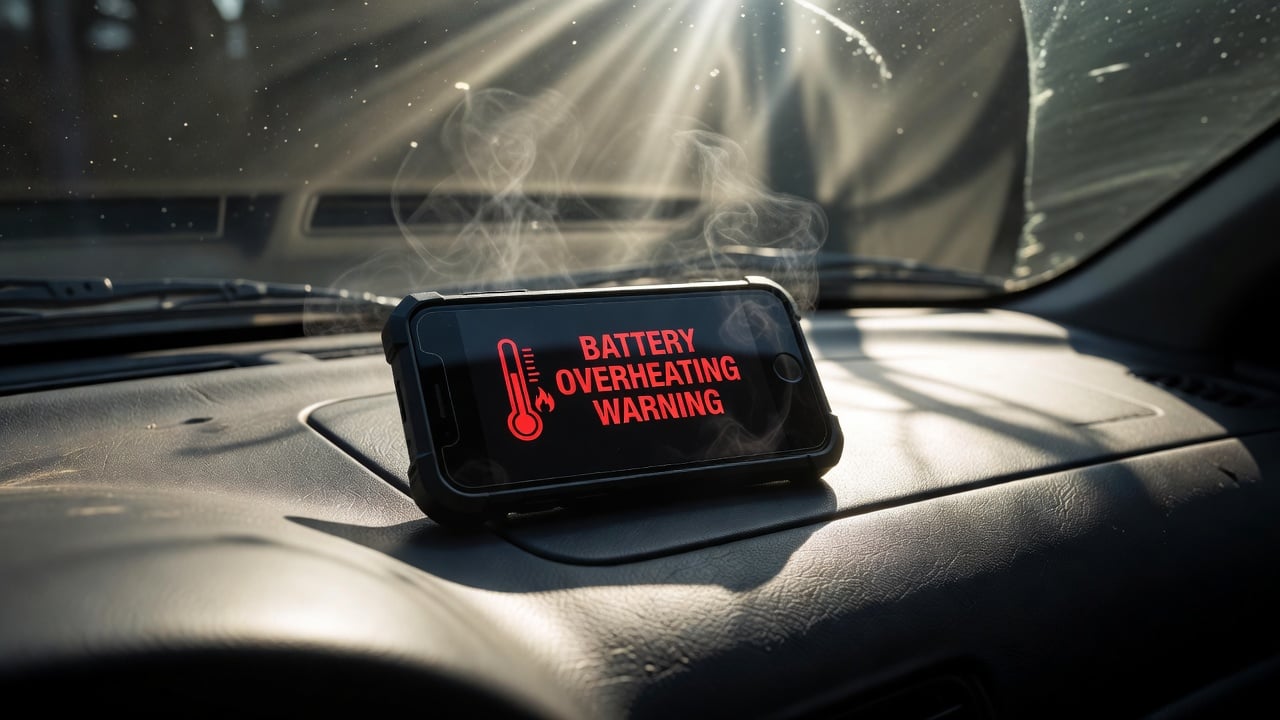
- Keep your phone out of direct sunlight. A phone on a car dashboard in summer, wrapped in a black silicone case, can reach temperatures that permanently damage the battery in a single afternoon.
The Bottom Line
Cases protect your phone from the obvious threats — drops, scratches, cracked screens. But they introduce a silent, cumulative threat that most users never consider: trapped heat slowly but steadily destroying the battery they rely on every day. The data from battery research is unambiguous: every degree above 20°C costs you measurable lifespan. At 40°C, you’re looking at 40% less battery life. At 45°C, you’ve halved it.
Your case isn’t killing your phone. But it might be killing your battery — one hot charge cycle at a time. The good news: a few simple habits can dramatically change the math, and tools like Chargie make it automatic. Your phone’s battery is fighting a war against heat. Make sure you’re not giving the enemy a blanket.
Sources: Battery University (BU-502, BU-808) at batteryuniversity.com; Apple Battery documentation at apple.com/batteries.
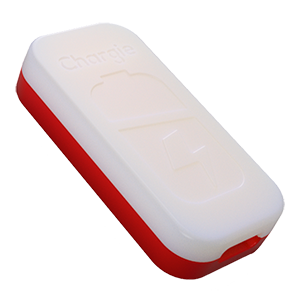
USB-C charge limiter that stops at your set battery level, so your battery never sits at 100% overnight. Extends battery lifespan by years. Works with any USB-C charger.
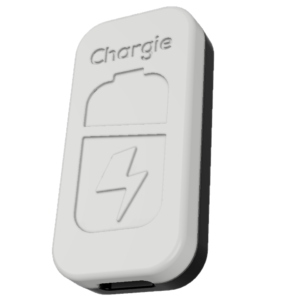
Limit your laptop charge to 80% via USB-C. Works with MacBooks, Dell, HP, Lenovo and most USB-C laptops up to 100W.
Protect Your Battery with Chargie
The world's first hardware charge limiter. Set a charge limit on any phone, tablet, or laptop — extend battery life by up to 4x.