

Ever wonder why your brand-new phone or laptop battery seems to lose its mojo so quickly? A big reason is how we charge it—especially leaving it plugged in at 100%. This is where a lithium-ion charge controller comes in. It’s like a smart guardian for your battery, a little device that manages the flow of electricity to save it from the stress of being overcharged.
Understanding the Guardian of Your Battery
Think of your battery like a bucket you’re filling with water. A standard charger is like leaving the tap on full blast. Eventually, it overflows, putting constant pressure on the bucket’s seams until they weaken. A smart charge controller, however, is clever enough to turn off the tap before the bucket gets too full, preventing that damaging pressure altogether. This simple action is key to slowing down battery aging.
Sure, your phone has a basic controller built-in, but its main job is just to stop an immediate catastrophe, not to extend your battery's lifespan. It’s hardwired to push the charge to 100% and keep it there, which sadly is a fast way to wear it out. This is exactly why a more advanced, external controller makes all the difference.
Why Smart Control Matters
Lithium-ion batteries are in everything. The market was valued at USD 134.08 billion in 2025 and is on track to hit USD 865.33 billion by 2034. Yet, the most common charging habit—keeping devices topped up to 100%—is actively harming these valuable power sources.
It’s a huge problem, but it’s one with a simple solution.
A dedicated lithium-ion charge controller does more than just basic safety. It actively manages the charge level to keep the battery in its happy place, which is usually between 40% and 80%.
This proactive approach prevents the chemical stress that degrades your battery over time. It’s exactly what we designed Chargie to do. Our device gives you the power to protect your expensive gadgets. By avoiding the constant strain of a full charge, you can dramatically slow down the aging process and save yourself a lot of money in the long run.
To see the difference, it helps to compare what your device does on its own versus what an advanced controller can do.
Built-In vs External Charge Controllers
Here’s a quick breakdown of how the standard internal controller in your phone stacks up against a dedicated external solution like Chargie.
| Feature | Standard Internal Controller | Advanced External Controller (e.g., Chargie) |
|---|---|---|
| Primary Goal | Prevent immediate failure (fire, explosion). | Maximize long-term battery lifespan. |
| Target Charge Level | Charges to 100% and holds it there. | Allows user to set a custom limit (e.g., 80%). |
| Overnight Charging | Keeps battery at a stressful 100% all night. | Schedules charging to complete just before you wake up. |
| Long-Term Health | Accelerates battery degradation. | Significantly slows down battery aging. |
| Control | No user control; fully automated by the manufacturer. | Full user control via a dedicated app. |
As you can see, the built-in system is really just a basic safety net. If you want to take real control and make your battery last, an external controller is the way to go.
From Simple Gadgets to Complex Systems
This need for smart charging isn’t just about our phones. These controllers are vital in a huge range of applications, from small personal gadgets to much larger power systems. For a great example of how these components are used in everyday products, just look at a standard Li Ion Battery Charger built for a mobility scooter.
Whether it’s for that scooter, an RV, a fleet of work phones, or just your own smartphone, the core principle is identical. When you use a smart system to manage charging, you get some serious benefits:
- Longer Device Lifespan: Stopping overcharging can dramatically increase how long your battery lasts before it starts to fade.
- Reduced Replacement Costs: When your battery stays healthy for longer, you avoid the hassle and expense of repairs and replacements.
- Improved Safety and Reliability: An intelligent controller adds an essential layer of protection against charging-related problems.
At the end of the day, a modern lithium-ion charge controller like Chargie puts professional-grade battery management right in your hands, helping ensure your devices last as long as they were meant to.
How a Charge Controller Protects Your Battery
To really get what a dedicated lithium ion charge controller does, we need to understand how it actually works. These little devices aren't just on/off switches; they use clever tricks to protect your battery from the very electricity that's supposed to be helping it. A key method is what some call hysteretic control.
This might sound technical, but the idea is simple. Think of it like a smart thermostat for your battery's health. Your phone’s built-in charger is designed to just jam the battery up to 100% and hold it there, which creates a constant state of chemical stress.
A smart controller, on the other hand, takes a different approach. Rather than just cutting power at the top, a device like Chargie lets the charge fall to a much healthier level—say, 75%—before it allows power to flow again. This on-off cycle keeps your battery resting in its low-stress "comfort zone" and avoids pinning it at that damaging peak voltage for hours on end.
Beyond Basic Charge Limiting
A good charge controller does a lot more than just cap the battery level. It acts as a multi-layered defense system, ready to protect your device from all sorts of real-world scenarios. Two of the most important shields in its arsenal are overtemperature and overcurrent protection.
Here’s what that means in simple words:
- Overtemperature Protection: Ever leave your phone to charge on a sunny dashboard? Extreme heat is a battery's absolute worst enemy. A smart controller senses when things are getting too hot and cuts the power completely, preventing permanent damage.
- Overcurrent Protection: Not all USB ports are trustworthy. A dodgy public charging station or a cheap power brick can send nasty power spikes straight into your device. Overcurrent protection is the gatekeeper that blocks these dangerous surges from ever reaching your battery.
This simple graphic shows the difference between raw, unregulated power and the safe, controlled charge a controller provides.
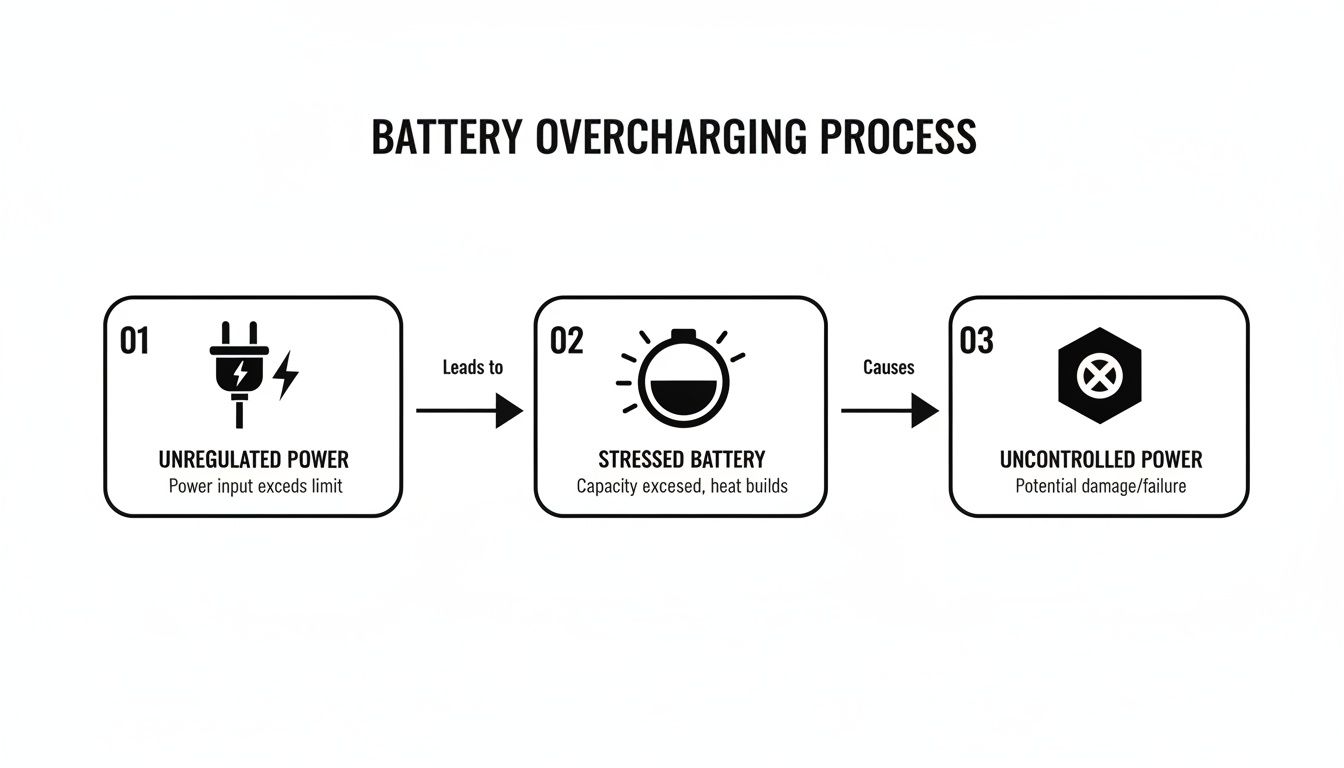
You can see how crucial that middle step is. The controller is what turns potentially harmful electricity into a safe, managed charge that won't cook your battery.
The Chargie Advantage in Action
This is where Chargie really shines. As a lithium ion charge controller built into hardware, it physically disconnects the power from your device. This isn't a software suggestion; it's a hard cutoff. That means no electricity can sneak through to the battery once your preset limit is hit—even if your phone or laptop is completely turned off.
By physically managing the electrical flow, a hardware controller like Chargie offers a foolproof method of protection. It enforces your charging rules 100% of the time, regardless of what your device’s software is doing.
This gives you total peace of mind. Whether you're charging overnight, plugging into an unfamiliar outlet, or powering a fleet device inside a hot vehicle, you know the battery is safe. These protections are what give you a much longer and healthier battery lifespan. It's the same principle that helps you understand how long solar batteries last; proper management is everything.
Ultimately, a controller’s job is to be the bodyguard standing between your valuable battery and the wild, unpredictable world of electricity. By intelligently managing charge levels, temperature, and current, it ensures your devices aren't just getting charged, but charged in a way that’s safe and sustainable for the long haul.
For a deeper dive, check out our guide on lithium-ion battery charging best practices.
Essential Features of a Modern Charge Controller
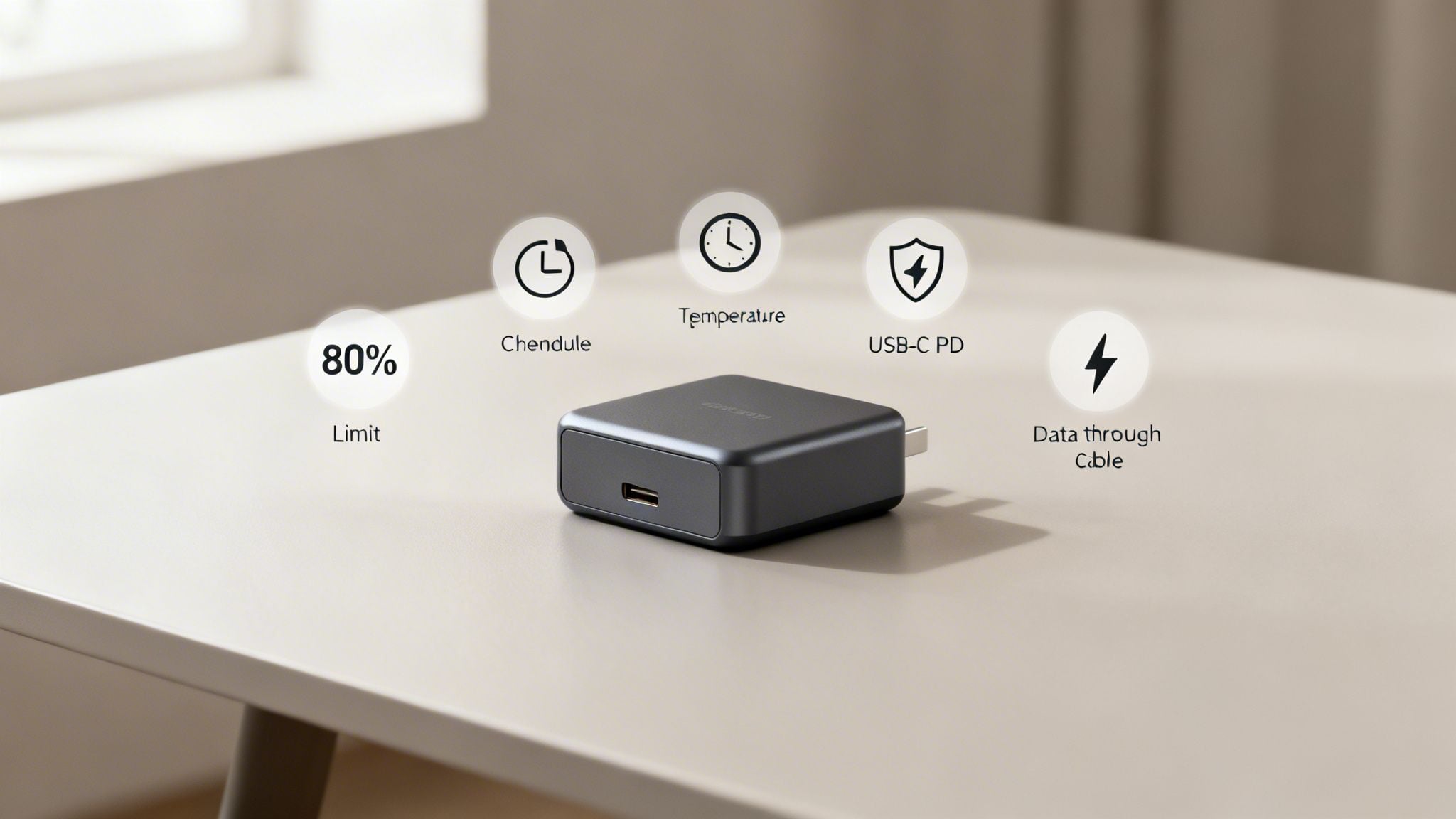
When you start looking at lithium-ion charge controllers, you’ll find they aren’t all built the same. A basic one might just cut power at a certain point, but a truly modern controller is packed with features designed to make protecting your battery almost effortless.
The single most important feature is the ability to set configurable charging limits. This is the absolute core of smart charging. Instead of letting your device constantly push itself to the stressful 100% mark, you get to decide where the charging stops.
Setting a custom cap, like 80%, is the most powerful thing you can do to slow down the chemical wear and tear that kills batteries. It’s a simple tweak with huge long-term benefits. You can get the full story on how this works in our deep dive on using a battery charge limiter.
Smart Scheduling for Overnight Charging
Leaving a phone plugged in for eight hours straight while sitting at 100% puts an incredible amount of stress on its battery cells. This is where smart scheduling becomes a game-changer.
A perfect example is Chargie’s Top Up Scheduler. Instead of rushing to full and just sitting there, it intelligently holds the battery at a healthier, lower level—say, 50-70%—for most of the night. Then, right before your alarm goes off, it tops up the charge so you still wake up with all the power you need for the day.
With this simple routine, your battery only spends a few minutes at its stressful peak instead of hours. This one change can dramatically extend its usable lifespan without you having to change your habits at all.
Hardware Control: The Non-Negotiable Feature
When you're picking a controller, you need to understand one critical difference: hardware versus software. Software-only apps that try to manage charging all have the same fatal flaw—they can't physically stop the flow of electricity. They have to rely on the device’s operating system, which means they can fail if the phone is off, the OS crashes, or the app gets closed.
A true hardware-level controller like Chargie is different. It's a physical device that sits between your charger and your phone, acting like an automated light switch for your power cord. When your preset limit is reached, it physically cuts the power.
This hardware-based approach is non-negotiable if you want real protection. It guarantees that charging stops, period. It works whether your device is on, off, or if the app isn't running, offering foolproof protection that software alone simply can't promise.
Power and Data for Modern Devices
A modern charge controller has to do more than just manage power; it has to keep up with how we use our devices today. For many users, two features are absolutely essential: data passthrough and Power Delivery (PD) support.
Data Passthrough: This is a must-have for anyone using Android Auto, Apple CarPlay, or USB tethering for internet access. This feature lets data flow right through the controller without interruption. With Chargie, you never have to choose between protecting your battery and using your phone for navigation, music, or file transfers.
Power Delivery (PD) Support: Laptops, tablets, and other high-power gadgets need a lot more juice than a phone. A high-quality controller must support the PD standard to safely manage charging for these power-hungry devices. Chargie’s laptop version, for example, is built to handle up to 100W, making it a perfect match for MacBooks, Windows laptops, and more.
These features aren't just nice-to-haves; they are the new standard for anyone serious about making their batteries last. Trusted by major players like Nokia Labs and over 50,000 users since 2019, Chargie is a solution that's ready for today's and tomorrow's devices.
Where Smart Charge Control Really Makes a Difference
We can talk theory all day, but the real magic of a lithium-ion charge controller happens in the real world. Let's walk through a few everyday examples to show you how a smart hardware controller like Chargie makes a tangible difference.
The Professional Driver
Picture a delivery driver or a rideshare pro. Their phone is their lifeline—for navigation, for calls, for getting paid. It's almost always plugged into the car charger, which means the battery is constantly pinned at 100%. Add the summer heat baking the car's interior, and you've created a perfect storm for killing a battery fast.
It's a story we hear all the time. Within months, their battery is shot. It can't hold a charge, forcing them to get a costly replacement. This is where a hardware controller changes the game. By simply capping the charge at 80%, a driver can keep their phone plugged in all day without ever stressing the battery. It’s a small tweak that can easily double the battery’s lifespan, keeping their most important tool reliable.
The Fleet or Kiosk Manager
Now, let's scale that up. Think about an IT admin managing a whole fleet of tablets for a delivery service or a set of interactive kiosks in a store. These devices have to be on and plugged in 24/7. With normal charging, their batteries would be fried in less than a year. That means huge replacement costs and a lot of headaches for the business.
This isn't a niche problem—it's massive. The commercial sector made up 54.7% of the global charge controllers market revenue in 2022. For an IT admin, a lithium-ion charge controller is a no-brainer. It delivers a direct return on investment by stopping premature battery death, cutting down on e-waste, and keeping the business running smoothly.
A smart controller lets these always-on devices hang out at a healthy, low-stress charge level forever. The battery stops being a disposable part and becomes a reliable backup power source instead.
The Device Testing Lab
If you’ve ever worked in a QA lab or as a developer, you know the drill. Test devices are tethered to a computer for hours, sometimes days, for power and data transfer. But that constant connection also means constant charging, which messes with battery performance tests and wears down the very units you're trying to test. A controller that allows data to pass through is the perfect fix.
With a device like Chargie, testers can finally get full control. They can:
- Hold a specific charge level (like 50%) to mimic real-world battery conditions for accurate testing.
- Power the device without the battery being constantly charged and degraded.
- Keep data flowing freely, which is absolutely essential for debugging and running diagnostics.
This lets testers create the exact environment they need, leading to better, more reliable results while keeping their expensive test hardware healthy.
The Everyday Smartphone User
Finally, we come to the most common scenario of all: you. You plug your phone in at night, and it sits there for eight hours, pegged at 100%. That high-stress state is slowly but surely chipping away at your battery's capacity. It’s the main reason your two-year-old phone can barely make it through the afternoon.
A hardware controller with a smart scheduler, like Chargie's "Top Up" feature, completely solves this. You just tell it when you wake up, and Chargie handles the rest. It’ll keep your battery at a happy 50-70% for most of the night, then finish the charge just before your alarm rings. When you understand the principles behind what is optimized battery charging, you can take simple steps to protect your phone. The result? You wake up to a full battery without the hours of damage from overcharging, adding years to your phone's useful life.
Setting Up Your Charge Controller for Best Results
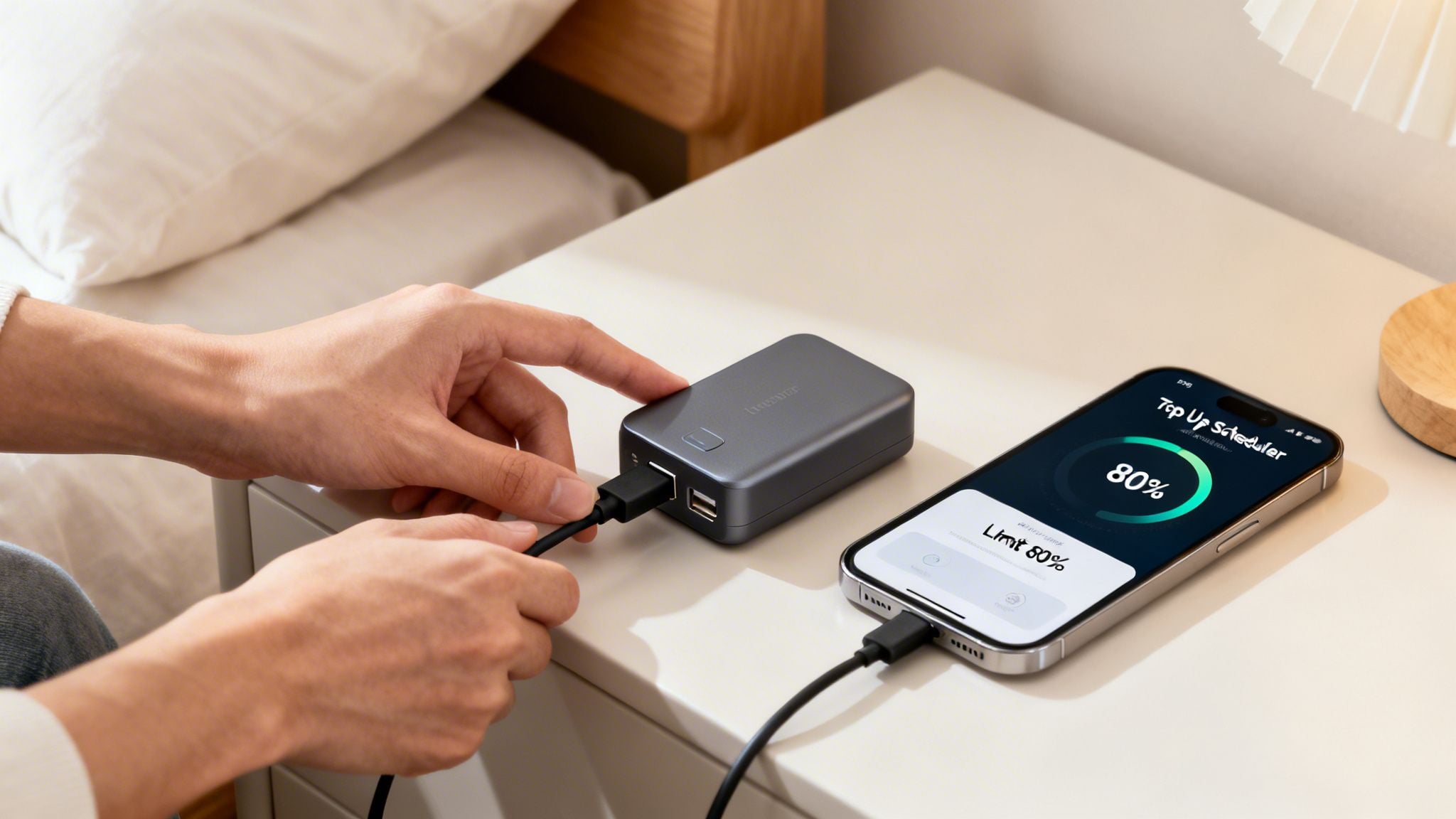
So, you've seen what a modern lithium ion charge controller can do. Now, let's get it working for you. Getting a hardware controller like Chargie up and running is incredibly simple. The physical setup takes just a few seconds, with zero technical skill needed.
You just plug the Chargie device into your power brick and then connect your usual charging cable to the other end. That's it. By sitting "in-between," it acts as a smart gatekeeper, controlling the electricity flowing into your phone or laptop.
With the hardware in place, the real magic happens in the companion app. After a quick Bluetooth pairing, you get total command over how your device charges. This is where you turn your dumb charger into a powerful tool for battery longevity.
Configuring Your Ideal Charging Limits
The single most powerful setting you can tweak is the maximum charge level. By default, your phone relentlessly pushes its battery to a stressful 100%. The Chargie app lets you take back control by setting a healthier limit—80% is the recommended sweet spot for daily use.
This one simple change dramatically cuts down the strain on the battery cells. The result? You can extend your battery's lifespan significantly. It's the most effective thing you can do to fight back against battery degradation.
The app's main screen gives you a clean, simple slider to set this limit.
This puts you in the driver's seat, letting you decide exactly how much juice your device should take in to preserve its long-term health.
Mastering Overnight Charging with Scheduling
Another game-changing feature is the Top Up Scheduler. It’s designed to solve the age-old problem of overnight charging. Instead of letting your phone sit at a damaging 100% for hours on end, the scheduler creates a much saner routine. Here's how to make it work for you:
- Set Your Wake-Up Time: Just tell the app when you need your phone ready to go.
- Enable the Scheduler: Chargie will automatically manage the charge overnight, keeping the battery at a low-stress level (say, 50-70%).
- Enjoy a Smart Top-Up: Right before your alarm goes off, Chargie will complete the charge. You wake up to a full battery without the hours of overnight damage.
This "just-in-time" charging approach means your battery only spends a few minutes at its stressful peak, not hours. It’s a true set-it-and-forget-it solution that delivers massive benefits.
A huge advantage of a hardware-based lithium ion charge controller is that these rules work even if your phone is turned off. Unlike software-only apps, Chargie physically cuts the power, giving you foolproof protection.
Tips for Different Charging Scenarios
Your charging needs aren't always the same, and a good controller should adapt with you.
- In the Car: If you use your phone for navigation, it's probably plugged in constantly. Set a charge limit of 80-85% to stop the battery from cooking itself, especially on hot days.
- Using Fast Chargers: Don't worry, you don't have to give up speed. Modern controllers like Chargie are fully compatible with fast charging standards like Power Delivery (PD). They safely pass through the high wattage until your limit is hit, so you get the best of both worlds.
- Different Cables: As long as you're using quality USB-C cables, your hardware controller will work flawlessly. It’s a universal fix for protecting any device, from your phone to your tablet and even your laptop.
The Financial and Environmental Impact of Smart Charging
It's one thing to talk about "charge cycles" and "battery stress," but what does it all really mean? When you connect the dots, you start to see a powerful story unfold—one that's great for both your bank account and the planet.
Using a dedicated hardware lithium ion charge controller isn't just a techy gadget. It's a strategic move with real, measurable payoffs.
Think about the battery in your phone. Most are built to last around 500 full charge cycles before they start to feel old and tired. But here’s the game-changer: just by avoiding the constant stress of pushing it to 100%, you can completely rewrite that story.
Simply capping the charge at 80% can extend its life by up to 4x. Suddenly, that 500-cycle battery is good for 2,000 cycles or even more.
Turning Extended Lifespan into Financial Savings
This isn't just a theory; it translates directly into cash saved. Instead of feeling forced to replace your phone every two years because the battery is shot, you could easily get four, five, or even six years of solid use out of it. The same goes for your laptop, your tablet, and anything else running on a lithium-ion battery.
Now, imagine you're a business running a whole fleet of devices. The savings multiply fast. The cost of swapping out batteries across dozens or hundreds of units is huge, not to mention the labor and downtime that hurts your operations.
By stopping premature battery death in its tracks, Chargie users have seen a massive 80-85% drop in their battery replacement costs. That’s not a small discount; it’s a total game-changer for the lifetime cost of your devices.
A Greener Planet, One Battery at a Time
The positive effects of smart charging go way beyond our own wallets. Every single battery we save is one less that needs to be manufactured and one less piece of hazardous e-waste headed for a landfill.
Making a new lithium-ion battery is an energy-hungry business. It involves intensive mining, refining raw materials, and shipping them all over the globe, all of which leaves a hefty carbon footprint.
When we make our devices last longer, we create a powerful ripple effect:
- Reduced E-Waste: Keeping our electronics in service means less toxic junk piling up in landfills.
- Lower Carbon Footprint: Fewer new gadgets being made means less CO2 pumped into the atmosphere from factories and global supply chains.
- Conservation of Resources: It takes the pressure off mining for finite resources like lithium and cobalt.
Using a smart lithium ion charge controller like Chargie is more than just a savvy financial move. It's a conscious choice to do your part and lessen your environmental impact. It's a simple, incredibly effective way to make your tech more sustainable.
Frequently Asked Questions About Charge Controllers
Whenever people first hear about using a dedicated lithium ion charge controller, a few questions almost always pop up. It's a new idea for most, so let's walk through the most common ones in simple terms.
Will Using a Hardware Controller Void My Warranty?
This is probably the number one question we get, and the answer is a firm no.
A hardware controller like Chargie is completely external. It’s a smart little device that sits between your charger and your phone's cable. All it does is manage the electricity before it ever gets to your device.
Think of it like a smart power strip for your phone. It doesn't modify or change a single thing about your phone's software or internal parts. Your manufacturer's warranty is there to cover defects in the phone itself, not the high-quality accessories you choose to use with it.
Is Hardware Better Than a Software-Only App?
Yes, and the difference is night and day. A hardware-based solution is simply the only foolproof way to do this.
Software-only apps try to stop charging by talking to the operating system, but they have a massive weak spot: they can’t actually cut the power. If the app crashes, the phone’s OS decides to ignore it, or you simply turn the device off, that software is completely bypassed. Charging goes right on up to a damaging 100%.
A hardware controller physically opens the circuit, like flipping a light switch. When your battery hits its target, Chargie cuts the power. It's a guarantee that works 100% of the time—whether your phone is on, off, frozen, or in the middle of an update.
Can I Still Fast Charge My Device?
Absolutely! A good lithium ion charge controller is designed for the modern world, and that includes fast charging.
Chargie is fully compatible with standards like USB Power Delivery (PD). It lets all that high wattage flow through so your device can juice up quickly. The controller's job isn't to slow you down; it's to stop the process at the perfect moment.
So you get the best of both worlds: a super-fast charge up to your healthy limit (say, 80%), and then the peace of mind knowing the hardware has safely cut power.
How Much Can It Really Extend My Battery Life?
While everyone's usage is a bit different, the results we see are dramatic. The science is simple: keeping your battery from sitting at 100% charge is the single biggest thing you can do to slow down its aging process.
By capping your charge at a much healthier level like 80%, you can dramatically increase the number of charge cycles your battery can handle before it starts to degrade. We've had countless Chargie users report getting up to 4x the normal battery lifespan.
That turns a phone you'd replace in two years into one that feels great for four, five, or even more.
Ready to take control of your device’s battery health and stop premature aging? With Chargie, you can implement these professional-grade charging strategies today. Get your Chargie and start extending the life of your batteries now at https://chargie.org.
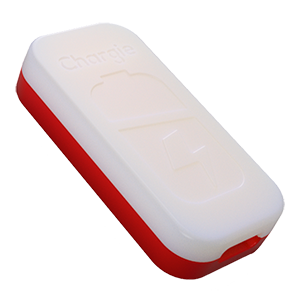
USB-C charge limiter that stops at your set battery level, so your battery never sits at 100% overnight. Extends battery lifespan by years. Works with any USB-C charger.
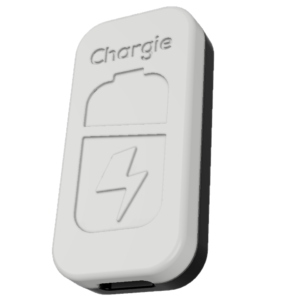
Limit your laptop charge to 80% via USB-C. Works with MacBooks, Dell, HP, Lenovo and most USB-C laptops up to 100W.
Protect Your Battery with Chargie
The world's first hardware charge limiter. Set a charge limit on any phone, tablet, or laptop — extend battery life by up to 4x.