
Why your smartwatch battery dies sooner than your phone’s
Most people assume all their lithium-ion gadgets age at the same rate. They don’t. A smartwatch is, from a battery-chemistry standpoint, the device most likely to feel “old” first — and there are three concrete reasons why.
First, the cell is tiny. An Apple Watch or Galaxy Watch carries a battery measured in the low hundreds of milliamp-hours — a fraction of the 3,000–5,000 mAh pack in a modern phone. Smaller cells have less buffer, so every bit of capacity loss is felt sooner in real-world runtime.
Second, you cycle it constantly. Because Apple’s own figures put the Apple Watch Series 11 at about 24 hours of mixed daily use (18 hours of activity plus 6 hours of sleep tracking), most people charge their watch every single day — often twice if they wear it overnight for sleep data. A phone owner who tops up every other day racks up far fewer full cycles per year.
Third — and this is the one almost nobody accounts for — the manufacturing target is lower. Battery University notes that small wearable batteries have historically been engineered to deliver around 300 charge cycles before meaningful degradation, while modern smartphones are specified for 800 cycles and more. Combine a 300-cycle design with daily charging and you can burn through the watch’s “good” battery life in well under two years.
The two silent killers: heat and 100%
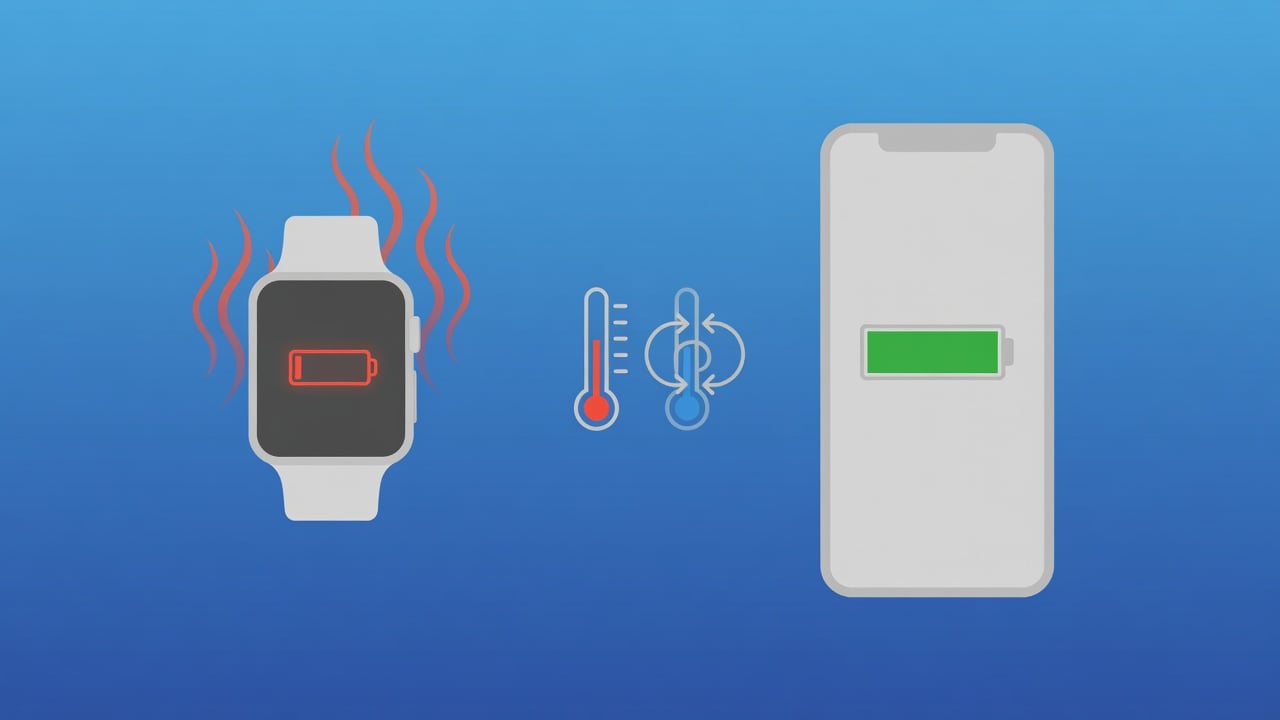
Lithium-ion cells age from two things above all: elevated temperature and time spent at a high state of charge. Battery University’s degradation research is blunt about it — “cycling, elevated temperature and aging decrease the performance over time.” A smartwatch is uniquely exposed to both.
Heat: Your watch lives strapped to a warm wrist all day, then often charges on a nightstand in a warm bedroom. Wearables don’t have the big metal chassis a laptop uses to dump heat, so the cell runs warm more of the time. If you’ve read our guide on summer heat and battery protection, the same physics applies — only the watch can’t escape your body temperature.
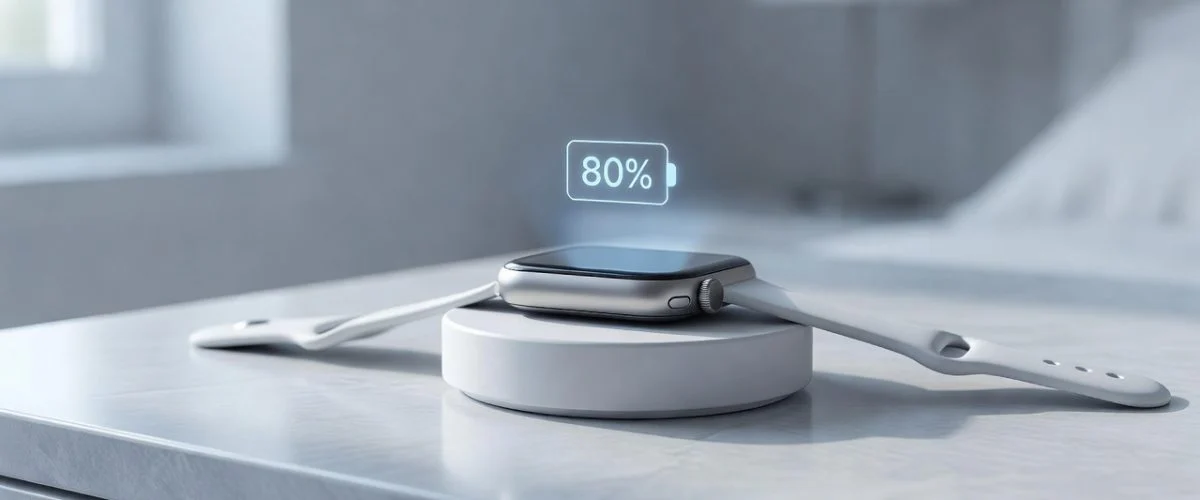
100% float charging: A charge cycle isn’t the only thing that ages a cell. Sitting full does too. When you put the watch on its dock at 9 p.m. and it hits 100% by 10:30 p.m., it then spends six or seven hours floating at full charge — the single highest-stress voltage state for a lithium cell. Multiply that by 365 nights a year and the damage adds up. This is the same mechanism we cover in why charging to 80% extends battery life.
This is where a hardware charge limiter earns its keep. A device like Chargie sits between the USB charger and the watch, detects when the cell is full, and cuts power physically — no software, no compatibility headaches. The watch never floats at 100% overnight, and you still wake up to a full charge in the morning.
Smartwatch vs. phone: the degradation math
Here’s how the typical smartwatch stacks up against a typical phone over the same calendar period. The numbers are illustrative but grounded in the cycle-life figures above.
| Factor | Typical smartwatch | Typical smartphone | Why it matters |
|---|---|---|---|
| Battery capacity | ~300–600 mAh | ~3,000–5,000 mAh | Smaller cell = less buffer, faster felt loss |
| Design cycle life | ~300 cycles | ~800+ cycles | Watch hits its limit far sooner |
| Charges per year | ~330–365 | ~180–250 | Watch is cycled almost daily |
| Time to ~300 full cycles | ≈ 10–14 months | ≈ 16–24 months | At 300 cycles the watch is spent; the phone is only halfway through its rated life |
| Overnight float at 100% | 6–8 hrs/night | Varies | High-SoC float accelerates wear |
| Heat exposure | Wrist + warm room | Pocket/desk | Constant warmth speeds degradation |
The takeaway: a watch that’s cycled daily can reach its ~300-cycle design point in roughly a year, while a phone takes closer to two. That’s why your two-year-old watch struggles to make it through the day while your same-age phone is mostly fine.
Signs your smartwatch battery is already wearing out
Wearables rarely show a tidy “battery health” percentage the way an iPhone does, so degradation tends to sneak up on you. Watch for these tell-tale signs:
- It no longer makes it through the day. The clearest signal — a watch that once lasted 24 hours now begs for a charge by dinner.
- It drops sharply in the last 20%. A worn cell’s voltage sags faster, so the battery falls off a cliff once it dips below roughly 20%.
- It dies in the cold. Aged cells handle low temperatures poorly; a sudden shutdown on a chilly morning walk often means real capacity loss.
- It runs warm on the charger. Rising internal resistance makes a tired cell heat up more during charging — which then accelerates further wear.
- It charges faster than it used to. A degraded cell holds less energy, so it tops up quicker — but drains just as fast.
How to slow the drain
You can’t change the physics, but you can change how you charge. These four habits meaningfully extend a wearable’s usable life:
- Cap the charge at 80–85%. If your watch supports it (or via a hardware limiter), stopping well short of 100% is the single highest-impact habit. Our article on 80% charging explains the chemistry.
- Charge during cooler hours. A watch that charges in a cool room at night instead of on a sun-baked dashboard in the afternoon ages measurably slower.
- Avoid full discharges. Shallow discharges (say, 80% down to 40%) stress the cell far less than running it to zero. Little top-ups are better than one deep drain.
- Use a charge limiter for overnight charging. Since most overnight charging is a long float at 100%, a USB charge limiter like Chargie cuts power at your chosen threshold and eliminates the float-wear entirely.
The bottom line
Your smartwatch battery isn’t defective — it’s just fighting tighter constraints than your phone. A smaller cell, daily cycling, body heat, and overnight float-charging conspire to age it faster. The good news: the same charge-management habits that protect your phone and laptop work even better on a wearable, because there’s less margin for waste. Cap the charge, keep it cool, and let a hardware limiter handle the overnight float. Your watch will thank you at the two-year mark.
FAQ
How many charge cycles does a smartwatch battery last?
Battery University data shows small wearable cells are typically rated for around 300 charge cycles before significant capacity loss, compared to 800+ cycles for modern smartphones. Real-world lifespan depends on charging habits, temperature, and how deeply you discharge each cycle.
Does overnight charging damage my smartwatch battery?
It’s not the act of charging overnight that’s the problem — it’s the float at 100% for hours after the cell is full. Keeping a lithium cell at maximum voltage for 6–8 hours every night accelerates degradation. A charge limiter that cuts power at 80–85% eliminates this float entirely.
Is it worth replacing a smartwatch battery?
Often, yes. If the watch otherwise meets your needs and the battery is the limiting factor, a replacement (official or from a reputable shop) can buy you another 1.5–2 years. But if you’re already seeing heat-related throttling or the watch struggles with current software, it may be time to upgrade.
Does the Apple Watch have a battery health feature?
As of watchOS, Apple does not expose a battery health percentage the way iOS does on iPhones. Third-party apps like CoconutBattery or Battery Life can give you a rough estimate via a paired iPhone, but the most reliable indicator is still real-world runtime.
Will a charger that stops at 80% really help?
Yes. Battery University’s data shows that the stress on a lithium cell increases sharply above ~80% state of charge. Stopping there — whether through a software setting on the watch or a hardware charge limiter — measurably reduces wear per cycle compared to topping off to 100%.
How does smartwatch battery life compare to fitness trackers?
Fitness trackers with smaller cells (like early Fitbits) can degrade even faster than smartwatches due to their tiny batteries. Larger fitness bands with more room for a cell tend to last longer. The same principles apply across all wearables: smaller cell + daily charging = faster aging.
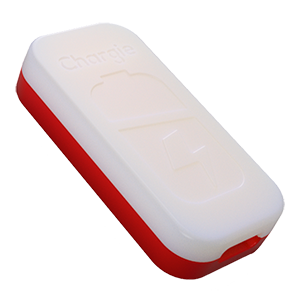
USB-C charge limiter that stops at your set battery level, so your battery never sits at 100% overnight. Extends battery lifespan by years. Works with any USB-C charger.
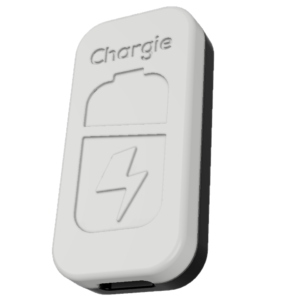
Limit your laptop charge to 80% via USB-C. Works with MacBooks, Dell, HP, Lenovo and most USB-C laptops up to 100W.
Protect Your Battery with Chargie
The world's first hardware charge limiter. Set a charge limit on any phone, tablet, or laptop — extend battery life by up to 4x.