


Why your camera battery drains faster than the box promised
You bought a wire-free security camera or video doorbell partly because of the battery-life claim on the box: “up to 6 months on a single charge.” Six weeks later you are back on the ladder, pulling the unit down to recharge it. You are not imagining it, and your camera is not defective. Manufacturer battery claims are measured in gentle lab conditions — a mild room temperature, a modest number of motion events per day, and no cold snaps or heat waves. Your front porch is nothing like that lab.
Every battery-powered doorbell and camera uses the same lithium-ion (or lithium-polymer) chemistry that powers your phone. According to Battery University’s research on lithium longevity, manufacturers rate most consumer lithium cells for just 300 to 500 full charge/discharge cycles before capacity noticeably fades. A camera that fully drains and recharges every few weeks can burn through those cycles in a couple of years (if you’re fuzzy on what a cycle actually is, our primer on battery cycle count breaks it down) — and the outdoor environment accelerates the decline at every step. Understanding the three real culprits (heat, deep discharge, and charging to 100%) is the key to doubling how long your device lasts between climbs up the ladder.
Culprit #1: Heat — the silent battery killer on your porch
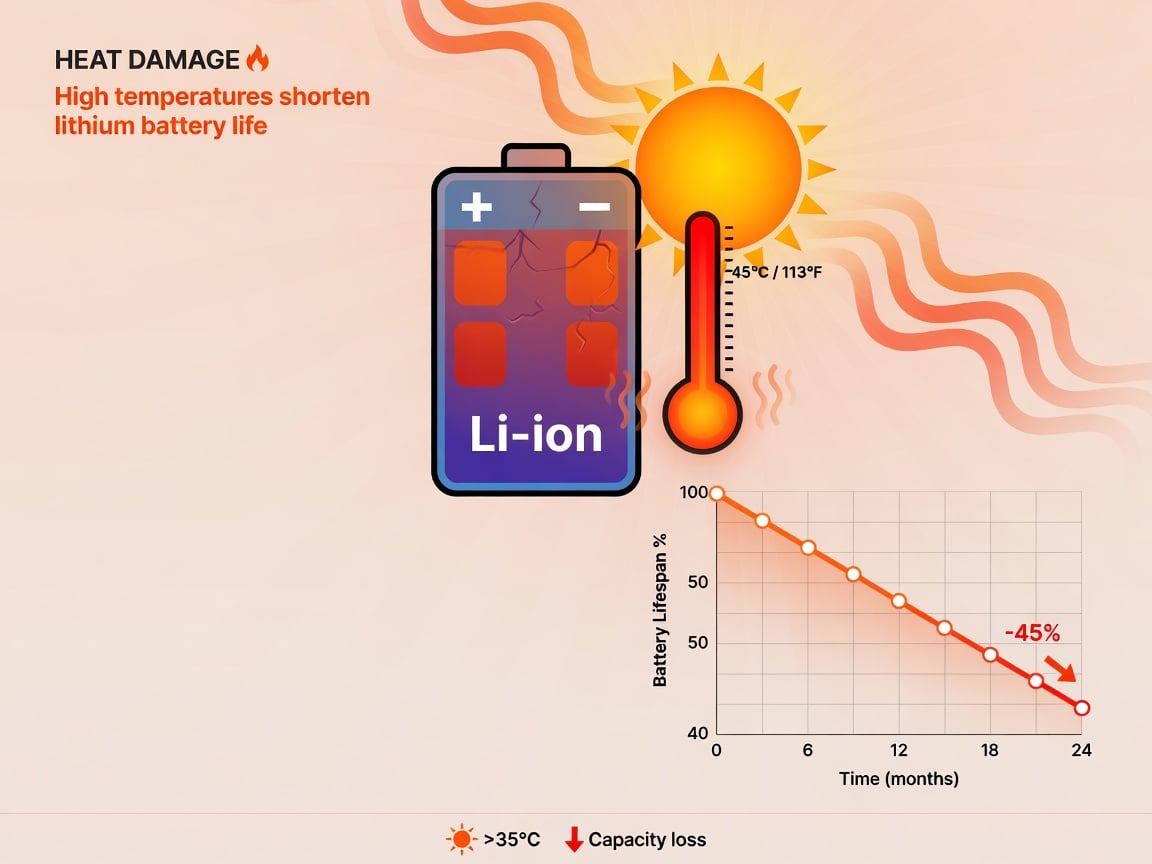
The single biggest reason outdoor cameras lose battery life faster than phones is temperature. Lithium batteries age fastest when they are hot, and a camera bolted to a south-facing wall or a doorbell baking in afternoon sun can reach internal temperatures far above the surrounding air.
The numbers are stark. Battery University’s temperature research shows that a lithium battery operated at 30°C (86°F) instead of a moderate 20°C (68°F) loses about 20% of its cycle life. At 40°C (104°F) the loss jumps to 40%, and charging or discharging at 45°C (113°F) leaves you with only half the lifespan you would get at room temperature. A dark plastic camera housing in direct summer sun easily hits those temperatures — which means your porch is quietly halving the life of every charge.
Cold hurts too — but differently
Winter is the flip side of the problem. Cold does not permanently damage the battery the way heat does, but it temporarily slashes usable capacity. The same research notes that a battery delivering 100% capacity at 27°C (80°F) typically gives only about 50% at −18°C (0°F). That is why your doorbell seems to plummet from “full” to “needs charging” during the first cold week of the year — the capacity is hiding, not gone, and it returns when the cell warms back up. The real danger in winter is charging: you should never charge a lithium battery below freezing, which matters if you top up the pack outdoors in a cold garage.
Culprit #2: Deep discharge cycles
Phones rarely hit 0% before you plug them in. Cameras, on the other hand, are designed to run their battery all the way down before alerting you — and many owners let them, because climbing a ladder is a hassle. That is exactly the wrong pattern for lithium chemistry.
Battery University is blunt on this point: “Deep discharge wears the battery down,” and a partial charge is consistently better for lithium cells than a full drain-and-fill (see their charging best-practices table). Every time your camera runs from 100% to near-0% and back, it counts as a full, high-stress cycle. Recharging at 30–40% instead of waiting for the low-battery warning turns those brutal full cycles into gentle partial ones and can dramatically extend the pack’s usable years — the same partial-charge principle we recommend in our guide to extending phone battery life. There is a second hidden risk: if a lithium pack sits fully depleted for a long time, its voltage can sag low enough to trip the internal protection circuit, sometimes making the pack refuse to charge at all.
Culprit #3: Charging to 100% every single time
Here is the counter-intuitive one. When you pull the pack, plug it in overnight, and put it back at a satisfying 100%, you are actually stressing it. A lithium cell held at full charge (4.2V per cell) sits under maximum internal voltage stress, and that stress compounds the heat damage happening on the wall. This is the same reason Apple, Samsung, and Google now cap charging around 80% on phones with their battery-protection features.
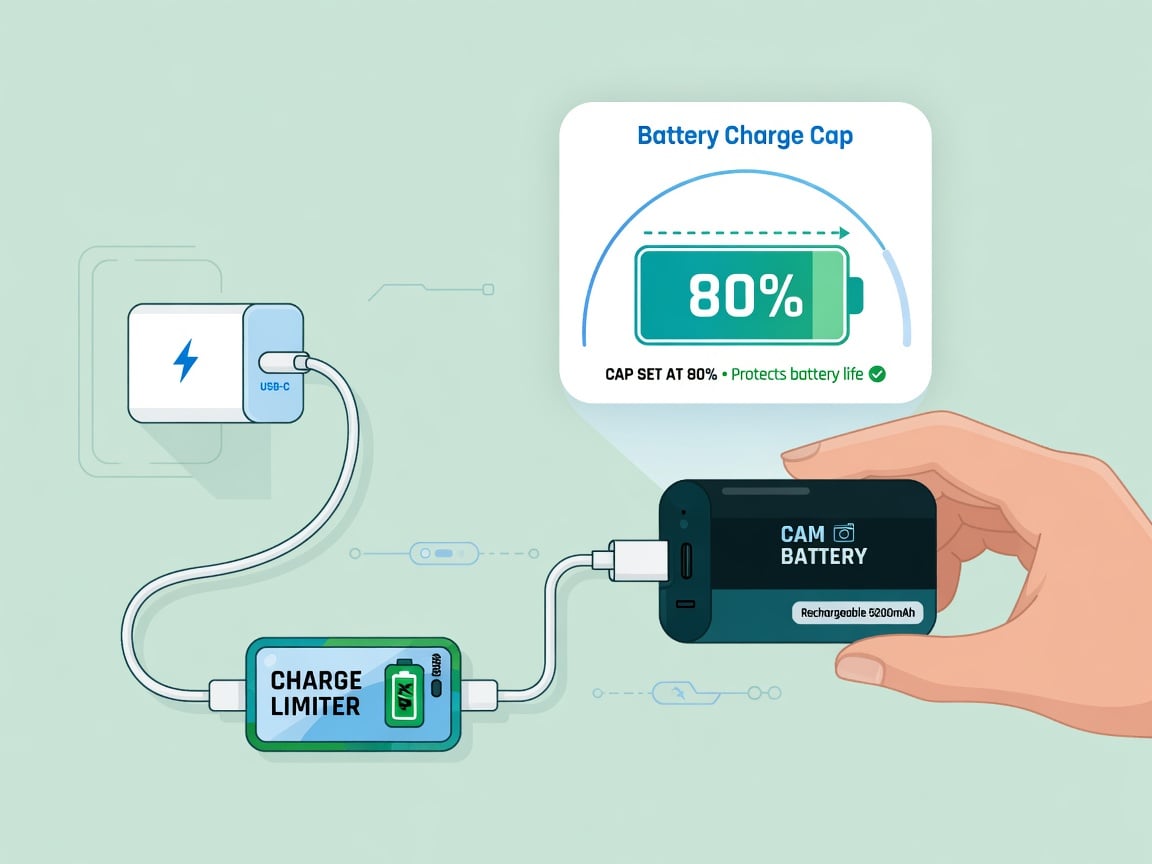
The fix is simple in principle: stop the charge around 80% instead of 100%. The problem is that almost no doorbell or camera has a built-in charge limit — you plug the removable pack into a USB brick and it charges to 100%, full stop. That gap is exactly where an external USB charge limiter earns its keep, which we cover below.
How the big brands compare
Different ecosystems handle battery life differently, but they all share the same underlying chemistry and the same three weaknesses. Here is how the popular battery-powered brands stack up in the areas that affect longevity.
| Brand / device | Battery style | Typical claim | Real-world weak spot |
|---|---|---|---|
| Ring Video Doorbell (battery) | Removable / built-in pack, USB-C | 6–12 months | High-traffic doorbells drain in weeks; heat on sunny porches |
| Arlo Pro / Essential | Removable pack, magnetic charge | 3–6 months | 4K/2K recording and cold snaps cut runtime hard |
| Blink Outdoor | Replaceable AA lithium cells | Up to 2 years | Non-rechargeable — heat still shortens the AA lithium life |
| Eufy / SoloCam | Large built-in pack, USB-C | Up to 6 months (solar models longer) | Sealed pack means no swap; must recharge in place |
| Google Nest Cam (battery) | Built-in pack, USB-C / proprietary | 1–6 months by activity | Event-heavy locations and heat drain it fastest |
A practical routine to double your battery life
You do not need to change hardware to get more life out of the pack you already own. These habits attack all three culprits at once:
- Mount out of direct sun. A shaded eave or north-facing wall runs meaningfully cooler than a sun-baked south wall — and every 10°C cooler roughly doubles battery lifespan.
- Recharge at 30%, not 0%. Don’t wait for the dead-battery alert. Topping up from a partial charge avoids the harshest full cycles.
- Stop the charge around 80%. That last 20% is where the most long-term stress lives. A USB charge limiter automates this.
- Trim motion zones and sensitivity. Fewer wake-and-record events per day means fewer cycles per month. Exclude the busy sidewalk or swaying tree.
- Lower video resolution if you can. 4K and 2K recording draws far more power than 1080p; drop it where fine detail isn’t essential.
- Never charge a frozen pack. Bring a cold battery indoors to warm to room temperature before plugging it in.
- Consider a small solar panel for cameras that support it — it keeps the pack topped in the gentle partial-charge range instead of deep-cycling.
Where a USB charge limiter fits in
Most of the habits above are behavioral — and behavioral fixes fail the moment you forget. The one culprit you cannot manage by hand is the charge ceiling: when you plug a camera pack into a USB charger, it goes to 100% and there is no setting to stop it. That is the exact problem Chargie was built to solve. Chargie is a small hardware device that sits between your USB charger and the battery pack; using the companion app you set a charge ceiling — say 80% — and Chargie cuts the current when the pack reaches it.
Because most modern doorbells and cameras charge over USB-C, the same limiter you might use for your phone works for the camera pack too. If you want the background on how the device does this, our explainer on what a USB charge limiter is walks through the mechanism, and the 2026 USB-C charge limiters comparison covers the options. The principle is the same one we describe for future-proofing any device’s battery, not just smartphones: keep the cell off the 100% ceiling and it will outlast the ones that live there.
Frequently asked questions
Why does my Ring or Arlo battery die so much faster in summer?
Heat. A camera or doorbell in direct summer sun can run 15–25°C hotter than the surrounding air, and lithium batteries age far faster when hot — roughly 40% faster cycle wear at 40°C versus 20°C. Move the unit into shade or mount it on a cooler wall and the difference is dramatic.
Should I let my camera battery fully drain before recharging?
No. Deep discharges wear lithium cells down faster than partial ones. Recharge when the pack hits around 30% rather than waiting for the low-battery warning. Letting the pack sit fully depleted for long periods can even trip its protection circuit and stop it charging altogether.
Is it bad to charge my camera battery to 100%?
Charging to 100% isn’t “bad” in one session, but keeping the pack at a full 4.2V per cell puts it under maximum voltage stress, which compounds over time. Stopping around 80% is gentler — the same logic behind the 80% charge caps on modern phones. A USB charge limiter enforces this automatically.
Do solar panels for security cameras actually help battery health?
Yes, indirectly. A solar panel keeps the pack topped up in the gentle partial-charge range instead of letting it deep-cycle from full to empty. That avoids the harshest cycles — just be aware the panel will usually push the pack toward 100%, so heat management still matters.
How many years should a camera battery last?
Most consumer lithium packs are rated for 300–500 full cycles, which translates to roughly 2–4 years of typical use. Heat, deep discharges, and constant 100% charging push it toward the low end; shade, partial charging, and an 80% ceiling push it toward the high end or beyond.
Can I use the same Chargie limiter for my phone and my camera?
If both charge over USB, yes. Chargie sits between the charger and whatever device you plug in, so the same unit can cap your phone one day and your camera’s removable pack the next. The charge ceiling is set per session in the app.
The bottom line
Battery-powered doorbells and security cameras don’t have weak batteries — they have hostile lives. They sit in heat, cycle deeply, and charge to 100% every time, and each of those three factors independently shortens lithium lifespan. Fix the environment (shade), fix the habit (recharge early, not empty), and fix the ceiling (stop around 80%), and you can realistically double the time between ladder climbs while pushing the pack’s total lifespan out by years. The first two are free; the third is exactly what a USB charge limiter automates so you never have to think about it again.
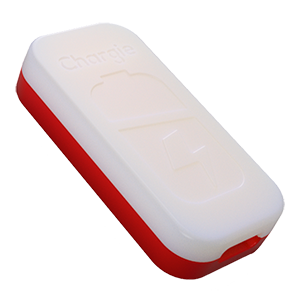
USB-C charge limiter that stops at your set battery level, so your battery never sits at 100% overnight. Extends battery lifespan by years. Works with any USB-C charger.
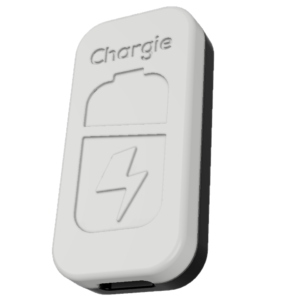
Limit your laptop charge to 80% via USB-C. Works with MacBooks, Dell, HP, Lenovo and most USB-C laptops up to 100W.
Protect Your Battery with Chargie
The world's first hardware charge limiter. Set a charge limit on any phone, tablet, or laptop — extend battery life by up to 4x.