
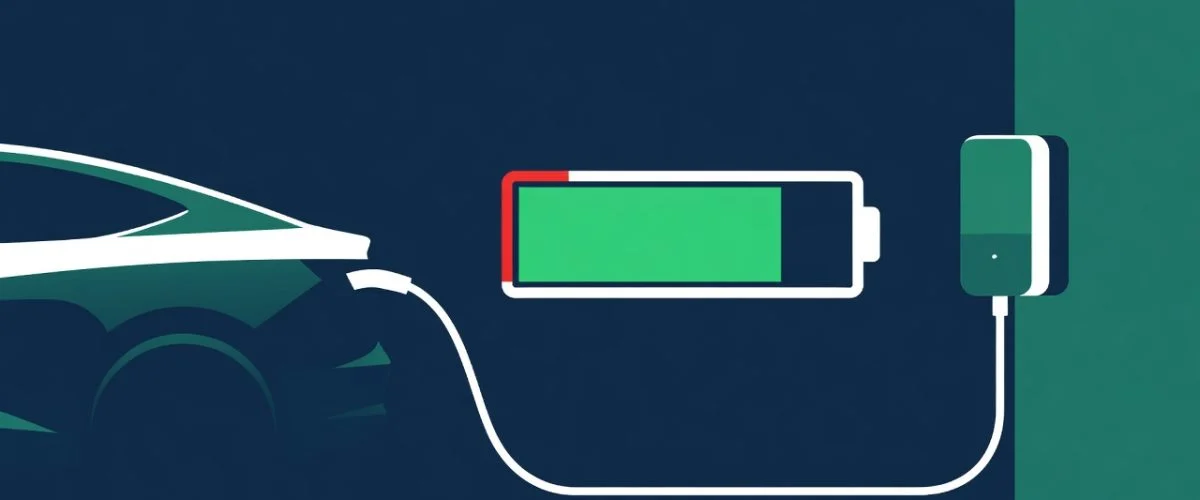

Short answer: For most electric cars, setting a daily charge limit of around 80% — and only charging to 100% right before a long trip — meaningfully slows battery degradation over the life of the car. It’s the same principle that protects your phone and laptop battery, just scaled up to a much bigger pack. Below is the science, the real-world range trade-off, and exactly how to do it on your EV.
What “EV battery health” actually means
When people talk about EV battery health, they’re really talking about state of health (SoH) — how much of the battery’s original usable capacity remains. A pack at 90% SoH delivers roughly 90% of the range it had when new. Capacity fade is normal and unavoidable: every lithium-ion battery loses a little capacity as it ages. The goal isn’t to stop degradation — that’s impossible — it’s to slow the rate so your usable range stays high for as long as possible.
The reassuring news: modern EV packs degrade slowly. A Geotab analysis of more than 22,700 electric vehicles found an average degradation rate of about 2.3% per year, and it identified frequent high-power DC fast charging as the single biggest risk factor accelerating that loss. At roughly 2–2.5% a year, a typical EV retains the large majority of its range well past the point most people keep a car — if it’s charged sensibly.
Why charging to 80% protects your EV battery
Lithium-ion cells are stressed most when they sit at a high state of charge (SoC). The voltage at the electrodes climbs as the pack fills, and the chemistry is least stable in the top 80–100% band. Time spent dwelling at a high SoC — not just the act of charging — is what quietly ages the cell. That’s why parking your EV at 100% for days does more harm than briefly topping up to 80% and unplugging.
This is exactly why most non-LFP EVs recommend a daily charge ceiling of about 80–90%, reserving 100% for trips. The notable exception is LFP (lithium iron phosphate) packs — common in standard-range Teslas and many newer EVs — where manufacturers often recommend charging to 100% regularly, partly because LFP chemistry tolerates high SoC better and needs a full charge for accurate range calibration. Always check your owner’s manual: it tells you which chemistry you have and the exact ceiling to set.
If this sounds familiar, it should. It’s the same 20–80% logic that extends the life of your phone, tablet, and laptop. We’ve written about the chemistry in depth in why charging to 80% extends battery life, and the same rule scales straight up to your car.
A quick word on the “range trade-off”
The most common objection to an 80% limit is range anxiety: doesn’t capping at 80% leave miles on the table? In practice, the trade-off is smaller than it feels. The average driver covers far less than 80% of their EV’s range in a typical day, so an 80% ceiling still leaves plenty of buffer for daily commuting, errands, and unexpected detours. You only need the top 20% on the days you’re actually taking a long trip — and on those days, you simply bump the limit back to 100% the night before. You give up nothing on the days that matter and gain years of slower degradation on every other day.
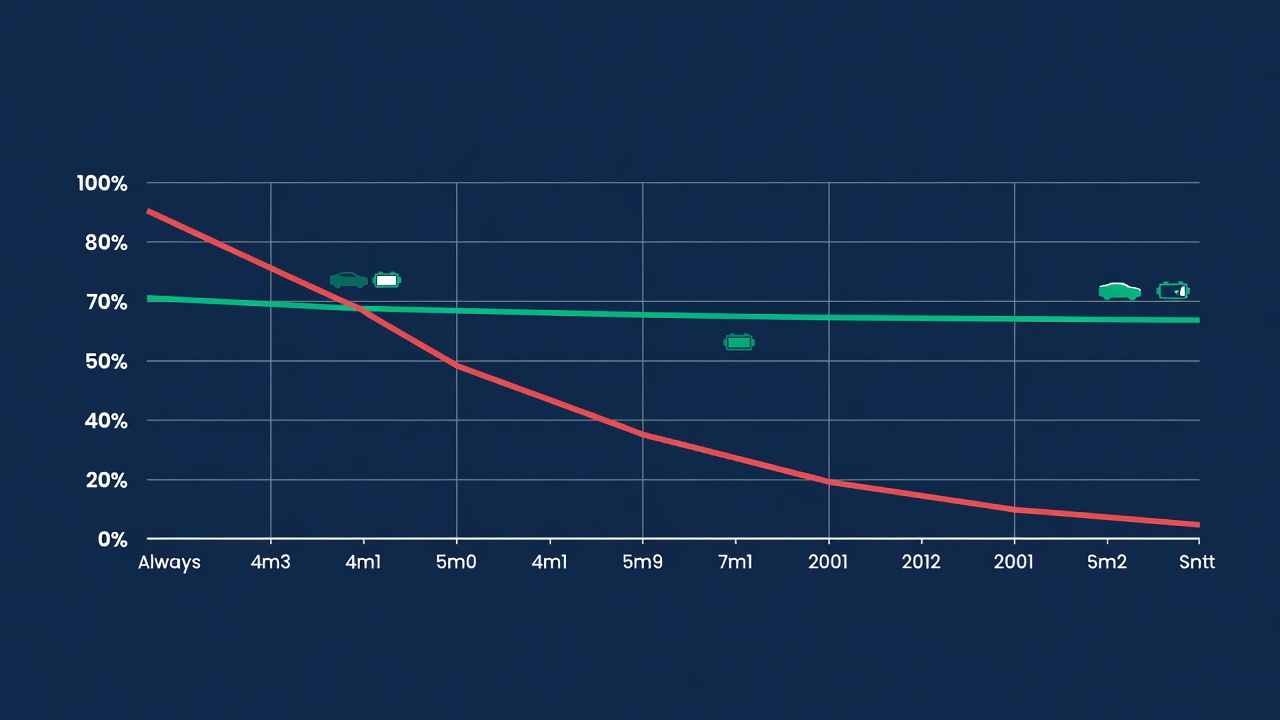
Manufacturer charge-limit guidance at a glance
Charge ceilings vary by chemistry and brand, so your owner’s manual is always the final word. As a general orientation, here is how the guidance tends to break down:
- Non-LFP packs (most long-range EVs): a daily ceiling around 80–90%, with 100% reserved for trips.
- LFP packs (many standard-range models): regular 100% charging is typically fine and often recommended, partly to keep range estimation accurate.
- Long-term storage (any chemistry): leave the pack at a moderate ~50–60% rather than full or empty.
If you’re not sure which chemistry your car uses, the manual or the manufacturer’s app will tell you — and it’s worth two minutes to confirm before you set a limit.
The biggest things that degrade an EV battery
Four factors do most of the damage. Each one is worth understanding because the fix is usually simple.
Does heat damage EV batteries?
Heat is the number-one accelerant of battery aging. High temperatures speed up the unwanted chemical reactions that permanently reduce capacity. You can’t control the weather, but you can park in the shade when possible, use your EV’s pre-conditioning to cool the pack before fast charging in summer, and avoid leaving the car at a high SoC in extreme heat. Most EVs have active thermal management that handles the rest — let it.
Is DC fast charging bad for your battery?
Occasional DC fast charging is fine; relying on it as your daily charging method is not. Fast charging pushes high current and generates heat, both of which stress the cells — the same Geotab fleet analysis flagged frequent high-power DC fast charging as the top degradation risk factor. The practical rule: use Level 2 (home/work) charging for everyday top-ups, and save DC fast charging for road trips where you actually need the speed.
Does charging to 100% (or draining to 0%) hurt?
Both extremes stress the pack. Sitting at 100% keeps the cells in their highest-stress voltage band, while repeatedly running down to near 0% adds its own strain. Living in the middle — roughly the 20–80% band for daily use — is the single most effective habit for long-term battery health on most EVs.
What is calendar aging?
Batteries age with time even when they’re not being used — that’s calendar aging. Storing a pack at a high state of charge accelerates it. If you’re parking an EV for an extended period, the standard guidance is to leave it at a moderate charge (around 50–60%) rather than full or empty.
Cold weather and your EV battery
Winter range loss surprises a lot of new EV owners, but it’s mostly temporary, not permanent damage. AAA testing found that at 20°F (-7°C) with the cabin heater running, average EV driving range dropped by 41% — meaning 100 miles of normal range falls to about 59 miles. (For comparison, 95°F with the air-conditioning on cut range by about 17%.) The biggest culprit is cabin heating, not battery damage.
The fix is pre-conditioning: warm the battery and cabin while the car is still plugged in, so that energy comes from the wall rather than the pack. Your range returns when temperatures climb. Cold weather costs you miles today; it doesn’t meaningfully shorten your battery’s life.
How to charge your EV for maximum battery life
The whole strategy fits in a short checklist:
- Set an 80% daily charge limit (90% if your manual says so; 100% for LFP packs).
- Charge to 100% only right before a long trip, and ideally time it to finish close to departure.
- Avoid sitting at 100% or near 0% for long periods.
- Prefer Level 2 / slower charging for daily top-ups; save DC fast charging for road trips.
- Pre-condition the battery in cold or hot weather while still plugged in.
- Park in shade and let thermal management do its job in extreme heat.
Free • 60 seconds • No app needed
Curious how healthy your EV battery really is?
Get your free EV charging score in 60 seconds and see how your charging habits stack up for range retention and pack longevity.
Why battery health protects your resale value
For most EV owners, the battery is the single most valuable component in the car — and the one buyers and dealers scrutinize most on the used market. A pack with higher remaining state of health means more usable range, which translates directly into a stronger resale price. Many used-EV listings and inspection reports now surface an SoH figure, so the charging habits you adopt today quietly compound into the number a future buyer sees. Treating your battery well isn’t just about your own driving experience; it’s about protecting the largest part of the car’s long-term value.
EV vs phone batteries — the same rule, scaled up
Here’s the connection that ties it all together: an EV battery and a smartphone battery are the same lithium-ion chemistry. The 80% rule that protects your phone is the exact same rule that protects your car — just a far bigger pack. If you’ve ever set an 80% charge limit on an iPhone or used a hardware charge limiter on a laptop, you already understand EV battery care.
Chargie has spent years on exactly this problem for phones, tablets, and laptops. If you want the deeper science or want to protect your other devices the same way, start with what a USB charge limiter does, our guide to iPad battery health, and the seasonal guides for summer heat and cold-weather drain. The principle never changes: keep the battery off the extremes, and it lasts.
Your free EV charging score
How much range is your EV quietly losing?
Answer a few quick questions about how you charge. We’ll point you to the right setup plus simple tips to slow degradation, protect range, and hold resale value.
Takes about 60 seconds. Find the right setup for your charging routine.
Frequently asked questions
Should I charge my EV to 80% or 100%?
For daily driving on most non-LFP EVs, charge to about 80% to slow degradation, and charge to 100% only right before a long trip. If your car has an LFP battery, the manufacturer often recommends regular 100% charges — check your owner’s manual to confirm your chemistry and ceiling.
Is it bad to leave my EV plugged in overnight?
No — being plugged in is fine. What matters is the charge limit you set: if it’s at 80%, the car simply stops there and the battery isn’t held at a high-stress 100% all night. Use your car’s charge-limit setting and overnight charging is perfectly safe.
Does fast charging ruin EV batteries?
Not from occasional use. The concern is making DC fast charging your everyday default — the high current and heat accelerate wear over time. Use Level 2 charging day to day and save fast charging for trips.
How long do EV batteries last?
Most modern EV packs degrade slowly — fleet data shows roughly 2.3% capacity loss per year on average — and are designed to outlast the typical ownership period, with most manufacturers warrantying the battery for 8 years or 100,000 miles. Charging habits make a real difference to where you land in that range.
Why does my EV lose range in winter?
Mostly because cabin heating draws a lot of energy and cold reduces battery efficiency. AAA measured a 41% range drop at 20°F with the heater on. It’s temporary: pre-condition while plugged in, and your range returns as it warms up.
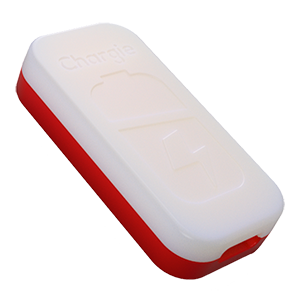
USB-C charge limiter that stops at your set battery level, so your battery never sits at 100% overnight. Extends battery lifespan by years. Works with any USB-C charger.
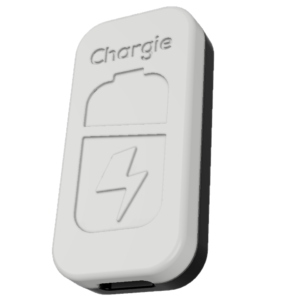
Limit your laptop charge to 80% via USB-C. Works with MacBooks, Dell, HP, Lenovo and most USB-C laptops up to 100W.
Protect Your Battery with Chargie
The world's first hardware charge limiter. Set a charge limit on any phone, tablet, or laptop — extend battery life by up to 4x.