
TL;DR: Massage gun battery health starts with your exact model’s charging instructions—not a universal percentage target. The Theragun mini documents reviewed here say to disconnect within one hour after a full charge, keep the device cool and dry, and fully charge it before long-term storage. The Hypervolt Plus manual reviewed here says not to charge overnight or leave charging unattended. Those are model-specific instructions, not interchangeable rules. Use the approved charging equipment, avoid hot storage, and seek service rather than opening a damaged battery.
Why your massage gun needs its own charging routine
A massage gun is easy to put away and forget. Unlike a phone, it may spend long stretches on a shelf between sessions. That makes its storage and charging instructions worth reading before you decide that permanently plugging it in is the easiest way to keep it ready.
The useful question is not simply whether charging is good or bad. It is what your manufacturer says to do when charging finishes, where the device should live between uses, and how to prepare it for a longer break. Those instructions can differ even between products carrying the same brand name.
This guide compares the Theragun mini user manual and warnings linked from Therabody’s support resources with a reproduced Hypervolt Plus manual. It does not establish compatibility for every Theragun, Hypervolt, or generic percussion massager. Check the model and generation printed on your device before applying an example below. The sources are linked at the end so you can compare the wording with your own documentation.
Battery runtime and battery health are different questions
Runtime means how long a charge lasts during use. Battery health concerns the battery’s ability to retain useful capacity as it ages. A short session followed by a low indicator is an observation, not a diagnosis: without a consistent comparison, it does not tell you which component needs attention.
Battery University’s lithium-ion overview explains that elevated temperature and prolonged time at a full state of charge can stress lithium-ion cells. It also explains why partial charging and shallower discharges can reduce stress. These are general battery principles, not a measured lifespan prediction for your massage gun. Its tables should not be converted into a promise that a particular routine will double your device’s life. Source: Battery University, BU-808.
For background, our guide to checking battery health explains the broader distinction. For a massage gun, start by recording what you can actually observe: its charging indicator, whether charging completes as described, and whether its behavior has changed under comparable use. Avoid treating a rough indicator as a laboratory capacity measurement.
Can you leave a massage gun plugged in?
Do not assume that a full-charge indicator means the manufacturer recommends leaving the adapter connected indefinitely. The Theragun mini warnings reviewed for this article explicitly say not to leave the device connected for more than one hour after it has fully charged. The same section says the device includes protection against overcharging, while warning that overcharging may reduce its life over time. Source: Theragun mini warnings, page 4, section 9.
That is a useful distinction: having a protection system does not erase the instructions about when to disconnect. A convenient practical approach is to charge when you can check the indicator and unplug afterward. The one-hour wording is an upper limit in this document, not a recommendation to deliberately keep charging for an extra hour.
The Hypervolt Plus manual reproduced by ManualsLib takes a different form: it says not to charge overnight or leave the device unattended when charging or in use. It also says to unplug the charger from the battery handle before use. Follow those instructions for the covered model rather than importing the Theragun timing rule. Source: Hypervolt Plus manual, important safety instructions.
If your manual is missing, find the official support page using the precise product name. Do not select a charging routine from a photograph of a similar-looking device. Until you have identified the correct instructions, avoid improvising an overnight charging arrangement.
Match the charger to the model, not just the socket
The Theragun mini manual reviewed here identifies a USB-C charging port. It instructs you to turn the device off before connecting the supplied cable. The accompanying warnings allow the included cable or a regular USB-C cable certified by a competent body, and warn against using an uncertified or damaged AC adapter. Source: Theragun mini user manual, page 6; warnings, page 4.
By contrast, the reproduced Hypervolt Plus manual lists its own AC charger and instructs users to use the charger supplied with the unit. A connector that appears to fit is not a reason to substitute a charger. Keep the original equipment identifiable, especially if a drawer contains adapters from several household devices.
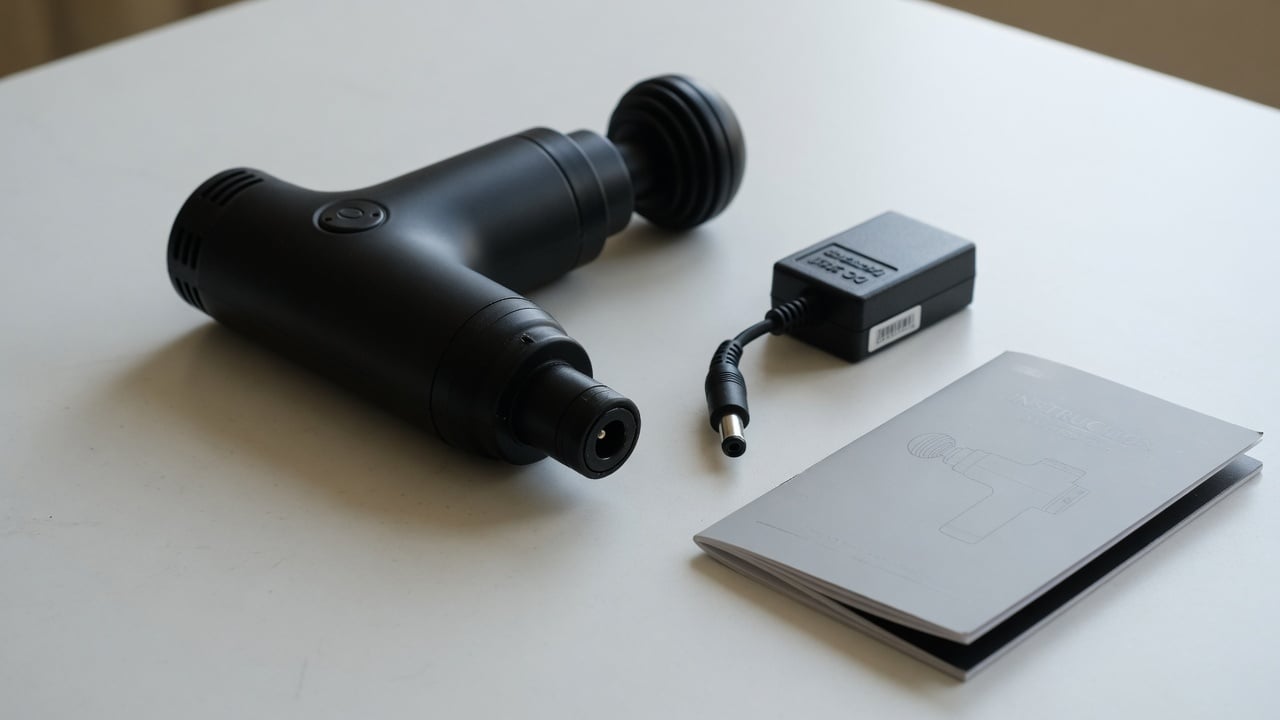
Consider keeping a simple note with the case: model name, manual link, and which adapter belongs to it. That small administrative step is more useful than guessing from cable appearance when you next unpack it. If equipment is lost, ask the manufacturer which replacement is approved.
Charging and storage: a model-specific comparison
The table separates instructions that actually appear in the reviewed documents from questions those documents do not settle. It is a starting point for checking your own manual, not a compatibility chart.
| Question | Theragun mini documents reviewed | Hypervolt Plus manual reviewed |
|---|---|---|
| Charging connection | USB-C; turn the device off before charging | Use the charger supplied with the unit |
| After charging | Disconnect within one hour after full charge | Unplug from the battery handle before use |
| Overnight charging | Do not exceed the stated post-full-charge connection limit | Explicitly prohibited; do not leave charging unattended |
| Storage location | Cool and dry; avoid temperatures above 40°C | Clean, cool place when not in use |
| Long-term storage charge | Warnings specify a fully charged battery | No percentage target established by the extracted guidance used here |
Why a blanket storage percentage can be bad advice
You may have read that lithium-ion batteries should be stored partly charged. Battery University describes the general disadvantages of prolonged full charge and heat. However, the Theragun mini warnings reviewed here specifically state that the battery should be fully charged for long-term storage. Both pieces of information deserve to be presented honestly rather than quietly removing the inconvenient one.
For this device, follow the manufacturer’s storage instruction. Fully charging before storage is not the same as leaving the device connected throughout storage: the same document says to unplug the cable when not in use and limits connection time after charging finishes. It is possible to follow both instructions without turning the storage shelf into a permanent charging station.
The reviewed documents do not establish a universal top-up interval for every massage gun. Do not invent a monthly routine or a precise storage percentage and call it a manufacturer recommendation. Ask support about extended storage if your manual does not address the length of break you have in mind.
Our explanation of why lower charge levels can reduce battery stress provides general context. It should not override a product-specific safety or storage requirement. The distinction matters more than choosing a neat percentage that is easy to remember.
Keep heat and moisture out of the routine
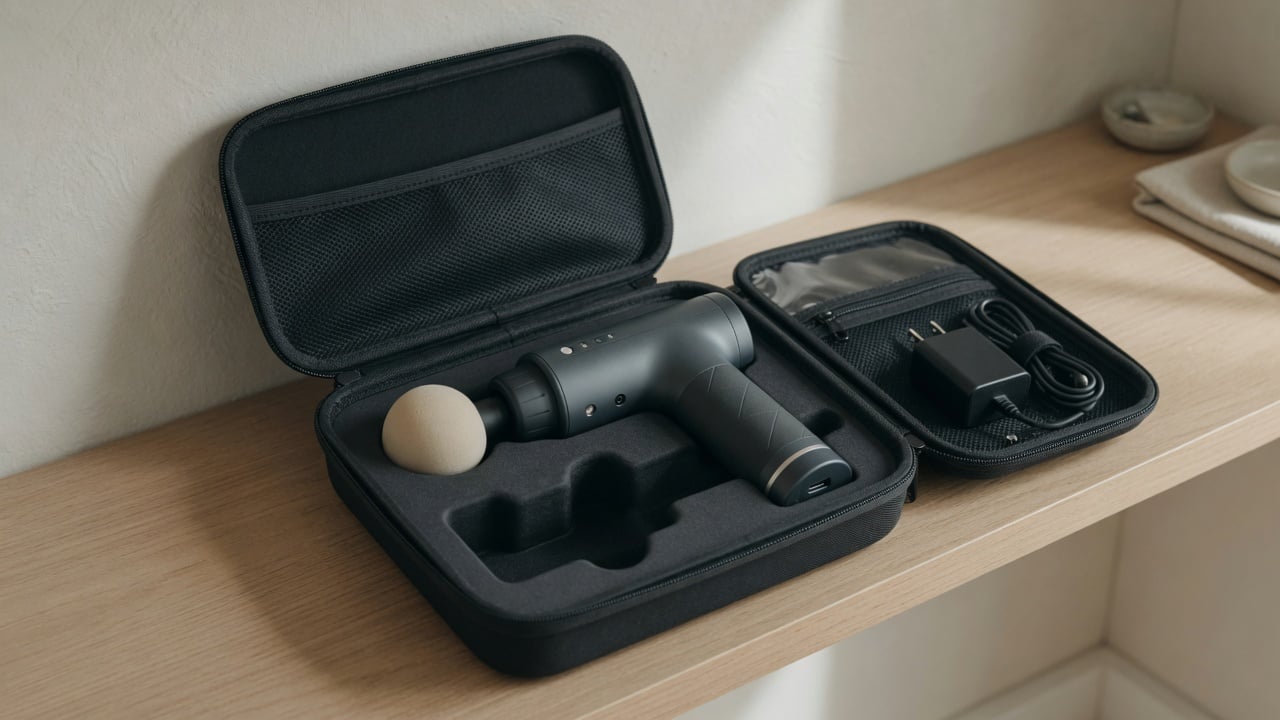
The Theragun mini warnings specify charging only when ambient temperature is between 0°C and 40°C, and storage somewhere temperatures will not exceed 40°C. They explicitly mention direct sunlight, a vehicle, and a metal building during summer as locations of concern. These are limits from the reviewed manual—not target temperatures for everyday storage.
The same warnings call for indoor charging in a well-ventilated, dry location and prohibit charging in a bathroom. They also say not to block motor vents or operate the device under a blanket or pillow. Keep the charging arrangement separate from wet towels and choose a location consistent with those instructions.
A practical habit is to check the surroundings before connecting the cable: is this the right equipment, is the surface dry, and can you monitor charging without covering the device? If the device has been somewhere outside its permitted conditions, consult its instructions rather than immediately plugging it in and hoping for the best.
When charging trouble needs service, not a workaround
For the Theragun mini covered here, the user manual describes a flashing indicator during charging and solid green when charging is complete. It also describes checking the battery indicator while the device is off. Use the indicator legend in the correct manual; do not assume that another model uses the same colors or meanings.
If normal charging behavior changes, note what happened before contacting support. Useful details include the model, the charging equipment used, the indicator behavior, and any recent drop or contact with water. That is a more useful starting point than repeatedly swapping unfamiliar adapters.
The mini warnings say not to use a device or cable that is damaged or not working properly and direct users to service. They also prohibit disassembly and warn of electric shock, fire, and exposure to battery chemicals. A battery-care article is not a reason to pry open a sealed handle or attempt to revive a questionable pack.
Our guide to battery swelling and prevention offers broader context. For a damaged massage gun, follow the manufacturer’s service route and local disposal requirements rather than applying a homemade repair procedure. The reviewed documents provide no basis for promising that a new cable will solve every charging failure.
Where does a charging limiter fit?
Readers familiar with Chargie may naturally ask whether the same approach used for a phone applies here. This article does not establish Chargie compatibility with either massage gun. A USB-C socket alone does not establish that a particular limiter, app, and device combination can implement a desired battery threshold.
Start with what a USB charge limiter does and our battery charge limiter overview for the broader concept. If you want to use additional charging equipment with a massage gun, verify the exact combination and the manufacturer’s requirements before buying or connecting it.
For a supported phone setup, our guide to setting an 80% charging limit addresses a different use case. Do not transfer that threshold automatically to a massage gun whose manual gives different storage instructions. For the models discussed here, the directly supported habits are simpler: correct charging equipment, timely disconnection, suitable surroundings, and manufacturer-led service.
FAQ: massage gun battery health
Charging habits
Can I charge my massage gun overnight? Check the exact manual. The reproduced Hypervolt Plus manual explicitly says not to do so. The reviewed Theragun mini warnings say not to remain connected for more than one hour after full charge, so an unmonitored overnight routine is not a sound way to follow that instruction.
Should I charge it while using it? Follow the model’s instructions. The mini manual says to switch it off before charging. The Hypervolt Plus guidance says to disconnect the charger from the battery handle before use. Neither example supports treating the charging cable as a power lead during a session.
Storage and battery percentages
Should every massage gun be stored half charged? No universal recommendation is established here. The reviewed Theragun mini warnings specifically call for a full charge before long-term storage. General lithium-ion advice does not replace that model-specific instruction.
Does a green light prove the battery is healthy? The mini manual identifies solid green as charging complete. It does not describe that light as a remaining-capacity health test. Use the indicator for its documented purpose and ask support about abnormal behavior rather than drawing a health diagnosis from color alone.
Accessories and repairs
Can I use a spare charger because its plug fits? Do not choose by fit alone. Use the charging equipment permitted by your manual. The Hypervolt Plus document specifies the supplied charger; the reviewed mini documentation gives its own USB-C cable and adapter requirements.
Can I open the handle to replace the battery? Do not assume a battery is user-serviceable. The reviewed mini warnings prohibit disassembly. Follow the service instructions for your exact device, even if an online video shows someone opening a similar-looking product.
Sources and scope
- Therabody: Theragun manuals directory, used to locate the documents below.
- Theragun mini user manual, especially page 6 for charging and indicators.
- Theragun mini warnings, pages 3–5 for charging, storage, environment and service.
- Hypervolt Plus manual reproduced by ManualsLib, a third-party reproduction, not a manufacturer-hosted page.
- Battery University: BU-808, general lithium-ion aging context, not product-specific lifespan testing.
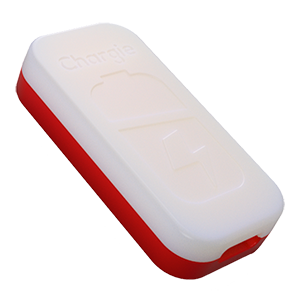
USB-C charge limiter that stops at your set battery level, so your battery never sits at 100% overnight. Extends battery lifespan by years. Works with any USB-C charger.
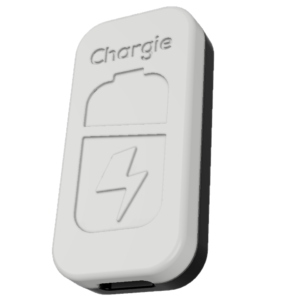
Limit your laptop charge to 80% via USB-C. Works with MacBooks, Dell, HP, Lenovo and most USB-C laptops up to 100W.
Protect Your Battery with Chargie
The world's first hardware charge limiter. Set a charge limit on any phone, tablet, or laptop — extend battery life by up to 4x.