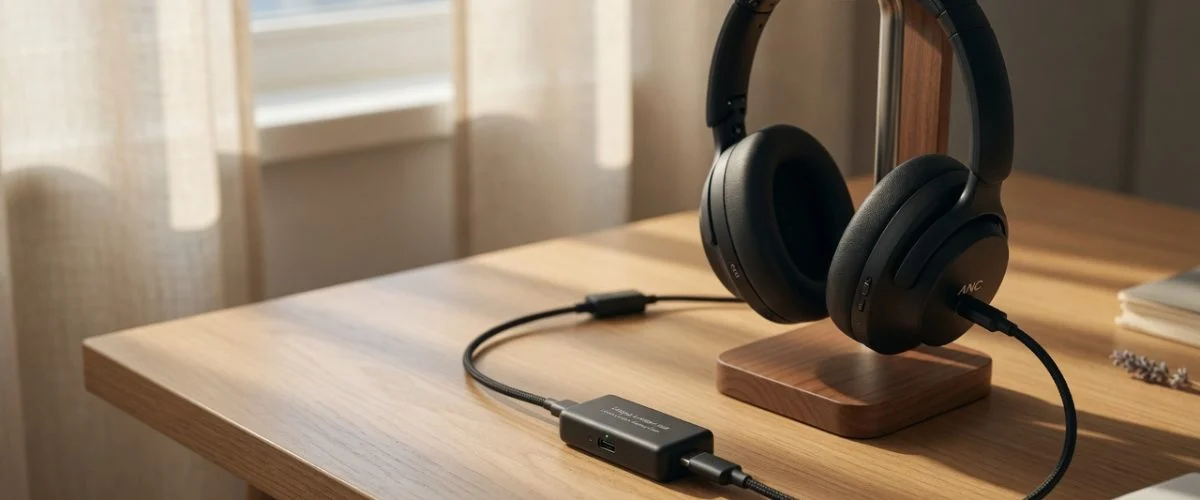

If your over-ear noise-cancelling headphones have started dying two hours early on long flights, or swelling at the ear cup, the battery hasn’t been “abused” — it’s just been sitting at 100% on its stand for a year. That’s calendar aging, and ANC headphones are the perfect storm for it. Get the 80% rule right, get heat out of the way, and a 700–1100 mAh Li-ion cell will outlive the drivers.
Why over-ear ANC headphones die so fast
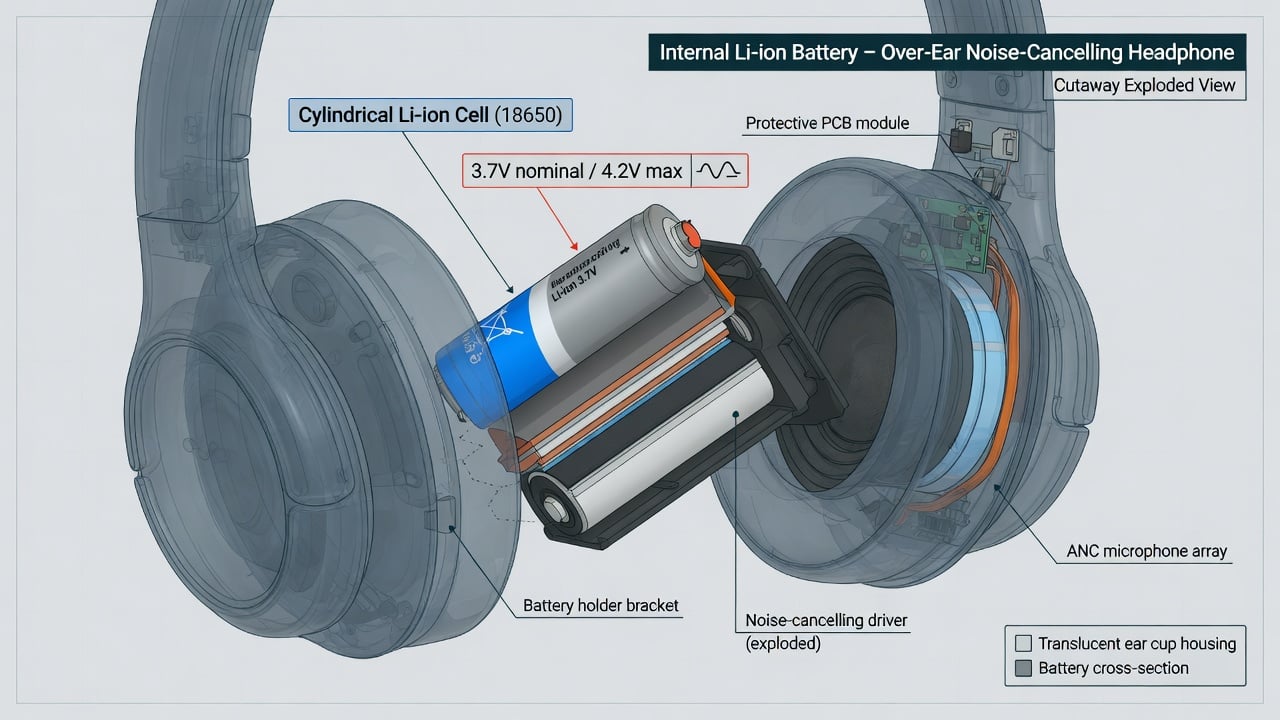
Pick up any pair of premium wireless over-ear cans — Sony WH-1000XM, Bose QuietComfort, Sonos Ace, Sennheiser Momentum 4, Bowers & Wilkins Px7, Bang & Olufsen H95 — and you’ll find the same constraints: a single 700–1100 mAh Li-ion (usually a pouch or small cylindrical cell, ~3.7 V nominal, charged to 4.2 V) tucked into one or both ear cups; a sealed plastic frame; USB-C (and on newer models Qi) charging in; and a stand, a desk, or a nightstand where the headphones live when you’re not wearing them.
That setup creates three chronic stresses the battery-management system can’t see:
- Continuous 100% SoC. Once the cell hits 4.2 V and the charger stops pushing current, the seat-of-the-cup BMS doesn’t actually discharge the cell to a friendly voltage — it just lets it sit at 4.2 V. At that voltage, the cathode (especially NMC, common in compact Li-ion designs) holds lithium at the edge of structural stability. Side reactions at the anode-electrolyte interface accelerate — the same SEI growth mechanism that shortens phone and laptop longevity if you leave them plugged in.
- “Off” isn’t actually off. Many modern pairs continue to listen for ANC-aware wake words, Bluetooth re-pairing, and firmware updates with the cell nearly full. The cell never gets a chance to drift down to ~80% on its own; it just sags a few tenths of a percent over days and the charger tops it back up to 4.2 V. That’s a microcosm of what Wikipedia summarises on trickle charging: the moment a Li-ion cell reaches full charge, “failure to accommodate the limitations of the chemistry… can lead to overheating and fire or explosion.” The same forces that drive that risk are driving your fade in capacity, just quietly.
- Heat against skin + cup foam. Ear cup interiors can easily reach 35–42 °C in use, especially with ANC + LDAC + a warm room. That’s not the same as 60 °C storage, but it sits inside the Li-ion “fast-charge window” of 5–45 °C — meaning the cell both charges and idles most of its life above the comfortable 25 °C baseline that Battery University cycle-testing assumes. Above ~25 °C storage, calendar aging roughly doubles for every 10 °C, per the Arrhenius behaviour cited in Li-ion durability literature.
Add it up and a $400 pair of cans can drop from a rated 30-hour ANC runtime to 18 hours inside 18 months, not because of bad manufacturing but because of how it’s stored.
The 80% rule, applied to headphones
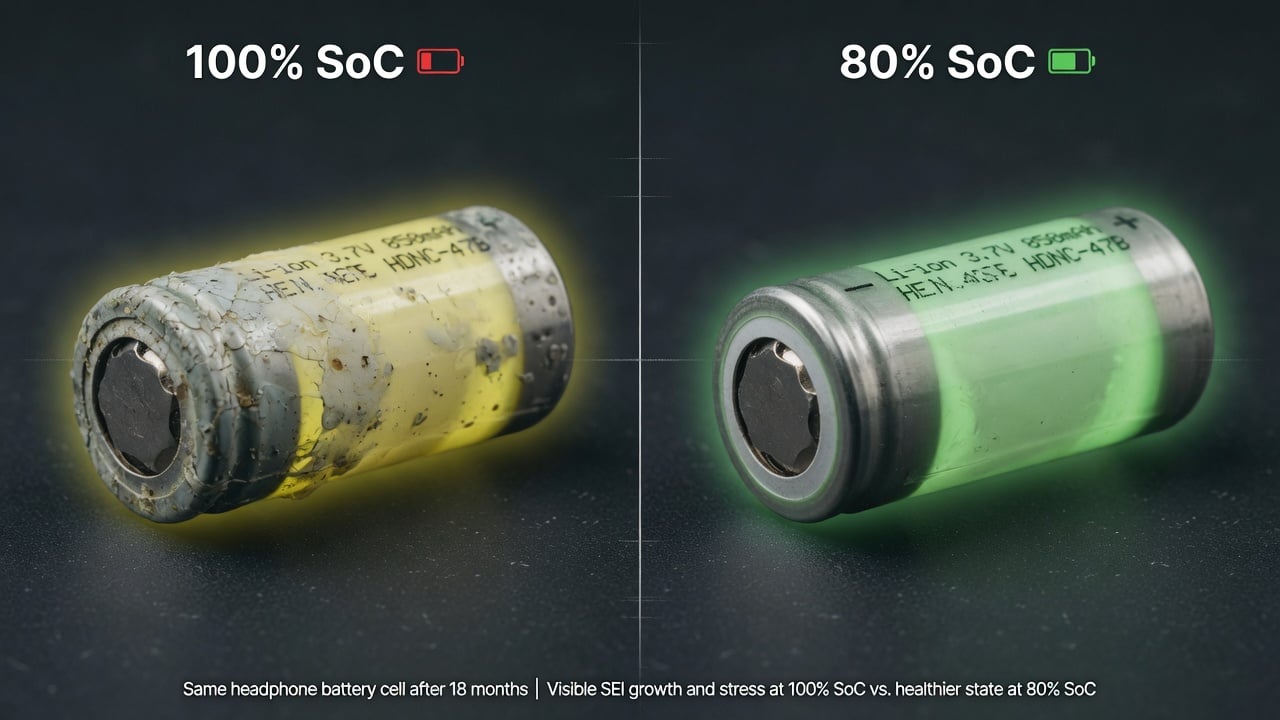
“Charge to 80%, avoid deep discharge” is the single piece of guidance that, across phones, laptops, EVs and now headphones, is the most consistently supported by cycle-life data: a Li-ion cell held at 100% SoC ages roughly twice as fast per cycle as one held at 80%. For headphones that means two practical moves:
- If your cans expose a “Battery Care” / “Battery Protection” toggle in their companion app — Sony has it, Bose QuietComfort added it, Sennheiser has it under Smart Control, Soundcore does, EarFun does — turn it on. It’ll cap the charge at ~80%. That moves the cell out of the dangerous high-voltage plateau and roughly doubles its useful calendar life.
- If your pair doesn’t, you need an external upper bound. A hardware USB charge limiter (what a USB charge limiter actually is here) in series between the USB-C cable and the charger does exactly this: it watches the cell-side voltage, cuts off at the threshold you set, and refuses to recharge until the cell has dropped 5–10%. For Sony WH-1000XM5/6, Bose QC Ultra, Sonos Ace, Bowers & Wilkins Px7 S2, Edifier Stax Spirit and similar USB-C-chargeable pairs, it works flawlessly because the headset negotiates USB-PD or BC1.2 over the cable — the limiter just gates power when the threshold is met.
That’s why a hardware cap rather than a software cap matters (as we covered for phones here): the headphone’s firmware already enforces 100% because that’s what the user asked for. A second, external cap is the only way to lower that ceiling.
How bad is the aging, really?
For context — the same physics that shorten phones also drive headphone fade. A Li-ion cell held at room temperature loses roughly 2–4% of rated capacity per year just from calendar aging, even if you never cycle it. Stored at 100% SoC that figure roughly doubles. So a one-year-old pair of headphones that’s been sitting on a stand since the day you unboxed them typically has 88–92% of original capacity, not 100% — and that’s the best case. The 30-hour-rated pair is now a 26–27-hour pair.
Some reference points worth knowing, drawn from the canonical Li-ion literature:
- End-of-life for a Li-ion cell is conventionally defined at 80% of rated capacity — below that, runtime becomes unworkably short.
- Charge window: the comfortable Li-ion charge window is 5–45 °C; above 45 °C, SEI growth accelerates substantially.
- Self-discharge at room temperature is on the order of 1.5–2% per month for Li-ion — low, but enough that over six months, e ven a stored pair slowly drifts enough that any wired charger would normally top it back to 100%.
- For an over-ear headphone, that “padding” between 100% and 80% is the usable lifetime win — it’s where the differential calendar aging lives.
So if you want your pair to still hold 25 hours of ANC at year three instead of 14, the storage state matters more than how you use them in any given week.
Comparing battery-care features across popular pairs
Not every brand exposes a battery-care toggle. Here is roughly where the major over-ear ANC pairs stand as of late 2026, grouped by how much software-side guard-rail you get:
| Brand & model | Battery size (typ.) | Rated ANC runtime | Charge port | Software battery-care toggle? | Hardware-cap path |
|---|---|---|---|---|---|
| Sony WH-1000XM5 / XM6 | ~1,200 mAh | 30–36 h | USB-C | Yes (Sony Headphones Connect → Battery → “Battery Care mode”) | Excellent — Chargie sits between cable and brick |
| Bose QuietComfort Ultra | ~750 mAh | 24 h (ANC on, immersive off) | USB-C | Yes (added 2024 firmware → Bose Music app → Settings) | Excellent |
| Sennheiser Momentum 4 / 4 Wireless | ~1,100 mAh | 60 h | USB-C | Partial (Smart Control → Battery → “Protect battery”; no % cap) | Excellent |
| Sonos Ace | ~1,050 mAh | 30 h | USB-C | No dedicated toggle; Sonos app shows battery % only | Excellent — Chargie is the practical path |
| Bowers & Wilkins Px7 S3 / Px8 | ~1,000 mAh | 30 h | USB-C | No (Music app → no cap; firmware updates have not added one) | Excellent |
| Bang & Olufsen H95 / Beoplay HX | ~1,110 mAh | 38 h (H95 ANC on) | USB-C | No | Excellent |
| Anker Soundcore Space One / Q45 | ~750–880 mAh | 40–55 h | USB-C | Partial (“Battery protection mode” appears in some firmware revisions only) | Excellent |
| Apple AirPods Max (over-ear, USB-C) | ~650 mAh (single cell, smart case) | 20 h | USB-C (2024 revision) | No “Optimized Charging”-style cap available via iOS for AirPods Max as of iOS 18 | Good — but Apple uses a non-standard 5 V/2.4 A profile; verify Chargie compatibility |
The short read: Sony and Bose explicitly hold the cell at a lower voltage through their own toggles — that gets most of the benefit. Sennheiser and Soundcore give you a partial lever. Sonos, Bowers & Wilkins, B&O and Apple’s AirPods Max leave the entire ceiling to you; a hardware USB cap is the practical answer.
The thermal lies you’ve been told about
A popular recommendation is to “never charge while wearing them.” For in-ear monitors on a case that’s reasonable: the case PCB can run warm and the buds can pile on top of the cell. For over-ear ANC, it’s mostly theatre: the cell itself doesn’t thermally connect to your ear; the foam and the driver sit between. The real culprits are ambient heat, sun-through-a-window, a radiator shelf, and a hot car. Two practical points:
- Don’t leave them on a windowsill or in a car. Cabin temperatures can exceed 60 °C in summer sun; the Li-ion damage that causes is partly recoverable (capacity) and partly permanent (impedance rise). Our summer heat guide covers that in more detail, and the same rules apply to anything with a Li-ion cell inside — phones, cameras, and over-ear headphones alike.
- If you’re travelling, store them in the case, in the bag, not loose on a luggage shelf. The case adds a thermal buffer and a shade against sun leaking through a seat-back pocket.
Lithium-polymer: the case where it matters
Most premium over-ear pairs have moved to LiPo pouch cells for the slim profile. LiPo’s chemistry is broadly similar to Li-ion (Wikipedia summarises: same intercalation chemistry, with the electrolyte replaced by a polymer gel such as PEG, PAN or PVdF), but it has two warnings worth understanding in a sealed ear cup:
- LiPo pouches swell visibly when they go wrong. A “loose” ear cup that suddenly feels firm is a swollen cell. Stop using the headphones, do not charge them, and dispose of them at a battery-collection point — our swelling runbook walks through what to do.
- LiPo cells age faster than cylindrical Li-ion at high SoC. The 80% rule is even more impactful.
Putting it together: a simple rule
If you only do one thing, do this: stop topping to 100%. Turn on Battery Care / Battery Protection if your pair has it. If they don’t, the cheapest, most reliable path is a hardware USB charge limiter in the cable path. The cell spends months at 100% SoC, and that’s the entire failure mode — the calendar-aging profile of a Li-ion cell at 100% is roughly twice as fast as at 80%, and that’s a number you can feel: 18 hours of ANC becomes 14 hours 12 months in, but a pair capped at 80% still does 27.
Heat, storage State-of-Charge, and idle drain are the three variables you can actually control. Everything else (fast-charging, deep-discharge, “memory effect”) is a non-issue on Li-ion / LiPo. Our general 80% setup guide explains the standard ways to wire that in, and our battery-health check is the closest thing to a Read-your-cup-diagnostic a phone or a laptop has, today.
FAQ
Are noise-cancelling headphones bad for battery life?
ANC itself uses a small amount of power (typically a few hundred milliwatts) and the cell’s overall discharge cycle is still way inside Li-ion’s design window. The reason ANC pairs appear to die young is storage: they’re at 100% on a stand for most of their lives. Cap the upper charge and the problem mostly disappears.
Is it OK to leave wireless headphones on the charger?
Not at 100%, no. The cell will sit at 4.2 V indefinitely, which is the high-voltage region where Li-ion ages fastest. Battery-care toggles drop the upper bound to ~80% and are safe to leave on indefinitely. A hardware USB cap between cable and b rick is the alternative.
How long should Bluetooth headphone batteries actually last?
Li-ion cells are rated to ~80% of original capacity at the cycle count in the spec sheet — for the typical pair, that’s 500 full charge cycles before runtime drops below 22–24 hours of ANC. But calendar aging runs in parallel and dominates for headphones that spend most of their time on a stand: 2–4% of capacity lost per year at room temperature, doubled if held at 100% SoC.
Does fast-charging headphones shorten battery life?
Fast charging pumps higher current through the cell. Modern chargers stage that current against cell temperature, so a 10-minute “emergency” charge to get a few hours of playback is fine. Routinely charging from 0 → 100% in 30 minutes, on the other hand, raises cell temperature into the >35 °C band more often — which compounds with idle storage heat. If you can, leave fast charging for travel days and slow-charge at home.
Should I store headphones charged or empty?
Neither extreme is great. The broadly-cited Li-ion storage recommendation is 40–60% SoC at 15–25 °C if you’re going to shelve the pair for more than a few weeks. For daily use, “as low as your daily use tolerates” is the rule — and a hardware cap set at 80% is the easiest way to enforce that.
Can the battery in Bluetooth headphones be replaced?
Sometimes, but rarely cheaply. Bose, Sony and a few boutique brands run authorised replacement programmes for premium models; the rest typically require a third-party repair shop with adhesive-removal skills and a soldering iron. Our battery disposal guide covers safe end-of-life if you’d rather not.
Sources
- Wikipedia, Headphones
- Wikipedia, Noise-cancelling headphones
- Wikipedia, Active noise control
- Wikipedia, Lithium-ion battery
- Wikipedia, Lithium polymer battery
- Wikipedia, Battery charger
- Wikipedia, Trickle charging
- Wikipedia, Self-discharge
- Battery University, Battery University articles on Li-ion charging and longevity (batteryuniversity.com)
USB-C charge limiter that stops at your set battery level, so your battery never sits at 100% overnight. Extends battery lifespan by years. Works with any USB-C charger.
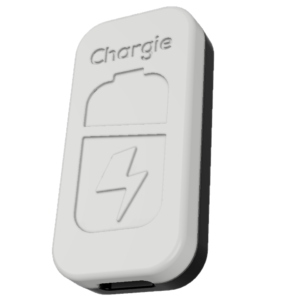
Limit your laptop charge to 80% via USB-C. Works with MacBooks, Dell, HP, Lenovo and most USB-C laptops up to 100W.
Protect Your Battery with Chargie
The world's first hardware charge limiter. Set a charge limit on any phone, tablet, or laptop — extend battery life by up to 4x.