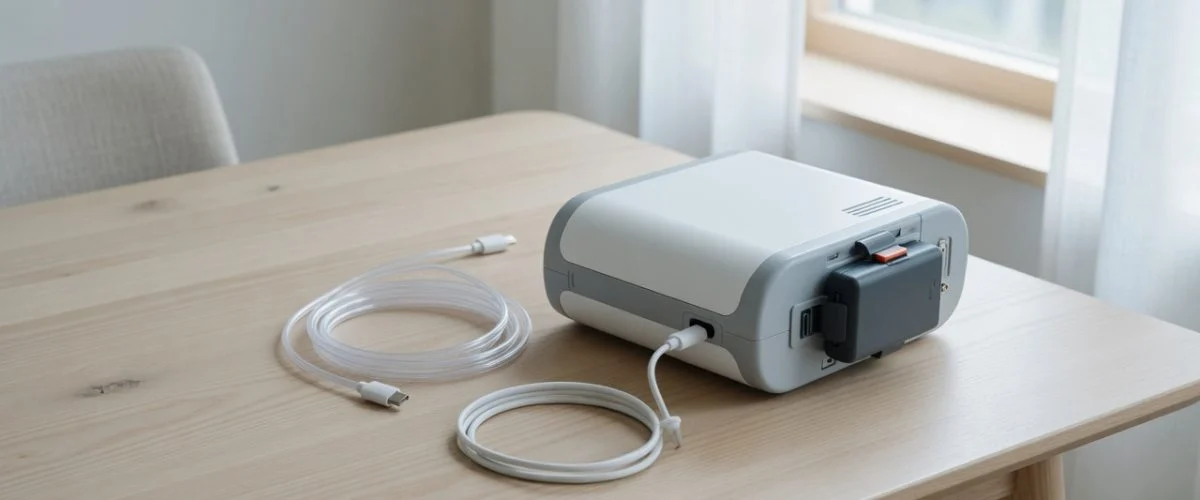

TL;DR: A portable oxygen concentrator is one of the few lithium-ion devices in your home that gets deeply discharged almost every day, then charged straight back to 100% — often overnight, in a warm room, sometimes while the compressor is still running. That is the worst combination available to a lithium-ion cell: high state of charge, heat and deep cycling, stacked. Manufacturers define cycle life as the cycles until capacity falls to 80% of rated value, and keeping a cell around 60–80% instead of 100% measurably reduces capacity loss. Here is why POC packs age faster than the machine they power.
This is battery care, not medical advice. Never change your oxygen therapy, prescribed settings, or backup power plan based on a blog post. Talk to your equipment supplier or clinician first — if a battery is your lifeline, redundancy beats optimisation every time.
Your Concentrator Will Outlive Its Batteries — By Years
Nobody mentions this when the supplier drops off a portable oxygen concentrator: the machine is built to last, the batteries are not. Sieve beds, compressor, valves and control board are engineered for years. The lithium-ion pack clipped to the side is a consumable.
That is chemistry, not a defect. Lithium-ion cells degrade on two clocks: a cycle clock that ticks when you charge and discharge, and a calendar clock that ticks whether you use the device or not. Manufacturers “typically specify cycle life as the number of cycles until capacity falls to 80% of its rated value.” Cross that line and a pack that gave you four hours out of the house gives you three.
For POC users both clocks run fast at once. You cycle the pack hard — the entire point of a portable device — then park it at 100% in a warm room because it has to be ready. Most electronics only do one of those: your phone sits at moderate charge, your CPAP backup battery mostly sits unused. A POC pack does the punishing version of both.
What Actually Drains The Battery: The Compressor
A POC does not store oxygen. It manufactures it continuously from room air by pressure swing adsorption. Inside is “a miniaturized air compressor, a cylinder filled containing the sieve, a pressure equalizing reservoir and valves and tubes.” The compressor forces air through a molecular sieve of zeolite — a microporous, crystalline aluminosilicate — which adsorbs nitrogen more strongly than oxygen. Strip nitrogen from air that is roughly 21% oxygen and 78% nitrogen and what remains is medical-grade oxygen of up to 90%.
That cycle is mechanical and never stops while the device is on. Pressure in a cylinder “rises from atmospheric to about 2.5 times normal atmospheric pressure (typically 20 psi/138 kPa gauge)” over a roughly three-second half-cycle, then drops so the nitrogen desorbs and vents. Your battery is not running a trickle of electronics — it is running an air compressor through a pressurise-vent cycle every few seconds, for hours.
This is why pulse-dose versus continuous-flow shows up on battery life, not just your prescription. Pulse dose delivers a bolus measured in millilitres per breath, and its “ability to conserve oxygen is key to keeping the units so compact.” Continuous flow “requires a larger molecular sieve and pump/motor assembly, and additional electronics” — intermittent-flow-only models weigh 2.8 to 9.9 pounds (1.3 to 4.5 kg), continuous flow units 10 to 20 pounds (4.5 to 9.0 kg).
Higher settings mean more compressor duty, more current draw, a deeper discharge in the same hour — quietly converting your pack from a shallow-cycle device into a deep-cycle one.
The Three Stressors, Ranked
Cycle life “is affected by many different stress factors including temperature, discharge current, charge current, and state of charge ranges (depth of discharge).” How those rank for a concentrator:
1. Sitting at 100% — biggest, and easiest to fix
“Simply storing lithium-ion batteries in the charged state also reduces their capacity and increases the cell resistance (primarily due to the continuous growth of the solid electrolyte interface on the anode).” At constant temperature “the SEI film thickness… increases as a square root of the time spent in the charged state.”
That is the whole argument: damage is driven by time spent charged, not cycles — a pack living in its dock at 100% ages on days you never leave the house. The fix is stated just as plainly: “High charge levels also hasten capacity loss. Frequent charge to > 90% and discharge to < 10% may also hasten capacity loss. Keeping the li-ion battery status to about 60% to 80% can reduce the capacity loss.”
2. Heat — and the concentrator makes its own
Degradation “is strongly temperature-dependent: degradation at room temperature is minimal but increases for batteries stored or used in high temperature (usually > 35 °C) or low temperature (usually < 5 °C) environments.”
Most devices only heat up when thrashed. A POC runs a compressor inside the same housing as the battery bay, warming the pack all session. Charging while it runs — what everyone does at a restaurant table or airport gate — stacks charge heat on compressor heat. Charging limits are stricter than operating limits: cells fast-charge “within a temperature range of 5 to 45 °C (41 to 113 °F),” and “charging at temperatures above 45 °C will degrade battery performance.” The scale matters — at 25 °C cells are “expected to lose irreversibly around 20% of their cyclable charge in 3–5 years or 1000–2000 cycles,” while accelerated studies at 50–60 °C see fully charged cells lose “ca. 20% of their cyclable charge in 1–2 years.”
3. Deep discharge, every day
The lead-acid world settled this decades ago: there is “an inverse correlation between the depth of discharge (DOD) of the battery and the number of charge and discharge cycles it can perform; with an average depth of discharge of around 50% suggested as the best for storage vs cost.” Lithium-ion is a different chemistry with a different curve, but the direction holds — avoid both extremes.
Running a pack to shutdown then refilling to 100% hits both extremes in one cycle — the worst available pattern, and the default for anyone who uses the device until it beeps.
How POC Battery Duty Compares To Other Devices
| Device | Daily depth of discharge | Time parked at 100% | Self-heating in use | Dominant ageing driver |
|---|---|---|---|---|
| Portable oxygen concentrator | Deep — often to shutdown | High (kept ready) | High — internal compressor | Cycling and calendar ageing |
| CPAP backup battery | None on most nights | Very high | Low | Calendar ageing at high charge |
| Smartphone | Shallow, topped up often | Moderate (overnight) | Low to moderate | Calendar ageing at high charge |
| Cordless power tool | Deep but infrequent | Moderate | Moderate | Cycling plus charge-hot cycles |
| Laptop on a desk | Minimal — mains powered | Very high | Moderate | Calendar ageing at high charge |
The Overnight Charge Is Where The Damage Happens

The pack charges correctly on its own. The standard procedure runs “at constant voltage with current-limiting circuitry… charging with constant current until a voltage of 4.2 V is reached in the cell and continuing with a constant voltage applied until the current drops close to zero,” and “typically, the charge is terminated at 3% of the initial charge current.” NMC cells run “a 3.7 V nominal voltage with a 4.2 V maximum while charging.”
So this is not overcharging. It is that plugging in at 22:00 and unplugging at 07:00 means the pack hits full around 01:00, then spends six hours at maximum charge, warm, growing SEI. Nightly for two years, that is thousands of hours in the one condition the cell likes least.
One precision the internet routinely botches: this is not trickle charging. “Lithium-ion batteries cannot handle indefinite trickle charging,” and “most Li-ion batteries cannot be safely trickle charged and can cause a fire or explosion” — which is why no competent manufacturer does it. Your pack is not trickle-charged overnight and will not catch fire because you left it plugged in. It is held at high charge: a slow degradation problem, not a safety one. Longer version in what trickle charging actually is.
The Two-Battery Rotation That Works
Most users end up with more than one pack — “battery capacity (or number of add-on batteries) and power cord options for recharging” are among the key variables when choosing a unit. Two packs give you an option one does not.
The trap is the obvious strategy: keep both at 100% permanently. That doubles readiness and doubles calendar ageing — two packs growing SEI at maximum charge, reaching 80% capacity at the same moment. Batteries bought together and abused identically die together, the one failure mode a backup exists to prevent.
A better structure, if your clinical needs allow:
- Designate a daily driver and a reserve. The daily pack absorbs cycling, the reserve absorbs calendar time — different curves, different failure dates.
- Keep the reserve mid-charge, not full. The 60–80% band is what the research points at; the LiPo hobby world lands in the same place, storing at “3.6~3.9 V range per cell, otherwise it may cause damage to the battery.”
- Top the reserve up on a schedule. Self-discharge is “typically stated by manufacturers to be 1.5–2% per month,” and “the rate increases with temperature and state of charge.” Check quarterly.
- Never let a reserve go flat and stay flat. “When stored for long periods the small current draw of the protection circuitry may drain the battery below its shutoff voltage; normal chargers may then be useless.” That is an unrecoverable brick.
- Swap roles every few months so the reserve is not motionless for years.
One rule overrides all of it: if you are travelling, flying, or facing storm season with unreliable mains power, charge everything full and ignore longevity entirely. Users “should have backup power or alternative oxygen sources in case of electric outages.” A pack at 70% is kind to the chemistry and useless in a blackout.
Where A Hardware Charge Limiter Fits
The gap is obvious once you see it: the advice is “do not leave it at 100% for hours,” and you are asleep for those hours. Nobody gets up at 01:00 to unplug a battery.
Phones and laptops solved this in software — Android, iOS and macOS all ship charge limits. A POC has a charging port, a status LED, and no user-accessible battery policy: no app, no toggle, no firmware option. This is exactly the category where a limit must come from outside, because there is no inside to apply it from — argument in full in built-in limits versus a hardware charge limiter.
A USB charge limiter sits between charger and device and cuts current at a threshold you set, so a pack stops at 80% instead of coasting to full and sitting there — the reasoning in why charging to 80% extends battery life, the setup in how to limit battery charge to 80%.
Two honest caveats, because this is medical equipment:
- Many POCs charge over a proprietary DC barrel jack, not USB. A USB limiter is only relevant to units and spare packs that charge over USB — with a proprietary brick, an inline USB device is not in the circuit at all.
- Clear anything in the power path with your supplier first. Some service agreements are explicit about third-party accessories, and a limiter that stops a charge you needed is far worse than a pack that ages faster.
Warning Signs Before They Strand You
- Runtime at a fixed setting. The only measurement that matters. Note your hours at the usual setting monthly — steady decline is capacity fade, a sudden drop is a failing cell.
- Voltage sag under load. “Internal resistance increases with both cycling and age… Rising internal resistance causes the voltage at the terminals to drop under load.” In a POC that looks like the device cutting out on compressor spikes while the gauge still shows charge.
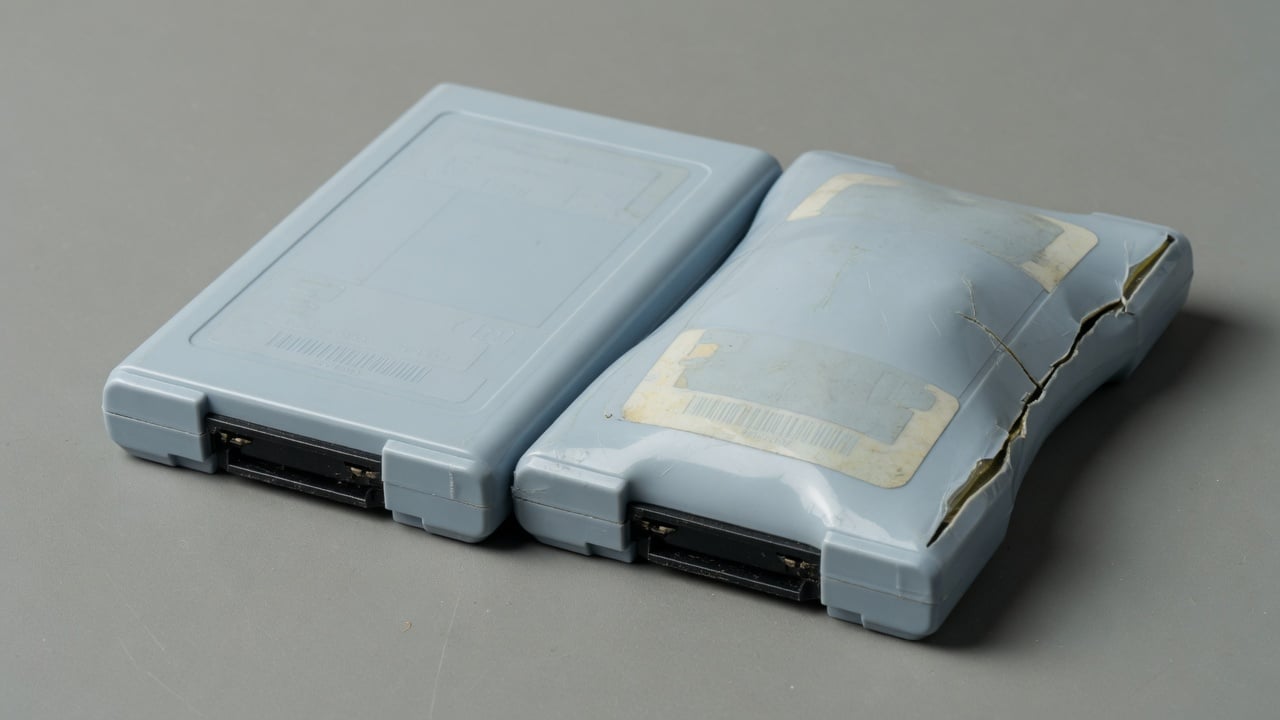
- Any swelling. A pack that will not sit flat or seat cleanly gets retired, not nursed — see battery swelling causes and prevention.
- Charging that finishes suspiciously fast. Not efficiency. It is holding less.
Keep a dead pack out of household waste — lithium cells “are a lot more reactive than classical vehicle waste like tire rubber,” with “significant risks to stockpiling used batteries.” See where to dispose of old batteries; many suppliers take the old pack back. To measure rather than guess: how to check battery health and what battery cycle count means.
Frequently Asked Questions
Is it bad to leave my portable oxygen concentrator plugged in all the time?
Not dangerous — the BMS terminates the charge at around 3% of initial charge current. But it ages the pack: storing lithium-ion charged reduces capacity and raises cell resistance via SEI growth that scales with the square root of time spent charged. If it is your primary supply, keep it plugged in and accept the tradeoff. For a travel or secondary unit, mid-charge is kinder.
Should I run the battery all the way down before recharging?
No — that is a nickel-cadmium habit that does not transfer. Frequent charging above 90% and discharging below 10% hastens capacity loss; roughly 60–80% reduces it. There is no memory effect to reset, and deep discharge risks dropping below the BMS shutoff voltage, which can leave the pack unrecoverable.
Why does my battery last less time than the advertised runtime?
Advertised runtime is quoted at a specific setting — usually the lowest pulse setting — on a new pack at room temperature. Higher settings work the compressor harder, and continuous flow costs far more than pulse dose. Add an aged pack with elevated internal resistance plus cold weather and the gap widens.
Can I charge the concentrator while using it?
Generally yes, and sometimes you must — just know it is the hottest scenario the pack sees, charge heat landing on compressor heat in one housing. Li-ion charges well between 5 and 45 °C; above 45 °C charging degrades performance. Give the unit airflow: off the car seat, out of the bag.
How should I store a spare battery I only use for travel?
Cool, and partially charged rather than full or empty — high temperature or high state of charge loses capacity faster, and the LiPo storage convention of 3.6–3.9 V per cell points at the same middle band. Check quarterly, since self-discharge runs about 1.5–2% per month and rises with temperature and state of charge.
Does a charge limiter interfere with the concentrator’s battery management?
No — a limiter works upstream, interrupting incoming power at a threshold; the BMS still governs cell voltage, balancing and protection as designed. But a USB limiter only sits in the circuit if the charging path is USB, and many POCs use a proprietary DC supply. Check your model and clear it with your supplier first.
The Bottom Line
A POC asks more of its battery than almost anything else you own: deep daily cycling, a compressor generating heat beside the cells, and long stretches at 100% because readiness is not optional. Capacity falls toward the 80% threshold that defines end of rated life, and arrives there sooner when charge level, heat and depth of discharge all push together.
You cannot change what the compressor demands. You can change how long the pack sits at full, how hot it gets charging, and whether your spare ages in lockstep with your daily pack — three levers worth real months of pack life.
Just keep the priority straight: battery longevity is a cost optimisation, oxygen availability is not. When the two conflict, availability wins — charge to full, carry the spare, let the pack age.
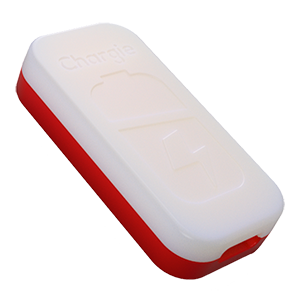
USB-C charge limiter that stops at your set battery level, so your battery never sits at 100% overnight. Extends battery lifespan by years. Works with any USB-C charger.
Limit your laptop charge to 80% via USB-C. Works with MacBooks, Dell, HP, Lenovo and most USB-C laptops up to 100W.
Protect Your Battery with Chargie
The world's first hardware charge limiter. Set a charge limit on any phone, tablet, or laptop — extend battery life by up to 4x.