
TL;DR: A rechargeable flashlight spends 99% of its life doing nothing at 100% state of charge — in a drawer, a glovebox, a go-bag, or a bedside table. That is the single worst way to store a lithium-ion cell. Wikipedia’s lithium-ion battery article puts it plainly: “Simply storing lithium-ion batteries in the charged state also reduces their capacity and increases the cell resistance,” because the solid electrolyte interface keeps growing on the anode whether you use the light or not. Add heat, leaking alkalines and NiMH packs on permanent trickle, and the emergency light you never used is dead when the power finally goes out. This guide covers the four flashlight battery families, what kills each one, and the storage routine — built around an 80% charge cap — that keeps a light ready without cooking its cells.
Your Flashlight Has The Worst Duty Cycle Of Any Device You Own
Think about how a phone battery lives: charged nightly, discharged daily, cycled hundreds of times a year. Now think about a flashlight. You charge it once, put it somewhere, and it sits. Maybe you use it four times a year. In cycle-count terms that battery should last a decade — and yet emergency lights routinely die after two or three years of doing absolutely nothing.
That is not a defect. It is calendar aging. Lithium-ion capacity loss runs on two clocks: a cycling clock driven by charge and discharge, and a calendar clock driven by time, temperature and state of charge. A phone burns the first. A flashlight burns the second, exclusively.
The mechanism: reduction of the organic carbonate electrolyte at the anode grows a Solid Electrolyte Interface layer where lithium ions get irreversibly trapped, and “at constant temperature, the SEI film thickness (and therefore, the SEI resistance and the loss in cyclable Li+) increases as a square root of the time spent” there. Time, not cycles — and the clock runs fastest at high state of charge and high temperature, which is exactly how everyone stores a flashlight.
Manufacturers define cycle life as the number of cycles until capacity falls to 80% of rated value. For a light you use four times a year, you will never reach that number by cycling. You will reach it by waiting. If you have never checked what your gear is actually holding, start with how to check battery health — the numbers on a three-year-old “barely used” light are usually a surprise.
The Four Battery Families In Flashlights — And What Kills Each One
Primary (disposable) types used in flashlights include button cells, carbon-zinc in regular and heavy-duty grades, alkaline, and lithium. Secondary (rechargeable) types include lead-acid, NiMH, NiCd and lithium-ion. A typical household has three of these scattered around, and each dies differently.
| Chemistry | Where you find it | Nominal voltage | How it dies in storage | Storage fix |
|---|---|---|---|---|
| Li-ion 18650 / 21700 | USB-C rechargeable EDC and tactical lights | 3.6–3.7 V | Calendar aging: SEI growth at high state of charge; accelerated by heat | Store near 50–60%, cap top-ups at 80% |
| Li-polymer (built-in pack) | Sealed pocket lights, headlamps, work lights | 3.6–3.7 V nominal, 4.2 V full | Same SEI aging, plus swelling in a sealed body with no room to expand | Never store at 4.2 V; R/C practice is 3.6–3.9 V per cell |
| NiMH AA/AAA | Headlamps, kids’ lights, older rechargeables | 1.2 V (1.25 V avg under load) | Overcharge damage from permanent trickle; voltage depression from partial cycling | Trickle below C/10; Duracell suggests C/300 to hold full charge |
| Alkaline AA/AAA/D | Everything cheap, everything in the junk drawer | 1.5 V fresh | Leakage — potassium hydroxide electrolyte escapes and corrodes contacts | Remove cells from any light stored over a month |
The failure modes barely overlap. An 80% charge cap does nothing for an alkaline leak; pulling cells out does nothing for a sealed Li-ion light. Know which chemistry you are holding before you try to protect it.
18650 And 21700: What Is Actually Inside Your Rechargeable Light
The 18650 is the workhorse. The name is the dimensions: 18 mm in diameter by 65.0 mm long. Sony developed it in 1991, though Panasonic claims to have done so in 1994, and it is widely regarded as the most produced lithium-ion cell size ever made — used in laptops, power tools, e-bikes, LED flashlights and the first-generation Tesla Roadster, Model S and Model X.
Critically, the 18650 designation refers only to physical dimensions and says nothing about electrochemistry. Cells in that format ship with LCO, LMO, NMC, NCA and LFP cathodes, and by the early 2020s manufacturers had introduced sodium-ion cells in the same can. Two 18650s that look identical can have very different cycle life and thermal stability: NMC and NCA dominate high-energy applications, LFP is valued for long cycle life and thermal stability.
For charging, the numbers that matter: an NMC cell with a graphite anode has a 3.7 V nominal voltage with a 4.2 V maximum while charging. The charge procedure is constant current until 4.2 V is reached, then constant voltage until current drops close to zero, typically terminating at 3% of the initial charge current. That final constant-voltage phase — the last stretch from roughly 80% to 100% — is where the cell sits at its highest voltage and highest stress. It buys you the least runtime for the most aging. That is the entire argument behind why charging to 80% extends battery life.
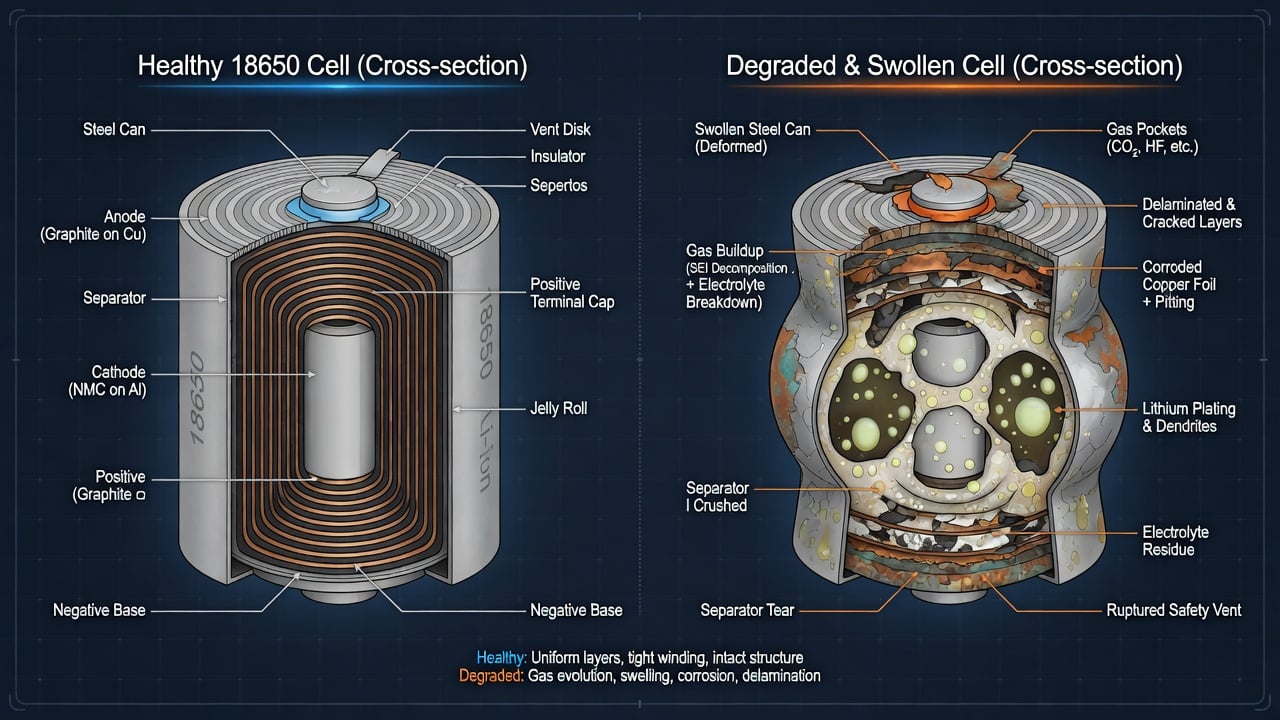
If a cell has visibly swollen, stop using it — see battery swelling: causes and prevention for what causes it and how to dispose of it safely. Li-ion cells contain flammable electrolytes, and a swollen cell inside an aluminium body with a screw-down tailcap is a pressure vessel.
The “Always Charged, Always Ready” Trap
Here is the reasoning that kills more flashlight batteries than anything else: it is an emergency light, so it should always be at 100%. Intuitive, and wrong in a specific, measurable way.
Lithium-ion self-discharge is stated by manufacturers at typically 1.5–2% per month, and that rate increases with temperature and state of charge. Run the arithmetic: a cell stored at 60% will still be above 40% after a year on the shelf — more than enough to light a stairwell for hours — while a cell stored at 100% for the same year has spent every one of those twelve months at maximum electrode voltage, growing SEI the whole time, and will have permanently lost capacity it never gives back. You traded real, permanent capacity for headroom you did not use.
For a light you are not carrying daily: store it at roughly 50–60% and top it up on a schedule you can remember — the weekend you change your smoke alarm batteries. For a light you do carry and recharge weekly: charge it, but stop at 80%. On a USB-C light that means an inline hardware cap, because almost no flashlight has a charge-limit setting in firmware. Phones and laptops increasingly do; a $40 tactical light does not.
This is the gap built-in battery limits vs a hardware charge limiter covers in detail: software limits only exist where a vendor chose to write them, and flashlight vendors have not. A hardware limiter sits between the USB source and the light and cuts current at your chosen threshold regardless of what the device’s own charge controller wants to do. If you want the step-by-step, how to limit battery charge to 80% walks through it.
Heat: The Glovebox Is The Worst Place You Could Have Chosen
Almost everyone keeps a flashlight in the car. It is the single most sensible place to keep one and the single most hostile place for the battery in it.
Lithium-ion chemistry performs well at elevated temperatures, but prolonged exposure to heat reduces battery life — and charging above 45 °C actively degrades performance. The recommended fast-charge window is 5 to 45 °C; below 5 °C charge current should be reduced, and under 0 °C charging becomes genuinely damaging. A parked car’s interior blows straight through the top of that range on any sunny afternoon, and the glovebox and centre console are the least ventilated parts of it.
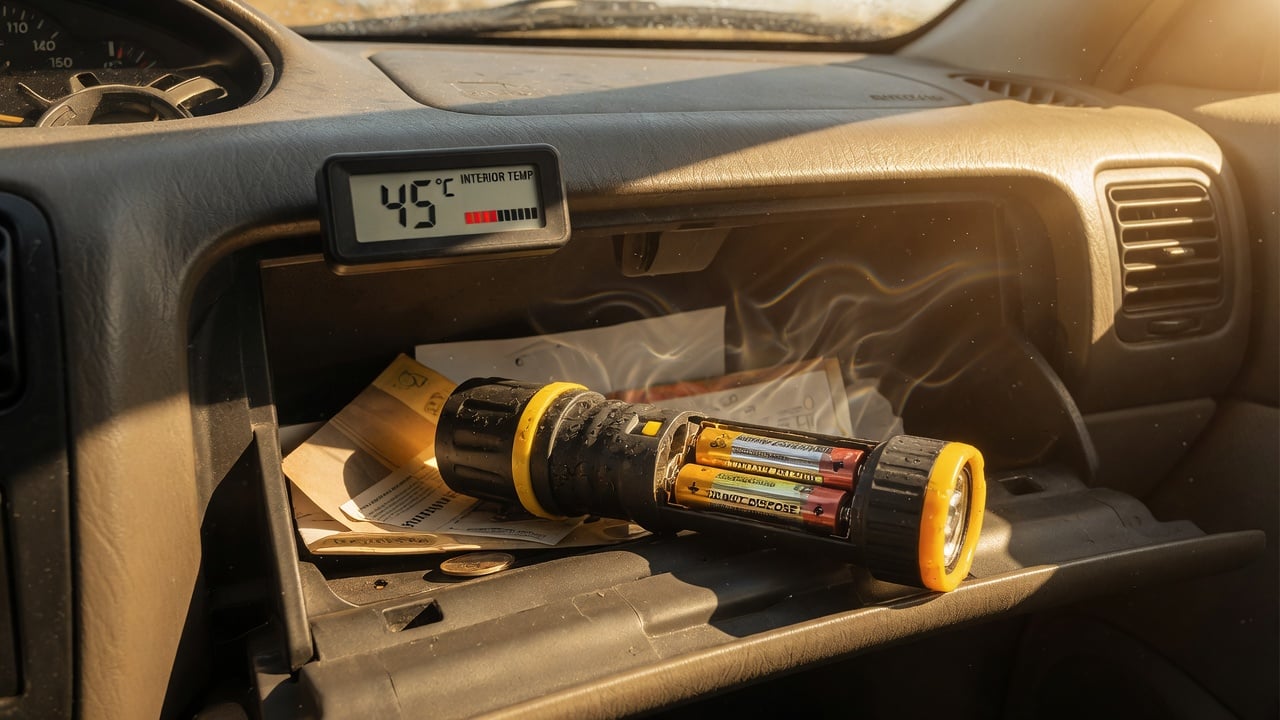
It compounds: self-discharge also rises with temperature, so the car light ages faster and drains faster, which means you find it flat more often and recharge it more often — cycling damage stacked on calendar damage. Same mechanism as the summer heat phone battery protection guide, different device.
If you must keep a light in the car, this is the one place where chemistry choice beats charging discipline. Wikipedia notes that some types of lithium primary cell can be stored for years with less risk of leakage — a CR123A-based light or a simple lithium-primary AA light will tolerate a hot car far better than a rechargeable Li-ion one. Keep the rechargeable indoors and the disposable in the car.
Alkaline Leakage: Why Your Headlamp Has A White Crust In It
Open the battery compartment of any flashlight that has been in a drawer for three years and there is a decent chance you will find a white, crystalline crust and green corrosion on the springs. That is potassium hydroxide, the alkaline electrolyte, having escaped the cell.
An alkaline cell runs on zinc and manganese dioxide with a potassium hydroxide electrolyte at pH above 7. Manufacturers fight leakage structurally: more manganese dioxide than is strictly needed to react with all the zinc, specifically to prevent gassing at end of life; a plastic gasket to increase leakage resistance; an aluminium foil or plastic film wrap as a final leak layer. When alkalines launched in the late 1960s the zinc electrodes carried a mercury amalgam film to suppress electrolytic action on zinc impurities — action that reduced shelf life and promoted leakage. Once legislatures mandated mercury reductions, makers had to greatly improve zinc purity to compensate.
None of those defences are permanent. A fully discharged alkaline cell left in a device is the highest-risk configuration, and a flashlight left switched on by accident in a bag is exactly that. There is one rule and it has no exceptions: if the light is going into storage for more than a month, take the alkalines out. Store them loose in the same drawer. When the cells do reach end of life, where to dispose of old batteries matters — alkaline and lithium go to different streams.
One more alkaline fact worth knowing before you buy a high-output light that runs on AAs: alkaline capacity collapses under load. An AA-sized alkaline might have an effective capacity of 3000 mAh at low drain, but at a load of 1 ampere the capacity could be as little as 700 mAh. A 1000-lumen AA light is drawing serious current. The datasheet number on the pack is not the number you will get.
NiMH In Flashlights: The Trickle-Charge Rules Nobody Reads
NiMH has almost entirely replaced NiCd and remains the sensible choice for AA/AAA headlamps, where you swap cells in the field instead of tethering the light to a cable. It gives about 1.2 V per cell against a fresh alkaline’s 1.5 V, but most alkaline-designed devices run until voltage drops to around 1.0 V, and NiMH voltage falls more slowly under load — so practical runtime is comparable. A fully charged cell supplies an average 1.25 V during discharge, declining to about 1.0–1.1 V.
Where NiMH gets destroyed is in cradle chargers that never stop. The manufacturer guidance is unusually specific and unusually ignored:
- Overcharging is generally considered safe only at very low currents, below 0.1C (C/10).
- The Panasonic NiMH charging manual warns that overcharging for long enough can damage a battery, and suggests limiting total charging time to 10–20 hours.
- Duracell suggests a trickle charge at C/300 for batteries that must be kept in a fully charged state — that is a three-hundredth of the cell’s capacity per hour, not a tenth.
- Energizer indicates self-catalysis can recombine gas formed at the electrodes for charge rates up to C/10, but notes this leads to cell heating, and recommends C/30 or C/40 for indefinite application.
A cheap wall charger holding four AAs at C/10 indefinitely runs them roughly thirty times harder than Energizer’s indefinite-application figure, and dumps the difference as heat. That is what a permanently docked headlamp cradle does. What is trickle charging covers why a “maintenance” current is not a free lunch.
A NiMH consolation: what people call “memory effect” in these cells is really voltage depression from repeated partial discharge, and it is reversible with a few full discharge/charge cycles. Unlike Li-ion calendar aging, that one you can actually undo.
The Routine That Keeps A Flashlight Ready Without Killing It
Everything above collapses into a short, boring routine. It takes about ten minutes twice a year.
| Light type | Storage state | Charge routine | What to avoid |
|---|---|---|---|
| Daily-carry USB-C Li-ion | Whatever it lands at | Top up to 80% via a hardware limiter, weekly | Leaving it plugged in overnight at 4.2 V |
| Emergency / go-bag Li-ion | 50–60% state of charge | Top up twice a year, capped at 80% | Storing it at 100% “so it is ready” |
| Car light | Lithium primary (CR123A / lithium AA) | Replace on expiry date, no charging | Keeping a rechargeable Li-ion light above 45 °C |
| NiMH headlamp | Cells charged, in the light, used monthly | Charge and unplug — never leave in a permanent cradle | Indefinite trickle above C/30 |
| Alkaline anything | Cells OUT of the device | N/A | Leaving alkalines in a light stored over a month |
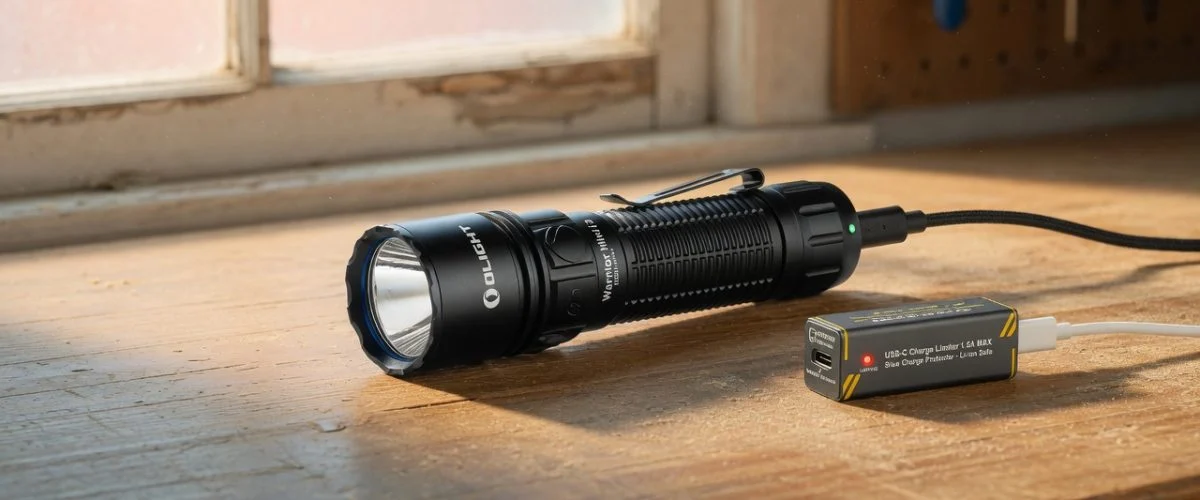
The one piece of hardware that makes the Li-ion rows possible is an inline USB charge limiter. Plug it between your charger and the light, set the cap at 80% for daily carry or 60% for storage, and the light physically cannot be held at 4.2 V — no firmware, no app, no vendor cooperation required. That is the whole product.
Frequently Asked Questions
Should I keep my emergency flashlight plugged in all the time?
No. A permanently docked Li-ion light sits at maximum electrode voltage indefinitely, and storing a lithium-ion cell in the charged state reduces its capacity and increases its internal resistance even with zero use. Store it at 50–60% and top it up twice a year. You will lose a little peak runtime and gain years of usable life.
How long can a rechargeable flashlight sit unused before it goes flat?
Manufacturers typically state lithium-ion self-discharge at 1.5–2% per month, and the rate rises with temperature and state of charge. From 60%, a cool-stored light is still usefully charged after a year. From 60% in a hot car, expect noticeably faster drain.
Are the 18650 cells in my flashlight all the same?
Only physically. The 18650 name refers to dimensions — 18 mm by 65.0 mm — and nothing else. Cells in that format ship with LCO, LMO, NMC, NCA, LFP and even sodium-ion chemistries, with very different cycle life and thermal stability. Buy cells from the light’s manufacturer or a known cell brand, and never mix cells of different age or capacity in a multi-cell light.
Can I use a USB charge limiter on a flashlight?
Yes, if the light charges over USB — which most modern rechargeable lights now do. The limiter sits inline on the USB connection and cuts charging at your set threshold, so it works regardless of whether the flashlight itself has any charge-limiting firmware. It has no effect on lights that use a proprietary barrel charger or on removable cells charged in a dedicated bay charger.
Why did my flashlight batteries leak when I never even used the light?
Because leakage is a storage failure, not a usage failure. Alkaline cells use a potassium hydroxide electrolyte, and the gaskets, aluminium wrap and excess manganese dioxide that hold it in are defences that degrade over years — fastest once the cell is deeply discharged. Remove alkalines from any light going into storage for more than a month.
Is it worth replacing the cell instead of buying a new flashlight?
Usually yes, on any light with a user-replaceable cell — a quality 18650 costs a fraction of the light. Check what battery cycle count actually measures first so you know whether the cell is genuinely worn or just poorly stored; a light that has been sitting at 100% for three years has calendar damage that a fresh cell will fix, and a habit that will kill the fresh cell too.
The Bottom Line
Flashlights fail where two facts meet: they hold expensive lithium cells, and they spend their entire lives idle. Cycling discipline — the advice that dominates every phone and laptop battery guide — is nearly irrelevant here. Storage discipline is everything.
Two habits cover 90% of it. Get alkaline cells out of anything going into a drawer. And stop holding your rechargeable lights at 100%: cap them at 80% for carry, park them at 50–60% for storage. The first habit is free. The second needs a hardware charge limiter, because your flashlight has no software that will do it for you.
Chargie caps charging in hardware, on the USB line, for any device that charges over USB — phone, laptop, power bank, or the tactical light in your go-bag. Start with what a USB charge limiter is, then set the cap and forget it.
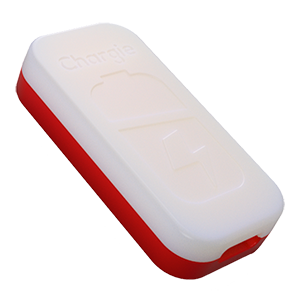
USB-C charge limiter that stops at your set battery level, so your battery never sits at 100% overnight. Extends battery lifespan by years. Works with any USB-C charger.
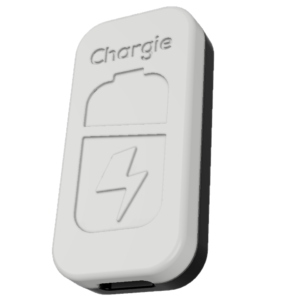
Limit your laptop charge to 80% via USB-C. Works with MacBooks, Dell, HP, Lenovo and most USB-C laptops up to 100W.
Protect Your Battery with Chargie
The world's first hardware charge limiter. Set a charge limit on any phone, tablet, or laptop — extend battery life by up to 4x.