
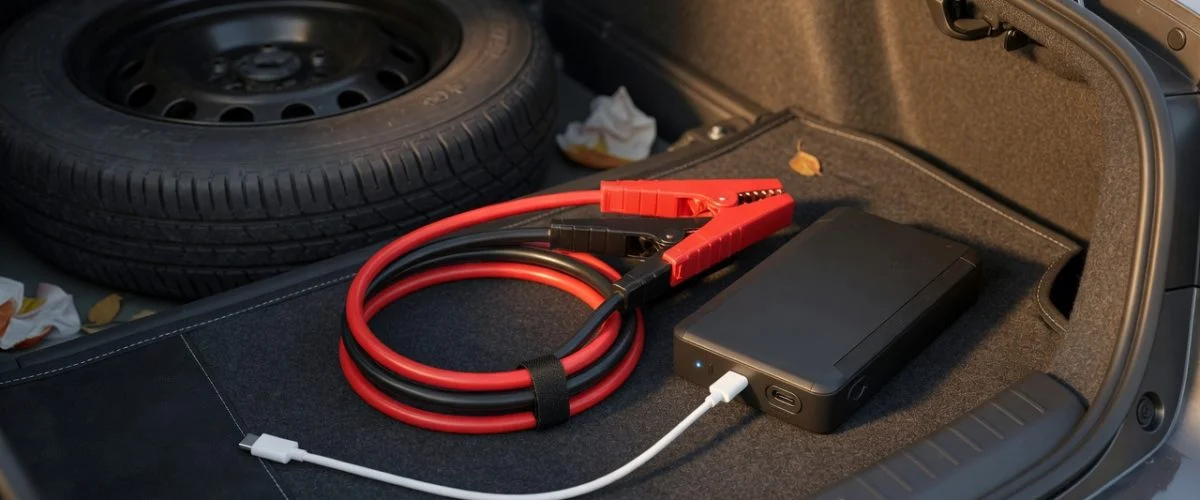

TL;DR: A portable jump starter is the only battery you own that is bought specifically to be ignored. It lives in a trunk or a glovebox at 100% charge, bakes at 60 °C in summer, freezes in winter, and gets checked once a year — if that. Every one of those conditions is a textbook accelerator of lithium degradation. The pack does not usually die from being used; it dies from sitting fully charged in a hot car. Store it at roughly 50–60% instead of 100%, keep it out of direct sun, top it up every three months, and cap the top-up at about 80% with an inline USB charge limiter. That is the whole difference between a pack that still cranks an engine in year six and one that is a swollen brick by year three.
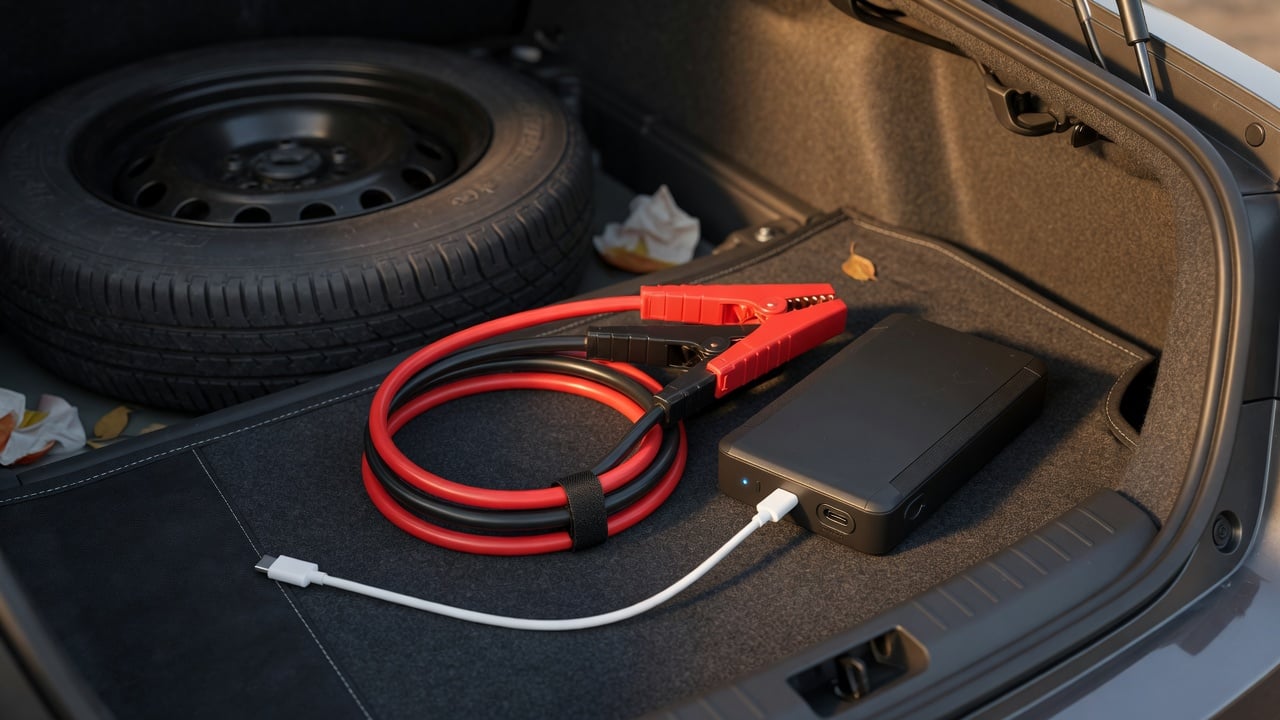
The Device You Buy Hoping Never To Use
That is a genuinely unusual duty cycle, and it breaks the advice you have read everywhere else. Most battery guidance is about cycling — how deep to discharge, how fast to charge, how many cycles you get. For a jump starter, cycling is almost irrelevant. You might cycle it three times in its entire life. What kills it is calendar aging: the slow, continuous degradation that happens while a cell simply exists, sitting at a given voltage and a given temperature.
Wikipedia’s lithium-ion battery article puts the mechanism plainly: “Calendar life describes degradation during storage as well as cycling,” and degradation “is strongly temperature-dependent: degradation at room temperature is minimal but increases for batteries stored or used in high temperature (usually > 35 °C) or low temperature (usually < 5 °C) environments.” It also notes that “batteries stored at a high temperature or a high state of charge often lose their capacities more quickly.”
What Is Actually Inside A Jump Starter
The category has consolidated around three chemistries, and which one you own changes the advice substantially.
Lithium polymer (LiPo) pouch cells. This is what the majority of slim, pocketable consumer jump starters use, because pouch cells give the best energy per gram. The trade-off is structural. As the lithium-ion article notes, “the absence of a case gives pouch cells the highest gravimetric energy density; however, many applications require containment to prevent expansion when their state of charge (SOC) level is high, and for general structural stability.” Expansion when held at high SoC is not a rare defect — it is a documented property of the format. That is why swollen jump starters are such a common sight in mechanics’ bins.
Lithium iron phosphate (LFP). The premium and semi-professional tier increasingly uses LFP, and for storage duty it is genuinely better. Wikipedia’s LFP article credits the chemistry with “low cost, high safety, low toxicity, long cycle life” and gives “cycle life from 2,500 to more than 9,000 cycles depending on conditions,” against “about 1,000 to 2,300 cycles” for NMC. It also highlights “thermal and chemical stability, which contributes to improved battery safety.” For a device that lives in a hot car and must not catch fire, that stability matters more than the modest energy-density penalty.
Heat Is The Primary Killer
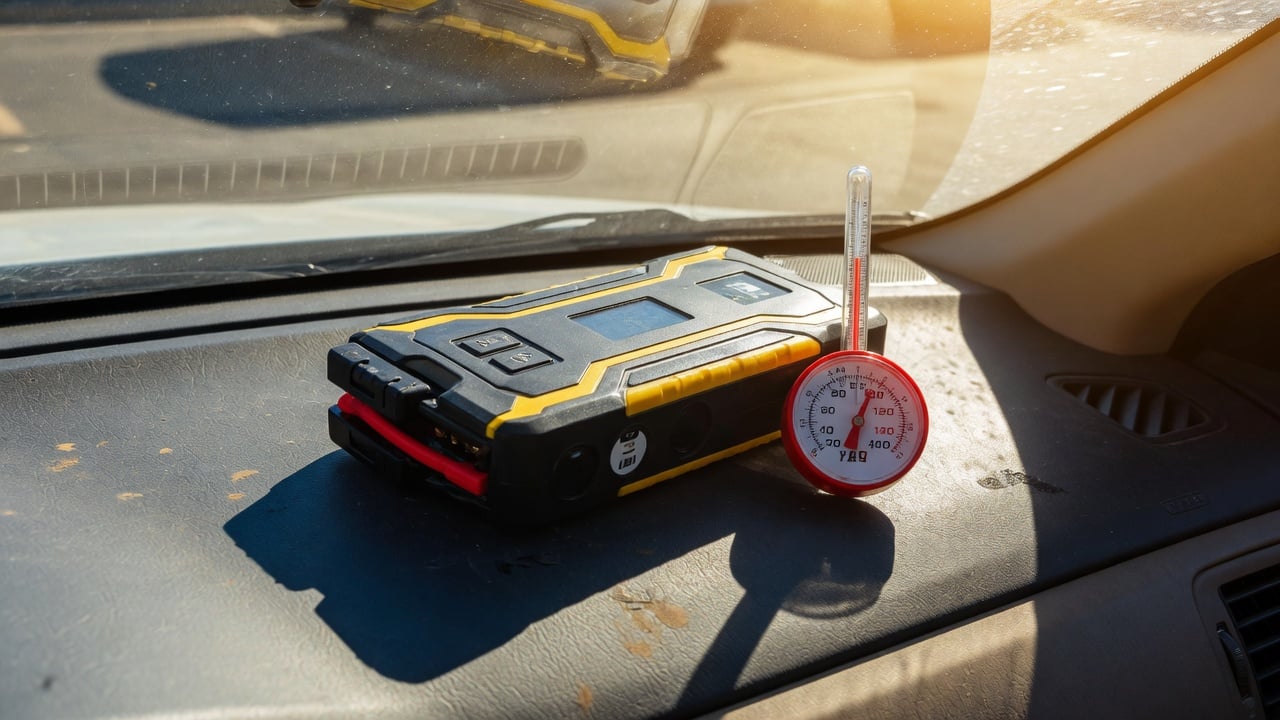
A car parked in summer sun is not merely warm. The cabin becomes a solar oven, and surfaces in direct light — the dashboard above all — run far hotter than the air. The lithium-ion literature is unambiguous about what that does: the chemistry “performs well at elevated temperatures but prolonged exposure to heat reduces battery life.”
The practical fix costs nothing. Move the pack out of the passenger compartment and into the trunk, ideally into a footwell or under the parcel shelf where it is shaded. Never leave it on the dashboard or the rear parcel shelf. If you live somewhere with genuinely extreme summers, the honest answer is to keep the pack indoors and put it in the car only for long trips — a jump starter in your hall cupboard at 20 °C will outlive one in a trunk at 50 °C by years. Our summer heat battery protection guide covers the same physics for phones.
The 100% Storage Mistake
Here is where nearly everyone goes wrong, and it is entirely understandable. The device is for emergencies. Emergencies demand full readiness. So you charge it to 100% and leave it there. Full tank, ready to go.
But state of charge is a stressor in its own right, independent of use. The degradation “rate increases with temperature and state of charge” — two multiplying factors, and storing at 100% maximises one of them permanently. A lithium cell held at its top voltage is under continuous electrochemical stress at every moment it sits there.
Translated to a jump starter: store it around 50–60%, not 100%. This feels wrong and is not. A decent modern jump starter at 50% still holds several times the energy needed to crank a typical petrol engine, because cranking draws enormous current for one or two seconds, not sustained power for an hour. You are trading a reserve you will almost certainly never need for a lifespan increase you will definitely benefit from. We unpack the underlying science in why charging to 80% extends battery life.
Swelling: The Warning Sign You Must Not Ignore
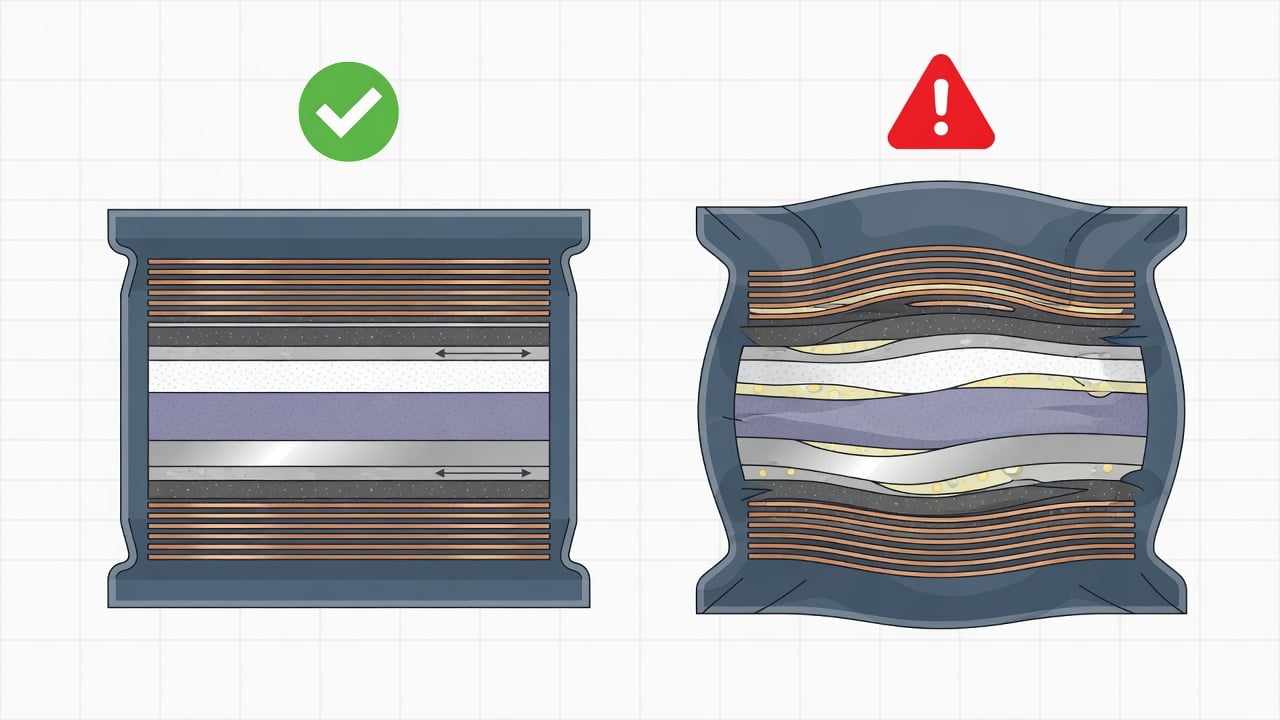
Because pouch cells lack a rigid case, gas generated inside a degrading cell has nowhere to go but outward. In a jump starter, the first symptom is usually mechanical rather than electrical: the case stops sitting flat, a seam gaps, a rubber port cover no longer seals, or the unit rocks on a table it used to sit flush on.
Treat that as a retirement notice, not a maintenance item. A swollen pack should not be charged again, should not be left in a vehicle, and should not go in household waste. Take it to a proper battery collection point — see where to dispose of old batteries — and read battery swelling causes and prevention for the full mechanism.
Cold Weather: When You Need It And When It Is Weakest
Low temperature appears in the same degradation list as heat: below roughly 5 °C, lithium cells are outside their comfortable operating window. Cold raises internal resistance, which cuts the peak current the pack can deliver — precisely the specification that matters when cranking an engine. A pack that comfortably starts your car in April may struggle at −10 °C in January.
Two habits fix most of this. First, if the pack has been sitting in a freezing car, warm it in your hands or inside your jacket for a few minutes before attempting a start; even a modest temperature rise recovers meaningful capability. Second — and this is the important one — never charge a lithium pack that is below freezing. Charging a cold lithium cell risks lithium plating on the anode, which is permanent damage rather than a temporary performance dip. Bring it indoors, let it reach room temperature, then charge. Our cold weather battery drain guide covers the same rules for phones.
Chemistry And Storage Comparison
| Pack type | Typical form | Cycle life (source figures) | Swelling risk | Best storage SoC | Check interval |
|---|---|---|---|---|---|
| LiPo pouch | Slim, pocketable consumer units | Lowest of the three | High — no rigid case | 50–60% | Every 3 months |
| Li-ion cylindrical (18650/21700) | Chunkier mid-range packs | ~1,000–2,300 (NMC) | Low — steel can contains it | 50–60% | Every 3 months |
| LFP (LiFePO₄) | Premium / semi-professional | 2,500–9,000+ | Low | 50–60% | Every 4–6 months |
| Lead-acid booster pack | Heavy workshop trolley units | Low; sulfates if left flat | None (vents instead) | Keep near full | Monthly |
The Maintenance Routine That Doubles Pack Life
The whole discipline fits in four habits.
- Set a quarterly reminder. Four calendar entries a year. This is the single highest-value thing you can do, because a jump starter that self-discharges to zero unnoticed can enter deep discharge, and a deeply discharged lithium pack may refuse to accept charge at all.
- Charge to about 80%, not 100%. On the quarterly check, top up and stop early. Most jump starters have no charge-limiting firmware, so this means either watching the indicator and unplugging, or automating it.
- Store cool and shaded. Trunk footwell over dashboard, indoors over trunk if your climate is extreme.
- Inspect the case each time. Set it on a flat surface. If it rocks, gaps, or bulges, retire it.
Step two is where most people fail, because it requires being present at the right moment. The device gives you no help: unlike a modern phone or laptop, a jump starter has no software charge ceiling. This is the same gap we describe in built-in battery limits vs a hardware charge limiter — when the device has no firmware limit, the only reliable ceiling is an external one.
An inline USB charge limiter such as Chargie sits between the charger and the pack and cuts power at a set percentage, so the quarterly top-up stops at 80% whether you are watching or not. Set it, plug in, walk away. See how to limit battery charge to 80% for setup. The one caveat: this works for USB-charged jump starters, which is most modern consumer units. Larger packs with a proprietary DC barrel charger are outside what an inline USB limiter can control — for those, the manual method and a timer are your options.
How To Tell If Yours Is Already Degraded
Jump starters do not report battery health the way phones and laptops do — there is no menu showing you a percentage of original capacity, and the technique in how to check battery health does not transfer directly. You are left with indirect signals, but they are reliable enough.
Charge retention is the best test. Charge to full, note the level, leave the pack untouched for a month at room temperature, and check again. A healthy lithium pack loses only a small percentage over a month. A pack that has dropped a quarter or more has elevated self-discharge and is on its way out.
FAQ
Should I keep my jump starter at 100% so it is always ready?
No — and this is the single most common mistake. High state of charge is an aging accelerator: cells “stored at a high temperature or a high state of charge often lose their capacities more quickly.” Store at 50–60% and top up quarterly. A pack at 50% still delivers vastly more than the one-to-two-second current burst an engine crank actually requires, and you gain years of usable life.
Is it safe to leave a jump starter in the car all year?
It is safe in the sense that quality packs have protection circuitry, but it is costly in lifespan. Degradation rises sharply above about 35 °C, and a parked car in summer exceeds that for hours daily. If you must leave it in the vehicle, use the trunk rather than the cabin, and never the dashboard. In extreme climates, storing it indoors and carrying it for longer trips is the better trade.
How often should I recharge a jump starter I never use?
Every three months for LiPo and cylindrical Li-ion packs; every four to six months is acceptable for LFP. Self-discharge never stops and accelerates with heat, so a hot-stored pack needs the shorter interval. The failure you are preventing is deep discharge, where the pack falls so low it will not accept a charge at all.
My jump starter has swollen. Can I still use it?
No. Stop charging it, remove it from your vehicle, and take it to a battery collection point. Swelling means gas generation inside the cell from irreversible degradation. In a device designed to deliver hundreds of amps, that is not a risk worth carrying in an enclosed car.
Is an LFP jump starter worth the extra money?
For a device that lives in a hot car, generally yes. LFP offers “cycle life from 2,500 to more than 9,000 cycles depending on conditions” against roughly 1,000–2,300 for NMC, plus “thermal and chemical stability, which contributes to improved battery safety.” You pay in size and weight for the same output, but for storage-dominated duty the durability and safety margin usually justify it.
Can I use a USB charge limiter on a jump starter?
Yes, if it charges over USB — which most modern consumer units do. An inline limiter sits between charger and pack and cuts power at your chosen percentage, so the quarterly top-up stops at 80% automatically. Packs that charge through a proprietary DC barrel jack cannot be controlled this way; for those you must unplug manually or use a timer.
The Bottom Line
A jump starter is judged on a single moment: the cold morning when the car will not turn over. Everything else it does is waiting. Because waiting is 99.99% of its life, storage conditions — not usage habits — determine whether it works when that moment comes.
Store it at half charge instead of full. Keep it cool and out of the sun. Check it four times a year. Cap the top-up at 80%. None of this is difficult, and none of it costs more than a recurring calendar reminder and, if you want the ceiling handled automatically, an inline limiter. The alternative is discovering on a February morning that the device you bought for exactly this situation swelled up in last July’s heat and has been dead in your trunk ever since.
Sources
- Wikipedia — Jump start (vehicle): portable jump starters, jumper cables, boost/engine-start charger features
- Wikipedia — Lithium-ion battery: calendar life, temperature-dependent degradation thresholds, state-of-charge stress, pouch-cell expansion at high SoC
- Wikipedia — Lithium polymer battery: cell voltage range, nominal voltage, storage-voltage practice
- Wikipedia — Lithium iron phosphate battery: cycle-life figures, NMC comparison, thermal and chemical stability, lead-acid replacement role
- Wikipedia — Self-discharge: temperature dependence, shelf-life impact, low-temperature storage benefit
- Wikipedia — Automotive battery: starter battery role and cranking current context
- Wikipedia — Battery charger: charger types, trickle and maintenance charging behaviour
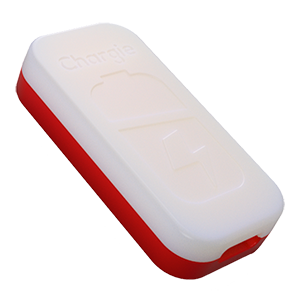
USB-C charge limiter that stops at your set battery level, so your battery never sits at 100% overnight. Extends battery lifespan by years. Works with any USB-C charger.
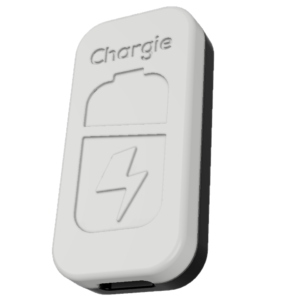
Limit your laptop charge to 80% via USB-C. Works with MacBooks, Dell, HP, Lenovo and most USB-C laptops up to 100W.
Protect Your Battery with Chargie
The world's first hardware charge limiter. Set a charge limit on any phone, tablet, or laptop — extend battery life by up to 4x.